Select your language


- Details
-
 By Vincenzo Caserta
 - Category: Development
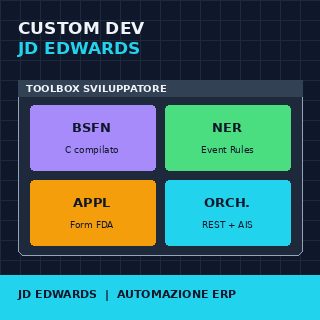
Custom development in JD Edwards — BSFN, NER, APPL, and ERP automation — is where most implementations determine either their long-term success or their technical debt for the next ten years. The platform offers four main tools for extending standard behavior, and every wrong choice about which tool to use for which use case creates consequences that only become visible when it is already too expensive to change direction: during an upgrade, during a retrofit, or during a Tools Release that changes the underlying behavior in undocumented ways.
This article lines up the four tools — Business Functions in C, Named Event Rules, FDA applications, and Orchestrator — describes what each one is actually suited for, and explains the decision patterns that work in production with real customers. None of the four tools is universally better than the others; each covers a specific problem space, and the discipline lies in recognizing that space before writing the first line of code.