




Promoting interactive applications (APPLA JD Edwards Interactive Application used to create user interfaces for data entry and retrieval.) based solely on "happy path" functional testing is a direct route to production instability. When a business analyst signs off on an APPL because they successfully processed a handful of test transactions, they miss the latent memory leaks, unmapped Data Structures, and unreleased table locks lurking in the Event RulesThe proprietary scripting language used within JD Edwards to define the logic and behavior of applications and reports.. In EnterpriseOne 9.2The current major release of Oracle's JD Edwards ERP software suite., a single unreleased database handle or an improperly closed business functionA reusable module of C or Java code that performs specific business logic or database operations. call in a custom APPL can degrade HTML serverThe web server component that renders the JD Edwards interface for end-users. performance for hundreds of concurrent users, transforming a minor deployment into an emergency Sev-1 rollback.
To prevent these runtime failures, technical teams must transition from subjective validation to an objective gate. Implementing a rigorous JDE APPL code review checklist before promotion ensures that every Object Management Workbench (OMW)The central JD Edwards tool for managing the development, lifecycle, and promotion of software objects. project undergoes static analysis of its form events, grid buffer allocations, and parent/child form interconnects before advancing past the DV environmentThe Development environment where code is initially written and unit-tested.. Treating this checklist as a mandatory technical gate—rather than administrative overhead—is the only reliable way to catch invalid database fetch loops and broken Web Runtime behaviors before they reach production.
The Cost of Post-Promotion APPL Failures
Promoting unvetted interactive application (APPL) objects directly into a production environment introduces silent killers like runtime memory leaks and sudden call stack crashes. When a developer bypasses strict validation, a poorly constructed event rule inside a grid loop can consume Call Object KernelA server-side process responsible for executing business functions and managing database requests. memory until the kernel itself restarts. This doesn't just crash the session for one user; it drops active database connections for every user routed to that specific kernel thread, halting critical business operations instantly.
The danger amplifies when dealing with complex UI patterns. A single unoptimized Power Form or Form Guided Assistant that initiates open-ended database transactions can lock standard master tables like F4211The primary database table in JD Edwards used to store Sales Order Detail information. or F0911 during peak shipping or journal entry hours. In one recovery scenario, a custom sales order entry APPL held an active transaction open while waiting for user input on a sub-form, blocking the standard P42101 sales order entry application for dozens of concurrent warehouse users. This occurred because the developer placed the manual transaction boundary control flags incorrectly across the parent and child forms.
Relying purely on functional testing by business analysts in a single-user DV or PY environment provides a false sense of security. Without a technical review gate, a significant portion of custom APPLs—in our experience around a third to a half—fail when subjected to actual multi-user production load. Remediating a database blocking issue or a memory leak in a live production environment costs significantly more, often by an order of magnitude, in emergency ESUs, CNCConfigurable Network Computing; the technical architecture and staff responsible for JD Edwards system administration and maintenance. triage hours, and lost operational throughput than catching the underlying code flaw during a formal pre-promotion review. Establish a mandatory rule: no APPL bypasses the promotion gate without a peer review of its event rule transaction processing settings.
Validating Event Rules and Business Functions
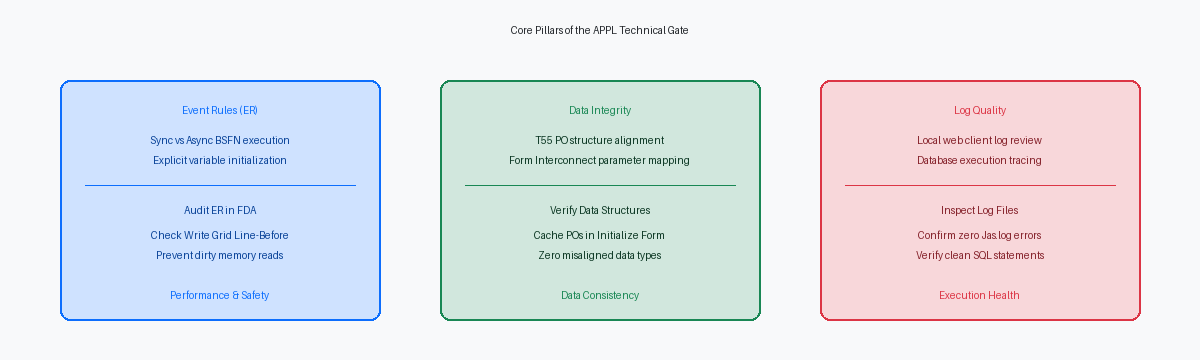
A common post-promotion failure occurs when developers place asynchronous business function calls inside critical validation events like Write Grid Line-Before. In the local development fat client, this might appear to execute sequentially due to low latency, but on an enterprise HTML server running WebLogic or WebSphere, the asynchronous thread executes out of order. This race condition causes database writes to commit before validation logic completes, leaving orphaned records in tables like F4211 or F0911. Every validation call in this event must run synchronously to guarantee data integrity before the transaction engine commits the grid row.
Reviewing Event Rules requires inspecting how Form-level (FRM) and Grid-level (GD) variables are handled. Developers frequently omit explicit initialization routines, assuming the runtime engine resets these variables for each row or form instantiation. When processing a multi-hundred-line grid, uninitialized variables retain values from the previous record, causing dirty memory reads that silently corrupt subsequent rows. You must mandate that all custom APPLs explicitly clear these variables in the "Grid Row Is Entered" or "Write Grid Line-Before" events to isolate each record's execution context.
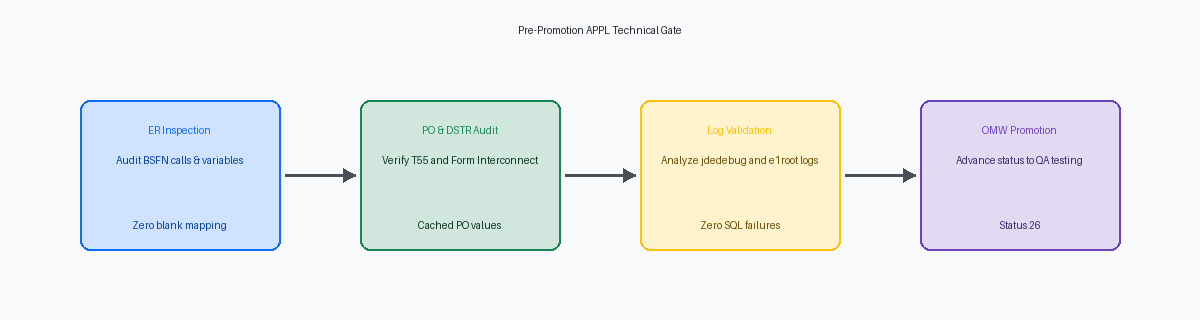
A thorough ER audit also means checking that every custom BSFNAn abbreviation for Business Function, a modular piece of code used to execute logic. call explicitly maps all required parameters rather than leaving them blank. Leaving parameters unmapped in the ER tool can pass random pointers or null values to the underlying C code, triggering memory violations (COB0000012 errors) that crash the callObject kernel. Finally, verify that any custom C business functions called by the APPL have been compiled and tested on both the 64-bit Windows development client and the target enterprise server architecture, whether it runs Oracle Linux or Windows Server. Running a local test on a fat client does not guarantee the code will execute properly once serialized and run in the HTML server runtime environment.
Auditing Processing Options and Data Structures
A misaligned T55 template is a silent killer that usually manifests as a memory violation in the JAS logsJava Application Server logs that record errors and events related to the JD Edwards web interface. during UAT. When reviewing the template, verify every data item alias against the design specification. Using a generic MATH10 for a date field or an ALPH for a numeric flag creates technical debt that requires a full OMW checkout and re-promotion to fix. This precision ensures that the application logic receives the exact data type the developer intended, preventing runtime casting errors that are notoriously difficult to debug once the code hits the Production environment.
Performance bottlenecks in complex APPLs often stem from repetitive calls to the Processing Option structure within Grid Record is Fetched or Row Exit events. Every direct reference to a PO value in the Event Rules triggers a lookup overhead. A senior developer maps all required PO values to dedicated Form variables (frm_) once during the Initialize Form event. This caching strategy ensures the application maintains a consistent state throughout the session and reduces the load on the enterprise server, especially in high-concurrency environments where dozens of concurrent users are hitting the same application.
Audit the Form Interconnect data structure (D55) to ensure it contains zero unused members. Leftover members increase the memory footprint and lead to data truncation if a larger numeric value is passed into a smaller field. Verify that every critical PO field has a hard-coded default value defined in the Initialize Form event. If a calculation or table lookup relies on a PO value that remains null because of a misconfigured version, the JDE runtime will likely throw an "Uncaught Exception," halting the user’s workflow and generating unnecessary support tickets.
Standardizing UI Controls and Form Extensions
A common failure in custom APPL development is overriding Visual Assist triggers on form controls instead of relying on the Data Dictionary. When a developer hardcodes a call to a custom Search & Select form (like a custom W550190A) directly in the Control Exited/Changed-Inline event, they bypass the central Data DictionaryA central repository that defines the attributes, validation, and formatting for every data field in the system. (DD) relationship. This bypass breaks when you upgrade Tools Releases, forcing you to retrofit individual APPLs. The reviewer must verify that any custom search form is mapped at the DD item level or via the Associate Search & Select tool in Form Design Aid (FDA) rather than coded as a manual business function call.
Grid columns mapped to MATH_NUMERIC data items like foreign currency amounts (ACR) or unit costs (UNCS) require strict validation of decimal formatting. If a developer copies a standard grid column but fails to set the override for "Display Decimals" to point to the correct data item, the runtime engine defaults to zero decimals. In a multi-currency environment, this oversight can cause a transaction for 1,500.50 USD to display as 150050, leading to database corruption during standard business function processing. Reviewers must inspect the properties of every numeric grid column to confirm that decimal overrides are dynamically driven by the transaction currency code (CRCD).
With Tools Release 9.2, Form Extensions and UDOUser Defined Objects; web-based customizations like grid formats or form extensions created by users without traditional coding. overlays frequently conflict with underlying base Event Rules. If a user hides a standard field using Form Extensions, but the base APPL's Dialog is Initialized event expects that control to contain a default value, the application will throw silent validation failures. Finally, high-speed data entry operators in finance and warehouse environments rely entirely on keyboard navigation. A standard check must confirm that the tab sequence in FDA flows logically and that standard hotkeys like Alt+I (Add) are not hijacked, preventing a substantial drop in transaction speed, sometimes exceeding 30%, in high-volume environments like voucher entry.
Enforcing Test Evidence and Log Validation
Promoting an APPL based on a developer’s verbal confirmation is a recipe for a weekend rollback. Every OMW project must include a jdedebug.log analysis confirming zero SQL fetch failures. It is common to overlook a failed fetch in a hidden grid column or a background BSFN call that fails silently. Searching for "FETCH" with a return code other than 0 or 100 prevents the "missing data" tickets that usually follow a production promotion.
The test evidence document must demonstrate successful execution across multiple distinct business scenarios: a new record insertion, an update to an existing record, and a deliberate failure test. Testing boundary conditions in the "Control Exited/Changed-Inline" event ensures the logic doesn't bypass critical validations when a user tabs through fields out of order. This level of rigor typically identifies a notable portion of logic gaps before the code reaches the QA environment.
Developers must validate the local e1root.log and jas.log files to ensure no Java-side null pointer exceptions occurred during the local web session. A "java.lang.NullPointerException" might only manifest to the user as a brief hang or a non-responsive button, but it indicates a failure in the web engine's ability to serialize the form state. Catching these errors locally prevents the "Web Client Exception" pop-ups that often plague poorly tested applications in the HTML tier.
Promotion approval hinges on screenshots of both successful inserts and validation error handling. Visuals showing the "Set Control Error" highlights on the form are necessary to verify that the user is correctly guided to fix data entry mistakes. Additionally, the evidence must include a database query result showing the record in the underlying table, such as the F4211. This proves the Master Business Function committed the transaction with the correct constants and didn't just clear the screen.
Executing the OMW Promotion Gate
A broken package buildThe process of compiling and preparing JD Edwards objects for deployment to different environments. in the middle of the night is almost always caused by a rogue dependent object left behind in a developer's personal default project. When promoting a custom APPL, every associated object—the processing options (T98012), the processing option data structure (TPO), the form data structure (DSTR), and any custom business functions (BSFN)—must reside in the exact same Object Management Workbench (OMW) project. If a developer modifies a standard BSFN like B4200310 to support a custom APPL but leaves the BSFN in another project, the package build will compile successfully in DV but fail catastrophically during the PY build.
Advancing the OMW project status systematically from status 21 (Programming) to status 26 (QA Testing) triggers the required transfer activity rules that copy the specs from the DV920 pathcodeA set of JD Edwards objects and data definitions for a specific environment like Development or Production. to PY920. Before clicking that button, check the Token tab in OMW (P98220) for every object in the project. If your team modified a standard application like P4210 to launch your custom APPL, holding an active token on P4210 in status 21 blocks other hotfixes from moving through the pipeline. Release those tokens or ensure the project transition releases them automatically during the status shift.
Run a final dependency check using the JD Edwards Cross Reference Facility (P980011) before initiating the build request. Many teams skip this because rebuilding the cross-reference tables (F980011 and F980021) is a heavy batch process, but querying it for your specific APPL takes less than a minute. This step prevents the promotion of orphan data structures or invalid event rules where a newly added variable in a BSFN call does not match the active DSTR spec in the target pathcode. Catching these mismatches at the OMW gate reduces post-promotion rollbacks to zero.
Establishing these technical gates ensures that your JD Edwards custom development remains stable, performant, and maintainable. By enforcing static code reviews, validating log files, and standardizing OMW promotion protocols, IT leaders can safeguard their production environments against costly runtime failures and minimize technical debt across the enterprise lifecycle.
