




In a typical custom estate of 5,000 to 15,000 objects, poorly architected Interactive Applications (APPLs)Interactive programs in JD Edwards used by end-users to view and manipulate data through a graphical interface. account for a substantial portion of post-upgrade retrofitting and hotfixes, often exceeding half of the total effort. Form Design Aid (FDA)The development tool within JD Edwards used to create and modify interactive application forms and their logic. makes drag-and-drop layout so simple that developers routinely dump complex business logic directly into control events, creating monolithic forms that choke during 64-bit runtimeA computing environment that processes data in 64-bit chunks, allowing for much larger memory usage and improved performance. migrations or Tools ReleaseA software update from Oracle that provides new technical features and system improvements for the JD Edwards platform. 9.2.8 upgrades. This structural debt is entirely preventable if you enforce strict JDE APPL development best practices for custom forms within your engineering team.
Establishing rigid development standards for custom forms means moving away from "quick-fix" Event Rules (ER)The proprietary scripting language used in JD Edwards to define business logic and application behavior. coding and adopting strict boundaries for transaction processing. By isolating database operations from form events and encapsulating reusable logic within Named Event Rules (NER)Reusable business logic created using Event Rules that can be called by multiple applications or reports. or C Business Functions (BSFNs)Reusable blocks of business logic written in C or Event Rules that perform specific tasks like database updates., you can reduce custom object touchpoints by nearly half during your next Application Update. This disciplined approach ensures your custom interactive applications remain highly performant, maintainable, and completely insulated from Oracle's continuous delivery code updates.
Establish Rigid Event Placement Boundaries
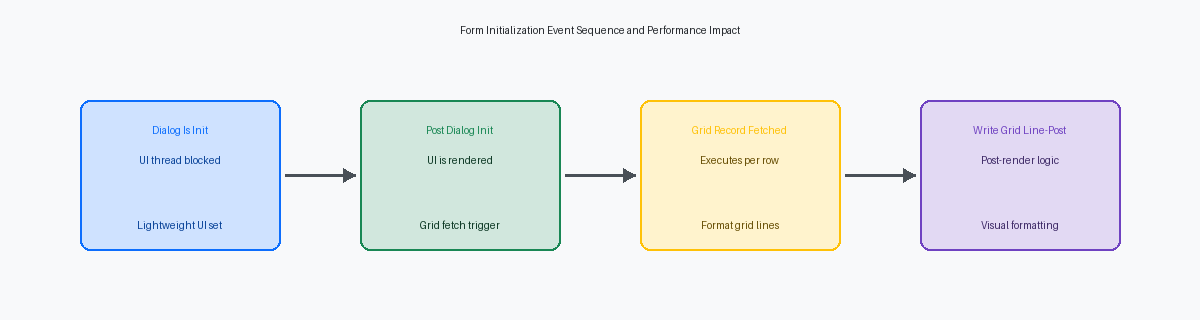
I regularly audit custom FDA applications where users complain about system freezes during launch. In the vast majority of these audits, the developer placed a heavy F0101 or F4211 fetch inside the Dialog Is Initialized event, blocking the UI threadThe main process in a software application responsible for handling user interactions and updating the screen. for several seconds before the form even renders. This event executes before the window is drawn; keeping it clear of database roundtripsThe process of sending a request for data to a database and receiving the results back over the network. is non-negotiable for maintaining sub-second response times.
Shift initialization logic that requires visual components to Post Dialog Is Initialized, but keep it strictly limited to light visual setups. This is where you disable form controls, set focus to a specific grid column, or toggle tab page visibility based on user roles. Do not execute master business functionsStandardized JD Edwards logic modules that ensure data integrity by validating all rules before updating the database. like AddressBookMasterMBF (B0100016) here; doing so delays the initial paint of the form and frustrates users who expect instant feedback.
When populating grids, poorly placed Table I/OOperations that read from or write data to database tables. frequently leads to runaway database calls. Grid record processing must be strictly confined to Write Grid Line-Before or Grid Record Is Fetched to prevent memory leaks and unnecessary database roundtrips. In a standard Find/Browse form query returning 500 rows, executing a custom fetch in the wrong event can scale your database overhead exponentially, turning a sub-second fetch into a multi-second bottleneck.
Button Clicked events must act purely as traffic controllers rather than processing engines. Use them to validate UI states, check mandatory fields, and delegate heavy transactional processing to asynchronousA process that runs in the background, allowing the main application to continue working without waiting for it to finish. business functions running on the enterprise server. Moving a complex validation routine out of the OK Button Clicked event and into an asynchronous BSFN reduces local client footprint and ensures database integrity even if the user's browser session drops mid-transaction.
Enforce Strict Table I/O Isolation Rules
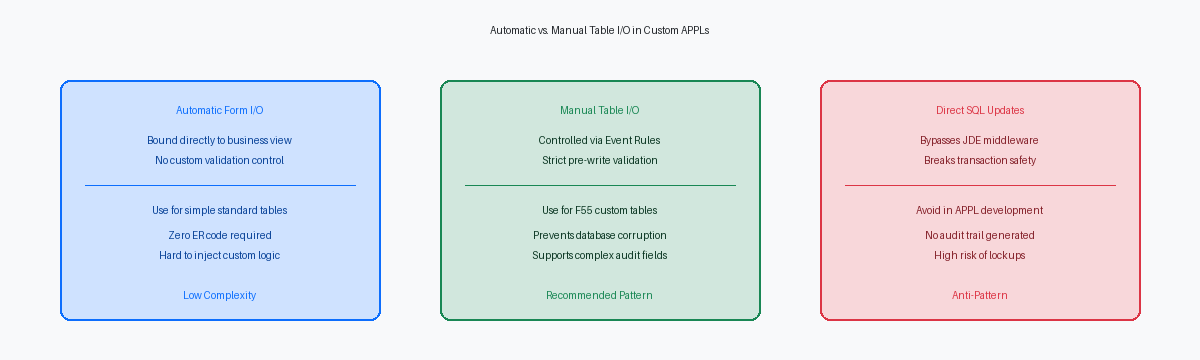
Writing direct Table I/OOperations that read from or write data to database tables. statements like Fetch Single, Select, Insert, or Update directly within Form Design Aid (FDA) Event Rules is a shortcut that routinely degrades production performance. When developers bypass the middlewareSoftware that acts as a bridge between different applications, tools, or databases to enable communication. layer to run a direct update on the F0911 ledger table, they bypass the JDE cache layerA temporary storage area in memory used to speed up data access and reduce direct database hits. entirely and often trigger unindexed database hits that stall the database engine. In a high-volume environment processing tens of thousands of journal entries daily, this direct-to-disk approach bypasses the validation routines that protect financial integrity.
Multi-table transactions and complex updates must be encapsulated inside a C Business Function (BSFN) or Named Event Rule (NER) to preserve database integrity and strict transaction boundariesThe defined start and end points of a database operation, ensuring all steps succeed or fail together as a single unit.. Running sequential inserts across F0911 and F0902 tables directly from control events risks orphan records if a network hiccup occurs mid-execution. Wrapping these operations inside a single, transaction-enabled BSFN ensures that the entire logical unit of work either commits fully or rolls back completely.
Standard JDE master business functions (MBFs) like F4211 Edit Line must be utilized instead of direct table updates to ensure business rules are consistently applied. Attempting to bypass the F4211 MBF by writing direct updates to the F4211 Sales Order Detail table inevitably corrupts status codes, tax calculations, and commitment buckets. Relying on the standard MBF suite guarantees that all core validations built into the Oracle standard code execute flawlessly.
Developers must explicitly close open table handles in the End Dialog event to prevent database cursorA control structure that enables traversal over the records in a database result set. leaks on the Enterprise Server. When an APPL opens a table dynamically using a handle and fails to close it, the database connection remains active, eventually exhausting the maximum cursor limit on Oracle Database or SQL Server. Adding a single "Close Table" statement for every explicit "Open Table" in your cleanup events eliminates these memory leaks entirely, saving hours of debugging during peak load testing.
Encapsulate Reusable Logic in NER and BSFN
I regularly audit custom applications where developers have written hundreds of lines of validation logic directly inside the Control Exited/Changed-Inline event. Moving these procedural calculations out of FDA Event Rules and into a reusable Named Event Rule (NER) immediately slashes the custom APPL's footprint and simplifies retrofitting during your next upgrade. For instance, encapsulating F4101 item master validation into a single NER allows both your custom screen and your inbound OrchestratorA JD Edwards tool used to automate business processes and integrate with external systems via REST services. to share the exact same validation logic.
To make these NERs modular, design them with strict data structures (DSTR)A defined format for passing data between different programs or functions within JD Edwards. that pass explicit key fields instead of relying on global system variables. If your NER references FI or GC values directly, you break encapsulation. Pass the ITM and MCU explicitly through the DSTR, ensuring the logic remains decoupled from the presentation layer.
For non-blocking operations, configure your business functions to execute asynchronously. Operations like sending notification emails or updating secondary audit tables should not force the interactive application to hang. Ticking the "Asynchronous" execution flag in the FDA Event Rules for these BSFN calls offloads the processing, dropping form submission times significantly, often by a third or more for remote users.
Custom C business functions remain mandatory when your design requires complex memory allocations, JDE cache APIsProgramming interfaces used to manage temporary data storage in memory for high-performance processing., or third-party DLL integrations. If you are managing multi-line allocations where you must store temporary grid states before final commit, a custom C BSFN utilizing jdeCacheInit maintains this transactional state in memory, processing thousands of records in milliseconds without generating physical database writes.
Implement Clean Naming and Variable Standards
Debugging a custom sales entry application like P554211 becomes a nightmare when developers rely on default Form Design Aid (FDA) naming. Every custom APPL must use a standard prefixing convention aligned with Object Management Workbench (OMW)The JD Edwards change management system used to control the development, testing, and promotion of software objects. pathcode rules, typically reserving the 55 to 59 namespace. For P554211, this means ensuring that all associated sub-objects, processing options (T554211), and data structures (D554211A) mirror the parent object ID to maintain a clean dependency map in the Object LibrarianA central repository in JD Edwards that stores metadata and location information for all software objects. tables (F9860 and F9861).
Within FDA, developers must rename custom controls and grid columns from their default system-generated IDs (like HC1 or GC2) to descriptive business names before writing a single line of Event Rules. Failing to do this causes compilation errors and unreadable code in the spec dumpA technical export of the internal specifications and logic definitions of a JD Edwards object.. To prevent scope confusion during active debugging sessions in the HTML client, FDA variables must follow strict prefixing rules: use evt_ for event variables and frm_ for form variables. This discipline reduces developer troubleshooting time by nearly half when tracing variable state changes in the jdedebug.log.
Data dictionary (DD) overrides applied directly to form controls or grid columns will be silently wiped out during a major tools upgrade or environment spec merge if they are not explicitly documented. When you override a row description or edit rule on a form, document this configuration in the control properties or within the form-level ER comments. This practice ensures that when the Oracle spec merge utility runs during a 9.1 to 9.2 transition, the upgrade team can quickly identify and restore custom overrides that were not preserved in the central objects repository.
Optimize Grid Performance and Data Fetching
Loading a custom grid against the F4211 table with millions of rows will crash an HTML server instance if the grid is configured to fetch all records. Enabling Page-at-a-Time processing on the grid properties is the primary defense against out-of-memory errors in the WebLogic or WebSphere JVMThe engine that enables a computer to run Java-based applications, managing memory and execution.. This setting forces the HTML server to fetch only the records needed to populate the visible grid rows, typically 10 to 50 at a time, rather than attempting to serialize hundreds of thousands of sales order lines into memory.
Minimizing the network payload size between the HTML and Enterprise servers requires strict discipline during Form Design Aid configuration. Developers often drag entire table structures into the grid, but every unnecessary column adds bytes to the serialized XML payloadThe actual data content transmitted in an XML format between different systems or servers. transmitted across the network. Custom forms must only include grid columns that are absolutely required by the business process, leaving auxiliary fields to be fetched on-demand via a row double-click or a separate slide-out panel.
When business logic dictates that certain records must be filtered out dynamically, developers often make the mistake of hiding rows after they are rendered. Programmatic filtering must occur inside the 'Grid Record is Fetched' event. Calling the 'Suppress Grid Line' system function within this specific event prevents the runtime from rendering the unwanted row, ensuring the grid page count and scrollbar behavior remain accurate for the end-user.
Custom grid sorting that deviates from the primary table's index structure will trigger database-level full table scansA database operation where the engine reads every row in a table because no efficient index is available., degrading performance for all concurrent users. If users require sorting by fields like actual shipment date (ADDJ) or customer PO (VR01) on the F4211, the database administrator must build a matching composite indexA database index based on multiple columns, used to speed up complex data retrieval queries.. Forcing SQL Server or Oracle Database to perform an in-memory sort on millions of unindexed rows defeats any optimization done at the application tier.
Design Custom Forms for Upgrade Resiliency
Directly modifying standard FDA forms like P4210 or P4310 is a liability that adds weeks to your next Tools Release upgrade. With the introduction of Form ExtensionsA low-code tool in JD Edwards that allows users to add fields and logic to forms without traditional development. in Tools Release 9.2.x, the vast majority of simple field additions, label changes, and button triggers can be handled without a single line of custom Event Rules (ER). When complex business logic forces your hand, build a clean P55 copy from the ground up rather than touching the base Oracle object.
When a P55 copy is unavoidable, developers must document every deviation from the standard template. Prepend every modified Event Rule block with a standardized comment header detailing the Modification ID, developer initials, and the date. This discipline pays off during the transition to the 64-bit runtime required by modern Tools Releases like 9.2.7 and 9.2.8. If your custom forms call underlying C business functions (BSFNs), any obsolete 32-bit APIs or hardcoded pointer sizes—such as using long instead of ID for pointers—will cause immediate runtime crashes on a 64-bit enterprise server.
Hardcoded APPL-to-APPL interconnects for third-party integrations create brittle dependencies that break during minor application updates. Replace these legacy touchpoints with Orchestrator service requests triggered directly from control events or form extensions. By routing external data exchanges through the Application Interface Services (AIS)A server component that allows external applications to interact with JD Edwards through modern web services. engine instead of deep-nesting them inside form-level Event Rules, you decouple the user interface from the integration layer. This architectural shift typically reduces the custom object retrofitting effort during a Tools upgrade by up to three-quarters.
Moving logic out of FDA and into BSFNs is about ensuring your 9.2.8 environment does not choke on bloated event rules. A custom APPL with over a hundred distinct event rules should always be refactored to isolate business logic from the presentation layer, protecting the interactive application from future upgrade friction.
