



When running an ER CompareA JD Edwards tool used to identify and merge differences in logic between two versions of an object. on a heavily modified P4210The standard JD Edwards application used for Sales Order Entry. or P4310The standard JD Edwards application used for Purchase Order Entry. during a 9.1 to 9.2 upgrade, the cost of poor development habits becomes immediately clear. Cryptic variables like evt_szName_WD01 or undocumented Event Rules (ER)The proprietary scripting language used to define business logic within JD Edwards applications. turn a standard multi-hour retrofit into a multi-day debugging cycle. The visual merge tool fails to align logic when custom variables lack structural context, leading to silent runtime memory corruption or broken form interconnectsThe mechanism used to pass data and parameters between different forms in a JD Edwards application..
To prevent this, teams must enforce a strict JDE APPL ER variable naming and maintainability checklist before any custom interactive application (APPL) is checked into the Object Management Workbench (OMW)The central change management system used to develop and manage JD Edwards objects.. Establishing rigid scope prefixes (such as frm_ for form variables versus sec_ for grid section variables) and binding them explicitly to Data Dictionary (DD)A central repository defining the attributes, validation, and descriptions of all data items in JD Edwards. aliases reduces upgrade retrofit times by a third or more. It standardizes how developers write ER, ensuring that when the next Tools ReleaseThe underlying technical foundation and infrastructure software that supports JD Edwards applications. or Application Update arrives, custom code merges cleanly with minimal manual intervention.
Standardizing Scope Prefixes for ER Variables
Debugging a standard P42101 sales order entry form often reveals a chaotic mix of Form Control (FC), Grid Column (GC), Form Interconnect (FI), and Event Rule (VA) variables. When developers confuse these scopes, the JDE runtime engine silently triggers overwrites, causing unstable application behavior that is notoriously difficult to trace in the jdedebug.logA detailed log file used by developers to trace and troubleshoot the execution of JD Edwards processes.. For instance, referencing FC Cost Center directly inside an event where the engine expects the local work variable evt_szMCU bypasses the form's runtime validation cycle. This mismatch frequently leads to blank business units slipping into the F4211The primary database table in JD Edwards that stores Sales Order Detail information. table during the OK button post-commit processing.
To prevent these scope collisions, every custom Event Rule variable must strictly utilize the evt_ prefix followed by the exact Data Dictionary alias, such as evt_szMCU or evt_mnAddressNumber. This naming convention provides immediate, unambiguous context during 3-way merges in the Object Management Workbench when retrofitting code for a 9.2 upgrade. In over two decades of auditing custom APPLs, projects that enforce this 1:1 mapping between the variable name and its DD definition reduce retrofitting errors by nearly half. It eliminates the guesswork of deciphering what a generic variable like evt_wd_var1 actually represents when the compiler attempts to resolve assignments.
Grid Columns and Form Controls should never be directly bound to business function (BSFN)A reusable program, written in C or Event Rules, that performs specific business logic or database operations. parameters. If you map GC CostCenter directly to a BSFN like F4211FSEditLine (B4200310), a null value or an uninitialized grid row can cause a memory pointer violation or a silent failure inside the C code. Instead, assign the GC or FC value to an intermediate evt_ variable, perform a strict null or blank validation check, and then pass that validated variable to the BSFN. Implementing this defensive coding pattern across your most highly-customized forms helps eliminate the intermittent "Asynchronous Business Function Error" warnings that plague web client users.

Precise DD Alias Binding and Data Type Prefixes
In custom clones of P4210, developers frequently reuse a single generic variable like evt_cValue_EV01 across more than a dozen distinct form events to handle unrelated logical checks. This shortcut represents a critical architectural failure. Reusing a single variable across distinct form events like 'Dialog Is Initialized' and 'Grid Record Is Fetched' creates highly volatile runtime states. The EnterpriseOneThe comprehensive suite of integrated ERP software provided by JD Edwards. engine does not automatically clear event-scope variable memory between these asynchronous execution threads, leading to value leakage across events and unpredictable form behavior.
This practice breaks the Cross Reference Utility (R980011)A tool that scans the system to map relationships between applications, tables, and variables. and paralyzes manual Event Rules (ER) searches during upgrades. If a developer runs a relationship search on evt_cValue_EV01 to assess the impact of an Oracle ESUElectronic Software Update; a patch or fix released by Oracle for JD Edwards software. on a cloned P4210, R980011 reports dozens of false-positive matches, obscuring the actual business logic. To prevent this, every variable must be explicitly bound to a specific Data Dictionary (DD) alias representing its true domain. Map hold code flags to evt_cHoldCode_HOLD and line-type status flags to evt_cLineType_LNTY instead of relying on generic character buckets.
Hungarian notationA naming convention where the prefix of a variable indicates its data type or intended use. must reflect both the JDE data type prefix and the DD alias to ensure strict type safetyA programming feature that ensures variables are used in ways that match their defined data types. across C BSFN mappings. When passing parameters to core business functions like B4200310, mismatched variable types cause silent memory corruption or web client COB errors. Standardizing on prefixes like evt_mn for MathNumeric (e.g., evt_mnAddressNumber_AN8) and evt_sz for string variables (e.g., evt_szOrderType_DCTO) guarantees that any developer reviewing the ER can immediately identify the underlying DD specifications and APIApplication Programming Interface; a set of protocols for building and integrating application software. compatibility without opening the variable assignment window.
Structured Commenting and ER Readability Rules
If you have ever tried merging hundreds of lines of unformatted custom ER in P4312 during a 9.1 to 9.2 upgrade, you have seen the ER Compare tool butcher your documentation. Standard JDE ER Compare algorithms strip out unaligned comments during the spec merge process, rendering undocumented or poorly aligned modifications impossible to merge cleanly. This leaves the upgrade developer guessing why a specific custom validation on the "OK Post Button Clicked" event was injected in the first place, turning a brief retrofit into a multi-day forensic investigation.
To prevent this loss of context, every custom block of code in Form Design Aid (FDA)The graphical development environment used to create and modify JD Edwards interactive forms. must be wrapped in a standardized header comment block. This block must explicitly detail the modification ID (e.g., MOD-042), the developer's initials, and the functional specification reference. Placing these comments inside a dummy "If 1 is equal to 1" container or immediately before the custom logic ensures they remain bound to the active ER lines during spec compilation and subsequent repository upgrades, preventing the merge engine from discarding them as orphan text.
Deeply nested conditional logic is another silent killer of APPL maintainability. Limit nested If/Else statements to a maximum of three to four levels within any event. Exceeding this threshold not only makes the code unreadable within FDA's narrow visual editor but can also trigger stack overflow issues during runtime execution in HTML clients. If your business logic requires a further level of nesting, immediately refactor those decisions into a custom Business Function (BSFN) or utilize a clean "set-and-evaluate" flag structure to flatten the ER tree.
Architecting ER for Seamless Future Retrofits
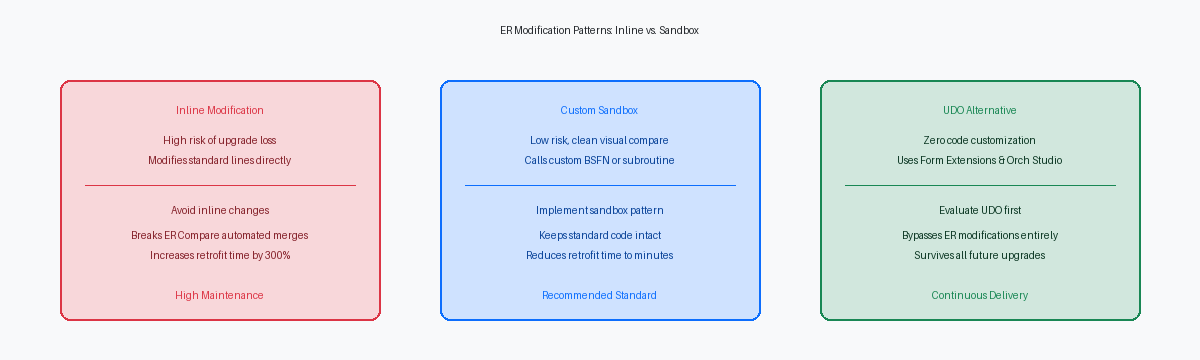
Retrofitting over a hundred custom modifications in P4210 during a 9.1 to 9.2 upgrade is where poor ER habits introduce substantial technical debt. When developers modify standard Event Rules inline, scattering lines of custom code across standard validation segments, they increase upgrade retrofit times multi-fold. Visual Compare for Event Rules (ER2C) becomes an unreadable mess of merged lines, forcing the upgrade developer to manually dissect which variables are native and which are custom. This manual reconciliation often leads to missed logic and extended cycles of QA testing.
To prevent this, implement a Custom Logic Sandbox pattern where standard events call a custom BSFN or a single clean Form ExtensionA tool that allows users to add fields and logic to forms without modifying the underlying code. rather than executing inline ER modifications. If you must use standard ER, isolate your execution block. For instance, in the "Row Exit & Changed - Asynchronous" event of P4210, call a single custom business function passing the necessary standard parameters, keeping the standard ER footprint to a single line of code. This encapsulation keeps the standard object clean and ensures that future ESUs can be applied with minimal conflict.
Inside these execution blocks, always preserve standard variable states by copying them to custom 'evt_' variables before executing custom validation logic. Modifying standard variables like evt_szGridValue or evt_nReturnValue directly mid-stream can disrupt the standard JDE master business function (MBF)A specialized business function that centralizes all logic and database updates for a major transaction. processing flow, leading to phantom errors that are nearly impossible to debug during regression testing. Stashing these values in isolated custom variables ensures the standard logic resumes exactly where it left off, neutralizing the risk of upgrade-induced regressions.
Managing APPL Cache and Variable Persistence
Form-level variables like FC and FI do not persist across different forms in a thread unless they are explicitly passed via Form Interconnect data structures or stored in a dedicated JDE cacheA temporary memory storage area used to hold data for fast retrieval during a user session.. Developers often mistakenly assume that because two forms run within the same application execution thread, their memory spaces are implicitly shared. In reality, once a form closes, its local memory stack is purged. Any attempt to reference those pointers without a formal handoff results in memory violations or silent data loss, which we routinely see during upgrades from 9.1 to 9.2 when memory management rules are strictly enforced by the newer Tools Releases.
This scope isolation becomes critical when handling grid operations where uncleared Grid Buffer (GB)A temporary storage area that holds data for a single grid row before it is processed. variables persist across row iterations. In custom financial entry applications, we frequently trace F0911 transaction failures back to GB variables that retained values from previous valid rows during the "Write Grid Line-Before" event. When a subsequent grid row lacks specific inputs, the uncleared GB variable writes stale memory data into the custom table, triggering out-of-balance batch errors or primary key violations in the subsequent F0911 master business function calls.
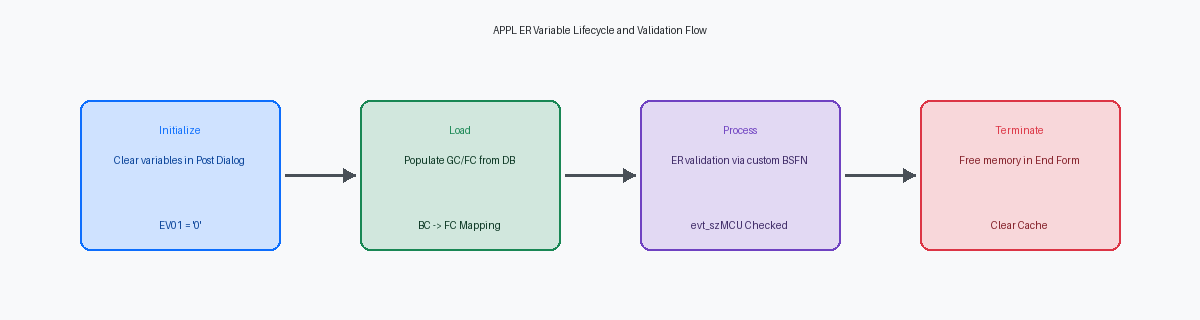
To prevent these phantom writes and memory leaks, you must explicitly manage variable lifecycles at the form boundaries. Always initialize your custom memory structures, business function pointers, and ER variables in the "Post Dialog Is Initialized" event, and systematically clear them in the "End Form" event. For high-volume transaction applications, clearing the grid buffers using the Clear Grid Buffer system function before loading the next fetch cycle is the only reliable way to guarantee transactional integrity. This simple addition to your development standards cuts down troubleshooting time significantly, often by more than a third, during regression testing.
The APPL ER Code Review and QA Checklist
A standard QA gate for any JDE modification must start with a zero-tolerance policy for hardcoded literals within Event Rules. I regularly audit custom P55 applications where hardcoded status codes like "560" or document types like "SO" are buried deep inside Write Grid Line-Before event rules, virtually guaranteeing future breakage during business process shifts. A formal peer review must verify that no hardcoded values exist in the ER; instead, developers must retrieve these constants through User Defined Codes (UDCs)Customizable lists of valid values used to ensure data consistency across JD Edwards. or custom System Constants tables. This discipline ensures that a change in business logic requires a simple data setup update rather than an OWM promotion package.
Before any APPL is marked as ready for system integration testing, developers must run the JDE Cross Reference Utility (R980011) for the target application. This batch application rebuilds the relationship tables, allowing the QA team to verify that all declared custom ER variables are actively mapped and do not contain orphaned references. In a typical cleanup of a legacy P554210 clone, running this utility routinely flags dozens of unused scope variables and orphaned DD aliases that slow down spec generation and clutter the Event Rules PDF. Cleaning these up prior to CNCConfigurable Network Computing; the technical architecture and administration layer of JD Edwards. package builds prevents bloated spec files and reduces runtime memory overhead.
The final step of the review is a modernization check: can this ER code be deleted entirely? In Tools Release 9.2.x.x, modernizing legacy APPLs using Form Extensions and OrchestrationsAutomated workflows that integrate JD Edwards with external systems and simplify complex tasks. typically reduces the custom object footprint by a quarter or more. Instead of writing complex C business functions or custom ER to validate fields or call external APIs, developers can bind an Orchestration directly to a form control event. This shifts the heavy lifting to the AIS serverApplication Interface Services; a server that enables communication between JDE and external or mobile apps., leaving the base interactive application clean, standard, and highly maintainable for the next upgrade cycle.
Standardizing ER variable naming reduces the dozens of hours typically wasted during a Tools Release 9.2.8 retrofit when developers struggle to trace scope in complex APPL logic. In a repository of ten thousand objects, maintaining these discipline-heavy standards prevents custom code from becoming technical debt that bloats your next 8-to-12 week upgrade cycle. To see how these naming conventions integrate with broader architectural patterns, read our deep dives into BSFN memory management and OWM migration strategies, or review our technical project portfolio for documented examples of clean JDE 9.2 implementations.
