




A standard EnterpriseOneThe comprehensive suite of ERP software from JD Edwards. grid processing just 500 rows can silently execute thousands of database fetches if you place unbuffered Table I/ODatabase input and output operations performed within the JD Edwards environment. or heavy business functions inside the Grid Record Is FetchedA specific event in JD Edwards that triggers every time a new row is loaded into a grid. or Write Grid Line-Before events. This synchronous executionA processing model where tasks are performed sequentially, requiring one to finish before the next begins. model creates a severe JDE APPLA JD Edwards interactive application or screen used by end-users. performance problem with repeated reads in grid loops, where the interactive JVMJava Virtual Machine, the engine that runs JD Edwards web-based components. thread blocks while waiting for sequential database roundtrips. When a single user action takes double-digit seconds instead of a fraction of a second, the culprit is almost always this repetitive, row-by-row synchronous processing.
To fix this, developers must stop treating the grid as a database cursor and start utilizing memory structures effectively. Before refactoring, analyze the target table's cardinalityA measure of how unique the data values are in a specific database column.; if you are repeatedly querying static setup data like payment terms (F0014) or branch/plant constants (F41001), that data belongs in a JDE cacheIn-memory storage used to hold frequently accessed data for faster retrieval. or a memory-resident NERNamed Event Rule, a JD Edwards business function created using a graphical scripting tool.. By shifting this logic to a C-based BSFNBusiness Function, a reusable code module used to execute business logic on the server. utilizing the JDE Cache APIA set of programming interfaces used to store and retrieve data from high-speed system memory., you reduce database overhead by a significant margin, often exceeding 80%, and restore sub-second response times.
The Anatomy of a Grid Loop Bottleneck
In custom JDE applications, developers frequently default to placing a F4101 Fetch Single inside the Grid Record is Fetched event to pull item master descriptions or category codes on the fly. This choice introduces a severe performance penalty because the Grid Record is Fetched and Write Grid Line-After events execute sequentially for every single row loaded into the grid control. If a user queries a search-and-select form that pulls 200 records, the HTML serverThe web server component that delivers the JD Edwards user interface to the browser. must wait for the enterprise serverThe central server that processes business logic and manages database communication. and database to complete these synchronous roundtrips 200 times before rendering the page.
The performance degradation compounds exponentially when multiple table lookups are stacked within these loop events. A typical custom grid displaying 200 records with three independent table lookups inside the loop—such as fetching from F4101, F4102, and F0006—results in 600 separate SQLStructured Query Language, the standard language used to communicate with and manage databases. statements executed sequentially. Because each statement requires its own roundtrip across the middlewareSoftware that acts as a bridge between different applications, tools, or databases., even a low-latency database response of 2 milliseconds per query balloons the grid load time to over a second of pure database wait time, excluding network overhead.
Under the hood, the JDE toolset's runtime engine treats every EREvent Rules, the internal scripting language used to develop logic within JD Edwards. statement as an isolated instruction. Unlike modern application frameworks that utilize ORMObject-Relational Mapping, a technique for converting data between database tables and programming code. to batch requests, the JDE engine cannot optimize these individual ER statements into a single set-based database operation. This architectural limitation means that placing Select and Fetch Next loops inside grid events forces the system into a chatty, row-by-row execution pattern that bypasses the database's ability to optimize set-based execution plans.
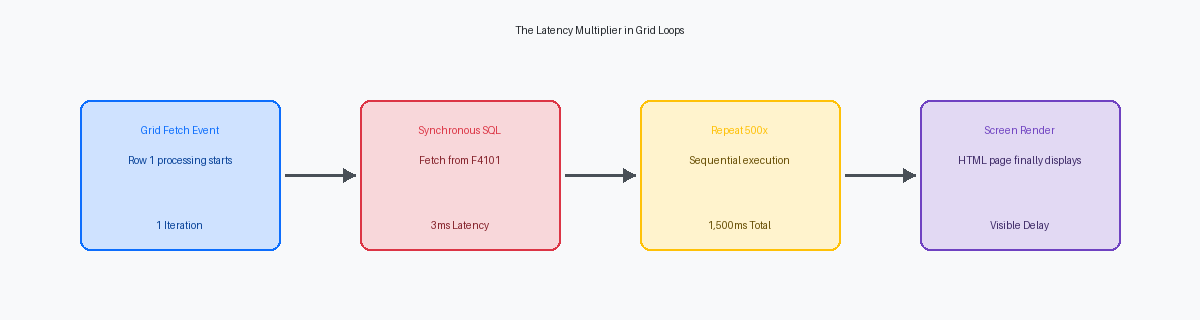
Measuring the Timing and Database Overhead
A single database fetch over a local network typically takes between 2 and 5 milliseconds. In isolation, a developer testing a single record on a local development client will never notice this delay. However, when this single fetch is embedded inside a Grid Record is Fetched or Write Grid Line-Before event and multiplied across a 500-row grid loop, the math changes drastically. A seemingly minor few milliseconds of latencyThe time delay experienced during data transmission or processing across a network. per fetch instantly escalates to over a second of pure database wait time for a single user action, stalling the interactive thread while the HTML server waits on the enterprise server.
To diagnose this specific bottleneck, you must bypass the standard CallObject kernel logs and isolate the jdedebug.logA detailed diagnostic file used to trace and troubleshoot JD Edwards system operations. for the specific HTML session. Searching this log for JDB_FetchKeyedA specific database operation that retrieves a record using a unique index or key. statements under the thread ID of your application execution reveals the exact timing breakdown of the underlying SELECT statements. You will frequently observe the same SQL statement executing hundreds of times with identical WHERE clause parameters—such as fetching the same category code description from the F0005 UDCUser Defined Codes, customizable tables used to categorize and validate data in JD Edwards. table or item master details from the F4101 for every single detail row.
Comparing the 'Time Start' and 'Time End' stamps of these sequential JDB_FetchKeyed calls exposes the cumulative lag of synchronous Event Rules execution. Because EnterpriseOne executes grid event rules synchronously, the user's browser remains locked in a processing state until the final iteration completes. If your log shows 500 iterations of a F4101 fetch taking a few milliseconds each, the multi-second gap between the first 'Time Start' and the last 'Time End' represents dead time that no amount of web server tuning or JVM memory allocation can resolve.
Identifying the Ideal Cache Candidate
In a standard distribution APPL like P4210 or P4111, the Grid Record Fetched event often triggers a redundant lookup to the F41001 (Inventory Constants) table for every single row. Static or slow-moving tables like F0005 (UDC) or F41001 are prime candidates for application-level caching because their data remains constant throughout the life of the application session. Querying the database 500 times for the same branch/plant constant during a grid load is a waste of database resources.
If the same record is fetched more than three times during a single grid execution, it must be flagged as a cache candidate to prevent redundant I/O. For instance, in a 200-row grid where 150 lines belong to the same three branch/plants, a standard fetch executes 200 SQL statements. By identifying these repetitive lookup patterns during the design phase, you eliminate the overhead of repeated database round-trips.
Using JDE Cache allows developers to load reference data once into user-space memory during the 'Post Dialog Is Initialized' event. Instead of hitting the database on every grid row, a custom C business function can pre-populate a memory structure with the necessary F41001 records. The grid loop then queries this memory structure instead of executing a SQL SELECT statement.
Storing key-value pairs in memory reduces the subsequent retrieval timing from milliseconds to microseconds. A physical database read across a network typically takes 2 to 10 milliseconds depending on network latency and database indexing. Retrieving that same key-value pair from local memory takes under 10 microseconds, resulting in a near-total reduction in retrieval time for that specific data point.
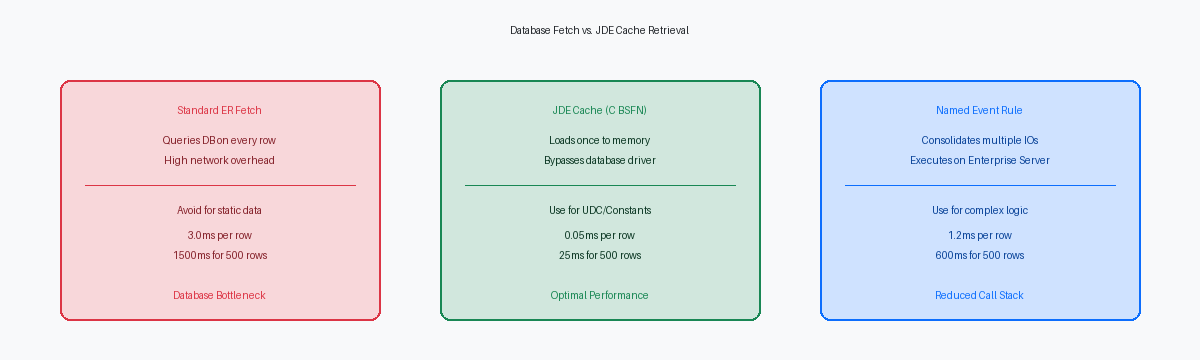
Refactoring to NER for Set-Based Logic
Placing five consecutive Fetch Single statements inside the Grid Record Is Fetched event of a heavy transactional application like P4210 or P4312 is an architectural anti-pattern. Each FDAForm Design Aid, the development tool used to create and modify JD Edwards applications.-level table I/O forces the HTML server to coordinate with the Enterprise server, generating massive call-stack overhead for every single row in the grid. Moving this repetitive table I/O into a Named Event Rule (NER) immediately consolidates these fragmented database operations into a single, compiled C component.
This shift allows you to group related validation steps—such as checking F4102 item branch records, F03012 customer billing instructions, and F4101 category codes—into a unified execution block. Because the NER runs directly on the Enterprise Server, the business logic executes significantly closer to the database engine. Instead of five separate round-trips from the presentation layer, the system processes the validation logic locally on the application tier, slashing execution times from over 100 milliseconds per grid row down to single-digit milliseconds.
To implement this, define a clean data structure that accepts the grid row's key fields—such as MCU, ITM, and AN8—and returns all five required attributes, such as line type, payment terms, and inventory cost, in a single call. This structured parameter list eliminates the need for sequential, independent database reads in the FDA.
By packaging these retrievals together, you minimize the network chatter between the HTML server, the Enterprise server, and the database server, transforming a chatty, row-by-row bottleneck into an efficient, set-based operation. For a grid loading 100 lines, this optimization reduces individual network calls from 500 down to just 100. This directly determines whether the application remains responsive under production volumes.
Implementing JDE Cache API in C Business Functions
When a grid contains 500 or more rows, executing database fetches via Table I/O inside the Grid Record Is Fetched event is highly likely to elevate callObject kernel CPU utilization. For maximum performance, C-based Business Functions (BSFN) using the jdeCache APIs offer the lowest-latency data retrieval because they eliminate the middleware translation layer. Operating directly within the callObject kernelThe server process responsible for executing business functions and managing memory.'s memory space, these APIs bypass the database driver entirely once the initial load is complete.
The APIs jdeCacheInit, jdeCacheAdd, and jdeCacheFetch allow developers to manage structured, in-memory data tables directly in the callObject kernel. During the Dialog Is Initialized or Post Dialog Is Initialized event of the APPL, a C BSFN can execute a single, optimized SQL select to load the entire subset of required reference records—such as 1,000 branch/plant constant records—into a custom cache instance. This single-trip database operation replaces hundreds of individual SELECT statements that would otherwise execute during the grid load.
Once the cache is populated, subsequent grid loop iterations query the memory cache using jdeCacheFetchPosition, completely bypassing the database driver and the network stack. This API execution within a C BSFN targets the specific cache bucket using a predefined index structure, retrieving the required row in sub-millisecond time. In a high-volume APPL with a 500-row grid, replacing individual SQL lookups with jdeCacheFetchPosition typically drops total event rules execution time from double-digit seconds down to a fraction of a second. Developers must pair this with a final call to jdeCacheTerminate in the End Form/Close event to prevent memory leaks in the callObject kernel.
Form Extensions and Orchestrations as Alternatives
Replacing legacy Event Rules with Form ExtensionsA JD Edwards tool allowing users to modify forms and map data without traditional coding. in Tools Release 9.2.x provides a zero-code method to map fields without touching the APPL. In P4210 or P4310 customizations, developers historically wrote ER on "Grid Record Is Fetched" to pull data from F0101 or F4101. Form Extensions bypass this by mapping columns directly, reducing upgrade retrofitting costs by a significant portion, often up to half, for simple data retrieval.
When multi-table joins are required, Tools Release 9.2.7 utilizes OrchestratorA powerful tool for automating business processes and integrating JD Edwards with external systems. data request aggregation to execute group-by operations at the database level. Instead of executing 500 individual SELECT statements to calculate a customer's open balance, a single REST call returns the pre-aggregated sum. This shifts the computational load to the database engine, where indexes optimize retrieval in milliseconds.
A critical architectural failure occurs when developers call these Orchestrations inside a grid loop event, such as "Row Is Exited/Changed Inline" or "Write Grid Line-Before". Every individual Orchestration invocation triggers an outbound HTTP POST request from the AIS serverApplication Interface Services server, which handles communication between JD Edwards and modern web services., introducing 15 to 50 milliseconds of network latency per row. In a grid displaying 200 lines, this anti-pattern adds up to several seconds of pure network overhead, rendering the application unusable and performing far worse than standard ER database reads.
To eliminate this latency, invoke the Orchestration once during the "Post Dialog Initialized" event to pull the aggregated dataset into a temporary memory structure before the grid loads. Use a fast pointer lookup to populate the grid rows, avoiding outbound network hops during the rendering phase. Restricting Orchestrator execution to these single-call, pre-grid initialization tasks ensures sub-second screen response times while maintaining a clean, upgrade-safe APPL.
Reducing row-exit latency from several seconds to a fraction of a second often requires moving beyond standard Event Rules into C-based caching for high-volume tables like F4211 or F0911. For developers managing 9.2.x.x environments, replacing repetitive grid fetches with memory-resident arrays is the most effective way to stabilize APPL performance under heavy concurrent loads. To see these patterns applied at scale—including specific BSFN cache structures and Orchestrator data request optimizations—examine our technical project portfolio or browse the related deep-dives on JDE memory management and AIS performance tuning.
