




Out of a typical library of 5,000 to 15,000 custom objects in a mature EnterpriseOneOracle's JD Edwards ERP software suite used for managing business operations and data. environment, interactive applications (APPLs)JD Edwards programs that provide a visual interface for users to enter, view, and modify data. represent the highest risk of database corruption when user inputs are unvalidated. Developers frequently treat processing options (POs)Parameters that allow users to change how an application behaves without modifying the underlying code. as passive text containers, allowing invalid data to seep into critical transaction tables like F4211The JD Edwards database table that stores detailed information for sales order lines. or F0911The JD Edwards database table used to store all General Ledger transaction records.. Implementing a structured JDE APPL processing options pattern to control application behavior safely prevents these downstream failures by enforcing strict data dictionaryA central repository that defines the properties, formatting, and validation rules for all data fields in JD Edwards. overrides and runtime validation before any form controls are loaded.
Standard JDE runtime architecture requires us to intercept and validate PO values during the "Dialog is Initialized"A specific event that runs when a form first opens, used to set up variables and validate settings. event of the entry form. If a PO value fails validation against a User Defined Code (UDC)A customizable list of valid values that ensures users enter consistent data into specific fields. table like 00/DT or a master file like F0006The JD Edwards database table that stores master information about business units and departments., you must terminate the application using the Press Button(HC &Cancel) system functionBuilt-in commands in JD Edwards used to perform specific actions like opening forms or displaying errors. immediately. This programmatic hard-stop eliminates the risk of users bypassing security or configuration rules, keeping your custom transactional applications stable across continuous deliveryA software development practice where code changes are automatically tested and prepared for release to production. updates in JDE 9.2.
The Anti-Pattern of Hidden Interactive Logic
In over two decades of auditing custom JDE code, I frequently see developers treating processing options as a lazy substitute for proper database configuration. Instead of querying the F0092The JD Edwards database table that stores user profile settings and security information. user profiles table to determine branch/plantA JD Edwards term representing a specific business location, such as a warehouse, office, or manufacturing facility. authority on custom interactive entry forms, developers hardcode user-specific paths into the processing options of a single version. This shortcuts clean database design and results in undocumented application paths that are impossible to audit.
Unlike batch UBEsUniversal Business Engines; background processes used for generating reports or processing large volumes of data. running in a statelessA computing model where the server does not retain user session information between individual requests. thread on the enterprise server, interactive HTML applications execute within a statefulA computing model where the server tracks the user's current status and data throughout their session. user session managed by the JAS serverThe JD Edwards Application Server that manages the web interface and communicates with the database.. When an APPL accepts unvalidated processing option values—such as an unchecked document type—it risks injecting corrupt data into master business functionsStandardized logic modules in JD Edwards that ensure data integrity when updating core database tables. like F4211FSBeginDoc. This mismatch between the stateful session and the database often leads to orphaned detail records or runtime memory leaks in the call object kernelA server process that executes business logic and database operations on the JD Edwards enterprise server..
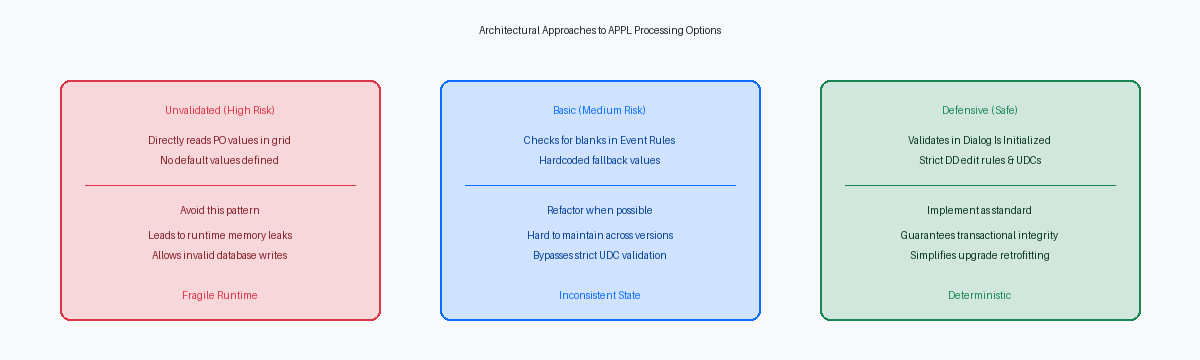
The primary driver of post-go-live bugs in custom APPLs is the assumption that a blank processing option means default behavior. If a developer fails to validate and assign default values during the Dialog Is Initialized event, a blank field bypasses critical logic. For instance, a blank line typeA code that tells the system how to process a specific transaction line, such as inventory or text. parameter might cause the application to skip tax calculations, a bug that typically remains undetected until month-end reconciliation.
To prevent these failures, you must enforce a separation of concernsA design principle that divides a program into distinct sections, each handling a specific part of the logic.. The processing option template must only serve as a passive container for raw parameters. The interactive application must contain the explicit validation logic to bind, default, and reject those parameters before any business function executes.
Designing the Processing Option Template T550101
Reusing standard Oracle templates like T4210 for custom applications is a fast track to production failures during your next Tools Release or application upgrade. When Oracle delivers an ESUElectronic Software Update; a package of fixes or enhancements released by Oracle for JD Edwards. that updates a standard template, the spec mergeThe process of combining custom software modifications with new updates provided by Oracle. process will overwrite your modifications, silently dropping custom parameters and corrupting your runtime specs. For a custom application like P550101, you must clone the structure into a dedicated template, T550101, ensuring your custom parameters remain isolated and upgrade-safe.
Inside T550101, resist the temptation to use generic EV01A standard JD Edwards data item used for simple "Yes/No" or "True/False" flags. or character data items like generic text fields for flags. Every processing option should map to an explicit Data Dictionary (DD) item with hardcoded edit rules, such as a custom UDC or a defined numeric range. If you use a generic field, you shift the burden of validation entirely to the application’s Event RulesThe proprietary scripting language used to create business logic within JD Edwards applications and reports., which increases the likelihood of unhandled null values and runtime memory leaks in your interactive engine.
Organize the template tabs to strictly mirror standard JD Edwards UXUser Experience; the overall ease of use and satisfaction a person has when interacting with software. guidelines, grouping options by functional impact. A clean T550101 design features three distinct tabs: 'Defaults' for pre-populating form fields, 'Process' for controlling business logic branches, and 'Versions' for specifying external UBE or APPL calls. This logical division prevents configuration errors where business analysts accidentally configure version overrides in fields intended for processing flags.
Every option in T550101 must have its default behavior explicitly defined in its DD glossaryThe descriptive help text associated with a specific field in the JD Edwards Data Dictionary. and programmatically enforced in the application code. When a user leaves a processing option blank, your code must interpret this as a specific, safe default rather than allowing undefined runtime behavior. For example, if a "Process" option for status updates is blank, the application should default to a safe state, like "do not update," and log the fallback action clearly.
Implementing Rigorous Validation in Dialog Is Initialized
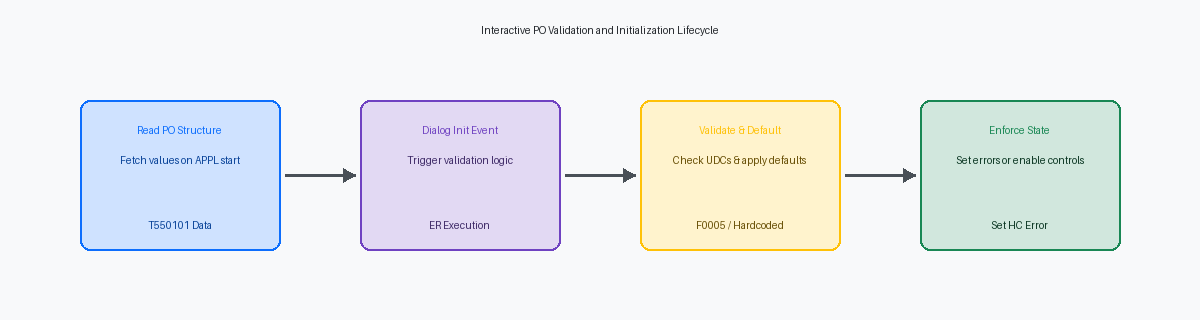
Waiting for the "Post Dialog Is Initialized" or "Control Is Entered" events to validate processing options is a common architectural flaw that exposes your database to corrupt records. All processing option validation must occur during the Dialog Is Initialized event of the APPL before any form controls are rendered to the user. In our remediation projects, we frequently find custom applications that allow a form to render with blank or invalid parameters, only to throw an error when the user clicks "OK." This is too late; by that point, the runtime engine has already executed initial database fetches and loaded cache structuresTemporary storage areas in memory used to hold data for faster access during processing. based on garbage inputs.
If a critical processing option contains an invalid value, the application must immediately issue a hard error using the 'Set HC Error' system function and terminate initialization. Failing to halt execution allows the form to load in an indeterminate state, leaving action buttons active and exposing the system to unauthorized data creation. If your processing option for a default Document Type (DCTOThe JD Edwards data item name used to represent a Document Type code.) is invalid, calling Set HC Error(FC Document Type, "0002") on the control or a dummy control forces the runtime to block input. It prevents the user from typing a single character or triggering any business functions that rely on that document type.
To prevent downstream database constraint violations, validate incoming processing option values against the appropriate User Defined Codes (UDCs) or master tables, such as the Company Constants table (F0010The JD Edwards database table that stores basic configuration and constants for companies.). For instance, when a processing option dictates a target Company (CO), executing a quick fetch against F0010 during initialization ensures the company actually exists before any transactional logic fires. This simple check eliminates the vast majority of database integrity errors that typically plague custom batch-like interactive applications. Implementing these strict validation gates at the absolute entry point of your APPL ensures that your business logic remains entirely predictable.
Interactive Behavior Control: A Concrete Code Example
Reading processing option values directly from the PO lpDS structure within deep event loops or multiple control events is a maintenance hazard that leads to unstable interactive behavior. Instead, declare a dedicated local variable like evt_szProcessMode_EV01 in the "Dialog Is Initialized" event of your interactive application (APPL). Resolving the PO value once into this local variable isolates your execution logic from subsequent, unexpected changes to the runtime PO structure. This single-point-of-resolution pattern simplifies debugging in ActiveEraA JD Edwards tool used to manage and navigate through application forms and menus. or when reading Event Rules logs because the variable state is explicitly tracked in memory.
Defensive coding requires an explicit fallback routine immediately after mapping the PO value. If the incoming processing option is blank, the Event Rules must assign a designated default behavior value—such as '1' for read-only mode—directly to evt_szProcessMode_EV01. Relying on implicit blanks to mean "default" is a common root cause of security gaps when a CNCConfigurable Network Computing; the technical architecture of JD Edwards and the role of the system administrator. administrator promotes a new version without generating corresponding processing option text. By forcing an explicit assignment in code, the application defaults to the safest, most restrictive execution path if misconfigured.
Once the state is locked into your local variable, use it to manipulate form controls (FC) and grid columns (GC) dynamically. For instance, if evt_szProcessMode_EV01 is set to read-only, call the 'Disable Control' system function on your primary action buttons and invoke the Set Action Security APIApplication Programming Interface; a set of rules that allows different software programs to communicate with each other. to block grid additions or deletions. If a user attempts to bypass these restrictions via a keyboard shortcut, trigger the 'Set Grid Cell Error' system function or call the Set Control Error API to halt the transaction before any database commit occurs. This dual-layer defense prevents unauthorized data modification regardless of how the user interacts with the form.
Building the Test Matrix for APPL Processing Options
Leaving interactive application testing to a developer's memory is how production environments end up with corrupted F41021The JD Edwards database table that tracks inventory quantities at specific locations. records or orphaned F0911 entries. A deterministic 4-column test matrix covering a comprehensive set of execution paths must map every processing option input parameter against expected application behaviors, form states, and database mutations. This matrix layout—detailing Input Parameter, Form State, Database Mutation, and Expected Behavior—forces the QA team to validate the application under conditions that standard unit tests ignore.
Testing must cover boundary conditions, including completely blank structures, invalid alphanumeric characters in numeric-only fields, and out-of-bounds numeric values such as entering a '9' where only '0' or '1' is valid. We cannot rely on informal happy path testing where a developer assumes the user will always input clean data. Manual or automated scripts, such as those executed via Oracle's test automation tools or JDE OrchestratorA tool used to automate business processes and integrate JD Edwards with external applications and devices., must verify that hard validation errors halt database processing exactly as designed, preventing invalid records from hitting the database. If a user inputs an invalid branch/plant, the form must set an HC_ERR on the control and disable the OK button.
Documenting this comprehensive matrix directly within the technical specificationA document that describes the detailed design and technical requirements for a software development project. ensures that future retrofits or Tools Release upgrades—such as moving from Tools Release 9.2.5 to 9.2.8—do not silently break application behavior. When CNC applies a new Planner ESU or developers retrofit custom objects during a 9.1 to 9.2 upgrade, they use this matrix to run regression tests in less than an hour. This level of rigor prevents the degradation of custom business logic over years of system maintenance, keeping your core ERP stable.
Retrofitting and Maintaining Custom APPL POs Safely
A sloppy spec merge during a 9.1 to 9.2 upgrade will quietly corrupt your interactive application behavior if you do not isolate custom processing option templates. When running the upgrade table merges and specification merges, custom T55* templates must be validated through Object Management Workbench (OMW)The central JD Edwards tool used by developers to manage, edit, and promote software objects. to prevent the loss of custom data structures. Standard JDE upgrade paths often overwrite or misalign the underlying PO Text (POT)The specific object in JD Edwards that defines the visual layout and labels for processing options. specifications when standard objects are replaced by newer Oracle releases. If the POT specifications do not exactly align with the compiled runtime structures of your interactive applications after an ESU or Tools Release upgrade, the APPL will read garbage memory offsets, leading to web client crashes or silent data corruption.
Modifying standard JDE processing option templates (like T4210 or T4111) is a technical debt trap that breaks during ESUs. When retrofitting standard APPLs, resist the temptation to append custom parameters directly to the standard PO template. This modification will be wiped out or misaligned during the next Planner ESU. Instead, store your custom parameters in a parallel F55The standard prefix used in JD Edwards to identify custom-built database tables. control table, keyed by User ID, Program ID, and Version Name. This design preserves the vanilla JDE template structure while allowing your custom business functions to retrieve extended configuration values safely at runtime.
Maintaining this architecture over years of continuous delivery requires visibility into which interactive versions run which templates. Schedule the cross-reference build (R980011A JD Edwards batch program that builds a cross-reference of how different software objects are related.) to run weekly in your development environment, rebuilding the relationships for Interactive Applications and Processing Option Templates. Reviewing these tables allows you to immediately flag orphaned interactive versions pointing to obsolete templates before promotion to Production. This proactive audit reduces your testing surface area significantly, often by a third or more, during a Tools Release update, ensuring only validated configurations migrate through your OWM pipeline.
For enterprise IT leaders managing complex JD Edwards footprints, establishing these development guardrails is critical to preventing silent database corruption and minimizing upgrade friction. To evaluate your current custom applications against these standards or to discuss optimizing your release pipeline, contact our enterprise architecture team for a comprehensive code quality audit.
