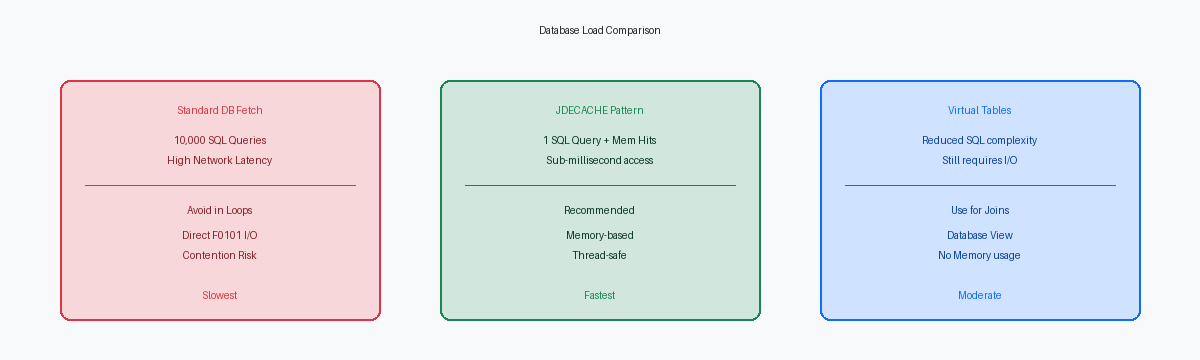

A high-volume UBEAn Oracle JD Edwards EnterpriseOne batch application, used for processing large volumes of data or generating reports without user interaction. processing 50,000 sales lines often wastes 15% to 20% of its execution window on redundant F0101The Address Book Master table in JD Edwards EnterpriseOne, storing core information about customers, vendors, and employees. lookups. Even with optimized database indexing, hitting the same Address Book record 5,000 times in a single batch run creates unnecessary SQL overheadThe additional processing cost incurred by the database system to parse, optimize, and execute SQL queries, beyond just retrieving the data. and middleware latencyThe delay introduced by the software layer (middleware) that connects different applications or systems, impacting data transfer speed.. This JD Edwards BSFN cacheA temporary storage mechanism within a JD Edwards Business Function (BSFN) to hold frequently accessed data, reducing database lookups. example reduces repeated F0101The Address Book Master table in JD Edwards EnterpriseOne, storing core information about customers, vendors, and employees. reads by moving the lookup logic into a local memory segment, bypassing the database layerThe part of a software system responsible for interacting with the database, handling data storage, retrieval, and management. for every request after the initial fetch.
Implementing this pattern correctly requires a pointer-based JDECACHE structureA data structure in JD Edwards C Business Functions that uses memory pointers to efficiently manage and access cached data. within a C Business FunctionA custom program written in C language within JD Edwards EnterpriseOne, used to encapsulate business logic and improve performance.. Instead of relying on the standard middleware to manage the buffer, we manually control the jdeCacheInitAn API function in JD Edwards used to initialize and create a new cache instance in memory for a Business Function. and jdeCacheFetchAn API function in JD Edwards used to retrieve data from an existing cache instance based on a specified key. operations to store F0101 attributesSpecific data fields or characteristics stored within the F0101 Address Book table, such as Search Type or Alpha Name. like Search Type (AT1)A field (AT1) in the JD Edwards Address Book (F0101) used to categorize an address book record, e.g., customer, vendor, employee. or Alpha Name (ALPH)A field (ALPH) in the JD Edwards Address Book (F0101) storing the alphabetical name or description of the entity. directly in memory. This approach eliminates the "zombie" cache risksThe danger of a cache instance remaining active and consuming memory after its intended use, leading to memory leaks and system instability. often found in poorly written custom code by ensuring the jdeCacheTerminateAn API function in JD Edwards used to explicitly release and clean up a cache instance from memory. call is tied to the UBE or application's end-of-process eventA specific point in time when a JD Edwards batch application (UBE) or interactive application finishes its execution, triggering cleanup routines.. In a typical 9.2 environmentRefers to a system running Oracle JD Edwards EnterpriseOne version 9.2, a specific release of the ERP software., this configuration can reduce physical I/OInput/Output operations that involve reading from or writing to physical storage devices like hard drives, which are slower than memory operations. for master data tablesDatabase tables containing core, relatively static business information, such as customer addresses, item details, or vendor records. by a significant margin, in our experience often exceeding 90%, significantly lowering database contentionA situation where multiple processes or users try to access or modify the same database resources simultaneously, leading to delays and performance issues. during peak processing windows.
The Performance Cost of Redundant F0101 Lookups
A UBEAn Oracle JD Edwards EnterpriseOne batch application, used for processing large volumes of data or generating reports without user interaction. processing 50,000 sales order lines often calls a BSFNShort for Business Function, a reusable piece of code in JD Edwards EnterpriseOne that encapsulates specific business logic. to retrieve the Alpha Name for the same Ship-To address thousands of times. If your loop hits 10,000 iterations and triggers a SELECT statement on F0101The Address Book Master table in JD Edwards EnterpriseOne, storing core information about customers, vendors, and employees. for every record, you are effectively DOS-attacking your own databaseAn analogy for overwhelming a database with excessive, unnecessary requests, similar to a Denial-of-Service attack, causing performance degradation.. Even with a well-indexed Primary Key on ABAN8A unique identifier (ABAN8, Address Book Number) in the F0101 table, used to quickly locate specific records., the round-trip latency between the Enterprise ServerThe central server in a JD Edwards EnterpriseOne architecture that hosts the business logic and processes, interacting with the database server. and the Database ServerA computer system dedicated to hosting and managing databases, responding to data requests from other servers or applications. is non-zero. In a standard architecture, the database middleware overheadThe processing cost incurred by the software layer that facilitates communication between the application and the database, beyond data retrieval. for a single PK fetchRetrieving a record from a database using its Primary Key, which is typically the fastest way to access a specific row. typically consumes 1 to 3 milliseconds. While 3ms sounds trivial, multiplying it by 10,000 iterations adds significant overhead, often half a minute or more of pure I/O wait timeThe duration a computer process spends idle, waiting for input/output operations (like reading from disk or network) to complete. to a single UBEAn Oracle JD Edwards EnterpriseOne batch application, used for processing large volumes of data or generating reports without user interaction. execution.
Developers frequently rely on standard service functionsPre-built, reusable functions provided by JD Edwards EnterpriseOne to perform common tasks, ensuring reliability and consistency. like GetAddressBookDescription (B0100066)A specific JD Edwards Business Function (B0100066) used to retrieve descriptive information for an Address Book record. because they are reliable and handle the necessary error checking. However, these functions are statelessDescribes a system or function that does not retain any information about past interactions; each request is processed independently.; they do not natively cache results across multiple calls within the same threadStoring data temporarily in memory so that subsequent requests for the same data within the same execution path can retrieve it quickly without re-querying the database.. Every time B0100066 is invoked, it opens a cursorIn database terms, a cursor is a control structure that enables traversal over the records in a database. Opening it prepares for data retrieval., executes the SQLThe process where the database system runs a Structured Query Language (SQL) command to perform operations like data retrieval or modification., and fetches the rowRetrieves a single record or line of data from the database result set after a query has been executed.. When this happens inside a high-volume loopA programming construct that repeatedly executes a block of code many times, often processing a large number of records. in a R42520 Print Pick SlipsA standard JD Edwards EnterpriseOne batch report (R42520) used to generate pick slips for sales orders, often processing many lines. or a custom R55 financial integrity reportA user-defined JD Edwards batch report (starting with R55) designed to verify the consistency and accuracy of financial data., the cumulative overheadThe total additional processing cost that accumulates over many repeated operations, leading to significant performance impact. becomes the primary bottleneckThe component or process that limits the overall performance or throughput of a system, causing delays. for the batch windowA designated period, typically overnight, during which batch processes and reports are run, often requiring high performance..
Scaling JDE logicThe business rules and processing instructions implemented within the JD Edwards EnterpriseOne system. for global enterprisesLarge, multinational companies with operations and users spread across different geographical locations. requires moving away from the fetch-on-demand mindsetA programming approach where data is retrieved from the database only when it is specifically requested, rather than pre-loading or caching. for master dataCore, non-transactional business data that is relatively stable and used across multiple business processes, e.g., customer names, item numbers. that rarely changes during a single session. Reducing the raw SQL execution countThe total number of times SQL queries are sent to and processed by the database system. is the most effective lever a developer has to improve performance without requesting expensive hardware upgrades or OCI instance resizingAdjusting the computational resources (CPU, memory) allocated to a virtual server (instance) hosted on Oracle Cloud Infrastructure (OCI).. By implementing a JDECACHE pointerA memory address that points to a specific JDECACHE instance, allowing a program to access and manage the cached data. to store the results of the first F0101The Address Book Master table in JD Edwards EnterpriseOne, storing core information about customers, vendors, and employees. lookup, subsequent requests for the same AN8The Address Book Number, a unique identifier for records in the F0101 table in JD Edwards EnterpriseOne. can be resolved in microseconds via memory rather than milliseconds via the network. This shift transforms linear performance degradationA situation where system performance worsens proportionally with an increase in workload or data volume. into near-constant execution timeA desired performance characteristic where the time taken to complete a task remains largely the same, regardless of input size, due to efficient processing. for master data resolution.
Designing the Cache Data Structure and Key
A JDECACHEA temporary storage mechanism within a JD Edwards Business Function (BSFN) to hold frequently accessed data, reducing database lookups. implementation lives or dies by the typedef structA C language construct used to define a custom data type (structure) and assign it a new name for easier use. defined in the BSFN header fileA file (typically with a .h extension) associated with a C Business Function in JD Edwards, containing declarations of functions, structures, and variables.. I have seen developers attempt to reuse existing Data Structures (DSTR)A way of organizing and storing data in a computer so that it can be accessed and modified efficiently. for cache storage to save time, but that is a mistake that often leads to memory alignment issuesProblems that occur when data is not stored at memory addresses that are multiples of its size, potentially leading to inefficient access or errors. or unnecessary memory overheadThe extra memory consumed by a program or system for internal management, data structures, or other non-payload data.. You must define a dedicated structure that contains only the fields you intend to persist. For a high-frequency F0101The Address Book Master table in JD Edwards EnterpriseOne, storing core information about customers, vendors, and employees. lookup, your structure should lead with the mnAddressNumber (MATH_NUMERIC)A variable type in JD Edwards (MATH_NUMERIC) used to store numeric values, often for Address Book Numbers. as the primary index, followed by the specific data points like szNameAlpha (ALPH)A variable type in JD Edwards (ALPH) used to store alphanumeric strings, typically for names. and perhaps szTaxId (TAX1)A variable type in JD Edwards (TAX1) used to store tax identification numbers.. Defining this in the .h fileA header file in C/C++ programming that contains declarations of functions, variables, and data types, shared across source files. ensures that every function within the source—whether it is the initialization, the fetch, or the termination—references the exact same memory footprintThe amount of main memory (RAM) that a program or process uses while it is running. across the runtime.
The uniqueness of the cache key is non-negotiable if you want to avoid the overhead of JDECACHE_FetchRecordsAn API function in JD Edwards used to retrieve multiple records from a cache instance based on filter criteria. with complex filters. By defining a single-key indexA database or cache index built on a single column or field, allowing for fast lookups based on that specific value. on mnAddressNumberA variable type in JD Edwards (MATH_NUMERIC) used to store numeric values, often for Address Book Numbers., the JDE cache manager performs a binary searchAn efficient algorithm for finding an item from a sorted list by repeatedly dividing the search interval in half. across the memory segments, which is significantly faster than a SQL index seekA highly efficient database operation that uses an index to quickly locate specific rows without scanning the entire table. on a large F0101The Address Book Master table in JD Edwards EnterpriseOne, storing core information about customers, vendors, and employees. table containing 500,000+ records. In a typical distribution environment where a single UBEAn Oracle JD Edwards EnterpriseOne batch application, used for processing large volumes of data or generating reports without user interaction. might process 10,000 sales lines, hitting the cache for the Sold-To and Ship-To namesIn sales orders, "Sold-To" refers to the customer placing the order, and "Ship-To" refers to the recipient of the goods. reduces the total database round-trips by 20,000 calls. This is not just a marginal gain; it is the difference between a fifteen-minute batch run and one that finishes in under five minutes.
Efficiency comes from packing the structure with every piece of data the calling application might need later in the execution flow. If your logic eventually requires the Search Type (ATY)A field (ATY) in the JD Edwards Address Book (F0101) used to categorize an address book record, e.g., customer, vendor, employee. or the Business Unit (MCU)A field (MCU) in JD Edwards representing an organizational entity, often used for financial reporting and cost tracking. from the Address Book, add them to the structure now. A 200-byte structure cached for 5,000 active customers consumes a negligible memory footprint, typically under a few megabytes of workstation or enterprise server memory. Compared to the latency of repeated JDB_FetchKeyed callsAPI calls in JD Edwards used to retrieve a single record from a database table using its primary key. over a congested network to an OCI-hosted databaseA database instance running on Oracle Cloud Infrastructure (OCI), Oracle's suite of cloud computing services., the memory trade-off is negligible. Ensure your JDECACHE_KEYSEGAn array used in JD Edwards C Business Functions to define the key segments for a cache, mapping to specific fields within the cached structure. array correctly maps to the offset of mnAddressNumberA variable type in JD Edwards (MATH_NUMERIC) used to store numeric values, often for Address Book Numbers. within the structure to prevent the middlewareSoftware that acts as a bridge between an operating system or database and applications, enabling communication and data management. from retrieving the wrong memory block during a fetch operation.
Initializing JDECACHE within the BSFN
Every BSFNShort for Business Function, a reusable piece of code in JD Edwards EnterpriseOne that encapsulates specific business logic. developer has eventually seen a Call Object Kernel crashA critical failure of the JD Edwards EnterpriseOne Call Object Kernel, which processes business functions, leading to system instability. because two different custom functions tried to initialize a cache with the same name. You must pass a unique, descriptive string to the jdeCacheInit APIThe Application Programming Interface (API) function in JD Edwards used to initialize and create a new cache instance in memory., such as "C550101_AddressBookCache". Using a generic name like "AB_Cache" risks a collision with standard Oracle BSFNsBusiness Functions (BSFNs) that are part of the standard Oracle JD Edwards EnterpriseOne software, developed and maintained by Oracle. running in the same thread. In environments processing 50,000 sales order lines, a name collisionA situation where two different entities (like cache instances) are assigned the same name, leading to conflicts and errors. can corrupt the memory space of the kernelDamaging or overwriting data in the memory area used by the operating system or application kernel, causing instability or crashes., leading to zombie processesProcesses that have completed execution but still have an entry in the process table, often because their parent process hasn't reaped them, consuming resources. on the Enterprise ServerThe central server in a JD Edwards EnterpriseOne architecture that hosts the business logic and processes, interacting with the database server..
Multi-threaded Call Object KernelsJD Edwards Call Object Kernels capable of executing multiple business functions concurrently within the same process, improving efficiency. reuse memory, making session isolationEnsuring that data and processes from one user session do not interfere with or access data from another user session. a primary concern. You prevent cross-session data contaminationThe unwanted mixing or corruption of data from different sources or sessions, leading to incorrect or unreliable information. by appending the Job Number (JOBS)A unique identifier assigned to a batch process (UBE) in JD Edwards EnterpriseOne, used for tracking and logging. to the cache name string. Without this unique identifier, User A might fetch Address Book data cached by User B. In a 9.2 environmentRefers to a system running Oracle JD Edwards EnterpriseOne version 9.2, a specific release of the ERP software., failing to include the Job Number causes intermittent data integrity bugsErrors in data consistency that occur unpredictably and are difficult to reproduce, often due to race conditions or shared resource issues. that are nearly impossible to replicate in a single-user local development environmentA development setup where a single developer works on their local machine, often making it hard to simulate multi-user issues..
Setting the cache index during initialization determines whether subsequent lookups operate at O(1) or O(n) complexityNotation describing how an algorithm's execution time or space requirements grow with input size. O(1) is constant, O(n) is linear.. You define the index using jdeCacheAddIndexAn API function in JD Edwards used to define an index for a cache instance, enabling faster data retrieval. immediately after initialization, mapping it to the F0101.AN8 fieldThe Address Book Number (AN8) field within the F0101 Address Book table in JD Edwards.. For a cache containing 2,000 records, an unindexed scanA database operation that reads every row in a table to find matching records, which is inefficient without an index. takes significantly more CPU cyclesThe basic unit of time that a computer's central processing unit (CPU) uses to perform an operation. More cycles mean more processing. than a keyed lookupRetrieving data using a specific key (like an index), which allows for direct and fast access to the desired record.. This performance gap is critical when the BSFN is called inside a loopA common programming pattern where a Business Function is repeatedly invoked within an iterative structure, often for processing multiple records. in a heavy UBEAn Oracle JD Edwards EnterpriseOne batch application, used for processing large volumes of data or generating reports without user interaction. like R42520A standard JD Edwards EnterpriseOne batch report (R42520) used to generate pick slips for sales orders, often processing many lines..
Logic must check if the hCacheA handle (hCache) is a reference or pointer to a specific cache instance, used to interact with it in JD Edwards Business Functions. variable is valid to minimize overhead. Checking the hCache variable against NULLA special value indicating that a variable or pointer does not refer to any valid object or memory location. ensures that if a BSFNShort for Business Function, a reusable piece of code in JD Edwards EnterpriseOne that encapsulates specific business logic. is called 10,000 times within one threadA single sequence of instructions executed by a program, often part of a larger multi-threaded process., initialization only occurs once. This approach reduces execution time by a significant margin, often between 10% and 20%, compared to functions that re-open handles on every call.
Implementing the Fetch or Insert Logic
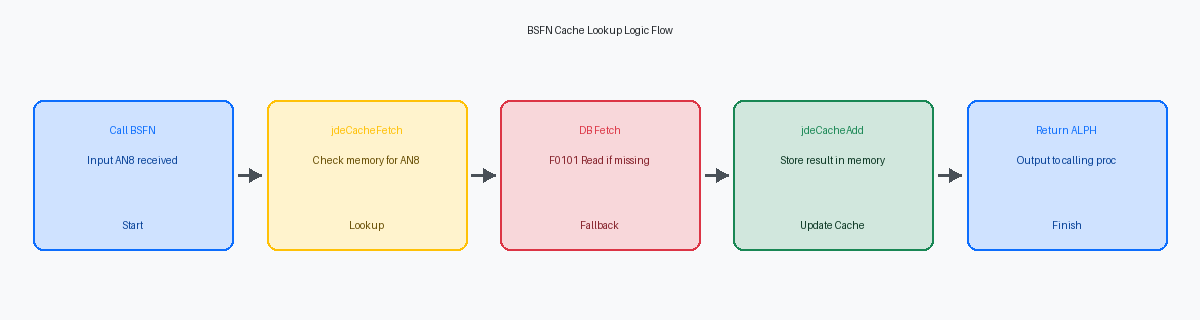
The BSFNShort for Business Function, a reusable piece of code in JD Edwards EnterpriseOne that encapsulates specific business logic. logic starts with an immediate call to jdeCacheFetchAn API function in JD Edwards used to retrieve data from an existing cache instance based on a specified key. using the passed-in AN8The Address Book Number, a unique identifier for records in the F0101 table in JD Edwards EnterpriseOne. as the primary key. This check occurs before any database activity, ensuring the system only consumes CPU cycles if the data is missing from the User Session's memoryThe portion of computer memory allocated to a specific user's interactive session or batch process, isolated from others.. In a high-volume UBEAn Oracle JD Edwards EnterpriseOne batch application, used for processing large volumes of data or generating reports without user interaction. processing 50,000 sales order lines, this single line of C code can eliminate tens of thousands of redundant SQL statements if the address book distribution is concentratedA scenario where a small number of Address Book records are referenced very frequently across many transactions.. The function signatureThe definition of a function, including its name, return type, and the types and order of its parameters. requires the hCache handleA handle (hCache) is a reference or pointer to a specific cache instance, used to interact with it in JD Edwards Business Functions. established during initialization and a pointer to the key structureA data structure specifically designed to hold the key values used for looking up records in a cache or database. containing the AN8The Address Book Number, a unique identifier for records in the F0101 table in JD Edwards EnterpriseOne. value.
When the fetch operation returns JDECACHE_NOT_FOUNDA return code from a JD Edwards cache API function indicating that the requested data was not found in the cache., the BSFNShort for Business Function, a reusable piece of code in JD Edwards EnterpriseOne that encapsulates specific business logic. pivots to the physical database. This is where you execute a standard JDB_FetchKeyedAPI calls in JD Edwards used to retrieve a single record from a database table using its primary key. against the F0101 tableThe Address Book Master table in JD Edwards EnterpriseOne, storing core information about customers, vendors, and employees. to retrieve the Alpha NameA field (ALPH) in the JD Edwards Address Book (F0101) storing the alphabetical name or description of the entity. or Search TypeA field (AT1) in the JD Edwards Address Book (F0101) used to categorize an address book record, e.g., customer, vendor, employee. required for the business logicThe custom rules and processes that define how a business operates and how data is processed within an application.. If the database returns a record, the BSFNShort for Business Function, a reusable piece of code in JD Edwards EnterpriseOne that encapsulates specific business logic. populates the local data structure and immediately calls jdeCacheAddAn API function in JD Edwards used to add a new record to an existing cache instance in memory.. By inserting the record into the cache at this point, you transform an expensive I/O operationAn Input/Output operation, involving the transfer of data between a computer and a peripheral device or storage. into a sub-millisecond memory writeWriting data to computer memory in less than one millisecond, indicating extremely fast performance.. This ensures the next call for the same AN8The Address Book Number, a unique identifier for records in the F0101 table in JD Edwards EnterpriseOne.—whether in a UBE loopA programming construct that repeatedly executes a block of code many times, often processing a large number of records. or an application gridA user interface component, typically a table-like display, used in interactive applications to show and manage data records.—bypasses the database entirely.
This fetch-or-insert pattern creates a self-populating bufferA temporary storage area (buffer) that automatically fills with data as it is requested, reducing subsequent retrieval times. that scales with batch process complexityThe level of intricacy and resource demands involved in running a batch application, often due to large data volumes or complex logic.. For a typical distribution clientA business that primarily deals with the storage, movement, and delivery of goods, often using ERP systems like JD Edwards. running JDE 9.2Refers to a system running Oracle JD Edwards EnterpriseOne version 9.2, a specific release of the ERP software., we often find custom BSFNsBusiness Functions (BSFNs) developed by users or consultants, tailored to specific business requirements beyond standard JD Edwards functionality. querying F0101The Address Book Master table in JD Edwards EnterpriseOne, storing core information about customers, vendors, and employees. for every detail lineA single line item within a transaction (e.g., a sales order line), containing specific product or service information., even when a single customer represents a significant portion of the transaction volume, often upwards of three-quarters. By using this logic, the database is queried exactly once per unique AN8 per sessionEach distinct Address Book Number (AN8) is queried from the database only once during a specific user session or batch job.. Encapsulating this within a specific C BSFNA custom program written in C language within JD Edwards EnterpriseOne, used to encapsulate business logic and improve performance. maintains a clean separation of concernsA design principle in computer science for breaking a program into distinct sections, each addressing a separate concern., keeping the calling applicationThe program or module that initiates the execution of another function or component, such as a Business Function. unaware of the underlying caching mechanismThe hidden or internal system responsible for storing and retrieving temporary data to improve performance..
If JDB_FetchKeyedAPI calls in JD Edwards used to retrieve a single record from a database table using its primary key. fails to find the AN8The Address Book Number, a unique identifier for records in the F0101 table in JD Edwards EnterpriseOne., the BSFNShort for Business Function, a reusable piece of code in JD Edwards EnterpriseOne that encapsulates specific business logic. must return an error without attempting a jdeCacheAddAn API function in JD Edwards used to add a new record to an existing cache instance in memory.. Attempting to add a null recordA record that contains no data or is considered empty, often indicating that no matching data was found. to the cache can lead to memory corruptionDamaging or overwriting data in a computer's memory, leading to unpredictable program behavior or crashes. or unexpected results in subsequent attempts. The overhead of the jdeCacheFetchAn API function in JD Edwards used to retrieve data from an existing cache instance based on a specified key. is negligible compared to a physical disk readThe process of retrieving data directly from a physical storage device like a hard drive, which is slower than memory access., making this pattern a performance standard for enterprise-grade customizationCustom software modifications designed to meet the high performance, reliability, and scalability standards required by large organizations.. You should recommend this approach for any master data lookupRetrieving core, relatively static business information (master data) from a database or cache. that occurs more than 1,000 times in a single execution threadA single sequence of instructions executed by a program, often part of a larger multi-threaded process..
Managing Cache Scope and Termination
A single UBEAn Oracle JD Edwards EnterpriseOne batch application, used for processing large volumes of data or generating reports without user interaction. processing 50,000 records that fails to terminate a cache instanceA specific, active occurrence of a cache in memory, holding temporary data for a program or session. can consume several hundred megabytes of RAM within the Call Object Kernel (COK)A core component of the JD Edwards EnterpriseOne Enterprise Server that executes Business Functions and manages their resources.. When multiple users trigger similar leaks, the COKA core component of the JD Edwards EnterpriseOne Enterprise Server that executes Business Functions and manages their resources. eventually hits its memory limit—often 2GB on 32-bit kernelsOperating system kernels designed to work with 32-bit processors, typically limited to addressing 4GB of memory.—and crashes, forcing a kernel zombieA process that has completed execution but still has an entry in the process table, often because its parent process hasn't reaped it, consuming resources. and dropping active sessionsCurrently running user interactions or batch processes within a system.. You must verify that jdeCacheTerminateAn API function in JD Edwards used to explicitly release and clean up a cache instance from memory. is explicitly called for every cache handle initialized; simply letting the BSFNShort for Business Function, a reusable piece of code in JD Edwards EnterpriseOne that encapsulates specific business logic. finish execution does not release the memory allocated in the JDE middleware layerThe software layer in JD Edwards that facilitates communication between applications and the database, managing resources like caches..
In a standard UBE batch processAn Oracle JD Edwards EnterpriseOne batch application, used for processing large volumes of data or generating reports without user interaction., such as a high-volume F4211 updateModifying records in the F4211 Sales Order Detail table in JD Edwards, often a high-volume operation., the cache should persist across Do Section eventsSpecific points in the execution flow of a JD Edwards batch application (UBE) where sections of code are processed. to maximize the hit rateThe percentage of times requested data is found in the cache, indicating caching efficiency. A higher hit rate means fewer database lookups. on F0101 lookupsRetrieving records from the F0101 Address Book Master table in JD Edwards EnterpriseOne.. The optimal pattern involves calling a cleanup BSFNA Business Function specifically designed to release resources, close connections, or terminate caches at the end of a process. during the End Report eventA specific event that occurs when a JD Edwards batch report (UBE) finishes its execution, often used for final cleanup.. This BSFNShort for Business Function, a reusable piece of code in JD Edwards EnterpriseOne that encapsulates specific business logic. must reference the specific hCacheA handle (hCache) is a reference or pointer to a specific cache instance, used to interact with it in JD Edwards Business Functions. handle used throughout the job to ensure memory is wiped cleanThe process of deallocating and clearing data from memory, making it available for other processes. before the process threadA single sequence of instructions executed by a program, often part of a larger multi-threaded process. terminates. If you use a global cacheA cache instance that is accessible and shared across multiple Business Functions or components within the same process or system. shared across multiple BSFNsShort for Business Function, a reusable piece of code in JD Edwards EnterpriseOne that encapsulates specific business logic. in a single thread, the termination logic must be centralized to prevent one BSFNShort for Business Function, a reusable piece of code in JD Edwards EnterpriseOne that encapsulates specific business logic. from orphaning a handleFailing to properly release a resource handle, leading to memory leaks or resources remaining allocated unnecessarily. that another BSFNShort for Business Function, a reusable piece of code in JD Edwards EnterpriseOne that encapsulates specific business logic. expects to be active.
Interactive applicationsSoftware programs that allow users to directly interact with the system, typically through a graphical user interface. require a more nuanced approach to scope. If a cache supports a complex Power FormA type of advanced interactive application in JD Edwards EnterpriseOne, designed for complex data entry and display, often with multiple sub-forms. with multiple sub-formsSmaller, embedded forms within a larger interactive application, used to display or manage related data., the developer must decide if the cache lives for the life of the form or is cleared after a specific event. Persisting the cache at the form levelRefers to the scope or context of an interactive application (form), meaning the cache persists for the duration of that form's use. allows for rapid UI responsesThe user interface (UI) reacts quickly to user input, providing a smooth and responsive experience. during grid scrollingNavigating through rows of data displayed in a grid or table format within an application. but necessitates a call to the termination BSFNShort for Business Function, a reusable piece of code in JD Edwards EnterpriseOne that encapsulates specific business logic. in the End Form eventA specific event that occurs when a JD Edwards interactive application (form) is closed, often used for cleanup.. In environments with 500+ concurrent usersA large number of users accessing and using a system simultaneously, requiring robust performance and resource management., failing to manage this scope leads to fragmented memoryA condition where available memory is broken into many small, non-contiguous blocks, making it difficult to allocate larger blocks. across the enterprise server's COK poolsCollections of Call Object Kernels (COKs) on the JD Edwards Enterprise Server, used to manage and execute Business Functions..
Using the hCacheA handle (hCache) is a reference or pointer to a specific cache instance, used to interact with it in JD Edwards Business Functions. handle correctly ensures you are terminating the specific instance created by your process rather than a global pointer. In a multi-threaded environmentA system where multiple parts of a program can run concurrently, sharing resources but requiring careful synchronization., passing the specific handle back to the termination function prevents accidental cross-contamination of dataThe unwanted mixing or corruption of data from different sources or sessions, leading to incorrect or unreliable information.. A common mistake is relying on a hard-coded cache nameA cache name that is directly embedded into the program's source code, rather than being dynamically generated or configured. in the termination call without verifying the handle is valid. Reliable BSFNShort for Business Function, a reusable piece of code in JD Edwards EnterpriseOne that encapsulates specific business logic. design includes a check for a null handleA handle that does not refer to any valid object or memory location, indicating an uninitialized or released resource. before attempting termination, avoiding memory violation errorsErrors that occur when a program tries to access a memory location that it is not authorized to use, often leading to crashes. while ensuring the heapA region of computer memory used for dynamic memory allocation, where programs can request and release memory blocks as needed. is returned to the OSOperating System, the software that manages computer hardware and software resources and provides common services for computer programs..
Benchmarking Results and Invalidation Limits
In a typical high-volume UBEAn Oracle JD Edwards EnterpriseOne batch application, used for processing large volumes of data or generating reports without user interaction. processing 50,000 records, replacing direct JDB_FetchKeyed callsAPI calls in JD Edwards used to retrieve a single record from a database table using its primary key. to the F0101The Address Book Master table in JD Edwards EnterpriseOne, storing core information about customers, vendors, and employees. with a JDECACHE implementationThe specific way in which the JD Edwards cache (JDECACHE) is set up and used within a Business Function or application. yields a 70-90% reduction in BSFN execution timeThe total time taken for a Business Function (BSFN) to complete its processing.. This performance leap occurs because the overhead of SQL statement parsingThe process by which a database system analyzes and interprets a SQL query to understand its structure and intent. and network round-tripsThe time it takes for a request to travel from a client to a server and for the response to return, involving network latency. to the database tierThe layer in a multi-tier architecture responsible for data storage and retrieval, typically a database server. is eliminated after the first encounter of a unique Address Number. In one logistics client scenarioA real-world example or case study from a business involved in the management of the flow of goods, services, and information., a 45-minute shipping manifest UBEA JD Edwards batch application (UBE) that generates a document listing the contents of a shipment, often for many orders. was reduced to less than ten minutes simply by caching the Alpha NameA field (ALPH) in the JD Edwards Address Book (F0101) storing the alphabetical name or description of the entity. and Search TypeA field (AT1) in the JD Edwards Address Book (F0101) used to categorize an address book record, e.g., customer, vendor, employee.. The efficiency gain is most pronounced when the ratio of transactions to unique entitiesThe ratio of the total number of processed transactions (e.g., sales lines) to the number of distinct master data records (e.g., unique customers) involved. is high, such as 1,000 sales lines referencing only 50 distinct ship-to addressesThe physical locations where goods are to be delivered, as specified in sales orders..
Data integrity relies on understanding that JDECACHE is a snapshot in memoryThe JD Edwards cache holds a copy of data as it was at a specific moment, not a continuously updated, real-time reflection of the database., not a real-time mirror of the databaseA system where the cached data is instantly updated to reflect any changes in the underlying database, ensuring perfect synchronization.. If a parallel processA process that runs simultaneously with another process, often on different CPU cores, to complete tasks faster. or a different threadA single sequence of instructions executed by a program, often part of a larger multi-threaded process. updates the F0101 recordA single entry or row in the F0101 Address Book Master table in JD Edwards EnterpriseOne. during the execution of your BSFNShort for Business Function, a reusable piece of code in JD Edwards EnterpriseOne that encapsulates specific business logic., the cache remains unaware and continues to serve staleInformation that is outdated or no longer accurate because the original source has been updated but the cached copy has not. data until the cache is explicitly terminatedA process or resource is intentionally and directly shut down or released by a specific command or action. or the process ends. This risk makes the pattern unsuitable for volatile transactional tablesDatabase tables (like F4211 or F0911) that experience frequent and rapid changes due to ongoing business transactions. like F4211The Sales Order Detail table in JD Edwards EnterpriseOne, storing individual line items for sales orders. or F0911The General Ledger Detail table in JD Edwards EnterpriseOne, storing individual financial transactions. where record status changes frequentlyThe state or condition of a data record is updated very often, making it unsuitable for static caching. within the same millisecond. For master dataCore, non-transactional business data that is relatively stable and used across multiple business processes, e.g., customer names, item numbers. like the Address BookA core JD Edwards EnterpriseOne module and table (F0101) that stores information about all entities, such as customers, vendors, and employees., where changes to a customer name or tax ID happen via infrequent maintenance applicationsSoftware applications used to update and manage master data, typically run less frequently than transactional processes., the risk of a mid-process collisionA conflict or data inconsistency that occurs when two or more processes attempt to modify the same data simultaneously during execution. is statistically negligible compared to the massive throughput benefitsImprovements in the rate at which a system can process transactions or data, leading to higher overall efficiency..
This caching strategyThe plan or approach used to determine what data to cache, when to cache it, and how to manage its lifecycle. is specifically designed for read-heavy master dataMaster data that is frequently accessed for reading but rarely updated, making it ideal for caching. that remains static for the duration of a single batch job or a specific interactive sessionData that does not change while a batch process or user session is active, ensuring cache consistency.. To prevent memory leaksA type of resource leak that occurs when a computer program incorrectly manages memory allocations, failing to free up memory that is no longer needed. or "Out of Memory" errorsErrors that occur when a program or system attempts to allocate more memory than is currently available, leading to crashes. on the Enterprise ServerThe central server in a JD Edwards EnterpriseOne architecture that hosts the business logic and processes, interacting with the database server., you must verify that the BSFNShort for Business Function, a reusable piece of code in JD Edwards EnterpriseOne that encapsulates specific business logic. includes a termination call to jdeCacheTerminateAn API function in JD Edwards used to explicitly release and clean up a cache instance from memory. in the end-of-process eventA specific point in time when a JD Edwards batch application (UBE) or interactive application finishes its execution, triggering cleanup routines.. When deploying these custom caches to production, use the Runtime Metrics section in Server ManagerA feature in JD Edwards Server Manager that provides real-time performance data and resource usage statistics for running processes. to track JDE Object usageMonitoring how JD Edwards objects (like Business Functions, tables) are being utilized by processes on the server. and memory consumption per processThe amount of computer memory actively being used by each individual running program or task.. If you observe the JDE kernel memory footprintThe amount of main memory (RAM) that the JD Edwards EnterpriseOne kernel uses while it is running. climbing steadily without plateauingReaching a stable level after an initial increase, indicating that memory usage has stabilized rather than continuing to grow., it usually indicates a failure to clear the cache segmentsReleasing the memory blocks allocated for cache data, making them available for other uses., which can eventually destabilize other processesCausing other running programs or tasks to become unstable, crash, or perform incorrectly. running on the same CallObject kernelA core component of the JD Edwards EnterpriseOne Enterprise Server that executes Business Functions and manages their resources..