




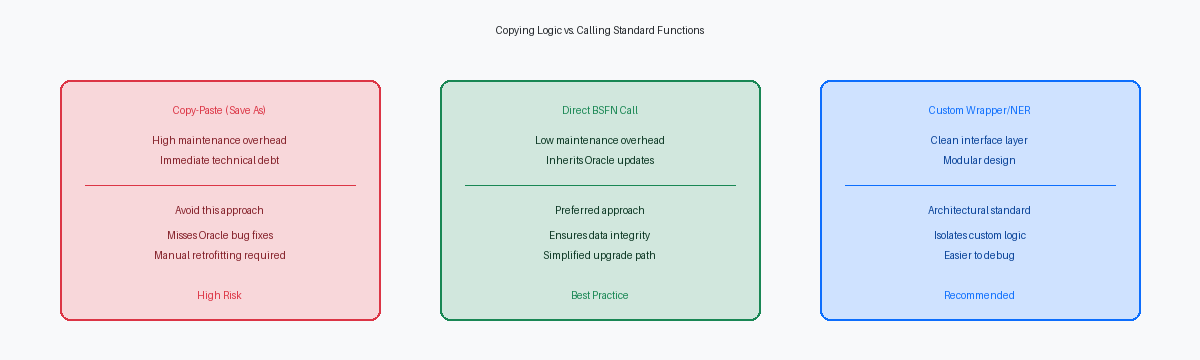
In a typical enterprise environment with over 5,000 custom objects, the most significant source of technical debt is the "Save As" culture. JDE BSFN calling standard functions instead of copying logic is the only sustainable way to manage complex customizations without creating an unmanaged fork of Oracle’s intellectual property. When a developer clones thousands of lines of C code from a standard Master Business Function (MBF) just to bypass one validation, they create a maintenance liability that eventually derails upgrade projects.
The False Economy of Logic Duplication
Developers often convince themselves that cloning a standard business function is a defensive move. They look at the 150+ parameters in a Master Business Function like B4200310 and decide it is easier to copy the source code into a 55/56 custom object than to map the data structure correctly. This creates an immediate fork in the logic that begins to decay the moment the project goes live. By isolating the code, they aren't protecting the customization; they are intentionally blinding it to every critical ESU and Application Update Oracle releases to address regulatory changes or edge-case data corruption.
A full copy of B4200310 (Sales Order Entry) typically exceeds 10,000 lines of C code, encompassing complex dependencies on cache management and internal sub-routines. When Oracle updates the F4211 schema—adding fields for localized tax requirements or advanced pricing features—the standard MBF is updated to handle these via the Planner ESU and subsequent code drops. Your custom clone remains frozen in time. If you have 500 custom objects and a significant portion of them, roughly 10%, are clones of major MBFs, you have effectively doubled your technical debt for the next Tools Release upgrade.
The Master Business Function (MBF) serves as the gatekeeper for data integrity within the JDE database. Invoking the standard function directly ensures that every validation check, from credit limits to commitment swaps, executes against the current Master Business Logic (MBSL) definition. When you bypass the standard call to run custom logic, you risk orphaned records in the F42199 or F4201 tables. In a high-volume environment processing thousands of orders per hour, a single missed cache clearance in a cloned function can lead to memory leaks that crash a CallObject Kernel in minutes.
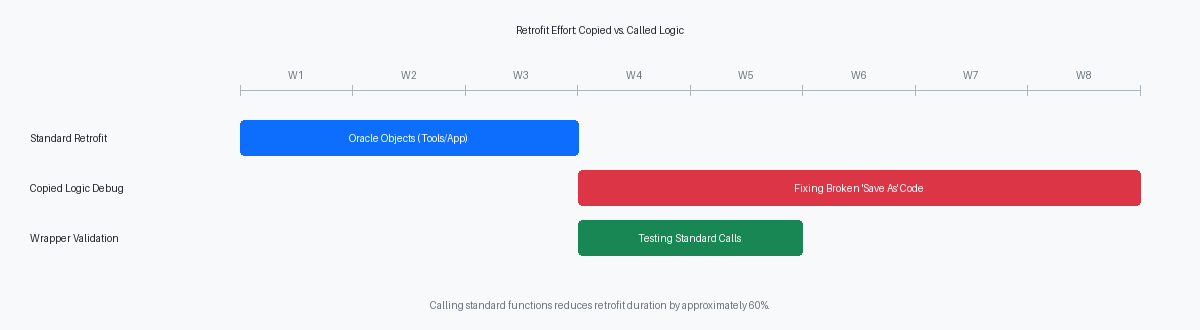
Maintaining a wrapper function that maps specific inputs to the standard parameters is a half-day task. Retrofitting an over 10,000-line cloned function after an EnterpriseOne 9.2 update can take a full work week of senior developer time once you factor in the inevitable debugging of pointer mismatches. Stick to the standard API. If the standard function lacks a specific hook, use a Post-Text Trigger or an Orchestration to extend the behavior rather than replicating the core engine.
Upgrade Risk and the Hidden Retrofit Trap
Visual ER Compare and OMW comparison tools identify deltas between versions of the same object ID. When a developer copies B4200310 to a custom 55 object to tweak a tax calculation, they blind the upgrade team to future Oracle enhancements. During a 9.1 to 9.2 migration, standard impact analysis identifies the 200–500 truly impacted custom objects where a standard object was modified. The copied C BSFN remains invisible to these tools because it is a unique custom object with no lineage to the original source.
These stealth objects are primary sources of Day 1 production failures. While the code compiles on a new Tools Release, the logic frequently breaks due to changes in table triggers or shared cache structures like the Sales Header (UI01) or Detail (UI11) caches. If Oracle adds a required segment to a cache structure in the standard BSFN to support a regulatory requirement, your copied function will likely cause a memory violation or silent data corruption because it operates on an obsolete cache definition.
Maintaining a logic clone doubles the testing footprint. For every ESU Oracle releases to fix a bug in the standard function, your team must manually identify the fix and port the code line-by-line. This manual reconciliation bypasses the automated benefits of the Specification Merge, forcing senior developers to spend hours in C++ editors instead of focusing on high-value Orchestrator integrations.
Shift the strategy toward creating wrapper BSFNs that call the standard Oracle functions. This narrows the upgrade impact to the interface level. If the data structure (DSTR) changes, the compiler flags it immediately. The upgrade team can then address the interface change in minutes rather than hunting for a runtime null pointer buried in thousands of lines of copied C code.
Encapsulation and Data Integrity via MBSL
Replicating XT0411Z1 (Voucher Entry MBF) logic in a custom BSFN or NER is a high-risk architectural mistake. This function manages synchronous updates across the F0411, F0911, and F0011 tables while maintaining the integrity of the batch header and GL distribution. When a developer copies the insert logic to avoid the perceived overhead of the Master Business Function, they almost always miss the specific commitment control boundaries or the sequencing required for GL post-readiness. We have audited custom voucher upload UBEs that created thousands of F0411 records where the corresponding F0911 entries were missing or the F0011 batch total was never updated, requiring several days of manual SQL repair to balance the subledger.
Standard functions utilize the JDE kernel to manage Next Numbers and security constants without requiring custom code. When you call XT0411Z1, the system automatically fetches the next available document number from the F0002 and applies company-specific constants from the F0010. Bypassing this via direct Table I/O results in document number gaps or duplicate key errors during high-concurrency batch processing. The JDE kernel handles the record locking on the F0002 table; writing custom C code to replicate this safely in a multi-threaded environment is a week-long effort that typically fails under peak load.
Bypassing the MBF layer leads to orphaned records in secondary tables like the F42199 (Sales Ledger) or F4111 (Item Ledger). In inventory transactions, skipping the standard BSFN means the F41021 (Item Location) quantities become decoupled from the ledger. These data integrity issues often remain hidden until a year-end audit or a physical wall-to-wall inventory reveals a double-digit variance. Using the standard function ensures that every internal trigger, from tax calculation to audit logging, executes in the correct sequence.
Modernizing via Orchestrator and AIS makes the use of standard BSFNs a prerequisite for stability. Most Orchestrations act as wrappers around standard Master Business Functions; if your custom logic bypasses these functions, you cannot expose that logic to REST calls or mobile apps without a total rewrite. Sticking to the standard BSFN call interface ensures that any Oracle update to the underlying table schema is handled automatically by the ESU, keeping your integration path functional through the 2034 support horizon.
Managing Hidden Dependencies and Cache
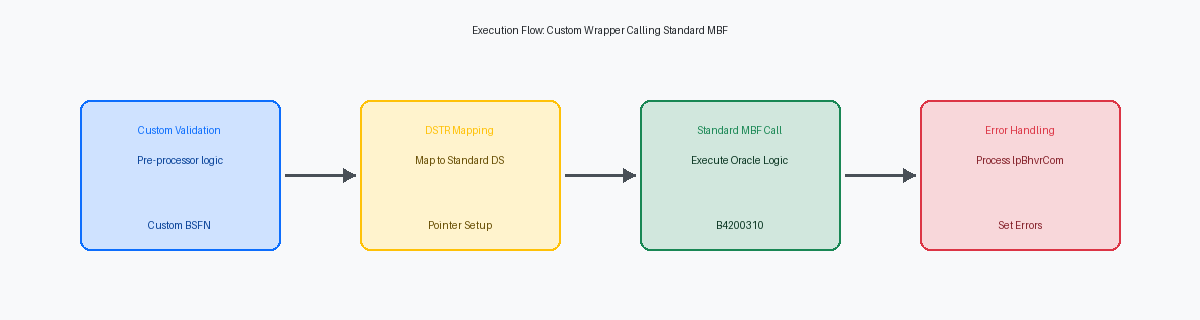
Calling a standard MBF like F4211FSBeginDoc or F0911BeginDoc isn't just about passing a data structure; it is about maintaining environment context. If you fail to pass the lpBhvrCom and hUser pointers from your wrapper BSFN down to the standard function, you break the connection to the user's session. This often results in the standard function failing to resolve the correct environment or losing the transaction boundary. In a multi-threaded CallObject kernel, an uninitialized hUser pointer is a direct ticket to a zombie process or a "COB0000012 - Local user handle not found" error that is notoriously difficult to debug.
Standard MBFs are heavily reliant on JDECACHE to maintain state between BeginDoc, EditLine, and EndDoc calls. When you call these functions from a custom C BSFN, you are responsible for ensuring the cache keys—typically a combination of Job Number (JOBS) and Computer ID (CTID)—are synchronized across every call in the stack. If your custom logic initializes a new Job Number but fails to pass it into the MBF's data structure, the function searches for a non-existent cache bucket. This mismatch usually manifests as a silent failure where the MBF returns a warning but no data is written to the work files, leaving the transaction in a partial, unrecoverable state.
Precision in data structure mapping is the difference between a successful integration and a memory violation. When nesting calls, specifically with MATH_NUMERIC and JDEDATE types, any misalignment in the source and destination structures will corrupt the stack. We have seen dozens of instances where a developer passes a pointer to a MATH01 variable instead of the variable itself, leading to an immediate 0xC0000005 access violation. You must use ParseNumericString or FormatMathNumeric to ensure the internal components of the MATH_NUMERIC structure are correctly populated before the standard function attempts to perform arithmetic or currency conversion.
The most frequent point of failure in these integrations is the mismanagement of the 'cActionCode' or 'cMode' parameter. Standard functions are rigid; passing an 'A' (Add) for a record that already exists in the cache or the physical table causes the MBF to throw a hard error. Conversely, passing a 'C' (Change) without first calling the 'Fetch' equivalent to populate the cache results in an 'Update Failed' status. Developers often overlook that standard MBFs expect the internal state to match the Action Code exactly, requiring a disciplined sequence of calls that mirrors the standard JDE power forms logic.
Regression Testing the Integration Path
Enabling Object Usage Tracking (P980011) in your production environment six months before an upgrade cycle provides the data needed to map exactly which standard Master Business Functions (MBFs) your custom wrappers invoke. Without this telemetry, you are guessing which B0100033 or B4200310 calls are critical paths and which are legacy noise. This data allows you to isolate the integration points where custom C code hands off data to standard logic, ensuring regression testing covers the actual footprint of the business process.
Automated testing scripts in the 9.2 environment must focus on boundary cases where custom logic intersects with standard MBF validations. When you pass a custom-calculated date into a standard BSFN, the validation layer in the standard function acts as your first line of defense. Testing should target these hand-off points to ensure that ESUs applied to standard objects haven't tightened validation rules in a way that breaks your custom inputs.
Debugging these nested BSFN calls in 'C' requires a local development client and a disciplined review of the CallStack in the jdedebug.log. When a custom wrapper fails three levels deep inside a standard kernel call, the log provides the only reliable map of the memory pointers and data structure values being passed. You are looking for the exact moment a pointer becomes invalid or where a MathNumeric variable exceeds its precision. This forensic analysis prevents intermittent memory violations in the new tools release.
Shifting logic to standard functions reduces the UAT cycle by roughly 20% because the core business logic is already Oracle-certified. Your business users only validate custom deltas, rather than re-proving that the General Ledger or Sales Order Entry logic still works. This efficiency gains back significant time in a standard upgrade window, allowing the team to focus on high-value Orchestrator enhancements instead of repetitive regression.
Performance Implications of Nested Calls
A standard BSFN call via jdeCallObject adds roughly 0.1 to 0.5 milliseconds of overhead depending on the server hardware and network latency. In a typical Sales Order Entry (P42101) stack where F4211FSEditLine might be called 50 times for a large order, the cumulative overhead of nesting sub-functions remains under 30 milliseconds. This is a rounding error compared to the hundreds of hours of forensic accounting required when a copied and modified version of F4114GetItemCost fails to update the F4105 correctly because a fix in the standard object was not replicated.
The transition to 64-bit JDE in Tools Release 9.2.5 and beyond fundamentally changed how the Enterprise Server manages the call stack for deep nesting. In the old 32-bit architecture, each nested BSFN call consumed a portion of the limited 4GB address space, often leading to memory allocation failures during heavy batch processing in R42800. With 9.2.5+, the flat memory model allows the runtime to handle pointers and large data structures more efficiently. You can nest five or six levels deep—calling F4211FSBeginDoc inside a custom wrapper—without hitting the architectural wall that previously forced developers to flatten their logic into monolithic, unmaintainable C functions.
Properly referencing standard header files (.h) in your custom C code ensures that your BSFN uses the exact memory alignment expected by the standard API. Instead of re-defining a data structure manually, which invites member alignment mismatches during a Tools Release upgrade, including the standard header allows the compiler to validate the structure at build time. This approach reduces the overall memory footprint of the jdenet_n process because the system is not juggling multiple, slightly different definitions of the same D4200310H structure across different DLLs.
Serialization time between the Enterprise Server and the HTML Server is often the real bottleneck, not the execution of the C code itself. A Data Structure (DSTR) with 200 members, half of which are unused parameters, increases the XML payload size and slows down the CallObject response. By stripping custom DSTRs down to the 15 or 20 essential elements required for the transaction, you reduce the serialization overhead by nearly half. This optimization, combined with the 64-bit runtime's ability to handle complex pointer math, makes calling standard functions the only defensible architecture for modern development. Technical debt is a choice made at the keyboard, and prioritizing standard function calls over logic duplication ensures your environment remains ready for the 2034 support horizon.
