




A single one-byte misalignment in a C business function (BSFN)A reusable piece of logic written in C or Named Event Rules that performs specific tasks in JD Edwards. data structure—such as a mismatch between DSTRA definition of the input and output parameters used by a business function or application. specs on the Enterprise ServerThe central server that processes logic and manages database connections in a JD Edwards environment. and local workstations—rarely triggers an immediate, clean crash. Instead, because the JD Edwards runtime passes pointers to packed memory structures by reference, a mismatch silently shifts the memory offset. This corrupts adjacent variables, turning a routine transaction into a source of erratic MATH_NUMERICA specialized JDE data type used to store and manipulate numeric values with high precision. failures or phantom UBEA background process or report that runs on the server to process data in bulk. crashes that defy standard troubleshooting.
Resolving these silent corruptions requires moving beyond basic jde.log analysis. This guide walks through a JDE BSFN data structure mismatch debugging example involving a custom inventory interface where a stale specification on an HTML serverThe web server component that renders the JD Edwards interface for users in a browser. caused a pointer offset shift. We will isolate the exact byte discrepancy using jdedebug.logA detailed trace file that records every SQL statement and API call during a JDE session. tracing and demonstrate how to attach the Visual Studio debugger directly to the active process to capture memory corruption before it pollutes the database.
The Mechanics of Memory Alignment in JDE BSFNs
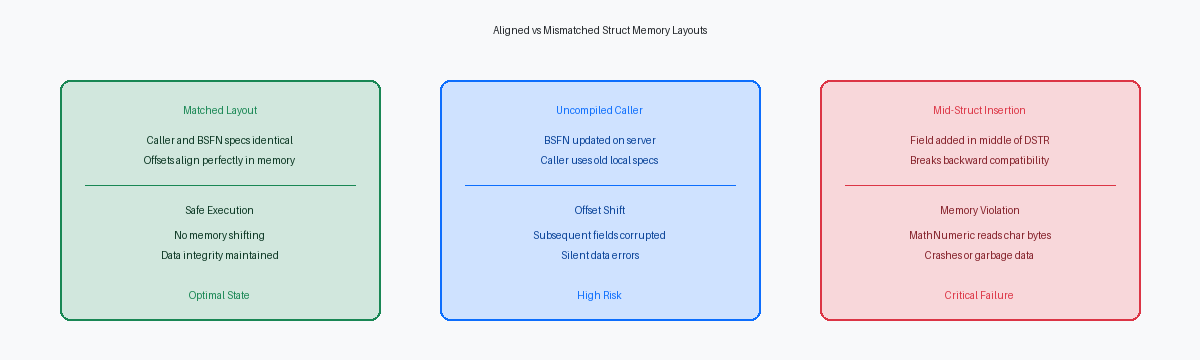
Every JDE business function written in ANSI C relies on typedef structures generated by Object Management Workbench (OMW)The central development environment in JD Edwards for managing objects and code changes. from the F98602 (Data Structure Master) and F98603 (Data Structure Detail) specifications. When a caller object, such as an APPLAn interactive web-based application used by end-users to enter or view data., UBE, or another BSFN, invokes a business function via the JDE engine, it allocates a contiguous block of memory representing this exact data structure. If this memory block is misaligned by even a single byte, the runtime engine misinterprets the boundary of every subsequent parameter in the stack.
This misalignment typically occurs when the compiled C header file (.h) on the enterprise server or fat client does not match the specifications of the calling object. The shift from 32-bit to 64-bit memory alignmentThe way data is arranged in computer memory to match the processing width of modern 64-bit CPUs. boundaries in EnterpriseOne Tools Release 9.2 magnified this issue, changing how compiler pragmas pack structures. In a 64-bit architecture, pointers scale to 8 bytes while legacy types like MATH_NUMERIC retain their internal 36-byte structure, meaning any discrepancy in the header file immediately causes the runtime offsets for each parameter to diverge.
When offsets diverge, the execution engine reads bytes from adjacent fields. A one-byte character flag might be read as the start of a MathNumeric pointer or an ID variable, causing the enterprise server to throw a memcopy violation or write garbage values directly into the database. In one case on Tools Release 9.2.7, a custom sales order validation BSFN threw random memory violations because the server's .h file was missing a single newly-added parameter, causing a pointer offset shift of exactly four bytes that corrupted the lpBhvrCom pointer.
Identifying Mismatches in the Jdedebug Log
Isolating business function memory corruption requires a clean jdedebug.log captured from a single-threaded HTML session or a local development client. When a mismatch occurs, the execution runtime misinterprets the memory offset of the incoming data structure, reading bytes from the wrong address. Capturing this failure under clean trace conditions isolates the exact boundary where the data structure's memory layout diverges from what the compiled C code expects.
The primary diagnostic anchors are the Entering jdeCallObjectA core JDE API used to trigger the execution of a business function. and Exiting jdeCallObject trace lines for the target business function. Comparing the parameter values dumped in the Entering block against the actual variables passed by the calling object pinpoints where the data corrupts. If the calling application or UBE passes a valid, formatted string like "10001" to the cost center parameter, but the log shows corrupted characters or a blank value immediately after the entry boundary, this indicates a data structure mismatch.
The mismatch manifests as corrupted or swapped values within the internal BSFN statements immediately upon entry. As the runtime attempts to map the misaligned memory, it often triggers specific engine-level warnings. Search the log for COB0000012 - Get direct pointer to LPDS failed, which indicates the call object kernel failed to resolve the local data structure pointer. Alternatively, unexpected Invalid Math Numeric conversion errors will occur inside the execution block because the runtime tried to parse an offset containing text characters as a MATH_NUMERIC structure.
The Silent Killer: Parameter Order and Data Type Shifting
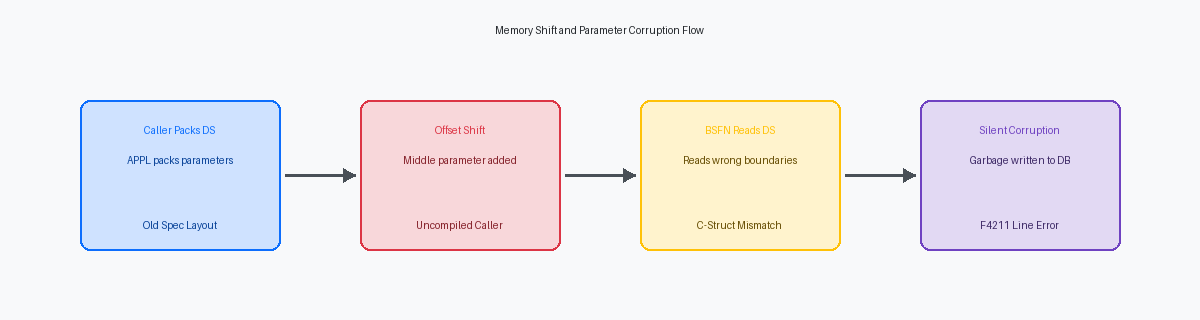
Inserting a new parameter into the middle of an existing Data Structure (DSTR) instead of appending it to the end is the primary catalyst for memory corruption in the EnterpriseOne call stack. Developers often do this to maintain logical grouping in the DSTR design tool, unaware that they are introducing critical runtime risks. If a caller object like an APPL or a UBE is not recompiled and built into the same parent package, it remains blind to this structural alteration. It continues to map and pass memory blocks based on the old parameter offsets, shifting every subsequent field by the exact byte size of the newly inserted element.
Consider the mechanical reality of a MATH_NUMERIC structure, which occupies eleven bytes of memory in the C runtime. If you insert a single-byte character field (like EV01) directly ahead of a MATH_NUMERIC parameter in the DSTR, the uncompiled calling object still transmits the pointer to the old memory offset. The receiving C business function then attempts to parse a memory segment shifted by exactly one byte. Instead of reading the valid numeric structure, the engine interprets random memory noise—often null terminators or adjacent pointers—as the numeric value, triggering immediate memory violations or corrupted data generation.
In one production incident, a custom sales order validation BSFN began writing corrupted F4211 line numbers (LNID) to the database. A developer had inserted a new flag into the middle of the validation DSTR but only promoted the BSFN, leaving the calling P42101 power form uncompiled in the production pathcodeA specific environment or set of central objects, such as Development (DV) or Production (PD).. The four-decimal-place LNID field shifted, causing the C engine to read junk memory and write line numbers like 101.2039 instead of 1.000. Rebuilding the local specifications and enforcing a full package build for both the BSFN and the P42101 immediately stabilized transaction processing.
Step-by-Step Debugging of a Mismatched Pointer in Visual Studio
Diagnosing memory corruption caused by a corrupted spec requires direct inspection of the memory layout rather than relying solely on log files. Using Visual Studio on a development client, open the BSFN's C source file and attach the debugger to the active activeConsole.exe process. For interactive applications (APPL), this process handles local runtime execution, whereas local UBE execution requires attaching to RunBatch.exe.
Once attached, set a breakpoint at the first executable line inside the target C function, immediately following the variable declarations. Trigger the event in the APPL or UBE to hit the breakpoint. When execution pauses, add the lpDS pointer to the Visual Studio Watch window to inspect the memory address allocated for the data structure.
Expand the lpDS structure in the Watch window to expose its individual members and their runtime values. Compare these values against the parameters passed by the calling APPL or UBE. If a MATH_NUMERIC member containing a short integer like 1 shows up as a massive corrupted value like -1163005939, or if a string parameter contains shifted characters from an adjacent field, an alignment offset is present.
To prove the misalignment, verify the memory addresses of the struct members directly. If the memory addresses of the struct members do not align with the variables passed by the caller object, the data structure mismatch is confirmed. This confirms that either the local specifications on the development client are out of sync with central objects, or a recent data structure modification was not built and deployed correctly to the runtime environment.
Rebuilding Specs and Cleansing the Spec Database
Resolving a corrupted data structure boundary begins in Object Management Workbench (OMW) on the development client. The typedef in the C source file should not be modified manually; instead, regenerate the C header file directly from the OWM specifications to ensure the alignment matches the JDE repository. Once regenerated, run a full local build of the business function (BSFN) via BusBuildA JD Edwards utility used to compile C business functions into executable libraries. to compile the new structure into the local bin directory. Crucially, any calling object—whether a parent BSFN, a UBE, or an interactive application (APPL)—must be recompiled or regenerated immediately to prevent the transmission of stale pointers.
When the mismatch manifests only on the Enterprise Server, the root cause is typically an out-of-sync spec database where tables like F98710 (Tool Definition Spec) and F98720 (Data Structure Spec) contain mismatched records compared to the deployed DLLsFiles containing compiled code that can be used by multiple programs simultaneously. or shared libraries. This drift typically occurs when a partial package deployment fails to update the spec tables in the central objects database, leaving the runtime engine reading old parameter offsets. To resolve this, deploy a clean update package to ensure the relational specs and the compiled C binaries are synchronized.
To guarantee that old specifications do not persist in memory, clear the local spec cache on the development client by deleting the local spec folder under the path code directory (e.g., DV920/spec). For web environments, access the Server Manager console and execute a clear cache command for the JDB database and serialized instruction caches on the HTML and AIS serversServers that enable mobile and third-party applications to interact with JD Edwards via REST services.. Skipping this step will cause testing to continue to fail with memory violations, even though the database specs and C code are aligned.
Defensive Coding Patterns to Prevent Structure Mismatches
Altering a production-proven data structure (DSTR) like the one for B4100210 (Inventory Decisions) introduces severe memory corruption risks. When business requirements demand new parameters, do not insert them into the middle of an existing structure. Instead, clone the business function to a new custom object or append the new members strictly to the end of the existing DSTR. This ensures that legacy callers, compiled against the original structure size, do not offset their memory writes into incorrect positions of the newly expanded C structure.
To enforce this safety net programmatically, implement a DSTR version signature validation parameter as the first element of the data structure. By placing an INT or CHAR version identifier at offset zero, the receiving C business function can immediately evaluate if the calling Application (APPL) or Universal Batch Engine (UBE) is passing a compatible spec version. If the incoming signature reads 2 but the BSFN expects 3, the code can gracefully exit with a custom jdeSetGBLError instead of executing a misaligned memory write that triggers a zombie processA server process that has completed execution but remains in the process table, often due to a crash. on the Enterprise Server.
Using generic lpVoid pointers to pass custom structures inside standard JDE data structures bypasses the compiler's type-checking safety net. Restrict casting to scenarios where standard APIs like jdeAllocA specific JDE programming function used to reserve a block of memory for data storage. or cache retrievals require it, and document the expected structure size explicitly. Finally, establish a rigid deployment protocol: any change to a DSTR should bypass the standard update package route. Deploying a modified DSTR via an update package frequently leads to partial spec distribution where the enterprise server runs the new structure but the local client or HTML server runs the old one; a full package build is required to guarantee spec synchronization across all path codes.
When retrofitting the 200–500 impacted objects typical of a 9.2 upgrade, these data structure alignment errors often signal deeper 64-bit migration risks or memory allocation discrepancies that require systematic validation before deployment.
