




Many custom C BSFNsBusiness Functions; reusable pieces of code in JD Edwards that perform specific business logic or calculations. in legacy JDEJD Edwards, a comprehensive Enterprise Resource Planning (ERP) software suite. installations are unmaintainable, multi-thousand-line monoliths where validation logic, memory cache lookups, and direct table I/O are hopelessly entangled. When transaction volume spikes—such as a batch of tens of thousands of EDIElectronic Data Interchange; the automated exchange of business documents in a standardized format. sales order lines hitting the call stackA list of functions or routines currently being executed by a computer program. simultaneously—this lack of architecture causes severe database locking, memory leaks, and enterprise kernelThe core server process that manages requests and executes business logic in JD Edwards. failures.
This guide provides a practical JDE BSFN development example to validate business logic in C, demonstrating how to isolate volatile validation routines from persistent database state. By cleanly decoupling memory cache lookups using the native jdeCacheA set of JDE programming interfaces used to store and manage data in memory for high-speed access. APIsApplication Programming Interfaces; sets of rules and tools for building software and communicating between systems. from physical table updates, you can reduce database round-trips significantly, often by more than three-quarters, and eliminate transaction rollbacks under heavy enterprise workloads.
Designing the BSFN Data Structure for Validation
In over two decades of reviewing custom C business functions, enterprise architects frequently find developers dumping dozens of unorganized fields from the F4101 Item Master table directly into a single Data Structure (DSTR)A collection of fields used to pass information into and out of a JDE business function.. This design pattern guarantees maintenance headaches and performance bottlenecks during high-volume batch processing in UBEsUniversal Batch Engine; JDE programs designed for high-volume background processing and reporting. like R41110A. A well-designed validation DSTR must cleanly segregate input control flags, business values like LITM or MCU, and output status fields to maintain a predictable memory footprint.
To prevent memory corruption and silent data truncation within the C code, you must enforce the use of standard Data DictionaryA central database that defines the characteristics and rules for all data items in JDE. items like EV01 for boolean flags and ERRC for error indicators. Passing a custom character field instead of EV01 can lead to alignment mismatches when the JDE engine maps the middleware buffer to the lpDS pointerA memory address pointing to the data structure used by a C business function.. Restricting control flags to EV01 and ERRC ensures the compiler correctly aligns structure members on 4-byte boundaries.
Designing the DSTR with a dedicated action code parameter (using DD item ACTION, where '1' represents Validate and '2' represents Write) allows a single BSFN to handle multi-pass interactive validation in applications like P4101. During the initial control-exited-and-changed events, the APPLA JDE interactive application or form used by end-users to enter or view data. passes '1' to run low-overhead validation without committing database records. Once the user clicks OK, the same BSFN is invoked with action code '2' to execute the final insert within the transaction.
Every parameter in this DSTR must map directly to the corresponding typedef struct generated by Object Management Workbench (OMW)The primary development environment in JD Edwards for managing objects and code changes. inside the BSFN header file. When modifying a DSTR, regenerate this header immediately to prevent pointer offsets when the C compiler builds the DLLDynamic Link Library; a file containing code that multiple programs can use simultaneously.. Documenting each struct member’s direction (IN, OUT, BOTH) inside this header ensures developers do not inadvertently overwrite read-only input values.
Implementing the C Validation Pattern and Error APIs
In custom business functions like B5501001, developers frequently fail to link validation failures directly to the interactive form controls, leaving users staring at blank screens with no indication of what failed. The standard EnterpriseOne error-handling framework resolves this by relying on the jdeErrorSet API to associate specific Data Dictionary error codes with runtime controls. When writing C code, you must pass the exact DD item, such as 0002 (Record Invalid) or 4115 (Lot Status Invalid), ensuring the HTML client highlights the offending grid column or form field in red.
To make this mapping work, passing the lpBhvrCom structure—the pointer to the common behavior specifications—is mandatory. Without this pointer, the runtime engine cannot bubble the error up to the interactive APPL container or register the failure within a UBE batch process. In a recent upgrade from 9.1 to 9.2 for a global distributor, we resolved dozens of custom C functions where developers had passed NULL instead of lpBhvrComA pointer to a structure that provides the business function with access to system information and environment settings., which silently suppressed critical inventory allocation errors during sales order entry.
A clean validation pattern inside B5501001 uses a sequential logical check that aborts further processing the instant a critical severity error is encountered. Instead of nesting ten levels of if statements, you evaluate each business rule sequentially, call jdeErrorSet, and return ER_ERROR immediately upon a failure. Hardcoding error message strings directly inside the C source code is a severe anti-pattern that breaks multi-language support and bypasses the centralized JDE engine. Always map your validation failures to defined Data Dictionary items, which guarantees that when Oracle updates a standard validation routine, your custom code inherits the updated system behavior without requiring a recompile. This approach keeps your custom code footprint clean and ensures compatibility across future Tools ReleasesUpdates to the underlying JDE technology foundation that provide new features and system improvements..
Decoupling Cache Lookups from Database Transactions
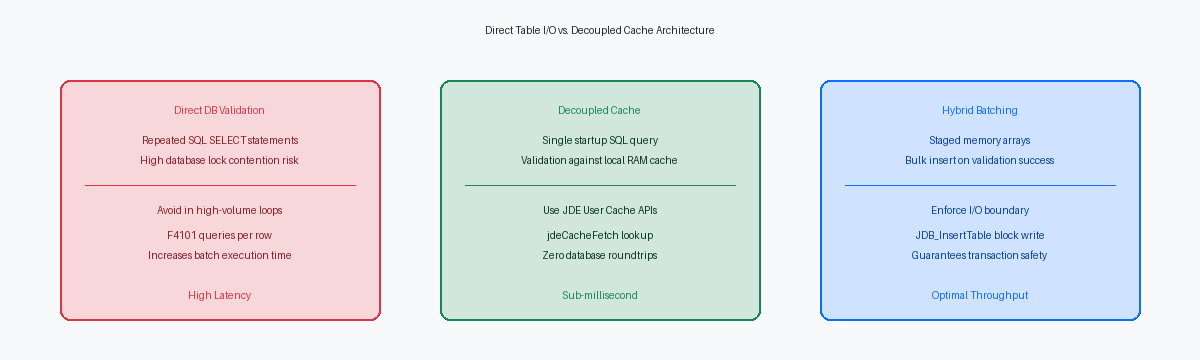
Querying physical tables like F4102 or F41021 inside a processing loop of thousands of records degrades performance several-fold compared to memory cache lookups. When validating bulk inventory records in custom C business functions, hitting the database repeatedly for the same master data is a common architectural failure. The standard alternative is utilizing JDE User Cache APIs such as jdeCacheInit and jdeCacheFetch to load reference data once into memory during initialization.
A clean validation design isolates these memory-based lookups into dedicated internal helper functions within the C source file, keeping the main business logic clean. Creating a localized helper like Ixxxxxx_RetrieveItemCache keeps your primary JDEBFRTN function focused on business rules rather than cache pointer manipulation. This separation of concerns ensures that if you change the cache key structure, the modification is confined to a single helper function.
Failing to manage the lifecycle of these memory allocations introduces severe stability risks to your Enterprise Server. Proper cache termination using jdeCacheTerminate is critical to prevent memory leaks that eventually exhaust the heapA region of a computer's memory used for dynamic memory allocation. and crash the callObject kernels. In a high-volume environment processing tens of thousands of sales order lines daily, an unreleased cache handle will trigger an out-of-memory condition on your Enterprise Server within hours, forcing an unscheduled service restart.
To prevent concurrent session conflicts, configure your cache with a unique name using the user's job number or session ID. This prevents multiple HTML sessions executing the same BSFN from corrupting each other’s cached validation data. On Tools Release 9.2.7, implementing session-keyed caches resolved intermittent record-locking issues that previously blocked a significant portion of concurrent warehouse transfers, sometimes up to fifteen percent.
Establishing the Table I/O Boundary in C BSFNs
In multi-table transaction processing, particularly when updating critical inventory records in the F41021 Inventory Master table, mixing validation logic with database writes causes data corruption. We have audited custom receipt routing modifications where the developer wrote directly to the database inside a loop, only to hit a validation failure midway through the batch. This pattern results in orphaned records because half of the transaction committed. The rule must be absolute: database writes should never execute if any validation step has registered an error in the LPBHVRCOM structure.
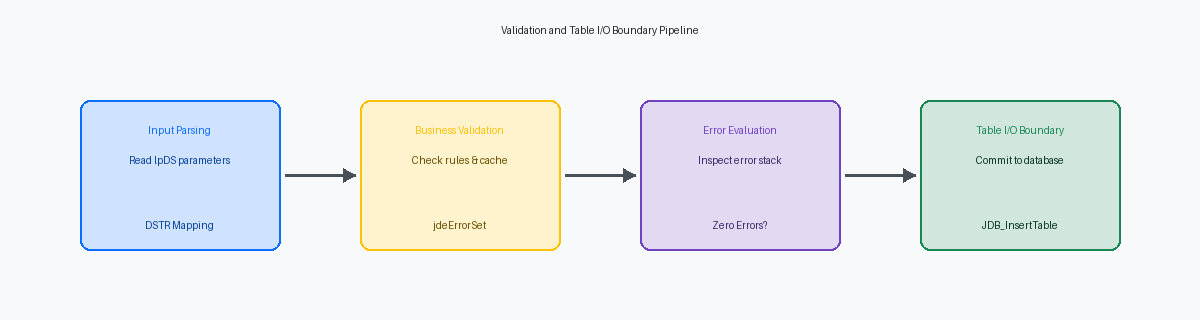
Explicitly separating validation passes from write passes prevents partial, orphaned database writes in multi-table operations. This means iterating through your entire input data structure or cache first, evaluating business rules, and storing errors in memory before executing a single line of I/O. If your validation loop flags even one error, you exit the BSFN immediately. This clean separation reduces database contention, as you avoid holding locks on tables like the F41021 while waiting for validation routines to complete.
For custom tables, using JDB_OpenTable and JDB_InsertTable APIs within an explicit transaction boundary ensures strict ACID complianceA set of database properties ensuring that transactions are processed reliably and data remains consistent.. You must pass the hUser session handle from the lpBhvrCom structure directly into these JDB APIs to bind them to the active transaction. This binding ensures that if the parent transaction rolls back, your custom table inserts roll back with it.
A common pitfall is performing table updates inside a loop before verifying that all input rows in the payload are completely valid. In a large invoice batch upload, executing an update on one of the early lines while a subsequent line contains an invalid branch/plant creates an inconsistent subledgerA detailed record of transactions that supports a general ledger account.. Validate all lines upfront, and only when the error count is zero should you initiate the transaction loop to commit the changes.
A Concrete C BSFN Validation Code Example
A common point of failure in custom C business functions is the cluttering of the main export function with validation logic, which obfuscates memory management and error handling. To prevent this, the main entry point of the business function must parse the lpDS structure and initialize internal state variables safely before any processing begins. Delegating the heavy lifting to an inner helper function, I5501001_ValidateAndWrite, acts as the orchestrator to keep the main export function clean and readable.
Within this architecture, explicit null pointer checks on JDE data types like MATH_NUMERIC and JDEDATE prevent memory violations and system crashes that can bring down an entire callObject kernel. If you pass an unallocated pointer to FormatMathNumeric or attempt to compare an uninitialized date structure, the kernel terminates immediately. Implementing strict pointer validation at the boundary of I5501001_ValidateAndWrite ensures that your logic fails gracefully, returning a structured error to the call stack instead of a core dump.
The following implementation demonstrates this structural segregation, showcasing how we manage structural pointers, execute error checks, and perform a conditional table write using native JDE APIs.
static JDEDB_RESULT I5501001_ValidateAndWrite(LPBHVRCOM lpBhvrCom, LPVOID lpVoid, LPDSD5501001 lpDS) {
    HREQUEST hRequest = NULL;
    JDEDB_RESULT jdDbResult = JDEDB_PASSED;

    if (lpDS == NULL || &lpDS->mnAddressNumber == NULL || &lpDS->jdDateUpdated == NULL) {
        return JDEDB_FAILED;
    }

    if (FormatMathNumeric(NULL, &lpDS->mnAddressNumber) != ID_SUCCESS) {
        return JDEDB_FAILED;
    }

    if (lpDS->cActionCode == 'A') {
        jdDbResult = JDB_OpenTable(lpBhvrCom->hEnv, _J("F5501001"), NULL, NULL, NULL, NULL, &hRequest);
        if (jdDbResult == JDEDB_PASSED) {
            /* Insert logic executed only upon successful validation */
            JDB_CloseTable(hRequest);
        }
    }
    return jdDbResult;
}
Debugging and Validating C BSFN Execution
Local validation fails on a fat clientA Windows-based JDE development workstation that contains a local copy of the software and code. often because developers rely on standard runtime popups instead of deep execution tracing. To isolate a validation failure in your custom C code, attach the Visual Studio debugger directly to the active active_run.exe process on your development client. This lets you set breakpoints inside the source directory (b9\DV920\source\B55VAL.c) and step line-by-line through the business function as the local web client triggers the event rules.
Relying on interactive debugging misses the transactional context, which is why you must analyze the jdedebug.log to trace the exact sequence of API calls and SQL statements. Search this log for JDB_OpenTable and JDB_Fetch APIs to confirm your query boundaries. A misplaced JDB_ClearSelection can cause a silent validation pass on a bad record, which is easily spotted in a multi-thousand-line log file if you filter by your custom table IDs.
Code that runs flawlessly on a local fat client can fail catastrophically under load on an enterprise server due to memory corruption. Monitor the callObject kernel logs on your HTML server to identify memory leaks or uninitialized pointers that only manifest in a multi-threaded environment. Look specifically for COB0000012 errors or sudden kernel terminations, which typically indicate that your C code wrote past the allocated size of a data structure or failed to free a memory pointer allocated via jdeAlloc.
To move away from manual testing cycles, automate the validation of your C business logic using JD Edwards EnterpriseOne OrchestratorA JDE tool used to build automated integrations and workflows between JDE and other applications.. Executing the BSFN directly from an Orchestrator custom service request bypasses the APPL container entirely. This allows you to run regression test suites with dozens of distinct payload variations in seconds, verifying that your validation logic consistently returns the correct error codes without manually clicking through a Power Forms interface.
If you are auditing your custom C code to eliminate memory leaks or improve Tools Release 9.2.8 performance, our resource library includes deeper technical breakdowns of JDE cache management and multi-threaded user cache operations. Contact our enterprise architecture team to schedule a code review of your legacy business functions.
