




In our code reviews across dozens of JDE 9.2The modern version of JD Edwards EnterpriseOne enterprise resource planning software. environments, we routinely find that a significant portion of custom C BSFNsBusiness Functions: encapsulated pieces of logic written in C or Event Rules to perform specific tasks.—often around a third to half—needlessly duplicate standard Oracle logic. Developers often clone entire modules like B4200310 or B1200010 just to execute a single validation, rather than implementing a clean JDE BSFN jdeCallObjectA core C API used to execute JD Edwards business functions dynamically from code. example call to execute a reusable business function. This redundant code breaks during upgrades because it bypasses Oracle's continuous delivery updates. The cleaner approach is to call the standard business function dynamically from your custom C code.
Implementing a precise dynamic execution pattern using jdeCallObject allows you to reuse standard business functions while fully preserving transaction boundaries and the lpBhvrComA pointer to the Behavior Common structure, which stores environmental and session state for a function. error stack. By passing the correct behavior common structure and mapping your data structures dynamically, you avoid hardcoding database dependencies that fail during ESUsElectronic Software Updates: patches delivered by Oracle to fix bugs or add features to JDE.. This approach ensures your custom estate remains thin, upgrade-tolerant, and compatible with Oracle's support roadmap through 2034.
The Cost of Duplicating Core JDE Business Logic
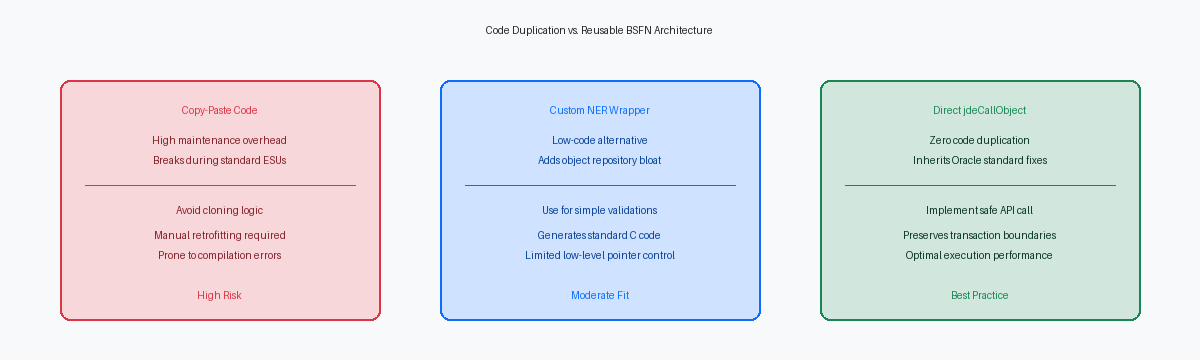
I regularly audit enterprise JDE environments containing 5,000 to 15,000 custom objects and find that between 10% and 15% of custom C business functions are unnecessary clones of standard logic. Developers often copy-paste a standard C function into a custom '55' object because they want to bypass a single validation check or override a hardcoded parameter. When you duplicate a complex master business function like Sales Order Entry Edit Line (B4200310), you inherit thousands of lines of highly volatile logic that your team must now manually retrofit during every upgrade or Electronic Software Update (ESU) cycle.
This duplication breaks the Oracle continuous delivery model. Instead of cloning standard objects, invoking the standard business function directly using the native jdeCallObject API ensures that any critical software fixes applied by Oracle automatically propagate to your custom applications. When Oracle delivers a tax calculation fix or an inventory allocation patch to the underlying standard code, your custom wrapper inherits that update immediately, completely eliminating weeks of manual code-merging and testing during your next 9.2 Tools ReleaseThe underlying technical foundation of JDE that manages the runtime, database, and system communication. upgrade.
Directly calling existing standard BSFNs also preserves the core database validation routines and guarantees transactional integrity across standard tables like F4211The Sales Order Detail table in the JD Edwards database. and F0911The Account Ledger table, where all General Ledger transactions are stored.. B4200310, for example, manages complex internal memory structures, tax calculations, and advanced pricing rules before committing records. Bypassing these native routines by writing custom SQL inserts or stripped-down custom C code inevitably corrupts downstream transactions, leading to broken ledger integrity reports that financial teams must reconcile manually at month-end.
Anatomy of the jdeCallObject API and LPBHID Structure
Directly invoking a business function from within C source code requires bypassing the standard Event RulesJDE's proprietary visual programming language used to define logic in applications and reports. engine and interfacing directly with the JDE core runtime engine. The jdeCallObject API is the gateway for this, demanding exactly four primary parameters passed in a rigid sequence: the target function name string (such as "F4111EditLine"), the behavior context pointer (lpBhvrCom), the user profile pointer (lpVoidA pointer to the User Profile structure, containing information about the current user's session.), and the pointer to the memory-allocated target data structure. Developers transitioning from Event Rules often underestimate the strictness of this C-level binding, where passing a null or improperly cast structure pointer triggers an immediate memory violation and a zombie kernelAn enterprise server process that has crashed or stopped responding but remains in the system's process list. on the enterprise server.
The second parameter, lpBhvrCom, acts as the operational nervous system for the call. This behavior structure maintains vital environmental state data, tracking active database connection handles, user session variables, and critical manual transaction processing boundaries. If you are executing a multi-table insert across F0911 and F03B11 within an active transaction, passing an uninitialized or corrupted lpBhvrCom pointer breaks the transaction boundary, causing the runtime to commit the first insert while silently failing on the second.
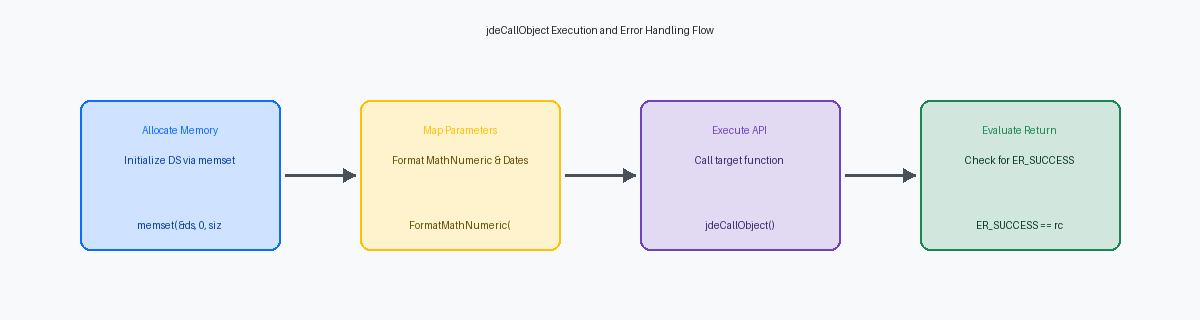
Every jdeCallObject execution yields an explicit JDEDB_RESULTA standard return type for JDE APIs indicating success, warning, or failure. return code that must be captured and evaluated. A return value of ER_SUCCESS (0) indicates successful execution, whereas ER_ERROR (2) or ER_WARNING (1) signals that the business logic failed to complete its routine. Skipping the immediate evaluation of this return code is a common, high-risk oversight in custom C BSFNs. Failing to check for ER_ERROR before proceeding allows downstream code to execute blindly, writing incomplete records to tables like F4211 and corrupting the transactional integrity of the entire database thread.
Data Structure Allocation and Mapping Patterns
Allocating memory for a target business function’s data structure requires strict adherence to alignment rules, especially since JDE transitioned to 64-bit processing with Tools Release 9.2.5. You must explicitly allocate this memory using either stack variables for smaller, local scopes, or dynamic heap allocation via the jdeAllocA JDE-specific API used to safely allocate memory on the system heap. API when handling variable-sized arrays or long-lived pointers. When using heap allocation, misaligning a MATH_NUMERICA proprietary JDE data structure used to store and manipulate numeric values with high precision. structure can cause instant memory faults on modern Linux enterprise servers.
Before passing this memory block to jdeCallObject, you must initialize the target data structure to null bytes using memsetA standard C function used to clear a block of memory by filling it with zeros. to wipe out any garbage stack values. Skipping this step often introduces intermittent bugs where uninitialized elements, like a flag field containing random memory junk, trigger false validation failures in standard MBFMaster Business Function: a centralized logic module that handles all validations and updates for a specific entity like Address Book. like F4211 Edit Line (B4200310). To prevent compilation type-mismatch errors on your enterprise compiler (whether Visual Studio or gcc), your custom calling BSFN must explicitly include the exact header file of the target function, such as b0100016.h for the Address Book MBF.
Managing data mapping within these structures reveals the limitations of standard C operators, which cannot copy complex JDE data types. Attempting a direct assignment on a MATH_NUMERIC or JDEDATEA proprietary JDE data structure used to store and manage dates. structure will corrupt the internal pointers and scale values, leading to silent database corruption. Instead, you must use dedicated APIs like FormatMathNumeric to convert numeric values to strings, or ParseDate and DeformatDate to safely manipulate date fields. For direct structure-to-structure copies, rely strictly on MathCopy and FormatDate to preserve the integrity of the decimal positions and internal structures before executing the call.
JDE BSFN jdeCallObject Example Call Implementation
Hardcoding master business function calls inside custom C business functions is where many junior developers fail, resulting in memory leaks or unmapped pointer errors. A standard, clean implementation calling the Address Book Master MBF (B0100016) requires declaring the DSD0100016 data structure directly in your custom C code rather than relying on generic pointers. This structure must be allocated on the stack to guarantee thread safety when executed under the JDE CallObject kernel architecture, which handles thousands of concurrent threads in a typical production HTML environment.
Before invoking the API, you must zero-init the structure using memset to prevent garbage memory from corrupting the JDE cache. Map your target Address Number input to the dsD0100016.mnAddressNumber member by converting the input string using the deformatMathNumeric API, which safely parses the numeric string into JDE's proprietary MATH_NUMERIC format. You then explicitly set the action code field, dsD0100016.cActionCode, to 'Inquire' to trigger a read-only fetch against the F0101 table.
With the data structure populated, execute the jdeCallObject API call by passing the LPBHID structure, the target function name 'F0101GetAddressBookData', and a pointer to your initialized DSD0100016 structure. Evaluating the return code is non-negotiable; you must check if the API returns ER_SUCCESS or ER_ERROR. Skipping this validation is the primary reason why silent failures occur, leaving custom applications with blank screen fields while the underlying kernel logs fill with unhandled exceptions.
If the API returns ER_ERROR, do not let the failure die in the C layer. Extract the specific error code from the JDE error stack using the jdeErrorSet API to bubble the message up to the interactive application or UBEUniversal Batch Engine: the JDE tool used for creating and running background reports and batch processes. level. This ensures the end-user sees the exact "Address Number Invalid" or "Search Type Mismatch" error on their screen rather than a generic, unhelpful web client exception.
Managing Transaction Boundaries and Error Stacks
A common failure point in custom financial interfaces is the creation of orphaned GL transactions due to isolated database connections. When executing transactional updates like Journal Entry Edit Line (B0900011), the child BSFN must join the active transaction boundary of the parent function. If you run B0900011 outside the parent's transaction, a subsequent failure in the voucher or invoice processing steps leaves uncommitted F0911 records or mismatched balances in the F0902 table. You must configure the parent-child relationship so they share a single database transaction, ensuring that either everything commits or everything rolls back.
Passing the active user handle (lpBhvrCom->hUser) inside the jdeCallObject invocation ensures that database lockouts and deadlocks are avoided. When the runtime executes nested business functions, using the parent's hUser pointer allows the database driver to recognize that the operations belong to the same session thread. If you mistakenly allocate a new user session via JDB_InitBhvr inside the child BSFN, the database treats it as a separate connection. This mistake leads to immediate thread blocking when the child attempts to update an F0911 row locked by the parent's uncommitted transaction.
If a child execution fails, you must invoke the standard JDE cache cleanup or rollback routines to prevent orphaned records in tables like F0911. Using manual transaction processing requires explicit calls to commit or rollback APIs depending on the final jdeCallObject return code status. When jdeCallObject returns ER_ERROR during a call to B0900011, you must immediately call jdeCallObject for B0900012 (Journal Entry Document Clean Up) to purge the cache. Failing to trigger this cleanup leaves stale header and detail data in the JDE cacheAn in-memory storage mechanism used to temporarily hold data for fast access during processing. structures, which corrupts the next transaction processed in the same call object kernel thread.
Performance Impact and Local Cache Management
Executing a loop that processes more than 10,000 records in a custom UBE—such as an inbound EDI sales order edit/update processor—will severely degrade system throughput if the target function performs redundant database lookups. A single repetitive query to F0010 or F0101 inside the loop adds cumulative SQL execution and network latency that can turn a minutes-long run into a multi-hour bottleneck. This overhead is entirely avoidable if you shift from disk-bound operations to memory-bound operations.
To optimize performance, developers must bypass repetitive disk I/O by utilizing standard JDE cache APIs like jdeCacheInitThe API used to initialize a named memory cache for storing temporary data. to store and reuse static setup data across repetitive child function calls. Loading constant tables or branch/plant constants into a named user memory cache during the initialization phase allows the system to resolve validation logic instantly. Retrieving a pointer from local memory takes less than a microsecond, whereas querying the database, even with index hits, incurs an unavoidable network round-trip.
Another critical area of optimization is database cursor and handle management. Keeping database table handles open across multiple iterations instead of allowing the called BSFN to open and close handles on every single call significantly reduces database cursor overhead. For example, passing a persistent table pointer or keeping the handle active in a parent data structure prevents the system from constantly allocating and deallocating OS resources. Finally, you must configure the calling and called BSFNs to execute within the exact same enterprise server thread. This specific OCMObject Configuration Manager: the system that determines where a specific object or logic should execute (locally or on a server). alignment prevents the JDE kernel from initiating cross-process communication or remote procedure call delays, keeping the entire execution stack local and fast.
Mastering jdeCallObject is the baseline for stabilizing a 9.2 custom code estate. If you are optimizing memory management or debugging complex cache patterns, this site contains deep dives on lpdsCommon usage and jdeCache API efficiency. You can also browse my technical project portfolio to see how these BSFN patterns scale in high-volume OCIOracle Cloud Infrastructure: Oracle's cloud platform for hosting enterprise applications and databases. integrations processing tens of thousands of transactions daily. These technical resources focus on the 200–500 truly impacted objects that dictate the stability and performance of your production environment.
