




A single mismanaged jdeAllocA JDE-specific function used to allocate memory on the server's heap for data storage. or unreleased cache handle within a custom BSFNBusiness Function; a reusable piece of C or Named Event Rule code that performs specific logic in JD Edwards. called inside a high-volume UBEUniversal Batch Engine; the JD Edwards tool used for running reports and background processing jobs. like R42565 can crash a CallObject kernelA server process that executes business functions requested by users or applications. in minutes, instantly terminating dozens of active user sessions on that specific JVMJava Virtual Machine; the environment that runs Java-based applications, such as the JD Edwards web server.. When troubleshooting unstable EnterpriseOne 9.2 environments, we frequently trace persistent zombie processes and memory leaks back to JDE BSFN memory management common mistakes in custom code rather than underlying database or OCIOracle Cloud Infrastructure; Oracle's cloud platform providing computing, storage, and networking services. middleware issues.
Generic C static analysis tools fail here because they do not comprehend the JDE-specific APIs—such as jdeAlloc, MATH_NUMERICA specialized JDE data structure used to store and manipulate numeric values with high precision. manipulations, or jdeCacheInitA JDE API used to initialize a temporary memory-based storage area (cache) for data.—that govern the EnterpriseOne memory heap. By analyzing how uninitialized pointers and missing jdeFreeA JDE-specific function used to release memory that was previously allocated, preventing leaks. calls behave under high-concurrency transaction loads, we can replace defensive guesswork with precise, repeatable code corrections that ensure server stability.
Unallocated lpDs Pointers and Null Structure Members
In over two decades of troubleshooting custom C business functions, few sights are as frustrating as a CallObject kernel crash dump file showing an access violation (0xC0000005 on Windows or a SIGSEGV on Linux) at a specific memory offset within a custom DLL. This crash frequently traces back to a developer assuming that every member of the JDE data structure pointer (lpDsA pointer to a data structure, commonly used in JDE C business functions to pass parameters.) is fully populated by the calling application. When an interactive application or an orchestration calls a business function, optional parameters left unmapped in the toolset do not pass default blank or zero values; they pass null pointers.
Attempting to read from or write to these unallocated pointer locations inside a custom C business function triggers an immediate segmentation faultA specific error that occurs when a program tries to access a memory location it isn't allowed to. on the enterprise server. In a multi-threaded JDE architecture, this is not an isolated, silent failure. A single unhandled null structure member does not just fail the current transaction; it terminates the entire CallObject kernel process. This immediate termination abruptly disconnects every active user session currently routed to that specific process ID, wiping out their unsaved transaction data and forcing them to re-establish their connection.
To prevent these production outages, defensive programming must be enforced in your design standards. You must write explicit NULL checks for both the parent lpDs pointer and its individual members before any memory assignment, string copying, or math manipulation occurs. Before executing a string utility function or calling a JDE API like MathCopy, verify the target pointer is valid using a conditional block such as if (lpDs != NULL && lpDs->lpMember != NULL). Implementing this basic validation across your most critical custom business functions will eliminate the vast majority of unexplained enterprise server kernel restarts.
String Buffer Overflows with JDE String Handling APIs
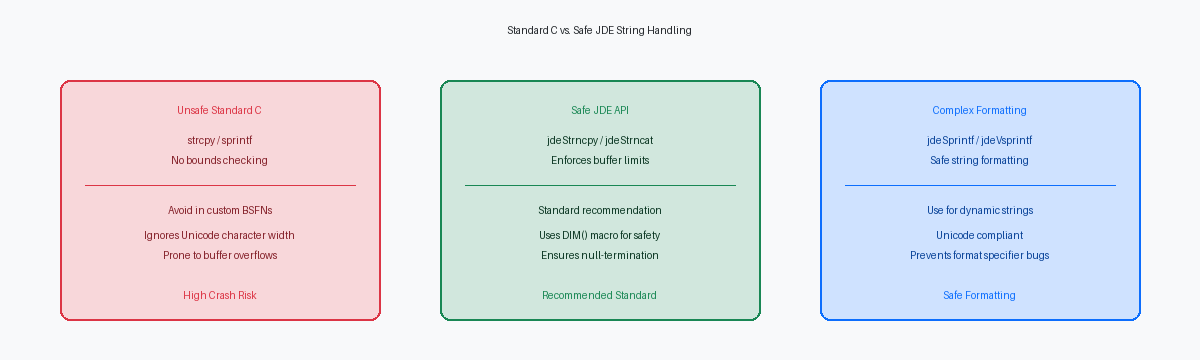
I still see legacy C business functions written with standard ANSI C string functions like strcpy and sprintf instead of the JDE API equivalents. These standard functions bypass JDE's unicode-aware character length handling, which expects JCHARThe JD Edwards data type for a character, supporting Unicode for international languages. (two bytes per character in the JDE runtime) rather than single-byte standard characters. When a custom BSFN processes multi-byte string data using standard C APIs, it miscalculates the actual memory footprints, writing past the intended boundaries and silently corrupting the heap.
Declaring a target buffer without accounting for the null terminator (for example, using char szBuffer[11] for a 10-character string but failing to scale for double-byte unicode elements) corrupts adjacent memory. In 64-bit Tools Release 9.2.5, memory alignment rules make these buffer overflows even more destructive by corrupting adjacent pointer addresses in the heap. Because the 64-bit compiler aligns data structures to strict 8-byte boundaries, a buffer overflow that previously wrote into harmless padding bytes in a 32-bit architecture now directly overwrites active memory addresses, triggering immediate CallObject kernel crashes.
Developers must size custom buffers using the defined Data DictionaryA central repository in JDE that defines the attributes and properties of all data items. length plus one and enforce bounds checking using the DIM macro with jdeStrncpy. Replacing raw assignments with jdeStrncpy(lpDs->szTarget, lpDs->szSource, DIM(lpDs->szTarget) - 1) ensures that the copy operation truncates safely rather than bleeding into adjacent memory addresses. Implementing this defensive check across your custom C repository prevents memory corruption before the code ever reaches the enterprise server runtime.
The Dangling Pointer and the Missing jdeFree
A minor memory leak seems negligible during unit testing on a local development client, but it becomes fatal in production. Consider a custom inventory reconciliation UBE processing a loop of tens of thousands of records. If a custom C business function called within that loop allocates memory via jdeAlloc but fails to release it, that tiny leak compounds into a significant megabyte-scale loss. On a 32-bit CallObject kernel architecture, or even under heavy multi-threaded enterprise workloads on 64-bit Tools Releases like 9.2.7, this cumulative leakage rapidly exhausts the kernel's address space, triggering a zombie process and an abrupt job failure.
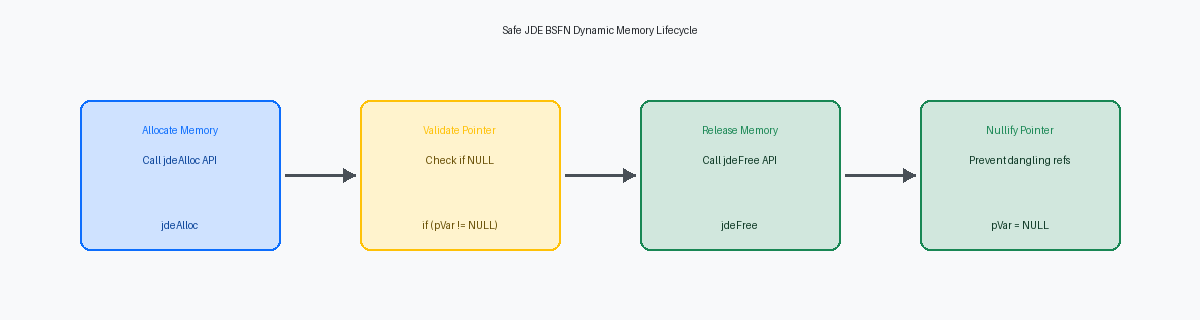
To prevent these leaks, every block of heap memory allocated dynamically through jdeAlloc must have a corresponding, guaranteed jdeFree before the business function exits. Developers often scatter return statements throughout their C code when validating parameters or handling database fetch errors, bypassing the cleanup logic at the bottom of the source file. Implementing a single-exit-point pattern—using a local variable like idReturnCode and a goto Cleanup; statement—ensures that the execution flow always routes through your deallocation block, regardless of where an error occurs in the business logic.
Releasing the memory is only half the battle; you must also neutralize the pointer itself. Immediately after executing jdeFree(pMyStructure), assign pMyStructure = NULL; to clear the address from stack memory. This explicit step prevents double-free errors, which occur when a subsequent error-handling block attempts to release the same pointer twice, immediately crashing the JDE runtime engine. It also eliminates dangling pointer references, ensuring that any accidental subsequent reads of that pointer variable fail predictably and safely during development rather than corrupting memory silently in production.
Improper MathNumeric and Date Structure Initializations
A production crash in a custom global voucher post-processing UBE revealed that thousands of F0911 journal entry rows had corrupted amounts due to an uninitialized local MATH_NUMERIC variable in a custom C business function. Developers coming from a standard C background often make the mistake of assigning values directly using standard C operators like = instead of using JDE-specific APIs. A MATH_NUMERIC is a complex structure containing a char array string representation, a sign byte, and decimal position metadata. Assigning a literal value directly or failing to initialize the variable leaves random stack garbage in these internal fields, which the database middleware then inserts directly into JDE tables like F0911 or F4211.
To prevent garbage data, some developers use memset to clear the entire data structure, but this is a dangerous shortcut. Running memset on a complex JDE structure can inadvertently wipe out critical internal pointers, currency configuration flags, or metadata that the JDE runtime engine relies on during execution. Instead, you must initialize these variables using designated APIs like ZeroMathNumeric to safely zero out the value, or ParseNumericString to convert a string representation into a valid JDE numeric structure.
Similar rules apply to the JDEDATE structure, where manual byte manipulation or direct string copying bypasses the validation logic of the JDE kernel. If you manually populate the day, month, or year components without validation, you risk corrupting the date memory boundary, leading to silent database failures during F4211 updates. Always use designated JDE APIs such as DeformatDate and FormatDate to safely manipulate date fields, ensuring the runtime engine correctly interprets the calendar data and maintains structural memory integrity.
JDE Cache Memory Leakage and Session Cleanup Failures
A single user session running the P42101 sales order entry application should never consume gigabytes of enterprise server RAM. Yet, this exact scenario occurs when custom business functions misuse JDE cache APIs like jdeCacheInit and jdeCacheAdd. While these APIs are essential for passing transactional data across multiple BSFN calls in a single session, they allocate memory directly from the operating system's heap. If the lifecycle of this memory is not explicitly managed, the CallObject kernel process will hold onto those bytes until the user logs out or the kernel recycle threshold is hit.
The root cause of this bloat is almost always an unhandled error path. When a validation fails or a database insert returns an error, developers often write an early return ER_ERROR; statement. If this exit occurs before executing jdeCacheTerminate, the specific cache handle is orphaned. The EnterpriseOne runtime has no built-in garbage collection for custom user caches; it relies entirely on the C code to clean up after itself. In high-volume environments, a user entering multi-line orders repeatedly throughout a standard shift can easily orphan numerous cache instances, driving kernel memory usage to critical limits.
To prevent these memory leaks, you must implement structured error-handling blocks that guarantee cleanup before any return statement. Every custom C BSFN using cache must have a unified exit point, typically labeled CleanUp:, where jdeCacheTerminate is systematically called using the exact cache handle. You should also utilize the jdeCacheTerminateAll API during the end-of-document or close-application events to ensure no dangling references remain in memory. Implementing this pattern across your custom P42101 wrappers will immediately stabilize enterprise server RAM utilization, keeping kernel memory consumption under 200MB per active user session.
Diagnosing Memory Crashes via CallObject Kernel Logs
A user running a custom sales entry application suddenly sees a "COB0000012: CallObject Runtime Error" pop up on their HTML client screen. This error is the classic signature of a CallObject kernel that has suffered a fatal memory violation, typically caused by an unallocated pointer or a buffer overflow in a custom C business function. When this boundary violation occurs, the EnterpriseOne engine immediately terminates the thread, generating a JDEDEBUG logA detailed trace file used by developers to troubleshoot JDE application logic and errors. and a corresponding console dump on the enterprise server.
To locate the root cause, you must bypass the generic HTML error and inspect the enterprise server's crash dump file, such as a core dump on Linux or a .dmp file on Windows. By analyzing the call stack within this crash dump, developers can trace the execution path back to the exact C source file and line number where the invalid memory access occurred. Comparing this stack trace with the JDEDEBUG log from the same thread ID reveals the precise parameter list passed to the offending BSFN right before the crash.
You do not have to wait for a hard crash to detect memory issues. Oracle's Server ManagerA web-based tool used to manage, monitor, and configure JD Edwards EnterpriseOne server components. allows administrators to monitor CallObject kernel memory consumption in real-time, displaying metrics like virtual memory size and thread count. If a specific kernel's memory footprint steadily climbs from a low baseline up to several gigabytes over a few hours, you are dealing with a progressive memory leak. Isolating these leaking kernels in Server Manager during user acceptance testing prevents unstable code from ever reaching your production environment.
Managing pointers and avoiding memory leaks in C BSFNs is critical for maintaining JDE kernel stability, especially when moving to Tools Release 9.2.8. If you are managing a legacy custom codebase, establishing rigorous memory management standards is the most effective way to prevent unplanned enterprise server downtime.
