




A single misaligned byte in a BSFNBusiness Function: A reusable piece of logic written in C or Named Event Rules used in JD Edwards. DSTRData Structure: A collection of parameters used to pass data between JD Edwards objects and business functions. can crash a CallObject KernelA server process in JD Edwards responsible for executing business functions on the Enterprise Server. on your Enterprise ServerThe central server in a JD Edwards architecture that handles logic execution and database communication., dropping dozens of active user sessions instantly. Developers often treat these structures like standard database schemas, assuming they can append a field or reorder parameters without consequence. In reality, the JDE runtime engine relies on strict single-byte structure alignment in C. Mastering JDE BSFN specifications—specifically how to read parameters and data structures—is the thin line between a stable system upgrade and a series of catastrophic memory violations at runtime.
When retrofitting or copying standard objects like B4200310 (Sales Order Entry) during a 9.1 to 9.2 upgrade, any mismatch between the specifications in the Object Dictionary and the actual typedef in the .h header file will cause silent memory overwrites. This technical reference provides the exact steps to inspect parameter directions, verify data types like MATH_NUMERICA specialized JD Edwards data type used to store and manipulate numeric values with high precision. and JDEDATEA specific JD Edwards data structure used to represent dates within the system., and safely map Event RulesA high-level, visual programming language used in JD Edwards to define business logic without writing raw code. to C-structures without risking memory corruption.
The Anatomy of a JDE BSFN Data Structure
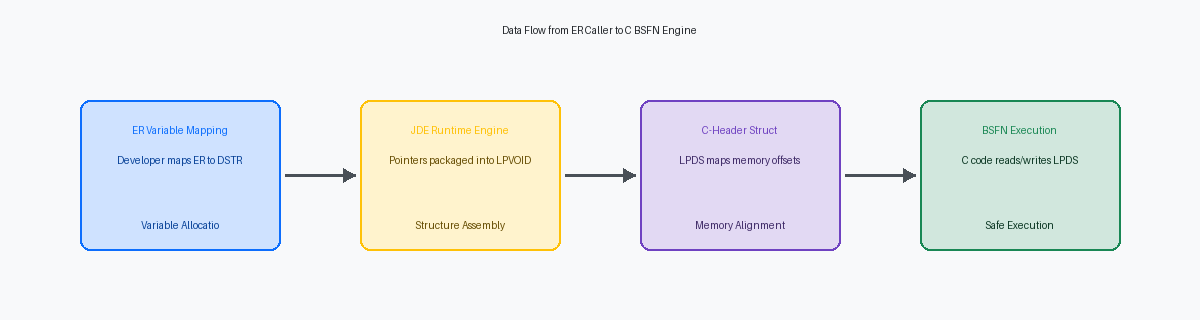
Every C business function execution in JDE relies on a strict memory contract defined by the Data Structure (DSTR). When a UBEUniversal Batch Engine: The JD Edwards tool used for creating and running reports and batch processes. or APPLInteractive Application: The JD Edwards tool used to create web-based user interfaces for data entry and display. calls a function like F0911BeginDocument (XT09111), the Event Rules (ER) engine allocates a contiguous block of memory based on the DSTR specifications. If there is even a single-byte discrepancy between what the toolset expects and what the compiled C code executes, you risk memory corruption that crashes the Call Object Kernel.
JDE data types do not map 1:1 to standard C primitives. For instance, the MATH_NUMERIC type used for transaction amounts in the F0911 DSTR is not a float or a double; it is a complex 38-byte structure containing a 32-character string representation, a single-byte sign flag, and a single-byte decimal position indicator. Similarly, a character field like EV01 (size 1 in the Data DictionaryA central repository in JD Edwards that defines the attributes and properties of all data items used in the system.) does not map to a standard single-byte C char in Unicode-enabled 9.1 or 9.2 environments. It maps to JCHAR, which occupies two bytes of memory to support wide character sets.
Mismatches between Data Dictionary (DD) specifications and the actual C-header typedefA C programming keyword used to define a custom name for an existing data type or structure. declarations are the primary cause of silent memory overwrites. If you modify a DD item's length without regenerating the header file and rebuilding the business function template, the compiled C code will write past the allocated buffer. This mismatch typically remains undetected during local fat-client testing but manifests as random STATUS_ACCESS_VIOLATION errors in production when the enterprise server processes high-volume batch runs.
Decoding Parameter Directions in Specifications
Inside the OMWObject Management Workbench: The primary development and lifecycle management tool for JD Edwards objects. data structure design tool, parameter directions are strictly defined as Input (I), Output (O), or Both (B). These designations dictate how the JDE engine handles memory allocation when a Universal Batch Engine (UBE) or interactive Application (APPL) invokes the underlying C code. For example, in the standard inventory transaction engine F4111EditLine (B4101250), the transaction action code (cActionCode) is defined as Input (I), whereas the generated document number (mnDocumentNumber) is set to Both (B) to return the key to the caller.
Under the hood, an Input (I) parameter is passed by value or as a constant pointer, meaning the C code must never attempt to modify its value at runtime. Output (O) and Both (B) parameters are passed as pointers, allowing the business function to write data directly back to the caller's memory space. In B4101250, parameters like the internal grid line number must be passed as Both (B) to allow the master business function to increment and return the correct pointer address to the calling application.
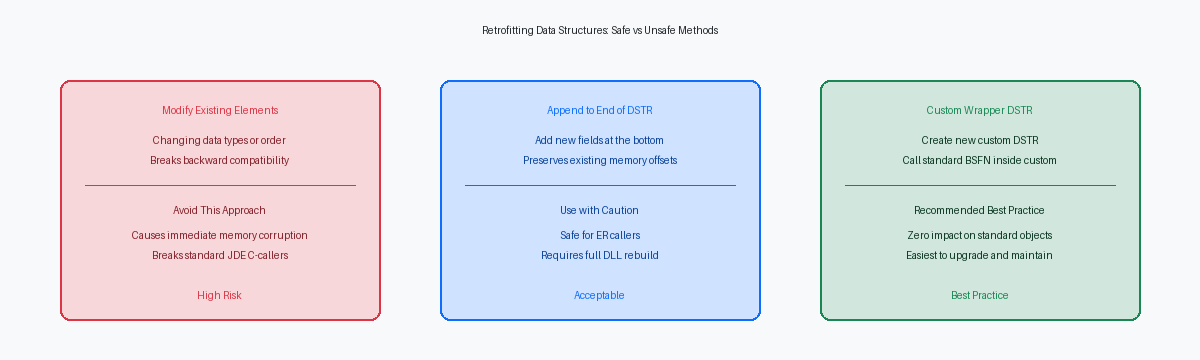
Changing a parameter direction from Input to Both in an existing function without updating all calling Event Rules will cause immediate memory violations at runtime. When the runtime engine attempts to write to a memory address that the caller allocated as read-only, it triggers a CallObject Kernel crash, often logged as a STATUS_ACCESS_VIOLATION in the jde.log. If you must modify data flow during a 9.2 retrofit, always append a new parameter to the end of the DSTR rather than changing an existing Input parameter.
Tracing the ER Caller to BSFN Parameter Mappings
In the JDE Event Rules (ER) designer, mapping variables, table columns, or form controls to a Business Function (BSFN) data structure relies on a visual drag-and-drop interface that masks underlying memory mechanics. This simplicity is dangerous. A developer mapping a 10-character string variable (such as a custom szCostCenter variable) to a 20-character DSTR element (like szLocation) creates a silent mismatch. The ER compiler does not throw a hard error or warning during generation, allowing this structural misalignment to bypass initial local validation.
At runtime, the JDE engine does not automatically truncate or validate these mismatched mappings. When the underlying C-based BSFN executes and attempts to populate the DSTR, it writes data based on the target parameter's defined size, writing directly past the allocated memory boundary of the smaller calling variable. This buffer overflow corrupts adjacent memory blocks in the call object kernel, routinely triggering cryptic COB0000012 memory violation errors in the jde.log or causing the enterprise server process to crash during high-volume batch runs.
To prevent these production-stopping crashes, developers must run the Event Rules Compare tool during retrofits to systematically verify that every calling variable matches the corresponding DSTR specification exactly. Do not rely on visual inspection of the ER line alone; inspect the data dictionary (DD) attributes of both the source variable and the target parameter to ensure their lengths align. If you are retrofitting custom modifications from release 9.1 to 9.2, this cross-referencing step must be a mandatory gate in your OWM promotion pipeline, saving weeks of post-go-live debugging.
Retrofit Safety When Copying Standard BSFNs
Cloning B4200310 (F4211FSEditLine) to a custom B5542031 to inject custom pricing or validation logic is a common pattern in distribution environments. However, duplicating this business function without respecting the structural integrity of its companion data structure, D4200310A—which contains over a hundred parameters—frequently introduces memory corruption. Modifying, reordering, or deleting any existing parameters in your cloned data structure breaks compatibility with standard JDE C-callers that dynamically resolve and map to these data elements.
To safely introduce custom parameters, you must append them to the absolute end of the copied data structure. The JDE runtime engine maps variables in memory based on strict byte offsets defined in the C structure header file. Inserting a new MATH_NUMERIC or char parameter in the middle of the structure shifts the memory address of every subsequent field, leading to silent memory corruption or an immediate Access Violation crash when standard code attempts to access those shifted offsets.
When retrofitting standard objects directly rather than copying them, modifying a data structure requires you to rebuild all parent DLLsDynamic Link Libraries: Files containing compiled code that can be used by multiple programs simultaneously. (such as CSALES or CALLBSFN where these functions are compiled). Failing to perform a full build of these parent DLLs leaves outdated binaries in your path code, meaning the compiled C code expects one memory footprint while the runtime engine delivers another. This structural mismatch causes catastrophic pointer misalignment at runtime when the call stack attempts to pass data. Always verify the generated .h file in your client's include directory matches the specs in the Object Dictionary after any local build.
Reading C BSFN Header Files vs Tool Specs
A common trap during a custom modification or retrofit is assuming that updating a Data Structure (DSTR) in Object Management Workbench automatically aligns the underlying C code. While OWM stores the DSTR metadata in the local spec.db or central objects database, the C compiler remains completely blind to these tables. It relies entirely on the generated .h header file on your development client. If you modify a parameter in the DSTR design tool but fail to regenerate the header file, your local build will compile against stale definitions, leading to immediate memory mismatches.
Take standard business function B4101250, which handles Item Master and Branch Plant validation. Inside b4101250.h, you will find the LPDSB4101250 pointer type and its corresponding typedef struct containing fields like szCostCenter. To ensure this memory block aligns exactly with the JDE middleware, the toolset wraps these structures in specific alignment directives, typically #pragma pack(1)A compiler directive that ensures data structures are stored in memory without extra padding between members. on Windows clients or #pragma pack(4) on Unix-based Enterprise Servers. This packing forces the compiler to lay out struct members sequentially without padding bytes, matching the exact memory representation expected by the JDE engine.
Developers must verify that the sequence and data types in the .h file match the OWM DSTR specifications exactly. A single mismatched member, such as a misaligned char array, shifts the memory offsets for all subsequent fields. When the JDE runtime passes the LPDS pointer to the BSFN, the code writes to the wrong memory addresses, corrupting adjacent variables. This discrepancy between the local spec.db and the generated header file will lead to local build failures or runtime memory corruption that crashes the CallObject kernel.
Validation and Testing of Modified Parameter Specs
A mismatch between local specs and the compiled C header is the primary cause of COB0000012 memory violations on the Enterprise Server. Developers must run a local build using BusBuildThe JD Edwards utility used to compile C business functions into executable libraries. on their development client immediately after any DSTR or BSFN modification. Do not just look for zero errors; analyze compile logs for alignment warnings, which indicate that the compiler is padding struct members differently than the JDE runtime expects.
When modifications introduce new pointer parameters, relying on basic execution testing is a recipe for intermittent crashes. You must use JDE cache and memory tracking APIs like jdeCacheInit and jdeAlloc to verify that modified parameters are not leaking memory or causing pointer corruption. Failing to explicitly track a void pointer's lifecycle in the C code will corrupt the JDE middleware memory heap, rendering the callObject kernel unstable.
Unit testing must include boundary testing of string parameters to ensure null-terminators are handled correctly by both the ER caller and the C code. If a parameter is defined as char szRemark[31], passing 30 characters from ER can cause a buffer overflow if the C code uses strcpy instead of jdeStrncpy. You must force these maximum-length scenarios to verify that the C code safely terminates the string at index 30.
Never promote a modified spec without tracing parameter values step-by-step. Launch ActiveConsole.exe on your local client with a debugger like Visual Studio attached to trace the execution. Stepping through the C code allows you to inspect the lpVoid data structure pointer, confirming that the data passed from the ER mapping aligns perfectly with the memory addresses in your local C structure.
Managing a custom estate of thousands of custom objects requires more than just successful compiles; it requires memory-safe pointer handling to prevent kernel failures in JDE 9.2.
