



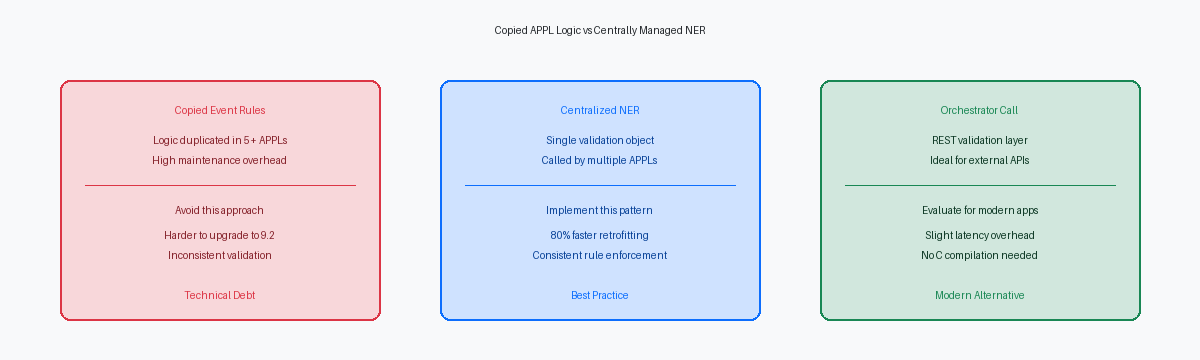
When auditing custom object repositories for 9.1 to 9.2 upgrades, I routinely find that a significant portion of custom validation logic—often between 30% and 50%—is duplicated across interactive applications like P4210 and P4310. Developers copy-paste Event Rules (ER)JD Edwards' proprietary scripting language used to define business logic within applications and reports. to meet tight deadlines, turning a simple validation rule into a maintenance bottleneck that breaks during Tools ReleaseThe foundational technology layer of JD Edwards that manages system performance, security, and web interactions. updates or when applying ESUsElectronic Software Updates are individual software patches released by Oracle to fix specific issues or provide enhancements.. This architectural anti-pattern unnecessarily inflates your custom code footprint and drives up retrofitting costs during upgrade cycles. To eliminate this technical debt, developers must transition to a centralized architecture; this JDE NER development example of reusable event rules for business logic demonstrates how to isolate validation rules inside a single Named Event Rule (N55XXXXX)A reusable business function created using Event Rules that can be called by various JDE objects. rather than scattering them across APPL events. Wrapping this logic in an NER generates a clean C business function (BSFN)Modular units of code, written in C or Event Rules, that execute specific business tasks. that can be called by P4210, P4312, or even an AIS orchestrationAutomated workflows using the Application Interface Services to allow external systems to interact with JD Edwards., reducing your upgrade retrofit timeline from weeks to hours.
The Anti-Pattern of Copied APPL Event Rules
I regularly audit JDE environments where developers have copy-pasted 100 to 200 lines of complex validation logic from a custom sales order entry application like P554210 directly into a procurement equivalent like P554310. This short-sighted practice creates immediate technical debt and exposes the system to severe regression errorsUnintended bugs that appear in previously working features after new code or updates are applied.. When the business changes its credit limit validation or order-holding rules, a developer must hunt down and modify every single iteration of that code across multiple custom APPL objects, doubling the testing cycle and risk of human error.
This redundancy directly inflates your upgrade budget. During a major 9.1 to 9.2 upgrade, automated analysis tools run a "smart filter" across your custom object repository, which typically holds 5,000 to 15,000 objects. When validation logic is scattered across dozens of interactive applications instead of centralized, it artificially inflates the count of impacted custom objects that require manual retrofittingThe process of re-applying custom modifications to standard objects after a software upgrade or patch.. This bloat extends what should be a predictable six-week retrofit phase into a ten-to-twelve-week effort, simply because developers have to refactor the same validation logic in ten different places.
Beyond upgrade complexity, burying business logic inside interactive application events like Col Exited and Changed degrades web client performance. The HTML client must constantly communicate with the JAS serverThe Java Application Server that manages the web interface and user sessions for JD Edwards. to execute these UI-bound events, adding unnecessary network roundtrips. Moving this logic out of the form and into a headless container ensures that validation runs identically whether triggered by a web user in P554210, a batch UBEUniversal Batch Engine, the JD Edwards tool used for running reports and high-volume background data processing. like R554210, or an external REST call via the Application Interface Services (AIS) server.

Designing the Data Structure and NER Parameters
A common mistake in custom JDE development is reusing standard Oracle data structuresDefinitions that specify the format and type of data passed between different software components. or generic 10-parameter structures for custom Named Event Rules. This shortcut creates tight coupling and makes future upgrades painful. A clean, reusable NER requires a dedicated parameter data structure, such as D554101A, designed specifically to pass structured inputs and return predictable error codes. This structure isolates your custom logic from standard schema changes, ensuring that a future Tools Release upgrade or ESUs won't silently break your parameter mappings.
Within D554101A, we define explicit input variables like Business Unit (MCU)A key field in JDE used to identify a specific department, branch, or warehouse. and 2nd Item Number (LITM)A user-defined alphanumeric identifier for products or parts in the inventory system., alongside output variables such as Error Code (ERRC) and Error Message ID (DTAI)A unique identifier for specific error messages or data definitions in the JDE dictionary.. Designing the data structure with a clear separation of inputs and outputs allows the underlying Event Rules to execute distinct validation paths. For instance, passing a specific action code parameter allows the same NER to toggle between strict inventory availability checks and relaxed branch-plant relationship validations without changing the object's signature or breaking existing callers.
To make this design truly reusable across both interactive applications (APPL) and batch processes (UBE), you must include a cSuppressErrorMessage control flag using the EV01A standard JDE data item used as a single-character flag, typically representing 'Yes/No' or 'True/False'. data item. When an interactive form calls the NER, it can set this flag to '0' to let the engine automatically throw a hard error to the screen. Conversely, an OrchestratorA powerful JDE tool used to build automated workflows and integrations between JDE and external systems. integration or a nightly UBE can set this flag to '1' to suppress the visual error, allowing the calling process to handle the validation failure gracefully by reading the returned ERRC value and routing it to a custom log or an external API response.
Building the Reusable Event Rules Logic
Writing a high-performance Named Event Rule (NER) requires strict adherence to table I/OInput/Output operations involving reading from or writing data to the database tables. efficiency, particularly when querying the Item Master (F4101) and Item Branch (F4102) tables. In a typical inventory validation scenario, we chain-read the F4102 using the primary index (Short Item Number ITM and Branch/Plant MCU) to verify branch-specific parameters. If the record is missing, we fall back to the F4101 to check global item status, ensuring we only query what is necessary.
To keep the logic flexible, we avoid hardcoding status values directly in the Event Rules. Instead, we call the System Function Get UDC (or execute a targeted read against the F0005 table) referencing User Defined CodeA flexible system for creating custom dropdown lists and validation rules without programming. table 55/ST to validate if the item’s current stocking type is allowed for the transaction. If a business analyst needs to add a new valid stocking type tomorrow, they simply update the 55/ST UDC table, completely bypassing the Object Management Workbench (OMW)The primary environment for JDE developers to manage code changes and project lifecycles. promotion cycle.
When validation fails—such as when an item is obsolete or the branch record does not exist—the NER must communicate this failure cleanly. We assign a specific DD item like '0002' (Record Invalid) to our output parameter, or we trigger the Set User Error system function directly within the NER. This design ensures that the calling application can gracefully halt processing before any database commit occurs.
Database performance degrades rapidly if your NER triggers full table scans on tables containing millions of rows, like the F41021 or F4102. Every Fetch Single or Select statement inside your Event Rules must align precisely with the table's existing index keys, such as index 1 (ITM, MCU) on the F4102. If your validation requires querying custom fields, verify that a corresponding database index exists in Object LibrarianThe central database that stores the definitions and metadata for all JD Edwards software objects. before deploying the code to production.
Calling the NER from Interactive Applications
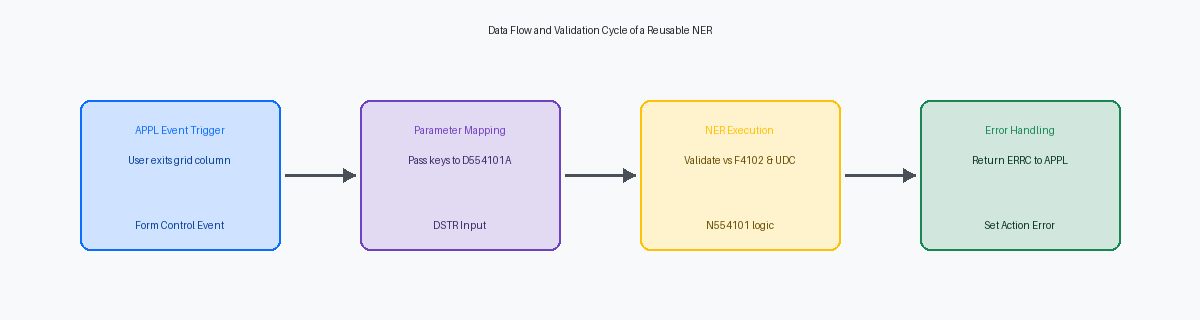
Placing validation logic directly into interactive forms is a maintenance trap. In a recent recovery of a botched sales order customization, we stripped out over a hundred lines of redundant code from the P554210 application. Instead, we called our custom NER directly from the Control Exited/Changed-Inline event on the Sold-To form control. For grid-level validations, mapping the call to the Grid Column Exited/Changed-Inline or Row Exit & Changed - Inline event ensures the validation fires exactly when the user modifies the cell, preventing dirty data from reaching the transaction buffer.
Inside the Event Rules (ER) designer, you map your Form Controls (FC) or Grid Columns (GC) directly to the input and output parameters of the custom Data Structure (DSTR)A template that defines the input and output parameters required for a business function to run.. The NER executes, evaluates the business rules, and returns a binary error flag ('1' for failure, '0' for success) along with a DD error glossary ID like 0002. Immediately following the NER call, you evaluate this returned error code; if it equals '1', you call the Set Action Error system function to halt transaction processing. This stops the form's OK button from committing invalid data to the F4201 or F4211 tables.
This architectural isolation is where the savings show up during a business process shift. When the business changes its threshold for gross margin validation from 10% to 15%, you modify only the internal logic of the NER and build the custom BSFN. The P554210 APPL remains completely untouched, eliminating the need to check out, modify, and rebuild the interactive application. This decoupling reduces your regression testing footprint from a full multi-scenario sales order cycle down to a single unit test of the business function.
The Maintenance and Upgrade Benefits of NER
In a 9.1 to 9.2 upgrade for a global manufacturing client, we analyzed 30 to 50 custom interactive applications that duplicated inventory validation logic. Retrofitting five separate custom APPLs during an upgrade takes roughly 15 to 20 hours of developer time to merge specs, resolve conflicts, and run unit tests. Consolidating that logic into a single Named Event Rule (NER) reduces this retrofitting effort by 70% to 80%, shrinking the task to a modification taking under four hours. This consolidation drastically slashes the time spent in Object Management Workbench (OMW) during Tools Release upgrades or application updates.
The technical mechanism behind this efficiency lies in how EnterpriseOne processes these objects. Unlike standard event rules embedded directly within form controls, NERs compile into clean C code stored in the specification repositoryThe database where JD Edwards stores the technical definitions and metadata of all system objects. as .c and .h files. When built, these files run natively on the enterprise server for optimal performance. This architecture ensures native execution speed, matching the performance profile of a hand-coded C business function without the associated maintenance overhead. Because the logic is decoupled from the presentation layer, you avoid the risk of Oracle's ESUs overwriting your custom modifications during an update.
Opting for NERs over raw C business functions solves a major resource bottleneck for JDE teams. Writing custom ANSI CA standardized version of the C programming language used for high-performance JDE business functions. business functions requires specialized knowledge of JDE APIs, memory pointers, and compiler-specific debugging tools. Using NERs lowers the technical barrier for development teams while maintaining native C execution speed for high-volume database operations. This allows standard application developers to write enterprise-grade, server-side logic without risking memory leaksA programming error where a system fails to release discarded memory, potentially leading to crashes. or system crashes.
Testing and Debugging Reusable NERs
Testing a newly developed Named Event Rule within a massive interactive application like P4210 or P4312 introduces too many variables and dependencies. Instead, isolate the NER execution early by checking the object out in Object Management Workbench (OMW) and launching a local web client instance. A highly effective practice is building a lightweight, two-field test harness APPL or a dedicated Orchestration in Orchestrator Studio. This allows you to pass specific input parameters directly to the NER and inspect the returned values in seconds, bypassing the need to complete a full, multi-step business transaction.
Because JDE translates NER into C code before compilation, you can debug the logic with absolute precision using Visual Studio. After generating the business function in OMW, open your local development environment's C compiler and attach the debugger to the active activeConsole.exe process. Open the generated source file—for example, N554101.c—set your breakpoints directly on the generated C statements, and trigger the logic from your test harness. This lets you step through the execution line-by-line, inspect variable allocations, and catch memory leaks or pointer mismatches before the code ever reaches the DV package build.
Simultaneously, analyze the jdedebug.logA technical log file that records every database call and logic step performed by the JDE engine. file to verify the exact behavior of the database and runtime engine. This log reveals the precise parameter mappings during the boundary pass between the calling application and the NER, showing you exactly where null values or truncated strings might be slipping through. It also exposes the raw SQL statements executed by the business function, allowing you to verify that table I/O operations are hitting indexes correctly and not causing unnecessary table scans.
Shifting logic from APPL and UBE event rules into reusable NERs is essential for managing a custom code estate that often exceeds 3,000 objects in a mature JD Edwards EnterpriseOne environment.
