



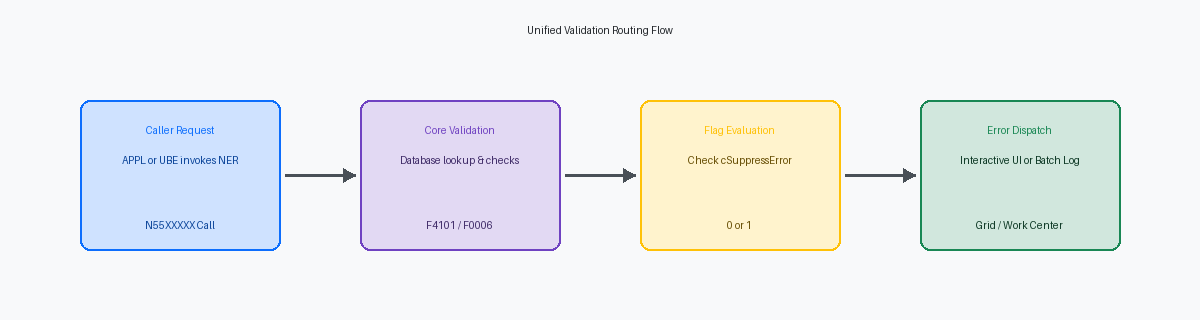
In mature JD Edwards 9.2A version of Oracle's Enterprise Resource Planning (ERP) software used for managing business operations. environments, I routinely find the exact same validation logic duplicated across a dozen or more different entry points, from custom P42101A specific JD Edwards interactive application used for entering and managing sales orders. power forms to automated EDIElectronic Data Interchange; a standardized method for transferring business documents between different computer systems. inbound UBEsUniversal Business Engines; JD Edwards batch processes used for reports and background data processing.. This fragmentation occurs because developers default to placing validation directly within the Control Exited/Changed event rulesThe proprietary scripting language used within JD Edwards to define business logic and automation. of an interactive application (APPLAn interactive application in JD Edwards that provides a user interface for data entry and retrieval.), rendering it inaccessible to batch processes. To eliminate this technical debt, you must decouple validation execution from both the user interface and batch runtimes by implementing a JDE NERNamed Event Rule; a reusable business function created using JD Edwards event rules instead of C code. reusable validation pattern for APPL and UBE callers.
Implementing this centralized approach allows you to consolidate logic within a single Named Event Rule (NER) using standard DD error glossariesThe Data Dictionary repository where JD Edwards stores standardized error messages and descriptions.. By passing a unified data structure containing action codes, this single BSFNBusiness Function; a modular piece of code used to perform specific tasks or calculations in JD Edwards. dynamically adapts, returning structured errors to an APPL grid or writing clean logs to a UBE's PDF without a single line of redundant code.
The Cost of Duplicated Validation Logic
Hardcoding identical validation logic in both the P4210The standard JD Edwards application for sales order entry and processing. sales order entry application and the R47011A standard JD Edwards batch process used to import EDI sales orders into the system. EDI inbound order processor is an architectural pattern that drains IT budgets. When upgrading from 9.1 to 9.2, this dual-maintenance reality drives a substantial increase in code retrofit costs, often up to half again as much. Developers must locate, modify, and unit-test the exact same rules across two completely different object types, doubling the surface area for human error during the upgrade cycle.
Beyond upgrade mechanics, this architectural split actively threatens transaction table integrity within critical files like the F4211The Sales Order Detail table, which stores individual line items for every sales order. Sales Order Detail and the F4111The Item Ledger table, which records all inventory transactions and history. Item Ledger. Batch uploads running through UBEs or inbound business functions frequently bypass the UI-level event rules of interactive screens. The result is silent data corruption: orphaned records, invalid branch/plantA specific business unit in JD Edwards representing a warehouse, manufacturing facility, or office. combinations, and mismatched unit costs that bypass APPL validation but slip directly into the database.
Consolidating these fragmented rules into a single, centralized Named Event Rule (NER) instantly slashes the custom object footprint by approximately a quarter to a third across the modification estate. Instead of managing dozens of disconnected Form ExtensionA JD Edwards tool that allows users to add fields or logic to screens without traditional coding. rules, Table TriggersLogic that automatically executes when a record is added, updated, or deleted from a database table., or UBE Event Rules, you route all validation through one reusable engine. This structural shift simplifies retrofits to a single point of validation, ensuring that any future regulatory or operational change is coded once and inherited everywhere.
A typical enterprise installation running JDE for a decade or more accumulates dozens of custom validation routines scattered across custom 55-to-59 namespacesThe reserved range of object names in JD Edwards used for custom-developed applications and reports.. These routines—ranging from simple lot status checks to complex margin calculations—are prime targets for this unified architectural pattern. Auditing your repository to identify these redundant routines is the first step toward stabilizing your transactional data before your next Tools ReleaseThe underlying technical foundation and system software that supports the JD Edwards application layer. update.
Designing the Reusable NER Parameter Interface
Designing a data structure that bridges APPL (interactive) and UBE (batch) requires explicit control over how errors are raised. If your NER calls SetUserBehaviorError directly, you break headless batch processing in UBEs or AIS OrchestrationsAutomated workflows that allow external systems to interact with JD Edwards via REST services., leading to silent failures. Instead, the custom Data Structure (DSTR)A defined set of parameters used to pass data into and out of a business function. must pass control flags like cSuppressErrorMessage and cErrorOccurred (both EV01A standard data item used for single-character flags, typically '1' for yes and '0' for no.), alongside a 10-character error code parameter szErrorMessageID (DTAIA data item type used to store and reference specific error message IDs in the Data Dictionary.) back to the caller. This decoupling allows an APPL to display a visual error using the returned ID, while a UBE can gracefully write the message to a PDF or work center.
To ensure the validation engine handles various operational contexts across modules like Procurement (G43The JD Edwards menu system and module code for Procurement and Purchasing.), the DSTR must include a standardized set of contextual fields. Map Company (szCompany, CO), Business Unit (szBusinessUnit, MCUThe data item representing a Business Unit, used to identify specific departments or locations.), and Item Number (mnShortItemNo, ITMThe Short Item Number, a unique numeric identifier for a product in the inventory system.) as optional inputs. In a real-world multi-currency implementation, passing these three variables allows the same NER to validate branch-plant constants or item-branch availability. If a caller only needs to validate an item, they leave the company blank; the NER handles the conditional logic internally, reducing the need for multiple single-purpose validation functions.
A common mistake that causes intermittent memory faults on 64-bit Enterprise Servers is using UI-specific Data Dictionary items in the DSTR. Data items designed for interactive grids often contain formatting triggers that do not align correctly in memory during headless execution. Stick to clean, primitive data types such as MATH_NUMERICA specialized JD Edwards data type used for high-precision mathematical calculations and currency values. for quantities and CHAR for flags. This guarantees that when a UBE calls the NER in a multi-threaded queue, the data structure aligns cleanly on 8-byte boundaries, preventing memory corruption and ensuring consistent execution across both local clients and the Enterprise Server.

Building the Core NER Validation Engine
Writing a stable validator means resisting the temptation to drop into custom C-code hacks or direct database API calls within the toolset. When building the core validation engine inside N55XXXXX, we restrict ourselves strictly to standard Event Rules (ER). This approach guarantees that when the client updates their Tools Release from 9.2.7 to 9.2.8, the OMWObject Management Workbench; the central development environment for managing JD Edwards software objects. generates the underlying C code flawlessly without breaking on compiler changes.
Inside the ER, we execute targeted database fetches against master tables like F4101The Item Master table, which stores basic information for every inventory item. and F0006The Business Unit Master table, containing definitions for all departments and locations. using only their primary keys—specifically Short Item Number (ITM) and Business Unit (MCU). Bypassing secondary indexes or partial key searches keeps the database fetch overhead near zero, which is critical when a batch UBE processes tens of thousands of records. If a lookup fails, we immediately flag the record as invalid before wasting CPU cycles on subsequent validation steps.
The engine evaluates incoming control flags to determine how to handle validation failures. If the calling application requires immediate UI feedback, the ER evaluates these flags to trigger either 'Set Action Code' or 'Set User Error' system functionsBuilt-in JD Edwards commands used within event rules to perform specific UI or processing tasks. directly within the execution path. For batch runs, the NER bypasses these interactive system functions and instead populates the output error structure, preventing runtime crashes in headless environments.
To maintain a clean interface, the NER returns a binary success flag, cErrorOccurred, set to '1' for failure or '0' for success. Alongside this flag, the function outputs the specific four-character JDE error code registered in the F9203The database table that stores the alpha descriptions for Data Dictionary items and error messages. data dictionary. This dual-return mechanism lets the calling APPL or UBE decide whether to halt processing entirely or write the error details to a work center table for asynchronous review.
Calling the NER from an Interactive Application
Triggering validation at the wrong point in the interactive lifecycle is a primary source of ghost errors and performance lag in customized applications like P554101A custom-developed version of the standard Item Master application.. To prevent this, place the custom NER call directly within the Grid Cell Exited - Changed Inline event of the target column rather than relying on loose post-commit checks. If you are validating a header-level control instead of a grid column, use the Control Exited event. This targeted placement ensures the validation executes only when a user actually alters a value, saving unnecessary database roundtrips on clean records.
When mapping the parameter list for the NER call within the Event Rules, pass the target grid row pointersTechnical references used to identify and access specific rows of data within an application grid. and set the cSuppressErrorMessage flag to '0'. Passing '0' tells the NER to let the interactive engine handle the screen state natively, rather than burying the error in the background or forcing a hard crash. Once the NER returns, evaluate the szErrorMessageID parameter. If this variable is not blank, immediately call the Set Grid Cell Error system function in P554101, passing the active Grid Control, the current Row, and the specific error ID returned by the business function.
A common vulnerability in custom APPL design is the "fast-typing" bypass, where a user hits the OK button before the cell-level validation event finishes processing. To block this loophole, you must replicate the validation call inside the Button Clicked event of the OK button, looping through the grid to re-evaluate all rows. This dual-layer check takes under ten milliseconds per row but guarantees that invalid data never slips through to the standard B4100140The standard Inventory Master Business Function used to validate and commit inventory transactions., during the critical table write phase.
Calling the NER from a Batch Engine
Executing validation logic inside a batch UBE requires a structural shift from interactive applications to prevent silent failures or runaway jobs. In an inbound item staging table processor like the R554101, which routinely processes a wide range of staging records per run (typically 10,000 to 50,000), you must place the validation NER directly within the Do Section of the primary driver section. For each staging record fetched, the UBE maps the raw input fields—such as MCU, LITMThe Long Item Number, a user-defined alphanumeric identifier for an inventory item., and UOMUnit of Measure; the standard unit (like 'EA' for Each) used to track item quantities.—directly to the NER's data structure, ensuring every record undergoes the exact same validation routine as an interactive screen.
When calling the validation NER from a batch context, passing a '1' to the cSuppressErrorMessage input parameter is mandatory. This suppression flag prevents the engine from trying to trigger interactive error dialogs or halting the thread, which would otherwise corrupt the batch runtime behavior. If the NER returns a cErrorOccurred value of '1', the event rules must bypass the database insert step by skipping the 'Write Section' system function, ensuring only pristine, validated data reaches your production F4101 or F4102The Item Branch table, which stores item information specific to a particular warehouse or location. tables.
Rather than leaving the user to guess why a record failed, the UBE must capture the specific DD error item returned by the NER. You can pass this error code directly to the standard B0100025 Business Function to write a detailed message to the JDE Work CenterAn internal JD Edwards messaging system used to notify users of batch processing errors., associating it with the specific EDI document number or transaction ID. For clients who prefer cleaner operational dashboards, inserting these validation failures into a custom error log table like F55ERR provides a direct source for custom monitoring tools, saving a significant portion of the triage time, often up to half of what is typically spent hunting through raw PDF output.
Performance and Cache Considerations
A validation routine that executes in under twenty milliseconds might seem negligible during interactive APPL testing, but it will cripple a high-volume UBE processing hundreds of thousands of records. If your custom validation NER executes redundant Table I/OInput/Output operations involving reading from or writing to database tables. on every single iteration, a nightly batch run that should complete in a few minutes will easily stretch to nearly an hour. This degradation occurs because database round-trips quickly accumulate network and disk overhead, especially when SQL execution plans fail to reuse cursors across repetitive calls.
To prevent this latency, you must exploit the JDE Service Cache or standard environment table caching on static setup tables like the F41001The Inventory Constants table, which stores system-wide settings for inventory management.. Ensuring the Inventory Constants table is cached in memory drops lookup times to under ten milliseconds per call, effectively eliminating database physical reads. For dynamic transactional lookups, bypass complex sub-queries inside the NER entirely. Instead, pass pre-fetched parent keys directly from the calling UBE's primary driver section via the business function data structure, keeping the NER's internal execution path as flat and fast as possible.
You must also guard against transaction isolation issues that occur when interactive APPLs and batch UBEs share the same logic. Open a local fat client, run your validation process, and immediately analyze the Enterprise Server call stack using JDEDEBUGA detailed log file that records every step of a JD Edwards process for troubleshooting. logs. Look closely at the transaction tracking sections to confirm the NER is not initiating nested transactions or holding locks on tables like F4101 or F0101The Address Book Master table, which stores information for all entities like customers and suppliers.. If you detect SELECT FOR UPDATE statements or unexpected Commit Transaction calls inside the validation loop, decouple those operations to prevent database deadlocks during parallel batch runs on your Enterprise Server. A single unindexed query in your validation logic can escalate to table-level locks under load.
Centralizing validation logic into reusable NERs is a baseline requirement for maintaining a custom estate of 500+ objects without bloating your 9.2.8 upgrade timeline. Moving this logic out of individual UI and batch engines into a unified business function ensures consistent data validation, reduces retrofitting overhead, and streamlines long-term system maintenance.
