



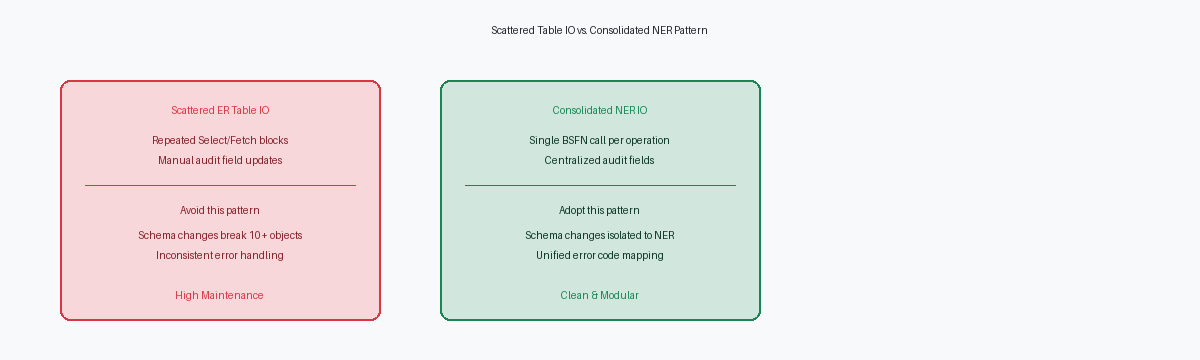
In a typical enterprise JDE footprintThe total installation and configuration of JD Edwards software within an organization., a single custom table like F55101 often has its Select, Fetch, Insert, and Update logic duplicated across 15 to 20 different APPLsInteractive screens or applications that users work with in JD Edwards. and UBEsUniversal Batch Engine; these are background reports or automated processes in JD Edwards.. This copy-paste approach to Event Rules (ER)The proprietary scripting language used to create logic within JD Edwards applications. creates a massive maintenance burden; a simple database schemaThe organized structure of a database, defining how data is stored and related. modification—such as adding a 10-character category code field—forces developers to manually refactor and test dozens of individual objects. Adopting a unified JDE NERNamed Event Rule; a reusable block of business logic that can be called by multiple programs. table IOInput and Output operations performed on database tables, such as reading or writing data. pattern to avoid repeated ER blocks consolidates these database operations into a single, action-driven Named Event Rule.
By encapsulating all database interactions for a table within a single NER, you reduce custom ER volume by up to 30% to 50% and establish a clean, modular data access layer directly in the JDE toolset. Instead of scattering raw Table I/O statements across Object Management Workbench (OMW)The central tool for managing the development lifecycle of JD Edwards objects. projects, developers call a centralized BSFNBusiness Function; a reusable piece of code used to perform specific tasks or calculations. using a simple action-code parameter (e.g., 'A' for Add, 'U' for Update, 'F' for Fetch). This shift slashes retrofitting time during Tools ReleaseThe foundational technology layer that provides the runtime environment for JD Edwards applications. upgrades and ensures absolute data integrity across all entry points, from interactive applications to incoming AIS OrchestrationA service that allows JD Edwards to interact with external systems and automate complex tasks. payloads.
The Cost of Scattered Table IO in Event Rules
When we modify a custom table like F55101—say, adding a 10-character cost center field (MCU) or an audit date—the immediate headache isn't the table regeneration itself. The real pain is hunting down the 10 to 15 different interactive applications (APPLs) and batch reports (UBEs) where a developer manually dragged and dropped the Fetch, Select, and Update Event Rules blocks. Duplicating table I/O across these objects creates an exponential maintenance footprint, turning a simple two-hour schema update into a multi-day search-and-replace exercise across your Object Management Workbench (OMW) projects.
In a standard 9.2 environment, a custom table like F55101 frequently has its CRUDAn acronym for Create, Read, Update, and Delete, representing the four basic database operations. operations copy-pasted across 10 to 15 distinct entry points, ranging from the primary maintenance screen to custom EDIElectronic Data Interchange; the automated exchange of business documents between different computer systems. UBEs. Each of these repeated Event Rules blocks represents a critical point of failure. A developer editing a Select or Update statement in a custom batch report might easily omit a key index field like UKID or LNID, leading to table scansA slow database process where every row is checked because no efficient index was found. that degrade database performance on your Oracle or SQL Server database.
This scattered architecture also paralyzes your ability to enforce global data integrity or consistent audit loggingThe practice of recording changes to data to provide a history for security or compliance.. If your business decides to log every change to F55101 status fields to a custom audit table, you must manually inject that logging logic into multiple calling objects individually. Miss just one interactive screen, and your compliance audit trail is broken. To prevent this, my direct recommendation is to isolate all database interactions for F55101 into a single, dedicated business function before your next Tools Release upgrade.

Designing a Focused NER for Table Operations
In our remediation of a global distribution client's custom order entry system, we replaced over a hundred individual Table IO statements scattered across a dozen different applications with a single, dedicated Named Event Rule (NER). The foundation of this pattern is a unified data structureA defined set of parameters used to pass data between different JD Edwards programs., D55101A, which encapsulates every column of the target table alongside critical control parameters. Instead of passing individual variables through multiple layers, this structure bundles the functional table fields with control flags like Action Code (szActionCode) and Return Status (cReturnStatus).
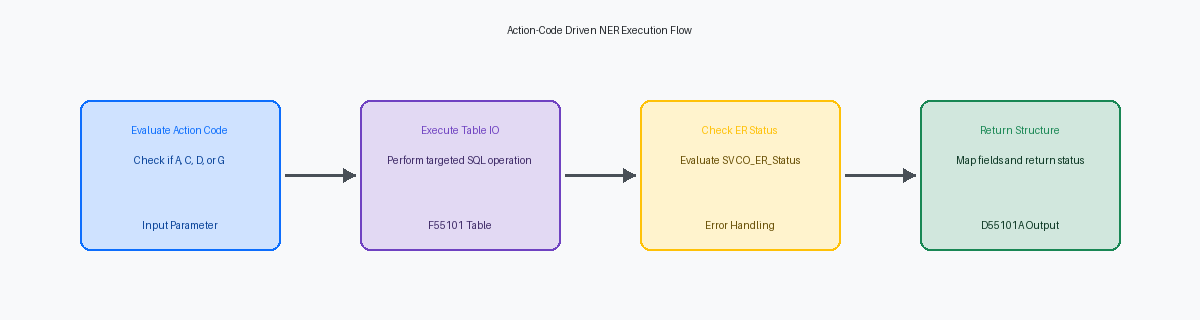
Within the NER, a conditional structure evaluates the Action Code to determine the database operation. We enforce a strict standard: 'A' executes an Insert to add a record, 'C' performs an Update to change it, 'D' executes a Delete, and 'G' triggers a Fetch Single to get the data. This design prevents developers from writing ad-hoc, incomplete Select/Fetch loops in the application Event Rules, forcing all database interactions through a predictable, tested code path.
Consolidating these operations into a single NER ensures that database transactions are managed as a single, predictable unit of work, which is critical when mapping to EnterpriseOne transaction processingA system that ensures a group of database changes are all completed successfully or none at all. boundaries. If an insert fails during a multi-table update, the NER can immediately roll back the transaction and return a failure status of '1' to the caller, preventing orphaned records in custom tables like F55101. This abstraction layer completely isolates the physical table layout from the calling applications. If you add a new column to the table or modify an index, you update the NER's internal code and the data structure, leaving the calling Event Rules untouched and eliminating the need to rebuild dozens of APPL or UBE objects.
Handling Complex Table IO and Error States
In more than a dozen upgrade audits, I have seen custom NERs fail silently because developers assumed a Select statement always succeeded. Your ER status evaluation logic must inspect SV CO_ER_StatusA system variable that tells the program if the last database action succeeded or failed. immediately after every single Fetch Single, Update, or Delete statement. Placing even one assignment or utility BSFN call between the Table IO and the status check risks overwriting the system variable, resulting in false positives that pollute tables like the F41021 with corrupt data.
Instead of hardcoding glossary text or calling Set ER Error inside the NER, map database states to a standardized output parameter like cReturnCode ('0' for success, '1' for record not found, '2' for duplicate key). This allows the calling APPL or UBE to handle the failure gracefully. A retail APPL might halt the transaction, whereas a nightly batch UBE might simply log the warning and proceed. Passing the raw code up the stack keeps the NER reusable across different environments.
When handling partial key fetches with a Select and Fetch Next loop, failing to validate the return status of the initial Select is a dangerous trap. If the Select fails and your code enters a While loop controlled by SV CO_ER_Status is equal to CO SUCCESS, you can trigger an infinite loopA programming error where a set of instructions repeats forever, potentially crashing the system. that pegs the enterprise server CPU at maximum capacity. Always initialize loop control variables and explicitly check the status of the first Fetch Next before entering the block.
Step-by-Step Implementation of the Custom Table IO NER
Standardizing database access in a custom Named Event Rule (NER) begins with a rigid data structure design. We map the primary keys, the payload fields, and a 1-character Action Code (cActionCode) to route execution. Inside the NER, the first line of Event Rules must be a conditional branchingLogic that directs the program to different actions based on whether a condition is true or false. block—typically a Select structure—that evaluates this Action Code to route execution. This centralized routing ensures that no database call is made without validating the operation type first, eliminating the risk of accidental table updates.
When the Action Code is 'G' (Get), the NER evaluates the incoming key parameters. If the caller passes a fully qualified unique key, the code executes a direct Fetch Single against the F55101 table; otherwise, it initiates an Open, Fetch, and Close cursor sequence depending on whether a unique key is provided. When the Action Code is 'A' (Add), the NER intercepts the write operation to centrally populate the standard audit fields. Instead of relying on the caller to pass these, the NER programmatically assigns the user ID (USER), program ID (PID), date updated (UPMJ), and time of day (TDAY) before executing the Insert statement.
For a 'C' (Change) operation, the NER executes a Fetch for Update or a direct Update statement based on the primary keys passed in the data structure. If optimistic lockingA method that allows multiple users to access data simultaneously, only checking for conflicts at the moment of saving. is required, the Fetch for Update locks the row in the F55101 database before modifying the record. Otherwise, a direct update executes, mapping strictly to the primary keys. This encapsulates database lock durations to milliseconds, preventing the long-held locks that occur when developers write manual table IO directly in form event rules.
Caller Examples: Refactoring APPL and UBE Event Rules
Look at the Grid Record Is Validated event on a standard P4210 custom clone. In a typical legacy implementation, this event contains dozens of lines of manual Table I/O, scattered with Fetch Single statements to validate item branch records. By refactoring this logic, we compress those lines of redundant Event Rules down to a single, clean BSFN call passing the key parameters. This shift reduces the APPL's local specifications size and eliminates the risk of unclosed table handles during rapid grid scrolling.
This refactoring approach isolates the presentation layer of the interactive application from the database access layer, mimicking a modern Model-View-ControllerA design approach that separates data management, user interface, and business logic into distinct parts. architecture within JD Edwards. When you strip SQL execution out of FDAForm Design Aid; the graphical tool used to build and modify JD Edwards application screens. and encapsulate it within an NER, you gain a single point of maintenance. If a custom table like F554101 requires a new index or validation, you modify the central NER once instead of searching through dozens of APPL entry forms.
For batch processing, a high-volume UBE like a customized R42565 processing tens of thousands of records benefits significantly from this design. Instead of repeating complex Fetch Single blocks in the Do Section event of the main detail section, the UBE calls the custom NER with an Action Code of 'G' to fetch pricing overrides. The UBE handles the returned data structure cleanly, evaluating the success flag before formatting the output line.
When the table operation involves non-blocking writes, such as updating a custom audit log table like F559801, developers can safely check the AsynchronousA way of running a task in the background so the user doesn't have to wait for it to finish. execution flag on the BSFN call properties. This allows the primary interactive thread to continue processing without waiting for the database write acknowledgment. Running the NER asynchronously prevents user interface lag during peak transactional hours, keeping the database interaction standardized.
Performance and Maintenance Wins in the Field
In a recent refactoring of a custom inventory allocation system for a major metals distributor, we replaced scattered F41021 and F4111 table I/O statements across several different entry applications with a single consolidated NER. This architectural shift cut the custom event rules line count by nearly half across the affected objects. By stripping out redundant select, fetch, and update blocks from individual form events, we eliminated the spaghetti code that previously obscured the actual business logic.
Consolidating table I/O into a compiled NER directly reduces the size of the generated specifications (specs)The underlying technical definitions that tell JD Edwards how an object should behave. for the calling applications and UBEs. When an APPL or UBE has fewer embedded ER table I/O statements, the runtime engine spends less time parsing and loading specs into memory at execution. This results in measurable improvements in application launch times and batch initialization phases, especially over high-latency WAN connections or in dense HTML server environments.
Database administrators benefit immediately from this design because it standardizes table access patterns. Instead of dealing with dozens of slightly different, ad-hoc SQL queries generated by various APPLs, the database engine processes highly predictable, reusable SQL execution plansThe roadmap the database follows to find and process data as quickly as possible. generated through a single, centralized object. This consistency allows the database optimizer to cache execution plans more effectively, reducing CPU overhead on the database server during peak transaction volumes.
From a maintenance standpoint, troubleshooting database issues or data corruption is no longer a multi-day hunt through nested event rules. Developers can open JDEDebuggerA tool that allows developers to watch their code run line-by-line to find and fix problems., set a single breakpoint within the designated Table IO NER, and capture every read or write attempt directed at the target table. This isolation capability reduces the mean time to resolution for production bugs from hours of log-tracing down to a few minutes of active debugging.
For organizations stabilizing a JD Edwards 9.2 environment, consolidating redundant database logic into a single Named Event Rule represents a highly effective method to reduce the custom code footprint by a fifth or more, simplify future upgrade paths, and ensure long-term system stability.
