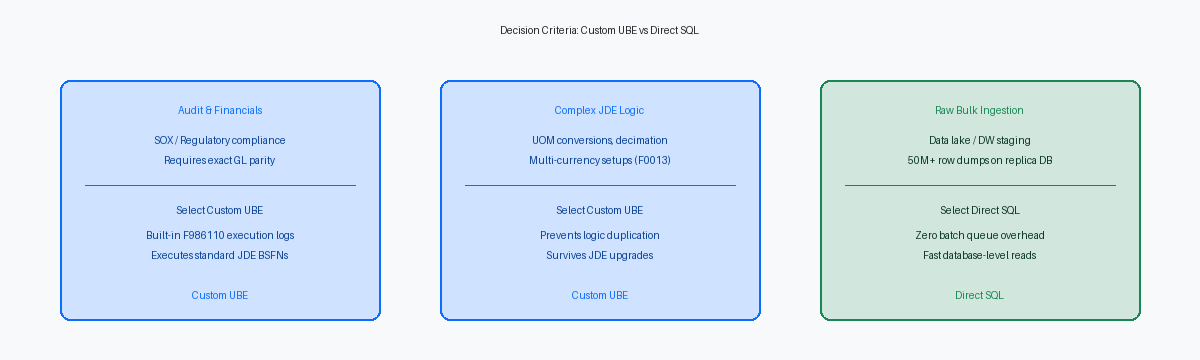

The inclination to bypass JDE middlewareThe software layer in JD Edwards that connects applications, manages database communication, and enforces business rules. and run direct SQL against tables like F0911The JD Edwards Account Ledger table, which stores detailed transaction records for the General Ledger. or F4211The JD Edwards Sales Order Detail table, containing line-level information for sales orders. usually stems from raw execution speed: a tuned SQL query can dump 500,000 rows in under fifteen seconds, whereas a custom UBEUniversal Batch Engine. A JD Edwards background process used to run reports, batch jobs, and data processing tasks. might take nearly an hour to process the same dataset. However, evaluating a JDE UBE custom data extract vs direct SQL solely on execution speed is an architectural mistake that routinely breaks downstream financial reporting.
Bypassing the JDE batch runtime strips away crucial business logic compiled inside C BSFNsC Business Functions. Reusable pieces of code written in C that execute complex business logic within JD Edwards.—specifically Julian date translations, dynamic decimal shift logic, and security kernel enforcement. When an integration team queries table F0911 directly, they lose the implicit decimal adjustments defined in F0013The JD Edwards Currency Codes table, which defines currency decimals and properties., forcing external data engineers to hardcode ERP business rules in a data warehouse. What looks like a 90% to 95% performance gain on day one frequently morphs into a major governance defect during the annual financial audit.
Architectural Differences in JDE Data Extraction
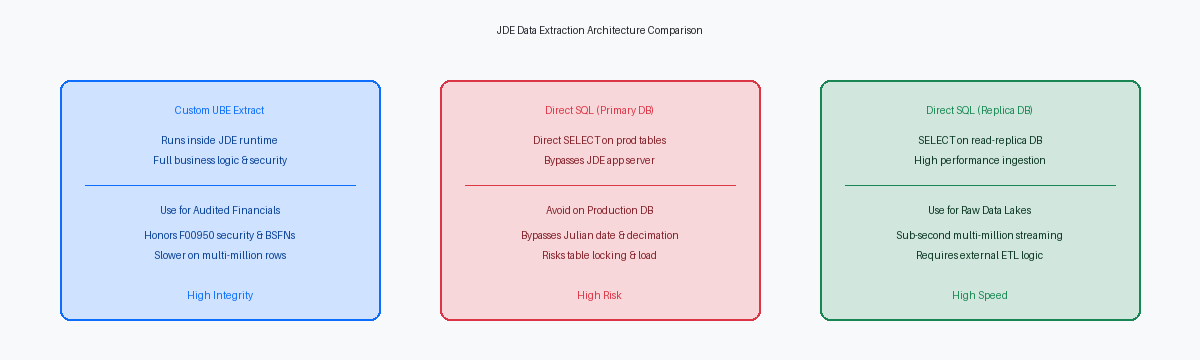
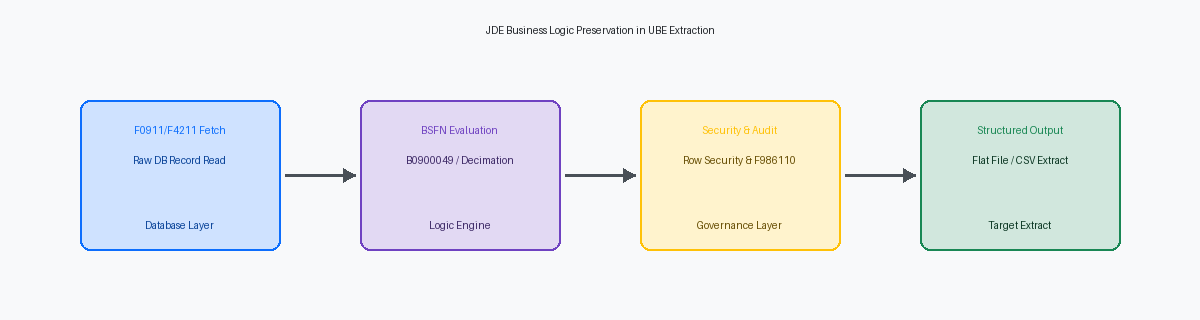
A custom UBE executes entirely within the EnterpriseOne runtime engine, inheriting environmental context, object-level security, and row security rules established in F00950The JD Edwards Security Workbench table, which stores application, action, and row-level security settings. without developer intervention. When a batch process fetches records from F0911 or F4211, the runtime engine evaluates user permissions, executes C business functions, and automatically scales implied decimal values stored in the database. Executing a direct SQL query against the underlying Oracle or SQL Server database bypasses this middleware layer completely, stripping away all JDE application logic and handing raw, uninterpreted table rows directly to the querying client.
That architectural bypass transfers the burden of data translation onto the SQL writer. JDE stores dates in a modified Julian formatA date format used by JD Edwards represented as a 6-digit number (1YYDDD), where YY is the year since 1900 and DDD is the day of the year. (1YYDDD, where 100001 represents January 1, 2000), requiring SQL queries to execute conversion formulas like DATE(TO_DATE(CAST(GLDGJ + 1900000 AS CHAR(7)), 'YYYYDDD')) across millions of rows. Worse, transaction amounts in tables like F0911 are stored as integers without decimal points; the runtime engine relies on the Currency Codes table (F0013) and field-level decimal positions (CDECThe field in JD Edwards that specifies the number of decimal places for a specific currency code.) to interpret the value. A direct SQL extraction that fails to join F0013 and scale amounts by POWER(10, F0013.CDEC) will report a 100,000 JPY balance identically to a 100,000 USD balance, inflating reported asset values by a factor of 100 for non-decimal currencies.
In our audits of 9.1 and 9.2 database architectures across manufacturing environments, a significant portion of custom SQL extraction views—in our experience around a third to half—contain silent currency scaling or date translation errors. Database developers outside the JDE ecosystem frequently misinterpret composite primary keys, ignore transaction origin flags, or omit status flow logic like F4211.SDLTTR threshold filtering. Direct SQL delivers throughput improvements of 5x to 10x over standard UBE processing for multi-million row extracts, but it creates persistent technical debt that costs enterprise reporting teams weeks of reconciliation time every fiscal quarter.
Preservation of JDE Business Logic and Calculations
A custom UBE running financial extractions invokes B0900049 (Get Period Information) to compute General Ledger balances directly from the F0902 table while respecting period patterns, fiscal year boundaries, and balance restatements. Replicating this balance aggregation in raw SQL requires writing fragile CASE statements across 14 period buckets (GBAN01 through GBAN14) and manually handling century bytes like GBCFY. The moment a finance team alters a fiscal date pattern in F0008, every direct SQL query silently outputs flawed period numbers. The UBE execution, by contrast, maintains full parity with standard system reports like R094121.
Replicating transaction-level logic in direct SQL breaks down even faster when dealing with operational data. Calculating net order pricing on the F4211 requires evaluating complex tax rules, order detail groups, and unit of measure conversions from F41003. A SQL query attempting to calculate net price by joining price adjustment history (F4074) invariably fails to account for secondary UOM conversions, tiered volume breaks, or dynamic tax overrides embedded in C business functions. A custom UBE executes these native C BSFNs during the Do Section event, guaranteeing that external data extracts reflect the exact monetary totals calculated at order entry.
Wrapping extraction logic inside a UBE also protects your enterprise data stack across system lifecycles. When Oracle delivers business logic fixes through 9.2 Application Updates, or updates standard calculations to comply with statutory tax modifications, UBE-based extracts automatically absorb those changes after a standard package build. Direct database queries bypass the runtime engine entirely, leaving reporting teams oblivious to schema or calculation changes until a compliance audit flags a discrepancy. Retaining complex business rules inside the JDE application tier eliminates the need to rewrite and re-verify custom SQL scripts after every Tools Release.
Auditability, Governance, and Security Enforcement
When an internal auditor asks who pulled the Q4 revenue figures at off-peak hours, a UBE extract gives you a definitive answer in under a minute. Native batch execution writes an immutable record directly to the Job Control Master table (F986110), capturing the user ID, job number, queue, completion status, data selection, and exact submission timestamp. Direct SQL queries executed through external database service accounts leave only generic session logs in Oracle DB or SQL Server. They prove that a service account connected, but completely obscure the actual human user or third-party application driving the request.
Bypassing the EnterpriseOne middleware runtime via direct SQL effectively nullifies your application security architecture. Direct database connections completely ignore JDE Object Security (F00950), Column Security, and row securityA security feature in JD Edwards that restricts user access to specific rows of data based on criteria like company or business unit. rules. If an external reporting engine queries F060116 (Payroll Master) or F0911 (Account Ledger) using a broad service account, any user with access to that reporting tool can view sensitive salary data or restricted branch balances that their JDE profile explicitly blocks. During Sarbanes-Oxley (SOXSarbanes-Oxley Act. A US federal law that sets strict auditing and financial regulations for public companies to prevent fraud.) and GDPR compliance audits, these unmonitored database vectors frequently result in severe control deficiency findings.
Running extractions through UBEs guarantees that EnterpriseOne user permissions, environment isolation, and native data masking policies—such as masking bank account details on F0030—are strictly respected during export. Our technical evaluation criterion for enterprise architects is clear: if the extract targets tables subject to SOX or data privacy controls, route it through a UBE or an AIS-backed Orchestration. Reserve direct database reads strictly for non-sensitive, high-volume transactional staging tables where access governance is fully managed inside a secured data warehouse downstream.
Performance, Execution Limits, and Database Impact
When pulling a 50-million-row F0911 dataset, a standard UBE relying on Do Section or Fetch Single Event Rules will choke enterprise batch queues for hours. In benchmark testing on an enterprise Oracle Database 19c backend, a row-by-row ER fetch loop processing a 50-million-row dataset averages 1,000 to 1,500 records per second, pushing total UBE execution time past ten hours. Every single row forces the JDE runtime engine to instantiate data structures, execute event logic, and handle application-layer memory allocations, generating massive, unnecessary CPU overhead on the Enterprise Server for pure data pass-through.
Bypassing the application layer with direct SQL executed against an index-optimized read-replica database drops that same 50-million-row F0911 extraction from over ten hours down to under 15 minutes. Setting bulk fetch array sizes to 10,000 records allows the database engine to stream data straight from memory buffers directly to the target destination without touching JDE middleware or consuming production database IOPSInput/Output Operations Per Second. A performance metric used to measure the speed of storage devices like hard drives and SSDs.. This complete isolation ensures critical operational jobs—like nightly MRP (R3482) or sales update (R42800)—never contend for threads or buffer cache space during heavy extraction windows.
When architectural policies prohibit bypassing the JDE layer entirely, a hybrid approach using custom C Business Functions wrapped inside a UBE provides the optimal compromise. Utilizing JDE C APIs like JDB_OpenTable, JDB_SetSelection, and JDB_Fetch with bulk fetches bypasses the slow Event Rules interpreter while retaining native JDE governance. In benchmarks on that same 50-million-row F0911 table, a well-constructed C BSFN finishes the extract in around 40 to 45 minutes. You get a 15-fold speed improvement over standard ER loops while preserving Object Configuration ManagerA JD Edwards tool (OCM) that maps where database tables, business functions, and batch jobs execute and reside. routing, environment security, and audit compliance.
Supportability, Life Cycle, and Decision Matrix
Custom UBE objects reside within the JDE Object Librarian repository (F9860) and follow established Object Management WorkbenchThe primary change management and version control system (OMW) used to develop and deploy JD Edwards objects. deployment pathways across DV, PY, and PD environments. When upgrading from 9.1 to 9.2 or applying a Tools Release 9.2.8 update, the standard upgrade path automatically captures these custom reports for impact analysis, spec merging, code retrofitting, and package distribution. Developers maintain strict version control, object locking, and deployment audit trails without relying on external documentation.
Unmanaged external SQL queries embedded in third-party ETLExtract, Transform, Load. A data integration process that pulls data from sources, cleanses it, and loads it into a destination database. engines operate entirely outside this governance umbrella. When JDE table schemas change, table indexes are rebuilt, or an enterprise moves workloads during an OCIOracle Cloud Infrastructure. Oracle's broad platform of cloud services that allows users to build and run applications in a hosted environment. migration, these external scripts fail silently or generate truncated data. We have audited environments where enterprise teams spent several engineering weeks troubleshooting corrupted analytics dashboards, only to find a third-party Python script hardcoded SQL joins against the F0911 and completely missed updated table specs following an ESU deployment.
Choose a custom UBE extract when auditability, row-level security enforcement, and native C BSFN business logic calculations are mandatory requirements. Running the extraction natively inside the JDE toolset guarantees that user security specs are honored, while the WSJ execution table (F986110) retains an immutable operational trail of execution timestamps, processing options, and user IDs for internal auditors.
Select direct SQL extraction against a secondary read replica or OCI Data Guard standby instance only for raw, unformatted data lake ingestion requiring throughputs exceeding 500,000 records per hour where zero business logic evaluation is required. Executing heavy SELECT queries directly against the primary production database risks table locks and buffer pool saturation on core tables like F4111 or F0911, immediately impacting concurrent interactive users in sales order entry and inventory processing.