




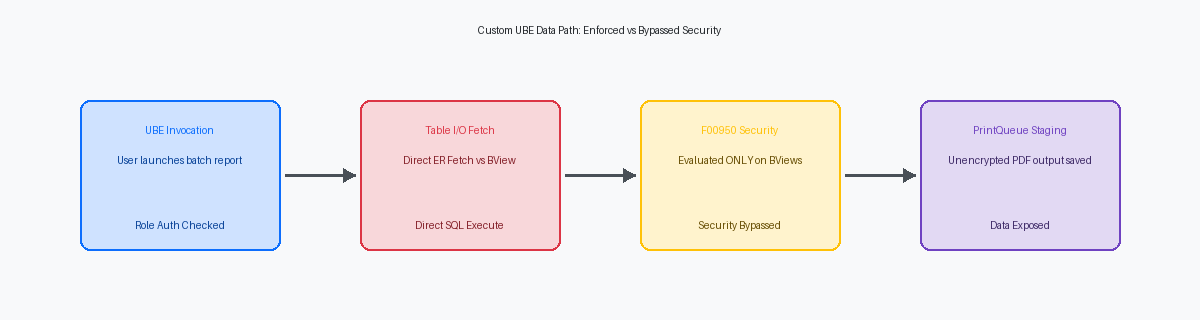
In broad enterprise audits, technical teams consistently find that a majority of custom Universal Batch Engine (UBE)The JD Edwards background processing engine used to run reports, batch jobs, and data processing tasks. reports unintentionally bypass the JDE security kernelThe core software component in JD Edwards that manages user authentication and enforces security rules. (F00950The JD Edwards database table that stores all Security Workbench configurations.). ERP leadership often assumes that active row security on tables like F060116 (Payroll) or F4105 (Item Cost) inherently constrains batch output. It does not. The moment a developer uses direct Table I/ODatabase input and output operations performed directly within JD Edwards Event Rules. in Event RulesThe proprietary scripting language used to write business logic in JD Edwards applications and reports. or invokes a custom C Business FunctionA program written in C used to perform complex calculations or high-performance database operations in JD Edwards. executing JDB_OpenTableA JD Edwards C API function used to open a database table for reading or writing. without explicitly passing the user's security context, engine-level row security is ignored.
Mitigating JDE UBE custom report security and data visibility risks requires evaluating the full output pipeline, not just user execution permissions. Custom batch processes routinely stage unmasked executive compensation, unit margins, and vendor banking details as flat PDF files directly in the Enterprise Server's PrintQueueThe server directory where JD Edwards batch reports are temporarily stored as PDF or CSV files. directory, or blast them via automated distribution lists to unauthorized internal roles. If security controls are not architected directly into the underlying Business ViewA JD Edwards object that links database tables together to expose specific fields to reports and applications. or programmatically enforced at runtime, your custom UBE estate remains a silent, unmonitored backdoor into the database.
Row Security Bypass in Custom Business Views and ER Code
Business Views custom-built for UBEs frequently omit primary security driver fields like Company (CO), Business Unit (MCU), or Address Number (AN8). When a developer builds a view on F0911 or F0101 and drops MCU to clean up join criteria, the EnterpriseOneThe comprehensive suite of ERP applications developed by JD Edwards. runtime SQL generatorThe runtime engine component that translates JD Edwards data requests into standard database queries. loses its target anchor. It cannot append the requisite F00950 row security WHERE clauses to generated database queries. The engine processes the request unfiltered, exposing global GL transactions or master records to users who should only see a single facility.
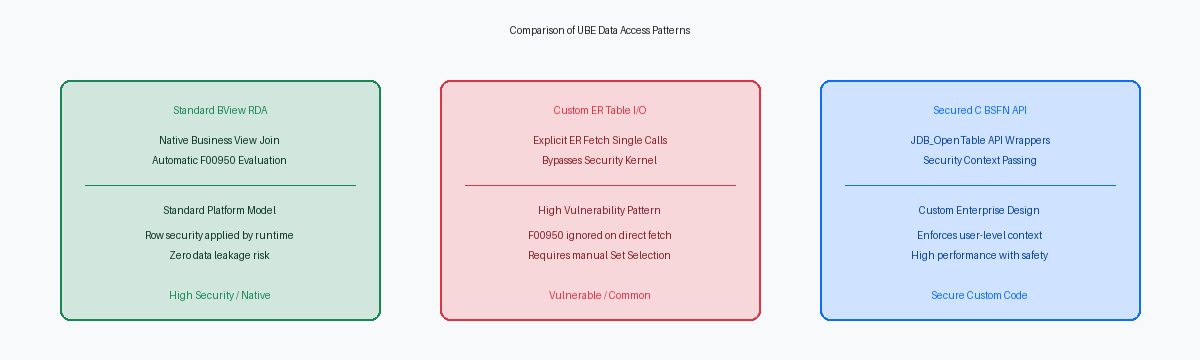
Moving data access into Event Rules introduces a parallel vulnerability through Table I/O. Standard primary Business View section fetches invoke runtime security, but ER Table I/O operations—such as Fetch SingleA Table I/O command used to retrieve a single specific record from a database table. or explicit Select/Fetch Next constructs—execute raw database operations that bypass F00950 security rules entirely. If a custom report calculates YTD balances by scanning F0902 through ER Table I/O, an operational manager restricted to Business Unit 100 will aggregate balances across all operating units without throwing a runtime security exception.
The explicit system function Suppress Row SecurityA system function that disables row-level security checks for the current report execution. inserted into Event Rules turns localized data exposure into a total execution bypass. Developers routinely drop this call into Initialize Section to fix fetch failures or speed up execution over hundreds of thousands of records. Once executed, it permanently disables runtime security evaluation for the entire report execution scope, executing every subsequent database call with administrative visibility regardless of who launched the job.
These flaws routinely hit production because teams validate custom UBEs exclusively under SYSADMIN or CNCConfigurable Network Computing, the system architecture and administration methodology of JD Edwards. profiles during unit testing. Administrative roles operate without F00950 restrictions, so missing key fields generate accurate totals during QA without alerting the team to the underlying exposure. Validating UBE security requires running mandatory test cycles under restricted operational roles and auditing custom business view definitions to confirm MCU, CO, and AN8 are present in every driving table.
The Fallacy of Direct Table Fetching in C Business Functions
When developers write C business functions to bypass Event Rules overhead in heavy batch jobs, the first API they hit is JDB_OpenTable. If that call initializes a table handle without an explicitly bound user handle (hUserA memory pointer representing the active user's session and security context in JD Edwards C APIs.) derived from JDB_InitUserA C API function that initializes a user session and loads their security profile. or JDB_InitBhvr, the runtime executes the database query under full process privileges. In a large portion of custom performance rewrites, developers pass a generic system handle to save a few lines of code, completely stripping out the JDE security kernel from the database round-trip.
This practice usually starts as an optimization effort for custom UBEs processing hundreds of thousands of records. Developers swap standard Business Views for direct C fetches to cut job runtimes from hours to minutes, unaware that background asynchronous UBE threads evaluate F00950 security rules differently than interactive APPLAn interactive application or screen that users interact with in JD Edwards. sessions. While interactive application screens automatically pass the active user session context through the security kernel, background batch processes executing on the Enterprise Server rely entirely on the user handles explicitly constructed within the function call stack.
Wrapping these unvalidated fetches inside generic, reusable C BSFNs opens a permanent data exfiltration vector across your report library. A custom financial UBE calling a direct fetch function against sensitive tables like F060116 for payroll or F4105 for actual costs will bypass row-level security entirely if hUser is absent. The UBE renders restricted data to any user authorized to submit the report, regardless of their F00950 row security setup. Before promoting custom C objects through OWMObject Management Workbench, the change management and development tool in JD Edwards., audit every JDB_OpenTable call to ensure it ties database handles directly to the runtime user context.
PrintQueue Directory Exposure and Unsecured WSJ Output
When an EnterpriseServerThe server that runs JD Edwards business logic, batch processes, and database communication. executes a UBE, the runtime engine writes the raw PDF, CSV, and OSA output directly to the PrintQueue directory as unencrypted flat files before any distribution logic triggers. On a typical production server running AIX or Windows Server 2022, thousands of transient files accumulate here containing raw payroll figures, bank account details, and unmasked customer credit profiles. If system administrators leave default operating system permissions intact, service accounts or local domain users can bypass EnterpriseOne security completely by reading the filesystem directly via SSH or SMB shares.
Inside EnterpriseOne, the vulnerability manifests through misconfigurations in Work With Submitted Jobs (P986110B) and its underlying F986110 Job Master table. Standard out-of-the-box JDE security allows users to query execution status across all environments, meaning a lower-tier clerk can view job headers created by executive roles. Without explicit row security restricting F986110.JCUSER to the logged-in user, any employee who opens WSJWork with Submitted Jobs, the application used to view and manage running or completed batch reports. can highlight a payroll or GL batch job run by the CFO and select Row > View Output to download the unencrypted PDF.
The exposure widens when report bursting is enabled in standard UBE or BI PublisherAn Oracle reporting tool integrated with JD Edwards to format, burst, and distribute reports. definitions. Bursting routines often generate dozens of individual PDF segments and write them to temporary UNC network staging paths before emailing them to distribution lists. Because these staging folders rarely enforce dynamic file-level access control lists, a staging directory created for vendor commission statements frequently remains readable to the entire domain for days.
Hardening this footprint requires immediate administrative action on both the OS and application layers. Restrict the Enterprise Server PrintQueue directory permissions strictly to the JDE service account, and implement row security on F986110 limiting JCUSER queries to equal login_user. Finally, schedule the Job Master Purge (R9861101) to run every 24 hours with the output deletion flag enabled, ensuring transient files exist on disk for less than 24 hours.
Distribution Lists and Delivery Security Failures
Embedded Event Rules (ER) email functions and BI Publisher bursting definitions strip security controls the moment an engine generates output. When a batch report runs under a generic system user account like OVRWRITE or JDE within the enterprise scheduler, execution ignores real-time F00950 Security Workbench re-evaluations for the ultimate output recipients. The engine processes the master dataset using the elevated authority of the batch service user, bypassing the role-based and row-level security models that protect interactive applications like P0801 or P4108.
Dynamic distribution lists built from custom tables compound this vulnerability. Custom UBEs frequently query custom cross-reference tables to assemble email recipient arrays for executive payroll or gross margin reports. If the underlying fetch logic skips explicit row security validation against the recipient's user ID, sensitive operational metrics land directly in the wrong inboxes. An internal transfer who moved out of a business unit on Tuesday will still receive that unit's unredacted financial report on Friday simply because the custom query validates active status in the F0101 Address Book without evaluating current data permissions.
Delivery protocols present an equally critical gap. Standard BI Publisher and native EnterpriseOne mail delivery configurations route generated PDF and CSV outputs over unencrypted SMTP connections on port 25. Raw financial extracts travel as cleartext across internal networks, leaving unmasked payroll and cost structures exposed to basic packet sniffing. Hardening this pipeline requires configuring SMTPS with explicit TLS within the Enterprise Server JDE.INI settings and replacing raw file attachments with secure, authenticated URL references to encrypted repositories.
Enforcing Runtime Row Security in Custom Report Design
Standard Event Rules execution often bypasses row security if developers build custom business views without explicit runtime enforcement. Calling the Set User SelectionA JD Edwards system function used to programmatically append custom filtering criteria to database queries. system function explicitly inside the Initialize Section event forces the UBE engine to evaluate the executing user's security context from the F00950 table before generating the dynamic SQL WHERE clause. This guarantees that ER-driven selection criteria supplements, rather than unintentionally nullifies, the active row-level security mapped to the user's role.
When report processing pushes table I/O down into custom C Business Functions, standard JDB_OpenTable calls frequently run under an unconstrained system handle that bypasses runtime row security entirely. Refactoring these C functions to pass explicit user handles via JDB_InitBhvr ensures F00950 security mappings evaluate continuously during every JDB_SelectKeyed and JDB_Fetch loop. Skipping this refactoring leaves general ledger balances or payroll records vulnerable to full exposure, regardless of what object-level restrictions exist in the environment.
Report security must simultaneously protect the execution definition within F9860 and F00950. If object security grants runtime prompt access without restrictions, end users can easily clear structural data selection filters in the "Prompt for Values" screen prior to submission. Enforcing strict object action security stops parameter tampering and ensures default selection logic remains untouched at queue submission.
Modern architectures isolate batch processing by routing UBE executions through OrchestratorA JD Edwards tool used to build integrations, automate tasks, and expose business logic as REST APIs. wrappers instead of raw EnterpriseOne menu selections. Launching a report through an Orchestration enforces REST-level role validation and input payload sanitization before the job reaches the Enterprise Server job queues. This modern API layer prevents unauthorized users from calling UBE specifications directly while maintaining complete audit trails across enterprise operations.
Hardening UBE Output Repositories and Audit Controls
An unmonitored enterprise server PrintQueue directory frequently hoards tens of thousands of unencrypted PDF and CSV files spanning several years of production runs. Stripping domain user read permissions at the operating system level—limiting file system access strictly to the JDE service account running jdenet_k—is your baseline defense. Combine this with automated nightly shell or PowerShell scripts to purge flat files older than 7 to 14 days. Forcing output management through authorized web client interfaces prevents users from scraping stale report outputs directly off enterprise server shares.
Directory permissions alone will not prevent a user from saving local copies of confidential reports once rendered. In the enterprise server jde.ini file under the [UBE] stanza, set PDF Encryption flags using EncryptPDF=1 alongside 128-bit or 256-bit restriction parameters (PrintAllow=N and CopyAllow=N). This enforces immediate document security on high-sensitivity batch runs like R070901 (Payroll Register) and R09801 (GL Post). The generated output remains encrypted at rest and in transit, preventing unauthorized printing, text copying, or local serialization even if the raw PDF stream is intercepted.
Prevent mass exfiltration of sensitive datasets by disabling CSV export capabilities at the UBE Report Properties level inside Report Design Aid for high-risk objects. To maintain complete oversight, configure auditing on the Job Control Status Master (F986110) table and monitor output view operations. Correlating F986110 records (JCUSER, JCPDFNAME, JCJOBSTATUS) with web application server access logs gives security teams a granular trace history. When investigating potential internal breaches, this log aggregation details the exact timestamp, IP address, and user ID behind every report execution, download, or view event.
