




Most batch application post-mortems I conduct trace back to the same flaw: a developer validates a custom UBEUniversal Batch Engine, the JD Edwards tool used to generate reports and run batch processes. in DV920The standard JD Edwards Development environment for release 9.2, used for initial coding and unit testing. against 50 rows of isolated test data, marks the Object Management WorkbenchThe JD Edwards change management system used to manage, develop, and promote software objects. project complete, and moves on. Within two days, that same report attempts to process 100,000 records in PY920The standard JD Edwards Prototype environment for release 9.2, used for quality assurance and integration testing., deadlocks F41021The JD Edwards Item Location table, which tracks inventory quantities by item, branch, and location. through uncommitted transaction boundaries, or starves the single-threaded job queue configured in F986110The JD Edwards Job Control Status Master table, which tracks the status and details of submitted batch jobs..
Generic enterprise software QA checklists fail JDE applications because they ignore toolset-specific architectural realities. They completely miss low-level runtime mechanics like F983051The JD Edwards Version Layout Detail table, which stores custom visual layout overrides for specific report versions. version layout overrides, CSV spatial grid alignment, and manual rollback behavior across asynchronous C BSFNsBusiness Functions written in C programming language, used to execute complex business logic in JD Edwards.. Executing a dedicated JDE UBE custom report testing checklist before promotion acts as a hard technical gatekeeper, ensuring your objects survive actual enterprise data volumes and runtime environments long before touching production.
Data Selection and Processing Option Integrity
Hardcoded Data Selection set directly within Report Design AidThe JD Edwards tool used to design and modify batch reports and processes. (RDAReport Design Aid, the JD Edwards tool used to design and modify batch reports and processes.) event rules on the Initialize Section event silently appends to or overrides version-level selections defined by end users. If you do not explicitly set the selection append flag using system functions or expose those parameters via Processing Options, the runtime engine builds SQL WHERE clauses that conflict with user inputs. Developers routinely miss this during local unit testing because test versions carry minimal data selection overrides.
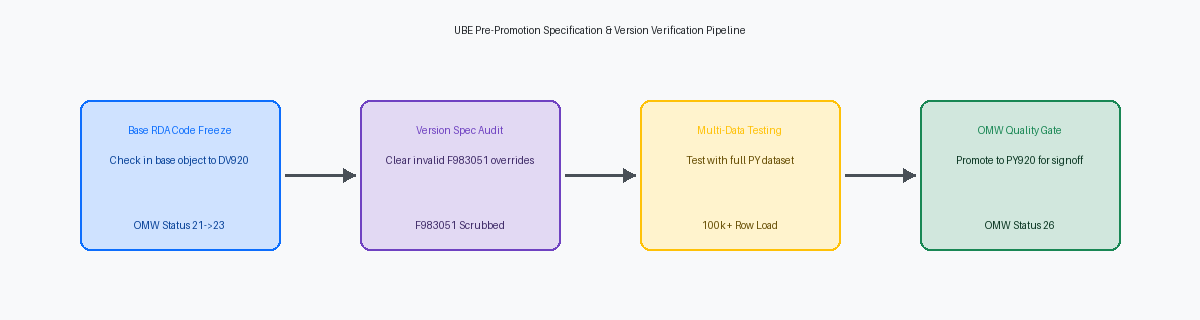
Performance failure in promotion pipelines almost always stems from dataset volume discrepancies between environments. A custom batch process querying F0911The JD Edwards Account Ledger table, which stores detailed general ledger transaction records. or F4111The JD Edwards Item Ledger table, which stores detailed history of inventory transactions. without hitting a composite index will finish in under two seconds in DV920The standard JD Edwards Development environment for release 9.2, used for initial coding and unit testing. across 5,000 records. Take that same report to PY920The standard JD Edwards Prototype environment for release 9.2, used for quality assurance and integration testing. against a 15-million-row F4111The JD Edwards Item Ledger table, which stores detailed history of inventory transactions. table, and the database engine drops the query plan into a full table scan, locking enterprise server job queues for nearly an hour before throwing an OCIOracle Cloud Infrastructure, Oracle's broad platform of cloud services. timeout error. Every custom data selection path across multi-year data loads must map directly to existing index definitions in Table Design AidThe JD Edwards tool used to create and modify database table structures and indexes..
Modifying a Processing Option Data Structure without auditing existing report versions creates silent memory corruption in the C runtime engine. When adding or shifting parameters in a template, you must regenerate the processing option text and validate the specifications stored in the F98306The JD Edwards Processing Option Text table, which stores the text and parameters for report processing options. table. Failing to open, re-save, and re-promote existing report versions against the revised structure causes the runtime engine to read incorrect byte offsets from F98306The JD Edwards Processing Option Text table, which stores the text and parameters for report processing options., passing garbage values into business function parameters and driving corrupt SQL generation.
Version Control, Layout Overrides, and Spec Integrity
Promoting a base report object without accounting for existing version layout overrides in the F983051The JD Edwards Version Layout Detail table, which stores custom visual layout overrides for specific report versions. table is the primary reason post-promotion output fails to reflect code changes. When a developer alters section layouts or grid column order in RDAReport Design Aid, the JD Edwards tool used to design and modify batch reports and processes., version-level specifications stored in F983051The JD Edwards Version Layout Detail table, which stores custom visual layout overrides for specific report versions. preserve the old visual structure unless explicitly cleared or synchronized. The runtime pulls business logic from the updated base object (F98222/F98305) while applying stale visual positioning from the target environment's existing version records. Clearing override records or running the Version Layout Override Merge (R983051) prior to user acceptance testing eliminates ghost layout bugs that consume hours of troubleshooting.
Direct OMWObject Management Workbench, the JD Edwards change management system used to control and promote software objects. object transfers between environments like DV920The standard JD Edwards Development environment for release 9.2, used for initial coding and unit testing. and PY920The standard JD Edwards Prototype environment for release 9.2, used for quality assurance and integration testing. frequently corrupt version specifications if spec merges are performed unevenly. You must audit version specifications using standard OMWObject Management Workbench, the JD Edwards change management system used to control and promote software objects. spec comparison tools or rebuild custom versions directly in the target environment when structural changes are significant. A complete rebuild takes only minutes per version but prevents silent spec corruption where section headers, page breaks, or event rules attached to version overrides randomly disappear during promotion.
Testing must not stop at the developer's custom version. Validate base report execution using standard XJDEStandard JD Edwards report versions pre-configured by Oracle, typically used as templates. or ZJDEStandard JD Edwards report versions pre-configured for interactive applications or specific batch processes. defaults alongside client-specific versions against distinct central object data sources. Running an unmodified XJDE0001 version verifies that core object logic remains sound before evaluating complex data selection or override rules in user-created versions. Doing this across both DV and PY central object data sources guarantees that relational specs and object path codes match before sign-off on package assembly.
Runtime Execution, Job Queues, and Web Submissions
Running a UBEUniversal Batch Engine, the JD Edwards tool used to generate reports and run batch processes. in Report Design AidThe JD Edwards tool used to design and modify batch reports and processes. (RDAReport Design Aid, the JD Edwards tool used to design and modify batch reports and processes.) local mode is a trap for developers validating new code. Local execution uses a Windows client runtime environment that ignores Linux or AIX memory allocation rules, masks null C pointer exceptions inside custom BSFNsBusiness Functions, which are reusable blocks of C or Named Event Rule code used to execute business logic in JD Edwards., and fails to evaluate job queue override mapping. Before promotion to DV or PY enterprise servers, force a server-side submission and audit the Job Master table (F986110The JD Edwards Job Control Status Master table, which tracks the status and details of submitted batch jobs.) record to verify that the job status transitions cleanly from P to D without dropping into E due to missing enterprise server library references.
Batch applications calling asynchronous C BSFNsBusiness Functions written in C programming language, used to execute complex business logic in JD Edwards. — such as F0911The JD Edwards Account Ledger table, which stores detailed general ledger transaction records. journal entry processing or custom inventory allocation functions — introduce immediate race conditions if the parent report terminates before child threads finish execution. Set the explicit wait-for-completion flag within the business function call data structure parameters or implement an event-rules loop checking thread process IDs. In the vast majority of premature job termination incidents during high-volume batch runs, the UBEUniversal Batch Engine, the JD Edwards tool used to generate reports and run batch processes. kernel closes the process handle while background C threads are still writing to memory, corrupting transaction headers and leaving orphaned records in staging tables.
When triggering batch reports via Application Interface ServicesApplication Interface Services, a JD Edwards server that enables integration with external mobile, cloud, and IoT applications. (AISApplication Interface Services, a JD Edwards server that enables integration with external mobile, cloud, and IoT applications.) or Orchestrator StudioA JD Edwards web-based application used to build orchestrations that automate business processes and integrate systems. REST calls, standard user execution contexts change. Orchestrations submit reports under designated proxy user profiles, which often lack proper environment overrides or object-level security in the submission log. Testing web submissions requires querying F986110The JD Edwards Job Control Status Master table, which tracks the status and details of submitted batch jobs. by JCUSER and JCENV to confirm the payload correctly passes data selection variables, routes to the designated single-threaded job queue (such as QB7334), and respects target user authorization masks before promoting the orchestration to production.
Output Rendering: PDF, CSV Export, and BI Publisher XML
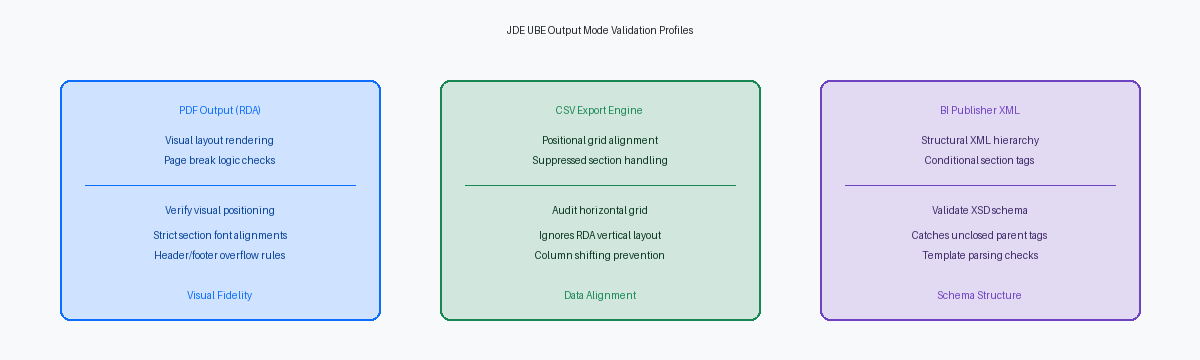
Developers routinely design UBEUniversal Batch Engine, the JD Edwards tool used to generate reports and run batch processes. layouts for PDF appearance, assuming the CSV export will automatically match. It will not. The JDE runtime generates CSV data based strictly on absolute horizontal grid alignment and section execution order, completely ignoring visual vertical placement or section overlapping in Report Design AidThe JD Edwards tool used to design and modify batch reports and processes. (RDAReport Design Aid, the JD Edwards tool used to design and modify batch reports and processes.). If Variable A is offset by even a single pixel to the left of Variable B's column header, the CSV engine creates an extra column shift, cascading errors down a multi-column extract. Before promoting code across environments, strip all visual overlapping and enforce precise numerical grid coordinates on every report variable.
When delivering output via BI PublisherAn Oracle reporting tool used to design and generate highly formatted documents from XML data., a report layout that runs clean in standard PDF often generates malformed XML trees under specific data conditions. Conditional section suppression—such as hiding a detail header based on business unit logic without suppressing the child detail section—breaks the XML schema hierarchy silently. The output engine emits an opening XML tag for a parent element, skips the section during execution, and then attempts to close a child tag without a valid container, causing the Java XDO engine to throw a parsing exception. Validate your XML schema output across every conditional branch in RDAReport Design Aid, the JD Edwards tool used to design and modify batch reports and processes. before registering the template in P95640The JD Edwards interactive application used to manage BI Publisher Report Definitions..
Report testing must cover three strict data volume boundaries: zero records, exactly one record, and 10,000+ records. Zero-data runs frequently crash custom C business functions tied to Do Section event rules when pointer arrays are initialized without safety checks, or produce orphaned PDF headers with corrupt page counters. Conversely, large data sets expose memory leaks in running totals and bad page-break logic, where accumulators fail to clear between level breaks after line counts exceed 9,999. Verify that event-level page break logic resets MATH_NUMERIC aggregate variables on every driver section shift, regardless of buffer size.
Performance Profiling, Memory Footprints, and Tracing
Running a custom UBEUniversal Batch Engine, the JD Edwards tool used to generate reports and run batch processes. against a tiny DV dataset will mask underlying architectural flaws that collapse under full production volumes. Evaluating execution timings requires parsing jdedebug.log and ube.log to identify nested SQL fetch loops executing inside high-frequency section events. If a report performs a FETCH EQUAL on the F4111The JD Edwards Item Ledger table, which stores detailed history of inventory transactions. or F0911The JD Edwards Account Ledger table, which stores detailed general ledger transaction records. table for every single record in the driver section, a two-minute test run on a few hundred rows expands exponentially to a multi-hour bottleneck on a 250,000-record dataset. Identifying these single-row fetch patterns in the debug trace allows developers to refactor logic into single SQL views or aggregate C BSFNBusiness Functions written in C programming language, used to execute complex business logic in JD Edwards. calls before code moves upstream.
Custom C Business FunctionsBusiness Functions written in C programming language, used to execute complex business logic in JD Edwards. called within main report Do Section events represent the single largest risk for server-side memory degradation. When custom C code allocates memory pointers using API calls like jdeAllocMiscSpace, failure to explicitly release those pointers using jdeFreeMiscSpace prior to function exit leaks memory on every driver loop iteration. A batch job processing 100,000 sales order lines will rapidly consume available heap memory on the Enterprise Server, leading to memory exhaustion, corrupted pointer references, and silent termination of the runubeThe command-line utility used to execute JD Edwards batch processes (UBEs) directly on the enterprise server. kernel process.
Validating execution runtimes against hard operational SLAs is a mandatory prerequisite for OMWObject Management Workbench, the JD Edwards change management system used to control and promote software objects. status advancement. A nightly inventory reconciliation job must comfortably execute under a 15-minute window during load testing to avoid overlapping with downstream pick slip generation queues. If performance metrics fail to meet these established SLA thresholds during volume testing, developers must refactor the processing logic rather than requesting queue priority overrides from the CNCConfigurable Network Computing, the technical architecture and system administration methodology of JD Edwards. team. Signed off code entering Object Management WorkbenchThe JD Edwards change management system used to manage, develop, and promote software objects. stage 26 must prove stability under stress, not just pass basic functional validation.
Transaction Processing, Manual Rollbacks, and Restartability
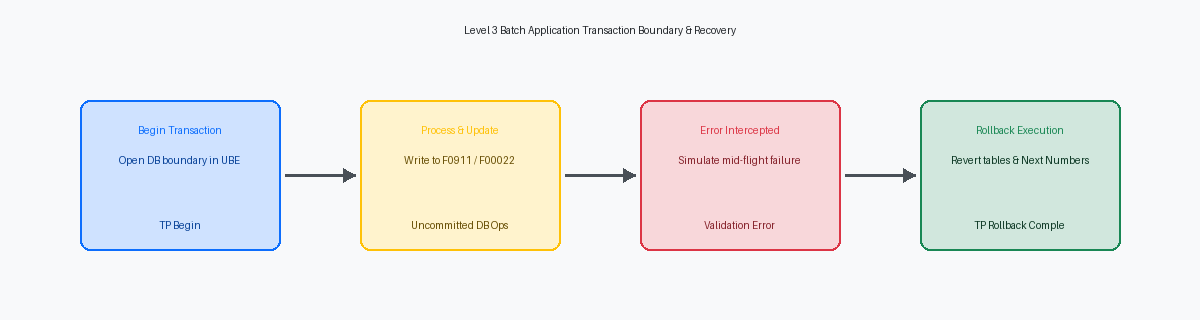
Batch reports performing Level 3 processing across core tables—such as F0911The JD Edwards Account Ledger table, which stores detailed general ledger transaction records., F03B11, or F4111The JD Edwards Item Ledger table, which stores detailed history of inventory transactions.—must explicitly manage transaction boundaries through report properties or business functions. Wrapping C BSFNsBusiness Functions written in C programming language, used to execute complex business logic in JD Edwards. or Table I/O operations in an active transaction requires selecting Include in Transaction on specific table handles and issuing manual commit transaction calls upon batch completion. Leaving these settings at standard defaults means a mid-stream database disconnect will permanently commit partial header records while dropping required child detail lines.
Rigorous testing before promotion demands a simulated mid-flight execution failure, such as terminating the runubeThe command-line utility used to execute JD Edwards batch processes (UBEs) directly on the enterprise server. kernel thread midway through execution, to verify system table behavior. You must prove that Next Numbers managed in F0002The JD Edwards Next Numbers table, which manages sequential document and transaction numbers. and F00022The JD Edwards Next Numbers table for system-specific or transaction-specific sequence numbers. roll back completely without leaving sequence gaps in audit-sensitive tables like F0411. If an aborted execution burns hundreds of document numbers or leaves F0002The JD Edwards Next Numbers table, which manages sequential document and transaction numbers. incremented despite zero inserted records, your transaction boundary failed to encapsulate the X00022 Next Number retrieval routine.
Finally, execution failures must leave custom staging tables—such as 55/56 series interface files—in a deterministic state that supports immediate re-execution. A failed run must cleanly flag processed records back to 'Pending' or set an explicit 'Error' status without creating orphan records in custom work tables. If recovering from a batch crash requires a database administrator to execute manual SQL update scripts before a business user can re-trigger the job from Work With Submitted Jobs, the object fails production readiness standards.
Enforcing these pre-promotion technical gates on custom UBEsUniversal Batch Engine, the JD Edwards tool used to generate reports and run batch processes. prevents unindexed F0911The JD Edwards Account Ledger table, which stores detailed general ledger transaction records. table joins, corrupted spec merges, and orphaned transaction records from crashing enterprise server job queues in production.
