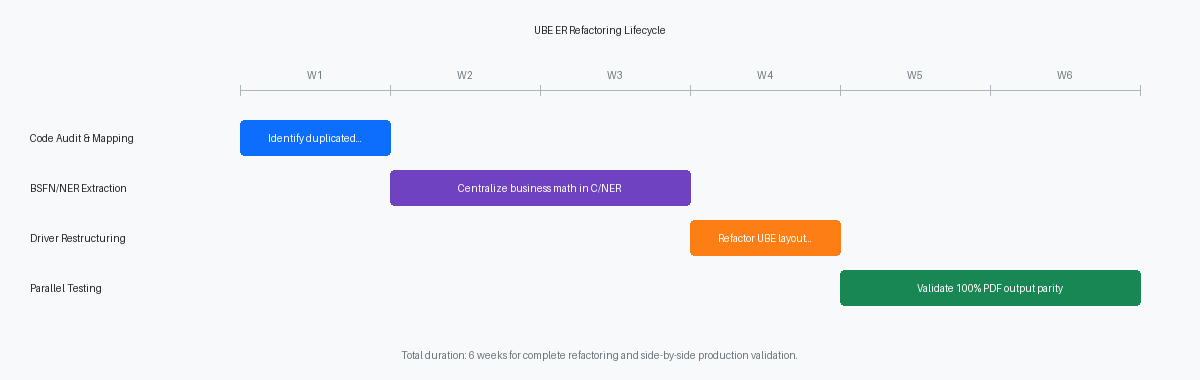

I routinely audit custom report estates where a significant portion of Event RulesJD Edwards' proprietary scripting language used to add business logic and event-driven behavior to applications and reports. code—often 30% to 40%—consists of identical logic copy-pasted across three or four conditional sections. Developers clone a section just to alter a visual layout for a specific branch or order type, duplicating hundreds of lines of complex inventory or tax calculation ER in the process. When business rules inevitably change, a developer patches Section A, forgets Section B, and introduces silent data corruption that takes weeks to catch in production.
To maintain clean report estates in EnterpriseOneOracle's JD Edwards EnterpriseOne, an integrated Enterprise Resource Planning (ERP) software suite., senior developers working with JDEJD Edwards, an enterprise resource planning (ERP) software suite developed by Oracle. UBEUniversal Batch Engine, the JD Edwards background processing engine used to run batch jobs, reports, and PDF generation. custom sections avoid duplicated event rules by isolating calculations inside C BSFNsC Business Functions, which are reusable business logic modules written in C to perform complex calculations or database operations., Named Event Rules (NERs)Reusable business logic modules in JD Edwards created using Event Rules scripting instead of C programming., or scope-defined subroutines. Decoupling data processing from visual layout sections reduces custom ER volume substantially, eliminates execution drift across conditional outputs, and stabilizes batch performance.
The Root Cause of Fragile Enterprise Reports
Custom UBE development in Report Design AidThe JD Edwards development tool used to design, layout, and program batch reports and UBEs. often degenerates into maintenance debt because developers take the path of least resistance when handling changing requirements. When a business requests a distinct layout variation or a separate data selection stream for foreign currency sales orders, developers rarely refactor the driver section. Instead, they copy the primary custom section, paste it three or four times inside RDA, and modify the data selection on each instance to avoid disturbing existing production logic.
Inspect almost any mature EnterpriseOne 9.2 installation and you will find custom batch applications carrying 50 to 80 lines of identical Event Rule code copied across four or more custom conditional sections. This duplicated EREvent Rules, the proprietary scripting language used in JD Edwards to define business logic. usually manages repetitive operations: manual table I/O fetches against F4211The Sales Order Detail File table in JD Edwards, which stores individual line-item information for sales orders. or F0911The Account Ledger table in JD Edwards, which stores detailed general ledger transaction records., foreign exchange rate calculations, or custom security overrides executing inside the Do Section event of every single section.
This copy-paste strategy creates severe fragility during standard system maintenance cycles. When tax calculation logic shifts or a new chart of accounts structure goes live, the developer assigned to modify the report updates the primary driver section, tests standard domestic transactions, and promotes the code. They routinely miss the third or fourth custom section because those sections only fire under specific processing option flags, distinct branch/plants, or non-standard document types.
The report passes technical object management checks because RDAReport Design Aid, the JD Edwards development tool used to design and program batch reports. compilation only checks syntax, but silent data corruption hits production during the next period-end execution. One section processes records using the revised business rules while an un-updated section writes flawed calculations to target tables. Resolving these integrity errors requires analyzing execution logs in Event Rule DebuggerA JD Edwards developer tool used to step through and troubleshoot Event Rules code line by line during execution., burning developer days on a defect pattern that structured UBE design eliminates completely.
The Real Maintenance Cost of Cloned ER Code
When a developer copies fifty lines of Event Rules from a detail section's Do Section event into a conditional summary section, they introduce immediate technical debt. In enterprise environments running complex financial or inventory reports, troubleshooting this cloned code accounts for a substantial share of support tickets on legacy UBE objects. What looks like a brief shortcut during initial report development becomes a permanent tax on the application support team.
The operational risk surfaces the moment business logic evolves. Consider a custom sales analysis UBE where currency conversion or freight allocation logic is modified in the primary detail section but overlooked in the subtotal section. That out-of-sync logic between detail and summary sections causes financial report imbalances that take days to diagnose, typically discovered by finance teams during month-end close rather than during standard unit testing. The developer must then trace duplicate event trees across hidden, conditional, and driver sections just to pinpoint where the calculations drifted apart.
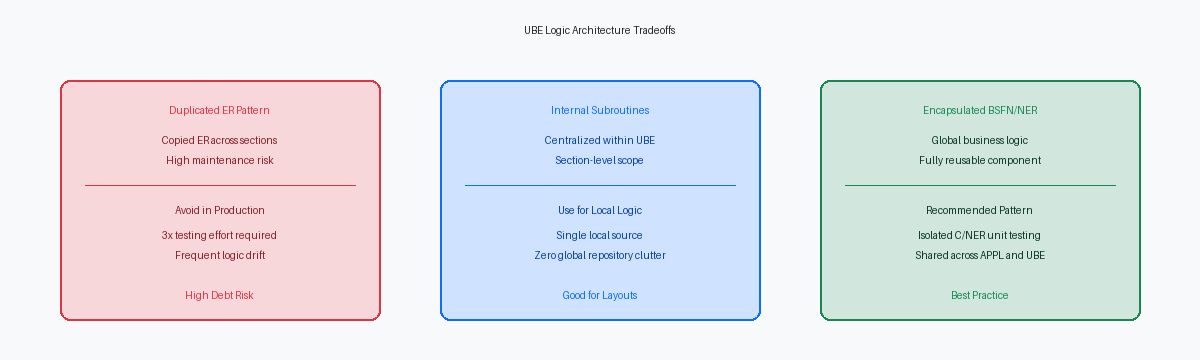
The downstream impact on quality assurance is equally severe. A single-line bug fix to a tax calculation formula should take under an hour to promote through Object Management WorkbenchThe change management and version control system used in JD Edwards to manage development objects.. When that formula is duplicated across three separate custom sections, QA teams must execute triple the regression testing cycles per production bug. Each section execution path—detail, subtotal, and grand total—requires independent data validation against table inputs like F0911 or F4211, delaying emergency production builds.
Centralizing Logic with Business Functions and Subroutines
Replacing duplicated Event Rules across conditional or custom sections starts with standardizing business logic into a single Named Event Rule (NER) or C Business Function. When a complex discount allocation algorithm lives in the Do Section event of four distinct report sections, any tax rate update or threshold tweak requires four separate edits in OWMObject Management Workbench, the change management and version control system used in JD Edwards. and four chances to introduce mismatched variables. Moving that logic into a single reusable BSFNBusiness Function, a reusable block of code (written in C or Event Rules) that performs specific business logic. driven by a targeted data structure guarantees consistent calculation results across the entire UBE execution context while cutting your Event Rules footprint by 60% to 80%.
For logic that strictly governs report presentation—such as suppressing zero-balance detail lines or dynamically toggling section visibility based on processing options—creating global BSFNs adds unnecessary object management overhead. Internal UBE SubroutinesSelf-contained sections of code within a report designed to perform specific tasks, reusable within that same object. fill this gap with zero overhead, keeping section-specific formatting logic contained within the UBE definition without cluttering the global Object Management Workbench repository. A single Execute Subroutine call placed inside multiple section driver events allows you to standardize page break flags and section headers across multiple custom conditional sections without creating an extra object in your system.
Decoupling heavy processing from the UBE layout engine fundamentally changes how you debug code. When validation rules sit inside C Business FunctionsReusable business logic modules written in C to perform complex calculations or database operations. rather than section event rules, developers can unit-test logic directly using C debuggers in Visual Studio or standard test harnesses without waiting 3 to 5 minutes for the Universal Batch EngineThe JD Edwards background processing engine used to run batch jobs, reports, and PDF generation. to parse data selections, initialize PDF drivers, and build specs. Isolating financial math from report presentation drops developer unit-testing cycles from minutes to seconds, turning complex multi-currency adjustments into clean, verifiably isolated modules before they ever touch a report event.
Architecting Clean Data Selection and Driver Sections
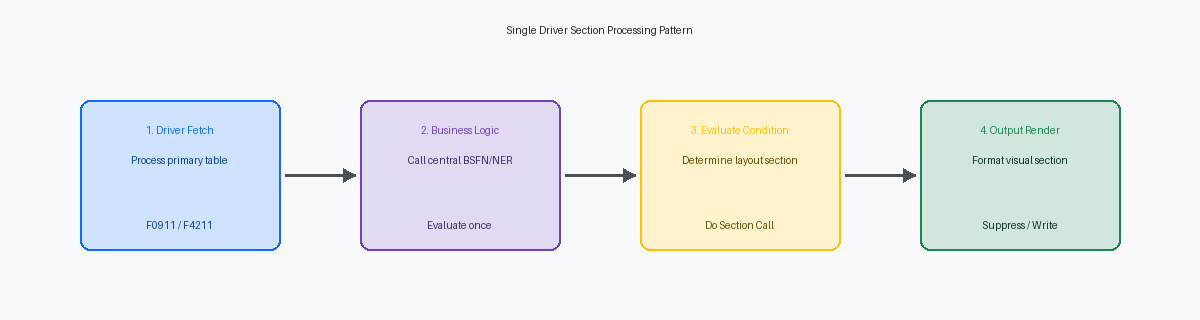
When developers clone Event Rules across multiple conditional sections to handle varied invoice or order formats, they build immediate technical debt. A resilient report architecture relies on a single invisible driver section bound to the underlying business view—such as a join on F4211 and F42119The Sales Order History table in JD Edwards, which stores historical sales order detail records.. The driver processes table rows, evaluates processing options, and executes specific layout sections on demand using the Do Section system function. Passing key data downstream through Section InterconnectA mechanism in JD Edwards reports used to pass data and variables between different sections of a UBE. parameters ensures that downstream sections act as pure presentation layers, completely eliminating the need to re-query the database or duplicate calculation logic across five separate Do Detail events.
Decoupling evaluation logic from formatting requires disciplined use of the Suppress Section WriteA JD Edwards system function that prevents a report section from printing or writing its output to the PDF. system function. Rather than scattering IF/ELSE conditions across conditional layout sections, consolidate validation inside the driver section's Do Detail event. When a sales order line fails status checks or falls outside current reporting thresholds, fire Suppress Section Write immediately within the driver to prevent output generation and skip child Do Section calls entirely. This structural separation keeps presentation sections strictly limited to mapping Section Interconnect values to display variables, preventing logic drift when formatting requirements change.
Hierarchical driver architecture delivers significant performance gains on high-volume batch runs processing 500,000+ records. In unstructured UBEs, every active conditional section independently triggers secondary table IO against master tables like F0101The Address Book Master table in JD Edwards, storing core entity information like customers, suppliers, and employees. or F4101The Item Master table in JD Edwards, storing primary definition and metadata for inventory items.. Centralizing table reads inside the primary driver and passing values through Section Interconnect data structures removes these redundant SQL SELECT statements from the batch engine loop. On heavy overnight inventory allocations or invoice print runs, this clean decoupling cuts overall execution overhead by up to a third and prevents enterprise server CPU spiking.
Modernizing Legacy UBEs Without Breaking Production
Never refactor a legacy UBE based on code inspection alone. When modularizing event rules across custom sections, execute identical data selections in your PY environmentPrototype environment, a JD Edwards environment used for testing and validating configurations and code before production. and perform complete data output validation via UBE compare PDF outputs. For report layouts outputting formatted text or raw CSVs, diffing the generated files against the legacy baseline catches hidden execution flow bugs—like an unexpected Do Section fire order or an uninitialized RV variable—that static code reviews miss. If a single financial accumulator shifts by a fraction of a cent, the build stays in DVDevelopment environment, the initial JD Edwards environment where developers write and test code changes..
Prioritize your modernization backlog by transactional throughput rather than developer convenience. Focus refactoring efforts on high-volume financial and inventory batch processes running over 50,000 records monthly, such as custom operational subledger rollups or daily stock movement feeds. Re-architecting low-volume monthly summary reports that process 200 rows yields negligible runtime gains. Streamlining high-frequency UBEs directly reduces temp table bloat and database lock contention on primary tables like the F4111The Item Ledger table (Cardex) in JD Edwards, which tracks all inventory transactions and stock movements. and F0911.
Promoting refactored reports through Object Management Workbench requires more than just passing unit tests; it demands structural enforcement. Institute an internal development standard that strictly forbids ER copying across sections for all new and modified objects. If two sections require identical inventory valuation logic or tax calculations, mandate the use of a standalone C Business Function or Subroutine. Developers must route shared parameters through a defined Data Structure (DSTR)A defined set of parameters used to pass data between JD Edwards objects, such as business functions and forms. rather than copy-pasting ER blocks across driver and custom sections.
This policy prevents the re-accumulation of technical debt across future Tools Release upgrades and Application Updates. When business logic changes, your team modifies a single compiled C BSFN or NER rather than editing multiple section events across legacy reports. If you are refactoring a custom code estate with over 5,000 objects to prepare for a Tools Release 9.2.8 upgrade, eliminating redundant section logic is the single most effective way to protect long-term stability.