




Most downstream integration failures in enterprise JDEJD Edwards, an enterprise resource planning (ERP) software suite by Oracle. environments stem from file collisions, race conditions during file lock windows, or missing environment context—not bad data payloads. When a custom UBEUniversal Batch Engine, a JD Edwards background process used for running reports and batch jobs. like R554210B drops flat files into a staging directory using default print queue conventions or raw job numbers, middleware parsers break the moment concurrent schedules overlap.
Establishing a standardized JDE UBE output file naming convention for integrations is a mandatory engineering baseline rather than a cosmetic exercise. Enforcing a deterministic token structure—combining system tags, microsecond-level execution timestamps, and temporary write extensions—eliminates ingestion conflicts before the target system reads line one. The following operational checklist details the token standards, atomic write patterns, and processing option configurations required across your EnterpriseOne 9.2 custom development estate.
Core Standard for Integration File Naming
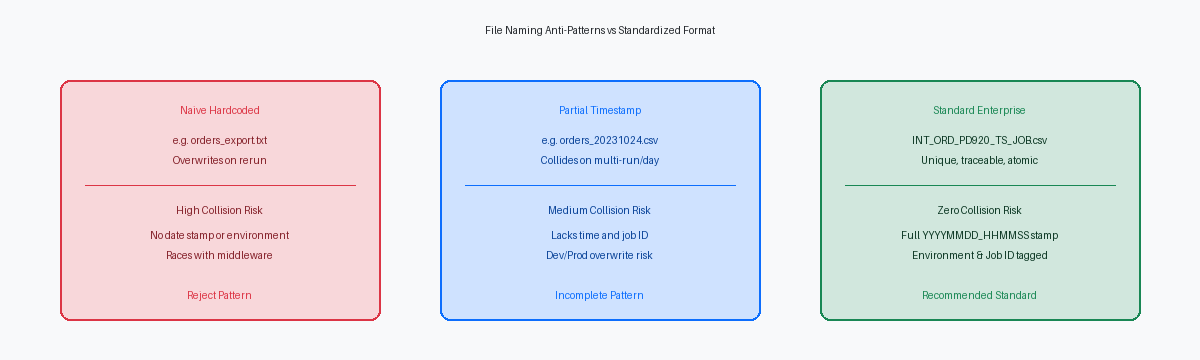
Hardcoded flat file names like orders.csv dropped onto an Enterprise Server mount will overwrite data when concurrent scheduler threads trigger the same C BSFNC Business Function, a compiled C program used in JD Edwards to execute complex business logic. or Flat File API call simultaneously. Enterprise Server multithreading on Linux or AIX kernels demands a deterministic tokenized syntax to prevent kernel-level file locking collisions. The baseline structure requires four compulsory tokens: Interface Identifier, Environment Tag, ISO Timestamp, and EnterpriseOne Job Number. A structure like INT_ORDEXP_DV920_20231024_143022_123456.csv satisfies this standard, where INT_ORDEXP identifies the business process and 123456 explicitly links the file back to its specific execution record in the F986110The JD Edwards system table that tracks the status and details of all submitted batch jobs. Server Jobs table.
Enforcing uppercase characters for static string prefixes while keeping dynamic extensions in lowercase creates instant visual clarity and precise programmatic filtering for automated file pollers. Third-party MFTManaged File Transfer, a technology platform used for secure and automated data transmission between systems. tools and middleware like Oracle Integration CloudA cloud-based integration platform by Oracle used to connect applications, automate processes, and analyze data. rely on POSIXA set of standard operating system interfaces based on Unix, ensuring compatibility between different platforms. regex filters to sweep staging locations. Combining high-precision timestamps down to the second with the system job number guarantees that even if concurrent instances of a custom outbound UBE run against different data selection sets at the same second, discrete files generate without thread contention.
Never stage these outbound integration files inside the standard EnterpriseOne PrintQueue directory. Standard report output paths are continuous targets for automated maintenance routines like R9861101 and OS-level shell scripts designed to purge old PDF and CSV report outputs. Dedicated export directories must be mapped on isolated local or network mount points, strictly separated from standard job execution queues to prevent automated maintenance jobs from sweeping unconsumed payload files.
Timestamp Formatting and High-Frequency Execution
Standardizing timestamps on outbound integration files requires strict format enforcement at the engine level rather than relying on default system variables. Fetching JDE system dates via standard Event RulesJD Edwards' proprietary visual programming language used to customize application and report logic. introduces immediate runtime failures because the EnterpriseOne logic engine evaluates date structures using the executing user profile's localization settings. A job running under user profile SCHEDULER_US yields 03042026 for March 4th, whereas SCHEDULER_EU yields 04032026. Implementing compact ISO 8601 formatting (YYYYMMDD_HHMMSS) across all export routines eliminates date interpretation errors between host Linux Enterprise Servers and external Windows middleware targets.
Developers often try to fix this with ER string parsing, but standard ER functions still evaluate against user-level date masks. Direct invocation of C business functions like B4700050 (Get System Date and Time) or B0500011 bypasses user profile preferences by fetching system ticks directly from the operating system kernel. Explicitly passing a hardcoded format mask within the BSFN data structure ensures the output string remains deterministic, yielding uniform file names regardless of who or what triggers the UBE run.
High-frequency interface jobs executing on 60-second scheduler intervals introduce additional concurrency risks. When parallel job queues execute simultaneous batch runs—such as rapid inventory allocation updates—second-level timestamp precision is insufficient. Two threads generating files in the same second create identical names like INV_OUT_20260330_140501.csv, leading to operating system lock collisions or silent file overwrites. High-frequency outbound processes must append millisecond precision or concatenate the F986110 Server Handle / Job Number (JCJOBNBR) onto the string suffix, guaranteeing absolute file path isolation across multi-threaded Enterprise Server environments.
Environment Tags and Cross-System Isolation
A single mistargeted outbound flat file from PY920 dropping into a shared vendor SFTP directory can trigger widespread duplicate financial transactions. Mandatory environment tokens—specifically DV920, PY920, and PD920—embedded directly into the filename structure create a hard firewall against cross-system contamination. When non-production and production enterprise servers map to a shared SAN mount or cloud storage bucket, these tokens provide the explicit isolation required by downstream automated processing systems.
Hardcoding environment strings into Event Rules creates an immediate Object Management WorkbenchThe JD Edwards change management and version control system used by developers to manage software objects. promotion hazard. Developers who hardcode explicit pathcode strings in custom BSFNs or NERs force manual code retrofits during OWM promotion to production. The proper approach invokes the C API uSysGetEnv or references the SL EnvironmentName system variable dynamically at runtime. Fetching the environment token programmatically ensures that the output filename shifts from DV920 through PY920 to PD920 automatically without requiring report version overrides or ER modifications.
Multi-foundation architecture and shared NAS mounts across non-production instances introduce subtle file-collision vectors. Combining environment tags with system prefixes—such as E1_PY920_AP_—isolates file streams when separate enterprise servers output data to identical mount points. This standard prevents concurrent UBE executions in DV920 from overwriting parallel test payloads generated during end-to-end user acceptance testing in PY920.
Middleware pollers built on platforms like Oracle Integration Cloud or Boomi must enforce token-based filename filtering. A poller monitoring /outbound/payroll/ must evaluate the environment token in the header and route any file marked PY920 strictly to non-production staging tables. Enforcing this token filtering at the middleware poller level prevents manual UBE executions in test environments from pushing test data into live production endpoints.
Atomic Writes and Integration Handoff Protocols
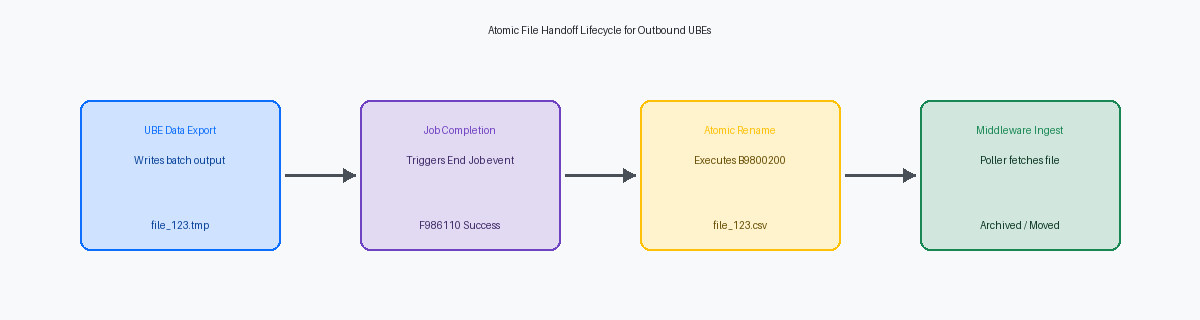
Middleware platforms like MuleSoft, Dell Boomi, or Apache Camel typically poll target file directories on tight 30-to-60-second cycles. When a batch process writing tens of thousands of outbound records targets inventory_export.csv directly, the polling service routinely attempts to ingest the file while the EnterpriseOne batch kernel still holds an open file handle. The downstream system either ingests a truncated payload or fails with a file lock exception, requiring manual operational intervention to clean up orphan records.
To eliminate these race conditions, configure the batch process to generate output using a temporary .tmp extension throughout the execution of the main driver section. Once processing completes successfully without errors, call the C business function B9800200 (Execute External Program) within the UBE End Job event to trigger a native operating system rename command. Transforming inventory_export_20260331.tmp into inventory_export_20260331.csv executes as an atomic filesystem operation in milliseconds, presenting a fully written, locked file to the waiting middleware.
Pair this atomic handoff pattern with a standardized directory architecture that maintains isolated staging and archive subdirectories on the enterprise server host. Middleware integration adapters must read exclusively from /outbound/staging and immediately move processed payloads into /outbound/archive upon successful ingestion. Unmanaged output directories routinely exhaust enterprise disk volumes—accumulating uncompressed flat files over several months easily consumes hundreds of gigabytes of storage. Implement a daily script to strictly purge archived output older than 30 days.
Dynamic File Naming via Processing Options
Hardcoding target directory paths or base naming patterns inside Event Rules or C business functions forces code modifications for basic infrastructure shifts. A hardcoded path like /mnt/interfaces/fin/outbound/ buried in a custom UBE report header event guarantees an emergency OMW cycle the moment CNCConfigurable Network Computing, the system administration and technical architecture methodology for JD Edwards. migrates an OS mount or renames an SFTP landing directory. Expose the base destination path, file mask, and file extension as discrete parameters on a dedicated Processing Option (PO) template. This puts operational authority where it belongs: in the hands of CNC and interface administrators using standard version management.
Implement a simple token substitution parser inside your report design to translate runtime variables embedded in the PO text string. Standardize on unambiguous tokens such as %DATE% for system date, %TIME% for execution time, %ENV% for the active JDE environment, and %JOB% for the server job number. When a PO string is set to INV_OUT_%ENV%_%DATE%_%JOB%.csv, your ER parses SL Environment and SL Job Number during report initialization, yielding an output string like INV_OUT_JPD920_20231024_849201.csv on OS disk.
This decoupled pattern enables zero-code promotions across DV920, PY920, and PD920. Promoting a custom UBE through OWM requires zero code retrofitting between non-production and production paths, because each environment maintains its own version-level PO values. If an enterprise interface engine modifies its target landing folder or requires a new file extension like .dat instead of .csv, a CNC engineer updates the PO version setting in seconds, entirely bypassing package builds and deployment downtime.
Integration Handoff Operational Checklist
Production schedulers firing batch exports without operational controls cause a significant share of post-go-live integration incidents. Before placing any flat-file exporting report into enterprise schedulers like Redwood or Tidal, run your technical lead through a mandatory pre-production validation check. This protocol prevents silent handoff failures and ensures zero manual intervention after deployment.
Traceability starts at the database level. Your output process must write the generated file name and path to a custom cross-reference table like F554301, linking it directly to the F986110 Job Control Master via Job Number (JCJOBNBR) and Process ID. Without this bridge, operations personnel waste 30 minutes or more per ticket parsing JDE printqueue logs. On the OS layer, output directories on Enterprise Servers running Linux or AIX must enforce explicit POSIX permissionsStandard operating system file permissions used to control read, write, and execute access on Unix-like systems. such as chmod 664 owned by the JDE service group. Relying on default umaskA Unix command and setting that determines the default file permissions for newly created files. settings frequently leaves generated files unreadable by middleware accounts (e.g., Boomi, MuleSoft, or OIC), causing silent downstream pipeline stalls.
Unmanaged staging directories represent a serious stability risk for underlying infrastructure. Generating thousands of outbound payload files daily will rapidly fill critical /u01 or /docker root volumes on your Enterprise Server, causing kernel panics that take down all JDE call object kernelsJD Edwards server processes that execute business logic and handle requests from interactive applications..
The final checks validate atomic .tmp-to-final file renames, dynamic Processing Option pathing across Environments, empty file suppression, and immediate automated email alerts for failed UBE steps. Signing off on all points during final staging testing isolates your integration layer from batch pipeline crashes.
