




In over two decades of enterprise JDEJD Edwards, an enterprise resource planning (ERP) software suite developed by Oracle. code audits, I still routinely see developers build brittle batch architectures using custom work tables (F55/F56Custom user-defined database tables in JD Edwards reserved for specialized client data or staging.) or Processing Option overrides just to pass a document number, batch type, or processing status between batch jobs. Adding an auxiliary work table to pass three fields introduces unnecessary database I/O, concurrency locks, and orphan-record cleanup routines for a task that native runtime functionality handles cleanly out of the box.
A well-architected Report Interconnect (DSTR)A JD Edwards data structure mechanism used for passing parameters directly between batch jobs. data structure in Report Design AidThe visual development application in JD Edwards used to build and design batch reports. is the standard, encapsulated mechanism for passing parameters across parent and child UBEsUniversal Batch Engines, the background report processing programs in JD Edwards.. When configuring a JDE UBE report interconnect to pass values between reports, the key is mastering parameter directionality (IN, OUT, BOTH) and managing the runtime trade-offs between synchronous and asynchronous execution. Enforcing these design rules at the data structure level eliminates hidden state dependencies and ensures chained batch jobs run predictably in production.
Designing the Report Interconnect Data Structure
A target batch process should treat its Report Interconnect data structure as an explicit, public API contract. Opening the Report Interconnect Data Structure editor in Report Design Aid (RDA) binds Data DictionaryThe central JDE repository defining database field attributes, data types, and edit logic. items directly to the report header without adding runtime execution overhead. This structure establishes the exact inbound parameters, outbound return values, or bi-directional state that the child UBE exposes to any calling parent object across your environment.
Directional flags—IN, OUT, and BOTH—must be assigned deliberately rather than accepting the editor's defaults. In the compiled C batch routines that the UBE runtime executes on the enterprise server, misconfigured directional flags create uninitialized variable traps or memory corruption when pointers swap back to the parent stack. If a child batch process validates a batch number without modifying it, locking that item as an IN parameter guarantees the parent process maintains deterministic memory integrity throughout the run.
Bind concrete Data Dictionary items rather than generic placeholder strings like a 100-character EV01 or TEXT200. Standard items like MN22A (Math Numeric) or DOCO carry native database formatting, edit rules, and implicit decimal scale metadata into the data structure. Routing currency amounts or units of measure through generic character buffers strips that decimal handling, introducing hard-to-trace truncation errors across manufacturing and financial reporting jobs. Designing a clean Report Interconnect data structure on day one prevents downstream retrofits across your batch architecture.
Synchronous Versus Asynchronous RI Execution Modes
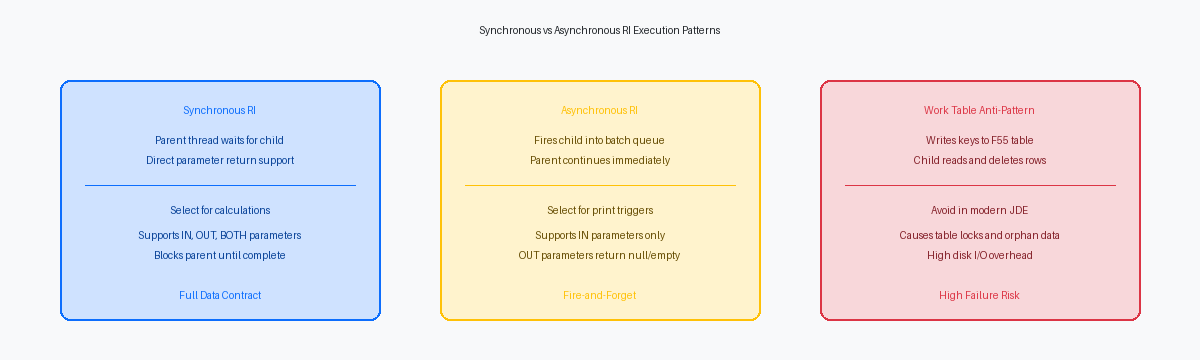
Selecting the synchronous execution flag—labeled "Wait for Completion" in Event RulesThe internal visual scripting engine used to construct programming logic in JD Edwards.—forces the parent UBE engine thread to pause processing at the call location. The parent thread enters a waiting state, polling the child process until it reaches its final cleanup phase and passes back its exit status code. This thread-blocking behavior is required whenever the parent expects values passed back through OUT or BOTH parameters, such as a calculated freight total or an updated batch control number. If the child fails, the parent receives that status directly, enabling immediate conditional error handling on the next line of logic.
Disabling "Wait for Completion" switches execution to asynchronous mode, causing JDE to call jdeLaunchUBEExA standard C API function in JDE used to spawn batch UBE jobs programmatically. to spawn a detached job in the designated batch queue. The parent UBE instantly moves to the next ER line without waiting for the child process to start. Consequently, any OUT or BOTH parameters in your data structure become entirely unreachable; the parent reads whatever value was in memory before the child even initialized. Developers who attempt to pass calculated totals back to a parent UBE via asynchronous RI will observe blank memory allocations because the runtime never maps return values back across detached job handles.
In multi-threaded queue configurations running 4 to 8 parallel job threads, asynchronous launches introduce silent race conditions. If a parent report spawns an asynchronous child UBE to process records and immediately queries F0911The General Ledger Account Ledger database table in JD Edwards. for those updates, the parent executes its SELECT statement before the child completes its JDB_CommitUserTransaction. To guarantee data integrity without hardcoding artificial delay loops in ER, force synchronous execution and enable 'Include Transaction' whenever child database commits must be visible to subsequent parent logic.
Parent UBE Implementation: Calling the Child Report
Placing a Report Interconnect call in an indeterminate event like Initialize Section or End Page break creates intermittent sequencing bugs that cost days in the debugger. In production UBEs, invoke the Report Interconnect system function exclusively within deterministic execution points—typically Do Section when dispatching per-record processing, or After Section Print when firing aggregated summary actions. This guarantees that your child batch job executes only after the data engine evaluates conditional formatting and section suppression logic.
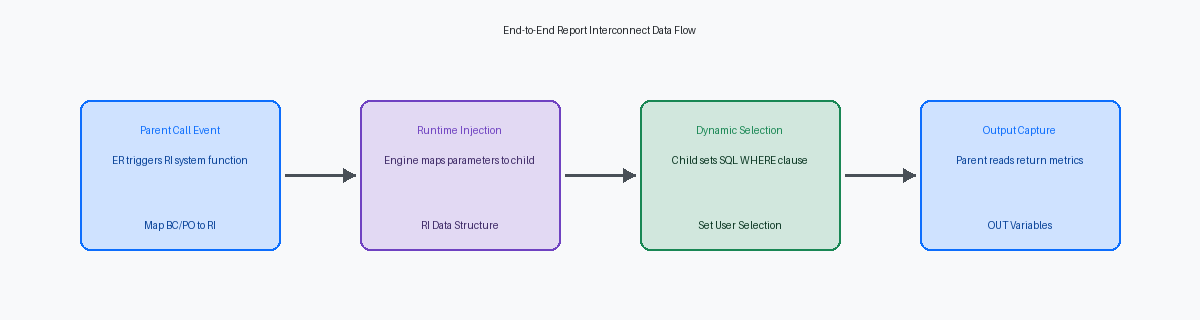
Parameter mapping inside the ER call interface demands strict variable hygiene. Map values directly from Business View columns (BC), Report Variables (RV), or Processing Options (PO) whose scope matches the current section boundary. Passing uninitialized report-level global variables that rely on prior section execution frequently injects nulls or stale memory addresses into the child report structure. If a value originates from a calculation, bind it explicitly to a section-level variable in the immediate event block preceding the call.
Hardcoding the target child version string directly into the system function wizard creates maintenance bottlenecks between non-production and production environments. Pass the version identifier dynamically through an ER expression or a dedicated processing option, allowing operations to route workloads to distinct subsystem queues or data selection templates without object check-outs.
Finally, treat the interconnect call as a failure-prone interface point. Always check the execution return value immediately following the system function statement rather than assuming the child UBE launched cleanly. Evaluating the system status variables directly after synchronous calls gives you the programmatic hook needed to log a failure to the PDF output, skip subsequent transaction rows, or stop a multi-threaded batch pipeline before corrupting staging tables.
Child UBE Implementation: Consuming RI in Event Rules
Data structure values mapped from the parent UBE are instantiated in runtime memory prior to the Initialize Report event firing. This event timing guarantees that processing options, ER variables, and section filters in the child execution lifecycle have full visibility into the parameter array. Because the runtime binds these values immediately upon process creation, consumption logic can be consolidated neatly at the start of the report execution stream rather than scattered across driver events.
The most reliable pattern for dynamic filtering relies on invoking the Set User Selection system function within the child section's Initialize Section event. Passing an RI parameter—such as RI szDocumentPayItem or RI mnAddressNumber—directly into Set User Selection with an EQUAL operator and AND join logic enforces index-backed SQL WHERE clauses. Executing this logic in Initialize Section ensures the database engine compiles the filter prior to opening the primary SQL cursor, preventing unindexed table scans on large tables like F0911 or F4211The Sales Order Detail database table in JD Edwards..
Defensive ER design requires evaluating whether incoming RI variables contain valid data before overriding selection logic. If an operator launches the child report standalone through Batch Versions, blank or zeroed RI variables will break expected filtering. Evaluating If RI szOrderType is NOT equal to <Blank> in event rules lets the child object conditionally fall back to standard Processing Options, preserving its ability to run as an ad-hoc batch report.
Capturing metrics to pass back to the parent requires strict event discipline at report termination. Assigning runtime values to outbound RI fields must occur in either the After Last Object Printed event of the primary section or the global End Report event. Populating outbound RI variables inside a Do Section loop risks returning incomplete aggregations to the calling UBE when processing large datasets across multiple page breaks.
Architectural Anti-Patterns: Work Tables vs Direct RI
Writing execution states to custom F55 staging tables just to pass batch keys between reports is a legacy pattern that degrades batch queue throughput. Every insert, fetch, and delete against an F55 staging table incurs network and disk I/O overhead, multiplying latency across high-volume batch runs. When child UBEs terminate abnormally due to memory exceptions or kernel drops, mandatory cleanup logic fails, leaving orphan records that pollute subsequent batch runs and trigger false-positive duplicate key errors.
Developers attempting to bypass database I/O by passing memory pointers via BSFN cacheBusiness Function cache, an in-memory data storage system used during C code execution in JDE. structures run into a different operational wall: process boundaries. While a C cache pointer lives cleanly in memory within a single Enterprise Server CALLKS kernel, child UBEs routed to multi-threaded job queues frequently spin up under separate RUNBATCH processes or separate physical batch servers altogether. The child job attempts to dereference a memory address that does not exist in its local address space, causing immediate silent execution failures or hard kernel crashes.
Direct value passing via the UBE data structure completely bypasses database engine locks and process isolation boundaries. The parent process packages the parameter buffer directly into the execution call stack, passing runtime values into the child UBE's initialize section without hitting the database or shared memory. This eliminates table lock contention and multi-threading concurrency collisions across 64-bit Enterprise Server kernels, allowing parallel processing queues to scale naturally.
Refactoring a legacy financial or inventory distribution pipeline from an F55 work-table architecture to direct parameters routinely drops overall batch processing elapsed time by 15% to 40%. Eliminating thousands of intermediate table writes per batch run frees up database buffer pools for interactive users while removing the maintenance burden of purge scripts.
Debugging and Testing Report Interconnect Calls
Stepping through Report Interconnect calls locally on a Web Dev Client gives you full visibility across the execution boundary. When running synchronously in the Event Rules Debugger, setting a breakpoint on the interconnect statement allows you to step directly into the child report's Initialize Section event without dropping the debugging context. If you step over instead of stepping into, the debugger completes the background thread silently and lands on the next parent statement. This local trace isolates variable scope mapping errors in minutes, saving you from deploying untested object packages to enterprise servers.
When diagnosing parameter corruption on an enterprise server, the jdedebug.logThe detailed execution log file generated by JDE kernel processes for troubleshooting logic and SQL operations. file provides the definitive payload dump, tracing parameter offset addresses and hexadecimal memory structures. Under Tools Release 9.2.x running 64-bit architecture, pay close attention to structure alignment padding in data structures on AIX and Linux kernels. Placing a 1-byte character flag directly ahead of an 8-byte pointer or math structure without explicit padding creates boundary discrepancies, causing parameter values to shift into incorrect byte offsets when passed to the child UBE.
Server-side asynchronous execution presents a distinct debugging trap: the parent job status in table F986110The Job Control Status Master database table in JDE tracking UBE batch process execution status. updates to 'D' while the child report is still queued or failing silently. You must cross-examine both the parent UBE_*.log and the child UBE_*.log files in the server print queue directory to catch queue overrides, environment translation errors, or payload truncation. Standardizing on native Report Interconnect data structures gives EnterpriseOne batch architectures deterministic parameter handling, predictable multi-threaded queue execution, and clean memory isolation without the overhead of custom staging tables.
