




When a four-hour nightly batch window creeps past 06:00 AM and collides with morning shifts, the finger-pointing is predictable. CNCConfigurable Network Computing: JDE's system architecture and administration framework. blames runaway custom reports, while developers insist the infrastructure team simply needs to allocate more job queue threads or add an Enterprise Server. Across decades of enterprise implementations, adding hardware to solve batch lag almost never works; poor execution of JDE UBEUniversal Batch Engine: The batch job and reporting engine in JD Edwards. scheduler performance developer responsibilities is what actually stalls queues and starves database engines.
CNC engineers configure concurrency rules, server groups, and schedule definitions, but they cannot tune out unindexed table I/O, unbounded transaction scopes, or memory leaks compiled into custom C business functions. Treating batch schedule degradation strictly as an infrastructure problem guarantees recurring SLAService Level Agreement: Target execution timeframes established for batch completion. breaches. Fixing it requires drawing a hard line between CNC operational queue controls and the developer's duty to build clean data pipelines and resilient memory lifecycles into UBE logic.
Defining the Boundary: Developer Scope vs CNC Operations
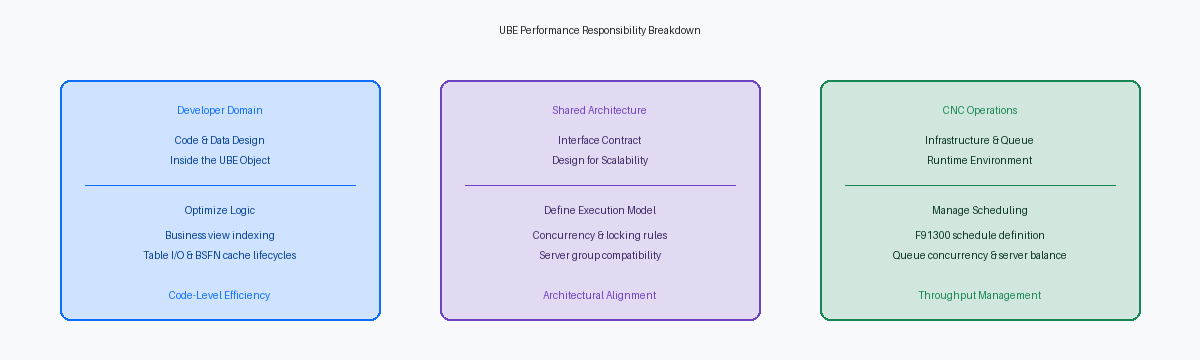
When a high-volume nightly batch schedule breaches its SLA, CNC administrators typically get the first call, but infrastructure controls cannot fix inefficient code. CNC manages the execution environment: tuning F91300 scheduler entries, mapping F986130 job queue definitions, and balancing server group assignments. They monitor job execution states inside the F986110 job control table, but queue re-prioritization and hardware scaling cannot resolve a report that loops continuously over unindexed table operations.
Developers own the internal execution efficiency of the code running within those batch queues. This scope spans data selection architecture, business viewA JDE object that defines table relationships and fields retrieved for processing. indexing strategies, table I/O execution frequency, and memory management inside custom Business FunctionsReusable programming logic components in JDE written in C or Event Rules.. If a developer places a fetch single inside a Do Section that evaluates hundreds of thousands of records without using proper table indices or cached handles, the database tier bottlenecks regardless of host server CPU allocations.
Operational friction escalates when teams treat multi-threading as a universal fix for slow code. Configuring a multi-threaded queue for an unpartitioned UBE causes data collisions, lock waits, and data corruption rather than performance gains. When parallel threads attempt to update identical records in tables like F0902 or F4111 without explicit data boundary controls, thread blocking stalls the queue engine completely.
A clean operational handoff requires developers to specify runtime profiles before any custom batch job reaches the scheduler. Developers must explicitly document data dependency models, target runtimes, runtime memory ceilings, and single-thread constraints for every custom report. Delivering this technical profile allows CNC to construct queue architectures based on application design rather than post-outage guesswork.
Developer Logic Flaws That Bottleneck Batch Queues
Batch queue bottlenecks are rarely caused by JDE Enterprise Server hardware caps; they are built line by line in Event RulesThe procedural logic language used inside JD Edwards development tools.. The most expensive flaw occurs when custom code executes table I/O inside the Do Section without aligning to a valid Business View index. On a large F0911 table containing tens of millions of records, an unindexed Select statement forces the database engine into a full table scanA database operation scanning every row in a table sequentially due to missing indexes. for every row evaluated by the section driver, turning a brief run into a multi-hour queue blocker.
Placing redundant Fetch Single or Select/Fetch Next loops inside the Do Section creates millions of unnecessary database round-trips. If a driver section evaluates 200,000 sales order detail lines in F4211 and calls custom table I/O inside the loop, the job shifts from an optimized database join to 200,000 discrete SQL queries. This pins the batch execution thread and consumes queue capacity while other scheduled jobs breach their SLAs.
Developers also write manual running totals inside Event Rules rather than relying on native database aggregation or section totaling functionality. Row-by-row math in ER logic incurs severe interpreter overhead, driving CPU utilization up on large datasets. Offloading aggregations to database views or C BSFNs reduces ER interpreter CPU cycles significantly, often by 60% to 80% on high-volume runs.
Misuse of Suppress Section Write compounds these operational issues during heavy background I/O. Hiding section output during long-running background processing causes operators and CNCs to see zero output log growth, leading them to assume the job has deadlocked. Before terminating a non-responsive UBE in Server Manager, query database session wait states to verify active physical I/O before assuming the thread is hung.
Managing Commit Boundaries and Memory Leaks in Batch Runs
When a custom UBE processes 50,000 sales order detail lines inside a single manual transaction boundary, it locks every impacted row in F4211 until the job completes. That unbounded transaction block holds exclusive row locks for hours, causing severe queue starvation for downstream scheduled UBEs like R42800 or R47031 attempting to access those standard tables. Developers must implement deterministic commit intervals—typically every 500 to 1,000 records—using JDB_BeginTransaction and JDB_CommitTransaction APIs rather than relying on automatic commit on job completion.
Memory management in custom C BSFNs called repeatedly within UBE main fetch loops represents an equally dangerous structural risk. Failing to execute jdeCacheTerminate or free allocated C structures via jdeFree across thousands of record iterations produces steady memory leaks. This pattern escalates until the Enterprise Server UBE kernel memory footprint exceeds 2 GB. On standard 32-bit JDE Enterprise Server runtimes, breaching this 2 GB process limit triggers an immediate kernel crash, leaving the scheduled UBE hanging indefinitely in Processing status within the F986110 table.
Preventing this kernel bloat during heavy batch runs requires isolating read-only lookup caches from transactional write buffers. Static reference data, such as branch/plant constants or exchange rates, should be loaded into a read-only jdeCache handle during Initialize Section and destroyed explicitly in End Section. Mixing transactional write buffers with long-lived lookup structures inside the primary record loop accumulates unreleased cache pointers. This inflates process heap memory, degrades OS paging performance, and ultimately starves adjacent batch queues sharing Enterprise Server resources.
Designing UBEs for Multi-Threaded Queues and Server Groups
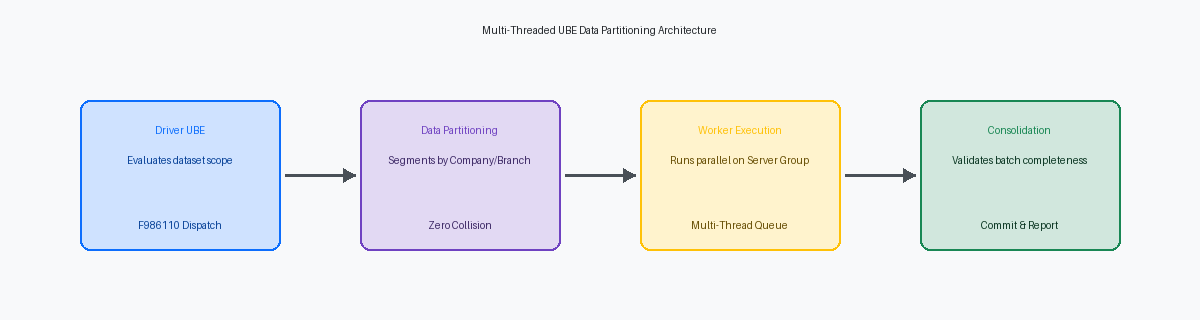
To scale heavy batch processing horizontally across multi-threaded queues, developers must partition data boundaries explicitly at the architectural level. A single massive run evaluating hundreds of thousands of sales ledger records across all business units chokes a queue, whereas splitting the workload into discrete data ranges—such as Branch/Plant groupings or account prefixes—enables parallel processing without table lock contention. The driver UBE evaluates total record volume and dynamically spawns worker UBE instances using LaunchBatchProcessEx (B9800240), passing localized interconnect values to each thread to ensure zero overlapping record sets.
Hardcoding enterprise server hostnames inside custom C business functions breaks CNC infrastructure design. When CNC configures P98617 Server Group configurations distributing parallel worker UBEs across multiple Enterprise Server nodes, hardcoded targets force thread execution onto a single host, bypassing JDE load-balancing algorithms and creating artificial CPU spikes on one node while others sit idle. Passing dynamic server group configurations allows JDE middleware to assign each worker instance to the least-utilized node in real time.
Parallel execution exposes data design flaws that single-threaded runs obscure. If parallel worker UBEs insert records into custom tables simultaneously, the underlying table schema must incorporate deterministic primary keys—typically combining a unique batch run ID, sequence number, and transaction timestamp—to handle out-of-order processing safely. Missing primary key components or relying on sequential Next Numbers without dedicated caching triggers immediate JDB3100011 primary key collisions during high-throughput parallel execution.
Subsystem Processing vs Scheduled Batch Architecture
Subsystem UBEsPersistent background JDE processes that run continuously to process jobs immediately as requests arrive. operate as persistent execution processes that continuously poll the Subsystem Job Master (F986113) table, requiring an entirely different architecture than discrete batch jobs. A common failure in custom subsystem development is omitting explicit wait states within the processing loop. On Tools Release 9.2.7 enterprise servers, a subsystem UBE without a built-in jdeSleep C BSFN or configured wake-up interval locks an execution thread at high CPU utilization. The process executes millions of idle SQL SELECT queries against F986113 per hour, starving legitimate batch queues on the Enterprise Server.
Conversely, setting up a standard UBE to run every 60 seconds via the JDE Scheduler as a pseudo-subsystem is an anti-pattern that degrades system-wide performance. Executing a single job on a one-minute loop generates 1,440 job master records daily in the Job Control Status Master (F986110). Over a 90-day period, this single report creates over 129,000 dead job rows. The JDE scheduler daemon must parse this inflated F986110 table on every wake cycle, degrading scheduler responsiveness and delaying time-critical nightly batch processing schedules.
Event Rule design within legitimate subsystems demands immediate record lock releases. When a subsystem process reads work records, executes business logic, and updates target tables like F4111 or F0911, transaction boundaries must be contained strictly within the iteration. Leaving record locks open while waiting for the next F986113 wake cycle creates severe database blockages. Developers must issue explicit SQL table updates and commit transactions immediately after processing each record, ensuring interactive users and secondary batch queues do not encounter deadlock cascades during peak operational hours.
Structured Triage for Batch Schedule SLA Breaches
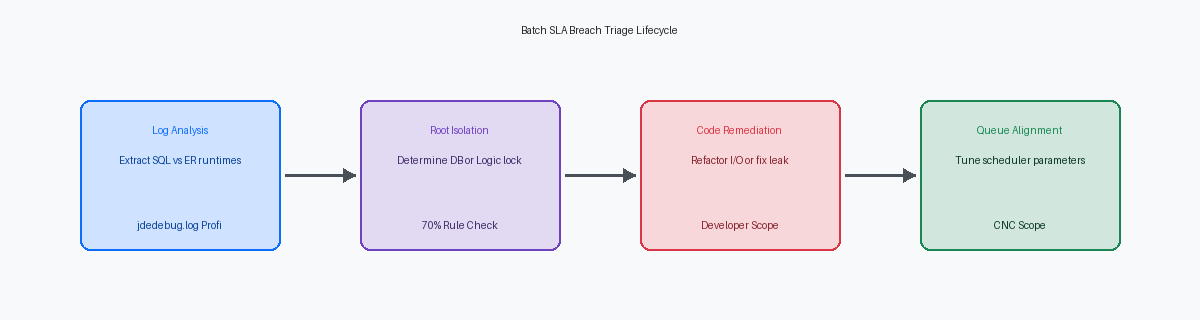
When a scheduled overnight batch breaches its execution window, triage begins by parsing the jdedebug.log and UBE runtime log through an execution profiler to establish the exact split between SQL execution time and Event Rule processing time. An 80% wait state on unindexed table I/O points directly to a missing index or inefficient query structure rather than an infrastructure bottleneck.
If SQL execution exceeds 70% of total runtime, the developer owns the remediation path. This requires analyzing the runtime-generated WHERE clauses, creating a targeted composite index in Object Management Workbench, or refactoring a bloated Business View to eliminate redundant table joins. Fetching 40 columns across four joined tables when the report only evaluates two fields creates massive database I/O overhead that no enterprise server can outrun.
When profiling data shows Event Rule and BSFN execution consuming the majority of runtime, the issue resides entirely in code structure. Developers must profile the execution tree to eliminate recursive BSFN calls, unindexed User Cache lookups, and nested Do Section loops that trigger database round-trips on every record. Refactoring repetitive fetches to pull from an in-memory cache consistently reduces logic processing time.
Adjusting queue parameters or assigning additional threads to a batch queue should be the absolute last step. CNC intervention belongs at the end of the triage sequence, enacted only after developer validation confirms that the UBE contains no algorithmic flaws or locking issues. Spawning multi-threaded queues against unoptimized code simply multiplies inefficient queries across the database, shifting the bottleneck rather than solving it.
If your team is refactoring legacy batch reports, redesigning long-running UBE data pipelines, or establishing runtime profiles for your enterprise scheduler queues, contact our JDE architecture team for a technical review.
