




Run a simple query against table F983051 in any mature EnterpriseOne 9.2 production environment, and you will routinely count upwards of 10,000 batch versionsPre-configured operational parameters for running JD Edwards reports or background jobs.. Most are operational deadweight: ad-hoc copies generated by users in production or developer prototypes pushed upstream without cleanup. When version sprawl goes unchecked, the fallout is immediate and expensive. Blind runtime overrides corrupt ledger integrity, unmonitored data selections bypass data security models, and repository bloat routinely causes batch package builds to fail.
Treating batch versions as informal user preferences rather than managed code assets is an operational vulnerability that will trigger audit findings. Establishing rigorous JDE UBEUniversal Batch Engine, the execution engine for background processes and reports in JD Edwards. versions and processing optionsParameters that control the behavior, defaults, and logic branches of JDE programs. governance replaces this chaos with enforceable standards across naming taxonomies, processing option template locking, mandatory data sequencing, and strict Object Management Workbench (OMW)The central change management system used to develop, test, and promote JDE objects. promotion pipelines.
The High Cost of Uncontrolled Batch Version Proliferation
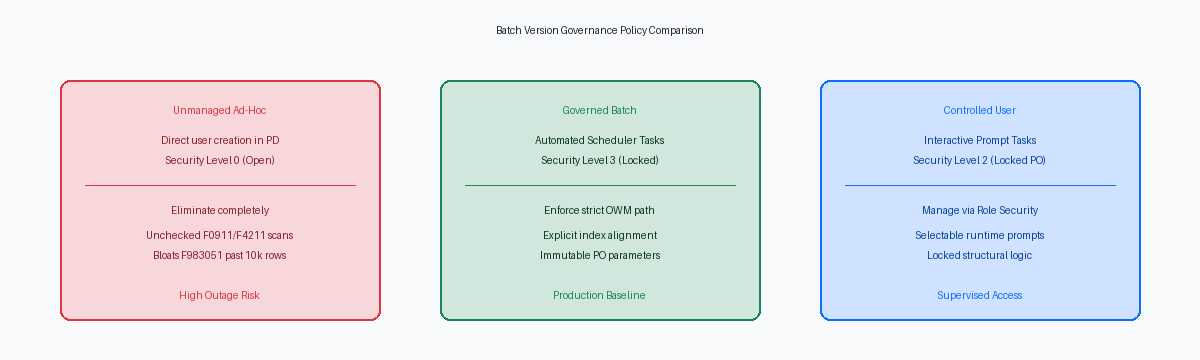
Most mature 9.2 environments carry over 10,000 records in the F983051 (Versions List) and F98306 (Processing Option Values) tables because CNCConfigurable Network Computing, the system administration and technical architecture layer of JD Edwards. administrators left Fast PathA navigation shortcut bar in JDE allowing direct access to applications via text codes. access to Batch Versions wide open in production. When version records climb past this threshold, runtime spec retrieval degrades across the HTML servers, and full package build windows stretch by two to three hours simply serializing and compressing thousands of abandoned, single-use specifications in Central ObjectsThe central database repository storing compiled object specifications in JD Edwards..
The performance penalty hits hardest on the database engine. Operations users routinely clone core engines like R09801 or R42565 to run ad-hoc queries, inadvertently stripping out indexed key columns or appending non-indexed filtering criteria. When multiple users execute these unindexed variations simultaneously against transaction tables containing 20 to 50 million rows (such as F0911 or F4211), the database engine defaults to full table scansA database operation that reads every row in a table because suitable indexes are missing.. Batch queues back up immediately, lock escalation spikes, and critical nightly billing streams miss their SLA windows.
Beyond database bottlenecks, ad-hoc runtime overrides of processing options introduce severe compliance vulnerabilities. When an operator modifies processing option flags at submission—such as changing posting edit code validation or overriding default GL dates—automated reconciliation controls break without generating an audit trail in the F986110 job execution logs. Implementing a disciplined version policy routinely eliminates 50% to 70% of redundant batch versions, consolidating thousands of uncontrolled user copies into a secure, parameterized core tied strictly to automated enterprise schedulers.
Batch Version Naming Conventions and Taxonomy Rules
The 10-character version name field (VERS) in the F98301 table is often treated like scratchpad space, filling Object Librarian with identifiers like TEST01, JSMITH, or RUNNOW. A disciplined structural taxonomy replaces this drift by encoding execution context directly into those 10 characters. Enforcing strict character allocations stops versions from colliding across environments and ensures your operations team can immediately identify how and where a job runs.
Prefixes must dictate runtime intent. Oracle baseline templates remain untouched under ZJDE (reports) and XJDE (interactive processing). Nightly batch streams running via the EnterpriseOne Job Scheduler or external schedulers like Control-M must use an SCH prefix (such as SCHGL001). External interface extracts and load programs use INT, while on-demand user executions use ADH or a standardized three-character company code.
Version descriptions in F98301 require an equally rigid syntax. Mandate a standardized format covering functional owner, execution frequency, and primary target: [Module] - [Cadence] - [Purpose]. A description like AP - Weekly - Electronic Payment Extract provides instant visibility into batch queues, eliminating the mystery jobs that stall subsystems and burn CNC triage hours during monthly maintenance windows.
Custom governance standards must explicitly bar developers and CNC administrators from modifying standard ZJDE and XJDE versions. An ESUElectronic Software Update, a software patch delivered by Oracle for JD Edwards., Planner update, or Application Update will overwrite Oracle-owned versions without warning, wiping out hardcoded processing options and data selection. Every operational run must exist as a dedicated custom version created under an approved prefix, tracked in OMW, and promoted cleanly through your pathcodesDirectory paths and specs mapping to a specific environment like Development or Production..
Processing Options Architecture and Template Locking
Processing Option data structures drive hard business logic branches inside Event Rules and C BSFNsC Business Functions, compiled C code modules providing high-performance logic in JDE.. When an end user or batch scheduler modifies a PO value at runtime without controls, they are effectively executing unversioned, unvetted code in production. Every custom UBE must ship with fully documented, validated default values baked directly into the base version template (ZJDE0001 or XJDE0001) rather than relying on manual operator intervention during job submission. Relying on users to remember whether a processing option flag should be a 1 or a 0 on a nightly financial roll-up is a guaranteed path to subtle ledger corruption.
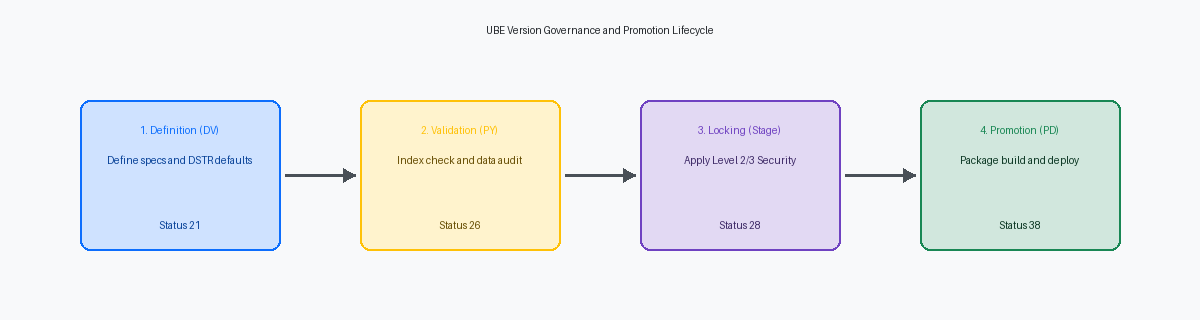
To prevent unauthorized runtime overrides, version security in P98300 must be strictly applied to all production batch versions. Setting the security level in the F98303 Version Security table to Level 2 (Prompting Restricted) or Level 3 (Prompting and Data Selection Restricted) locks down the processing option interface entirely for scheduled batch jobs. When a production version is locked at Level 2 or 3, users can submit the UBE to execution queues, but the system actively blocks access to the processing option values, eliminating accidental modifications by third-shift operators.
Modifying processing option text or adding tabs directly in non-development environments creates silent corruption that manifests during the next Tools ReleaseSystem software maintenance updates providing platform foundation functionality in JDE. or Application Update. Any structural change to a PO data structure (T98305A) or processing option text template must be checked out in Object Management Workbench under a tracked OMW token and promoted through DV, PY, and PD. Standardizing this promotion path ensures that Spec Merge utility operations retain custom PO layouts during 9.2 Application Update cycles, protecting your operational logic from being overwritten by Oracle standard templates.
Data Selection and Data Sequencing Enforcement
A user overriding the data sequence on an F0902 financial reporting version does not simply reorder rows; it silently destroys aggregate calculation integrity. The Universal Batch Engine triggers Level Break Header and Level Break Footer event rules based strictly on the sort order defined in Report Design AidThe JDE tool used by developers to build report layouts, data logic, and batch sequences.. When an operator moves Account ID (AID) ahead of Business Unit (MCU) in the runtime version sequence to alter the visual layout, the engine fails to fire reset logic at the expected boundaries. The batch job completes with a normal D status, yet outputs corrupt subtotal balances without logging a single runtime error.
Automated batch jobs managed by the JDE Job Scheduler require immutable runtime boundaries. Every scheduled production version must have its data selection permanently locked via version security flags to prevent operators from modifying or clearing critical date ranges, batch types, or processing flags during manual re-runs. An unlocked version allows a well-meaning clerk to accidentally strip out fiscal period filters, sweeping unapproved draft transactions directly into permanent ledger tables.
Technical leads must review execution plans in SQL performance monitors for any custom version querying large transaction tables prior to promotion sign-off. Filter criteria must align strictly with existing compound indexes on high-volume tables such as the Item Ledger (F4111) or Accounts Payable Ledger (F0411). Forcing dynamic selections on non-indexed columns triggers table scans that saturate database I/O. In multi-threaded batch queues, these unoptimized queries escalate to row and page locks, bringing concurrent interactive sales order processing and warehouse dispatch to a dead stop.
OWM Promotion Workflows and Environment Strategy
Treating batch versions as transient end-user configurations rather than formal system objects is how production spec tables get corrupted. A UBE version carries the same structural weight as a C BSFN or a table modification, and its lifecycle must follow the exact Object Management Workbench path from DV920 to PY920 to PD920. Skipping promotion steps or manually creating versions directly in production environments bypasses standard change control and leaves orphaned records across central object tables.
Preventing ad-hoc version creation requires hard enforcement at the environment level. Use Security WorkbenchThe primary JDE application (P00950) used to manage user, application, and action security. (P00950) to set Action Security revoking Add and Copy permissions on P98305 within the PD920 environment. When business units demand a new report layout or processing variant, the change must originate in DV920 under an OMW project, complete validation in PY920, and deploy through proper release channels.
Your OMW transfer activity rules must guarantee that processing option specifications in table F98306, version headers in F983051, and data selection/sequencing specs move atomically. A misconfigured activity rule that transfers the header while dropping selection specs results in catastrophic batch errors during critical jobs like R42565 or R09801. The target environment receives half an object, leaving the runtime engine guessing.
Coordinate version promotions directly with your package deployment schedule. Promoting a version spec without deploying it to the Enterprise Server and clearing the HTML server serialized spec cache creates a dangerous mismatch between web client views and server execution engines. Schedule version spec deployments during established change windows, and always run an explicit package build or spec deployment to keep Enterprise Server runtime specs perfectly aligned with web application servers across all tiers.
Routine Governance Audits and Version Lifecycle Cleanup
Unchecked UBE repositories routinely accumulate thousands of single-use batch versions that bloat specs and stall package builds. A quarterly CNC cleanup routine should execute an automated SQL cross-check querying the Version Header table (F983051) against the Job Control Status Master (F986110) in the Server Map database. Filtering for custom versions with zero execution records over a rolling 180-day window instantly isolates candidate objects for decommissioning.
Retiring these stale entries directly cleans up underlying system tables. Executing a standard Object Management Workbench purge or batch delete procedure systematically strips orphaned processing option records from F98306 and custom data selection specs from F98301. Leaving dead versions in the environment forces the package build process to handle useless specs during every full package build, inflating deployment package size by 15% to 25%.
Governance also requires continuous security monitoring alongside routine purges. Automated SQL audit scripts should run weekly in the production environment to identify any batch version where Processing Option or Selection security is set to Level 0. Allowing open access in production enables end users to override critical data selection on standard jobs like R42565 or R09801, introducing severe risk to financial controls and operational integrity.
Maintaining a lean batch repository of under 2,000 active versions across your enterprise environment keeps full package builds tight and simplifies retroactive object retrofitting. When applying continuous delivery Application Updates on EnterpriseOne 9.2, retrofitting impacted batch applications becomes significantly faster when developers do not have to evaluate, rebuild, and re-test hundreds of obsolete versions that should have been archived years ago. Standardizing version naming, locking processing option data structures, and enforcing strict OMW lifecycles ensure your batch operations remain audit-ready and performant through every upgrade cycle.
