




Across mature EnterpriseOne 9.2 environments, a significant share of production batch failures—often 30% to 40%—stem from custom UBEsUniversal Batch Engine; JD Edwards programs that run background processes, reports, and bulk data updates. that executed cleanly on local development clients. Developers routinely validate reports against a small 1,000- to 2,000-row DVDevelopment environment in JD Edwards where developers write and test new code. dataset using default version specifications, completely ignoring how the runtime logic behaves on an Enterprise Server under concurrent multi-threaded execution, unindexed joins on major tables like F0911The Account Ledger table in JD Edwards, storing detailed general ledger financial transactions. or F4111The Item Ledger table in JD Edwards, storing detailed inventory transaction history., and unreleased JDECACHEA JD Edwards programming feature used to store data in temporary memory for faster processing. memory allocations.
Promoting an unvetted batch object through Object Management Workbench (OMW)The JD Edwards change management system used to control, develop, and promote software objects. guarantees emergency rollback requests, locked enterprise job queues, and corrupted work tables in production. Enforcing a strict JDE UBE custom report testing checklist before promotion gives developers and technical leads a concrete protocol to audit SQL index alignment, runtime memory disposal, version data structure drift, and Work Center restartability before any code hits PYPrototype environment in JD Edwards, used for quality assurance and user acceptance testing..
Environment and Version Parity Validation
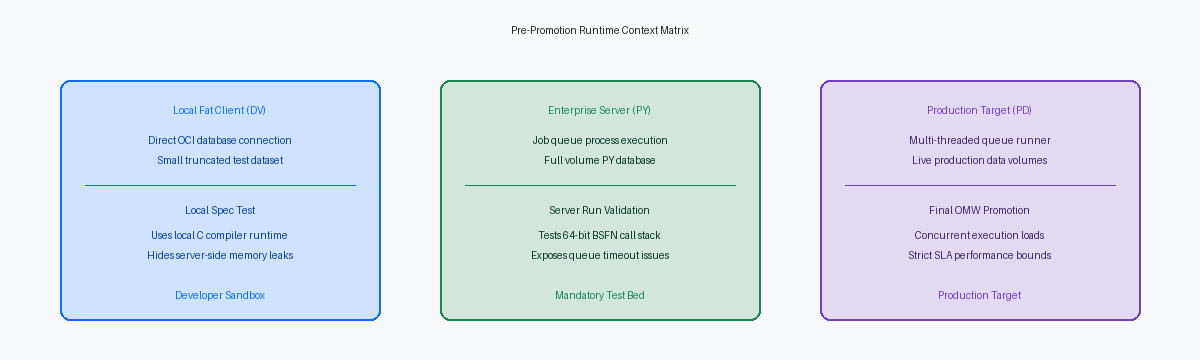
Promoting a UBE version to DV or PY without first verifying that the parent report template specifications are checked in and compiled into a deployed package is the fastest way to generate false test results. When a developer modifies report objects, data structures, or embedded C BSFNsBusiness Functions; reusable blocks of C or Event Rules code that perform specific business logic., the runtime engine evaluates the version against the target environment's active server package. If that package lacks the updated parent specs, the enterprise server executes the previous spec build, leaving you debugging issues that exist only because of environment mismatch. Require a full or update package deployment to the target testing environment prior to running a single version validation.
Processing option data structure (PODS) modifications create severe corruption risks if handled incorrectly. Inserting a new member into the middle of an existing data structure shifts the byte offsets of every subsequent parameter. Because existing version values are stored as raw binary blobs in the F983051The JD Edwards table that stores processing option values and configurations for batch versions. processing option master table, this structural shift corrupts the runtime values passed to the UBE without throwing a syntax error. Querying F983051 directly via SQL or DataBrowserA JD Edwards web tool that allows users to query and view table or business view data directly. lets you compare VRPID and VRVERS records to identify versions with orphaned or misaligned processing option values before they hit user acceptance testing.
Version-level data selection overrides present another silent failure vector. When a version overrides section layout or data selection, it permanently severs inheritance from the parent template. Updating the template's default selection later will not propagate to these modified versions, often leaving deprecated date ranges or missing company filters active in production runs. Finally, any custom Data DictionaryThe central repository in JD Edwards defining all database field attributes, labels, and validation rules. items linked to new processing option fields must be verified in the target environment's DD specs. If a dictionary item exists in DV but has not replicated to PY with identical visual attributes and display length, input parameters will truncate silently at execution time.
Data Selection, Sequencing, and SQL Index Alignment
A custom financial report processing 10 million rows in the F0911 will crawl unless the data selection maps directly to an existing composite index such as F0911_6 (GLDCT, GLDOC, GLKCO, GLDGJ). Adding an unindexed field like GLEXR to the selection criteria often forces the optimizer into a full table scan, stretching execution times from under a minute to several hours. Always pull the database execution plan or inspect the jdedebug.log on the Enterprise Server to confirm the query engine hits the indexed access path before approving promotion.
Complex Event Rules logic containing mixed AND/OR operators rarely translates to raw SQL the way a developer visualizes it in RDAReport Design Aid; the JD Edwards tool used to design and modify batch reports and UBEs.. Oracle Database and Microsoft SQL Server handle parser precedence differently when EnterpriseOne constructs the dynamic WHERE clause. Reviewing the SQL trace log is mandatory to verify that nested logical groupings preserve clause boundaries, preventing unintended record drops or ballooning result sets.
Data sequencing mismatches remain the primary root cause of corrupted summary calculations in batch processing. When a section relies on Level Break Footer execution to aggregate totals, the version sequencing must mirror the level break fields in exact left-to-right order. Dropping a secondary sequence column such as GLSUB breaks the internal trigger sequence, resulting in premature subtotal flushes or cumulative errors across unrelated business units.
Finally, test version-level data selection in both Append and Override modes against the template design. If the template contains base criteria—such as filtering out unposted entries via GLPOST—a version created in Override mode will completely drop those base rules. Confirm that production versions use Append mode to ensure user-defined criteria combine via logical AND operators with core application logic.
Runtime Cache, Memory, and Session Cleanup
A standard overnight UBE processing 100,000 sales order lines will silently degrade the enterprise server if C business functions called inside the Do Section leak memory. When a custom BSFN allocates memory via jdeAlloc for every processed record, that pointer must be explicitly released using jdeFree before the function returns. Failing to clean up per-record allocations compounds linearly, causing kernel memory bloat from 50 MB to several gigabytes in a single run and forcing the CALLBSFN kernel into an unauthorized restart.
Cache management across UBE event rules requires the exact same lifecycle discipline. Any JDECACHE handle initialized via jdeCacheInit in the Initialize Section or Report Header must have a corresponding jdeCacheFree call in the End Report event. Leaving cache handles active after report execution leaves orphan memory segments in the kernel heap, which corrupts subsequent report executions sharing that same active server process.
Variable pointers passed across Event Rules and C BSFN data structures present a different hazard: stale data propagation. When processing a driver table like F0911, every pointer variable or cache key stored in ER must be explicitly reset to null or zero at the top of the Do Section. Otherwise, if record 405 fails a BSFN validation, the data structure retains values from record 404, writing incorrect ledger balances without throwing an error.
Secondary table fetches inside driver loops must account for null fetch scenarios cleanly. When a custom UBE loops through secondary records in F4111 based on a primary F4101 item ID, failing to check SV_File_IO_Status or evaluate ER_SUCCESS after every fetch leads to infinite processing loops. Testing must confirm that a missing secondary record breaks the loop cleanly rather than pinning the enterprise server CPU thread at 100% until administrator intervention.
Output Validation, Page Breaks, and CSV Formatting
Developers routinely test UBE layouts using five-record data sets, missing visual defects that manifest on multi-page production runs. Executing a 500-page batch against populated tables reveals orphan headers, broken page breaks, and blank trailing pages caused by unhandled section suppression logic. Verify that conditional suppression does not leave hanging footers. Inject 1,000+ record sets during validation to confirm summary footers collapse cleanly without producing empty final pages.
A PDF that renders visually perfect can fail completely in CSV mode because JDE calculates column placement using CSV grid alignment based on RDA horizontal coordinates. Never validate CSV output in Excel; open raw text files in an editor like VS Code. Check for overlapping layout frames that push values into incorrect columns, and verify that leading zeros on string fields—like an 8-digit item number 00142890—retain quote enclosures so downstream parsers do not truncate them.
Using Suppress Section Write in Event Rules to hide detail lines while aggregating summary totals frequently introduces silent calculation errors. Verify that suppressed detail sections execute variable accumulation before suppress calls fire. When using Re-initialize Section ER logic to reset counters across break headers, confirm running totals clear cleanly and do not carry stale values into subsequent control groups.
For BI Publisher reports, never build templates against XML samples generated from local fat clients. Local XML handles tags differently than the enterprise server. Pull sample XML payloads directly from Work With Submitted Jobs after executing on an actual enterprise server to ensure complete schema alignment.
Large Volume Performance and Timeout Limits
Running a custom UBE against a 500-row fat client table in DV proves only that your syntax compiles. Real validation requires submitting the report on the PY enterprise server against a production-sized table containing at least 100,000 records. Query execution plans on Oracle DB engines behave completely differently when scanning six-figure record sets, exposing unindexed joins and implicit data type conversions that run in seconds in DV but blow past a standard multi-hour batch window in Production.
During these high-volume test runs, monitor the process memory on your enterprise server at the OS level. Process memory must remain flat after the initial buffer allocation; steady memory growth indicates unreleased memory pointers or leaking JDE cache structures within custom C BSFNs or NERsNamed Event Rules; custom JD Edwards business functions written using Event Rules instead of C code.. If a batch process processing 100,000 rows inflates the UBE kernel memory footprint from 50 MB to over a gigabyte, that job will crash with an out-of-memory error when handed 500,000 rows in PDProduction environment; the live JD Edwards system where actual business transactions are processed..
Verify the job queue configuration and multi-threading parameters before authorizing promotion. If your UBE updates custom staging tables, running concurrent executions in a multi-threaded queue like QB7334 will trigger record lock escalation and immediate SQL deadlocks unless explicit single-threaded queue assignment is enforced in Server Manager. Test simultaneous execution using two identical versions mapped to the same queue to confirm that table locks do not stall processing.
Document the total runtime, records processed per minute, and CPU utilization from the test run in your promotion sign-off sheet. Establishing a baseline—such as processing over 100,000 records in under 20 minutes on the PY enterprise server—gives the CNCConfigurable Network Computing; the technical architecture and system administration methodology of JD Edwards. team an exact SLA performance benchmark. If the same job takes 45 minutes after the next Tools Release update or infrastructure shift, you immediately know whether to troubleshoot database execution plans or kernel memory allocation.
Restartability, Error Handling, and Work Center Logging
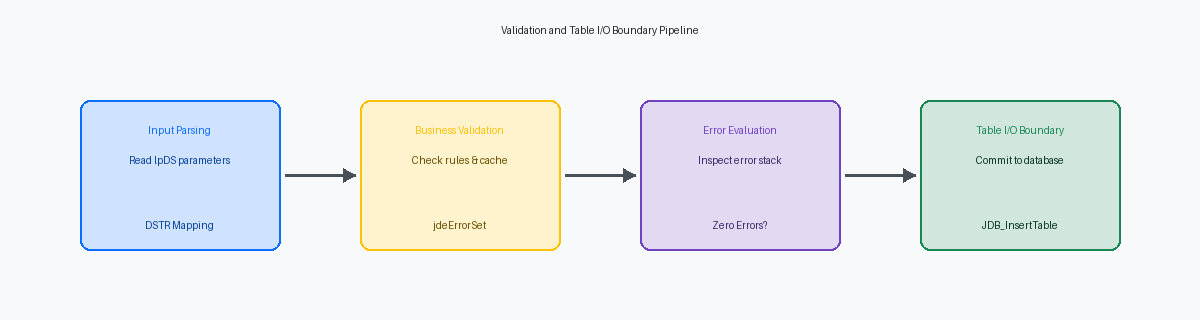
A UBE that updates financial tables like F0911, F0902, or F0411 without explicit transaction processing boundaries is a silent corruption engine waiting for a network blip. You must verify that Transaction ProcessingA database feature that ensures a group of operations either all succeed or all roll back together. (TP) is enabled at both the report property level and on every table I/O open call within your event rules. When a process fails halfway through a 10,000-record batch, the database must roll back the transaction set cleanly rather than leaving orphaned G/L detail lines in F0911 without corresponding account balance updates in F0902.
Simulate mid-execution batch failures during QA by issuing a kill command against the runube kernel process while the report is actively writing records. Once the batch drops to Status 'E', trigger a restart to confirm that custom work tables, record-locking flags, and batch control records in F0011 clear out or reset automatically. If your operations team needs to execute manual SQL cleanup scripts against staging tables before a failed report can be re-run, the code is incomplete.
Error notifications dispatched to the JDE Work Center (PPATPersonal Productivity Application Tool; the JD Edwards system used for routing workflow messages and errors.) through business functions must provide precise context. Passing generic messages like "Update Failed" forces functional analysts to dig through enterprise server logs; configure your event rules to populate error parameters with the specific document number (DOCO), order type (DCTO), key company (KCO0), and line number (LNID).
Disable all C-BSFN trace overrides and developer debug logs within object specifications before Object Management Workbench (OMW) check-in. Leaving hardcoded log triggers or diagnostic output calls inside UBE event rules will generate tens of gigabytes of redundant log files on your enterprise server during peak nightly execution windows.
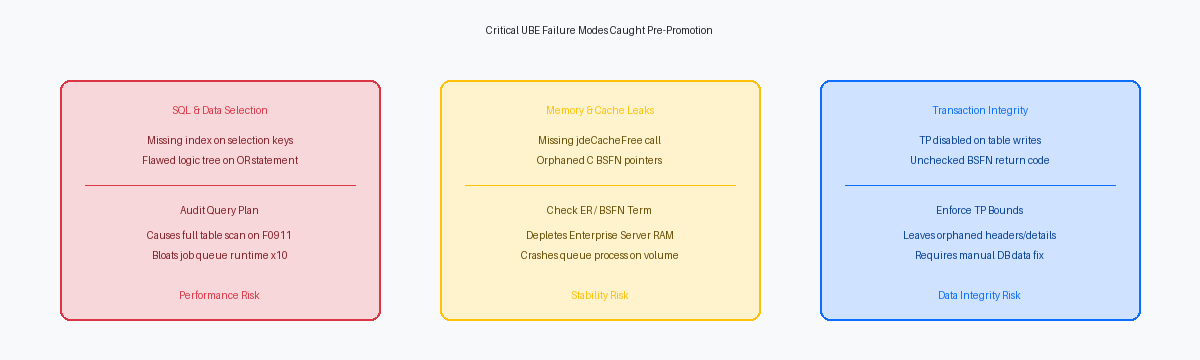
If you are systematically auditing your custom UBE estate before a Tools Release upgrade, establish these gate checks within OMW to catch spec, memory, and runtime errors prior to promotion.
