



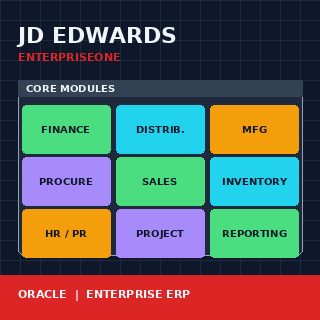
JD Edwards is a name that means slightly different things to different audiences. To a CFO at a manufacturing firm it is the ERP system the finance team has used for fifteen years. To a CIO weighing modernisation options it is one of the platforms competing for a transformation budget. To a developer with a CV in the ecosystem it is a specific stack of tools, languages and metadata layers built around a relational database. All three views describe the same product, and any conversation that flattens them into one risks the same misunderstanding the term has produced for decades. This article walks the product end to end as it stands today, who runs it, what it actually is technically, and what the realistic options around it look like in the current decade.
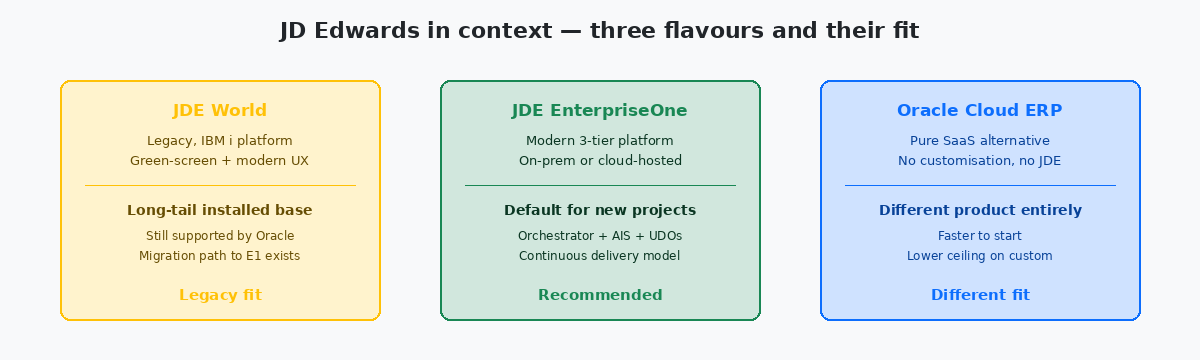
The product has survived three corporate owners, multiple architecture rewrites, and a generational shift in what enterprise software looks like. It is still actively developed by Oracle under the name JD Edwards EnterpriseOne, with a parallel legacy product called JD Edwards World still receiving support. The questions that matter — should we stay on it, should we modernise on it, should we replace it — depend on understanding which JD Edwards is in front of you and what its current trajectory actually is.
A short history that explains the present
JD Edwards as a company was founded in 1977 by three former accountants — Jack Thompson, Dan Gregory, and Ed McVaney — in Denver, Colorado. The original product was a finance package for the IBM System/38, which evolved into the AS/400 product that became known as JD Edwards World. World was a green-screen, RPG-based system tightly integrated with IBM's midrange platform, and it dominated mid-market manufacturing and distribution accounts through the 1990s.
The platform shift came in 1996 with the launch of OneWorld — a complete architectural rewrite for client/server deployment, written in C, with a metadata-driven design that separated the application logic from the underlying database. OneWorld eventually became EnterpriseOneThe modern flavour of JD Edwards, originally named OneWorld, redesigned in the late 1990s for client/server deployment and now running primarily as a web application. The active product line under Oracle ownership., and it is what the term "JD Edwards" usually refers to in any modern conversation.
The corporate path was less stable than the product. PeopleSoft acquired JD Edwards in 2003 in a friendly deal. Oracle then acquired PeopleSoft in 2005 in a hostile takeover that included JD Edwards as part of the package. The acquisition produced two years of strategic uncertainty — would Oracle invest in the product or fold it into the broader Oracle Applications portfolio — before Oracle publicly committed to continued development under the umbrella of its Oracle Applications Unlimited programme.
That commitment held. Two decades later JD Edwards EnterpriseOne is on Tools Release 9.2.x with active feature delivery, a published roadmap, and an installed base measured in the thousands of customers across manufacturing, distribution, construction, real estate, and professional services. The roadmap-to-2034 commitment Oracle has publicly stated is what gives the product the stability that makes long-term investment in it defensible.
The architecture that defines what JDE actually is
Strip away the marketing and JDE EnterpriseOne is a three-tier metadata-driven application platform. The presentation tier is browser-based, served by a Java application server that renders forms defined in JDE's metadata layer into HTML5 and JavaScript. The logic tier runs on the JDE Enterprise Server, which executes compiled C business functions and the visual event-rule logic attached to forms and UBEs. The data tier is a standard relational database — Oracle, Microsoft SQL Server, or IBM DB2 — accessed through JDE's data abstraction layer rather than directly.
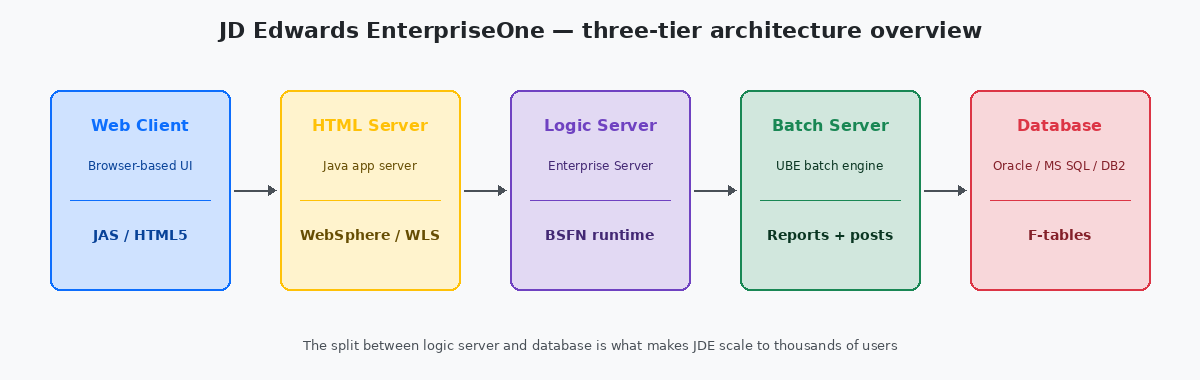
The metadata is what makes JDE different from a conventional software product. Every form, every business function, every UBE batch report exists as a row in a repository table, and the runtime composes those rows into running code at execution time. A custom form added by a client follows exactly the same path as a standard form delivered by Oracle, which is why custom development in JDE works the way it does and why the upgrade methodology has to handle merged metadata rather than merged source files.
The batch side runs through the UBEUniversal Batch Engine — JDE's batch report runner, used for every batch job in the system from period close to inventory replenishment. UBEs can produce PDF output, write to F-tables, or both. framework, which schedules and executes reports and posting jobs. Period close, inventory replenishment, payroll calculation, dunning letters, EDI processing — all of these run as UBEs against the database, with output going to PDF, to F-tables, or to both. The architectural split between interactive applications and batch jobs is what lets JDE handle the operational mix of a real ERP without either side starving the other.
The integration layer has evolved significantly over the last decade. OrchestratorJDE's low-code automation studio that composes REST calls, AIS service requests, BSFN invocations and notification logic into named flows. The strategic integration tool for new projects on EnterpriseOne. is the strategic tool — a low-code automation studio that composes REST calls, AIS service requests, and notification logic into named flows. AIS, the application interface service layer, exposes every form and BSFN as a callable REST endpoint. UDOs (user-defined objects) let business users build extensions — composite forms, watchlists, personalised landing pages — without writing code. These three together turn EnterpriseOne from the desktop application it started as into a platform that integrates cleanly with modern systems.
The functional footprint: what JDE actually does in the business
JDE is a horizontal ERP with strong vertical depth in a handful of industries. The horizontal layer covers what every ERP covers: general ledger and financial reporting, accounts payable and receivable, fixed assets, procurement, inventory management, sales order management, and basic human resources and payroll. These modules are mature, well-tested, and rarely the reason a client chooses JDE over an alternative.
The verticals are where the product earns its reputation. Discrete and process manufacturing have deep coverage in JDE — work orders, bills of material, routings, shop floor control, capacity planning, lot tracking. Distribution and warehouse management are mature, including advanced shipping, transportation management, and pick-pack-ship variations that handle complex fulfilment networks. The construction and real estate modules — job cost, contract billing, property management, lease accounting — are differentiators that very few competing products match, which is why JDE has a strong installed base in homebuilding, contracting, and property management.
The footprint is what keeps the product in the conversation when an organisation considers replacement. A pure-finance JDE site can move to almost any modern ERP with manageable effort. A construction or homebuilding JDE site that has spent twenty years configuring the job cost module against the way the business actually runs has a much harder migration problem, because the depth of fit is built into hundreds of configuration points and dozens of custom extensions. This asymmetry shapes every modernisation decision around the product.
The people, partners and economics around the platform
The JDE community is smaller than the SAP or NetSuite communities and larger than people assume from outside. Estimates vary, but Oracle has cited active customer counts in the multiple thousands across the EnterpriseOne and World installed bases, with concentrations in North America, Europe, and parts of Asia-Pacific. The user group structure — Quest Oracle Community in North America, regional groups elsewhere — gives the community a venue for technical and functional knowledge exchange that is genuinely active.
The partner ecosystem is what makes day-to-day work on the platform possible. Oracle does very little direct services delivery on JDE; the implementation, customisation and managed-service work is done by partners and independent consultants. The economics this produces are unusual for a major ERP: the platform license cost is one component, but the larger ongoing spend is on partner services for upgrades, retrofits, integrations and custom development. Organisations that understand this build their JDE budget around services first and license costs second.
The independent consultant layer matters more than it does in most enterprise software ecosystems. A senior JDE consultant with twenty years on the platform brings depth that no partner training programme reproduces — knowledge of how F-tables evolved, why a specific BSFN behaves the way it does in 9.2.6, what changed between Tools Releases. Organisations that nurture this knowledge inside their teams retain capability that partner-only models lose every time the staffing rotates.
Where JD Edwards sits in 2026 and what comes next
The current state of JD Edwards in 2026 is more stable than the trade press suggests. Oracle's roadmap continues to deliver new features quarterly through the Application Update mechanism, the underlying Tools Release continues to evolve with security, integration and AI-related capabilities, and the user base continues to add new customers — fewer than competing modern platforms, but enough to keep the ecosystem viable. The combination of continuous delivery on Application Updates and the Code Current methodology has materially changed what running JDE looks like compared to a decade ago.
The strategic decisions facing any JDE-using organisation today fall into three categories. Stay and modernise on JDE — the path most installed customers take, focused on adopting Orchestrator, AIS, UDOs and the integration capabilities that make JDE behave like a modern platform. Migrate to Oracle Cloud ERP — a real path with real trade-offs, since Oracle Cloud ERP is a different product with a different operational model and most of the customisation depth in a long-running JDE installation does not migrate one-to-one. Move to a third-party platform — possible but expensive, with the migration cost depending heavily on how much of the JDE footprint sits in standard versus custom code and configuration.
The right decision depends on factors that are not technical: the depth of vertical fit, the appetite for change, the available budget, the urgency of competing pressures elsewhere in the business. The technical question — "can JDE still do what we need it to do" — almost always has the same answer, which is yes, it can. The harder questions are commercial and organisational, and they are the ones the rest of this site is built around.
For more on the technical side of working with JD Edwards, the related articles on JDE upgrade methodology, on custom application development, on Orchestrator integration patterns, and on UBE batch monitoring cover the practical layer in depth. The technical project portfolio documents the kinds of work the platform supports across modernisation, integration and operational improvement programmes.
