




Most failed pathcodeA specific set of JD Edwards object specifications and business logic corresponding to an environment like Development (DV) or Prototype (PY). builds in PY trace back to a developer promoting an OMWObject Management Workbench, JD Edwards' primary change management and object lifecycle tracking system. project without checking in a dependent data structure or verifying local specs against Central ObjectsThe central database repository storing master definitions, event rules, and code specifications for JD Edwards objects.. A functional sign-off confirms a requirement was met, but it tells you nothing about architectural integrity. When developers self-promote out of status 21 without rigorous peer oversight, they introduce phantom dependencies, orphaned tokensExclusive check-out locks in OMW that grant a single project the right to modify an object and promote changes., and uncompiled C business functionsCompiled C-language modules in JD Edwards that execute complex transactional and computational business logic. that routinely break nightly update package builds for the entire team.
A rigorous JDE OMW approval process for technical leads operates as an engineering firewall, not an administrative rubber stamp. Before any custom modification advances toward status 28, the technical lead must audit token holdership, verify spec check-ins, and demand forensic unit test evidence—including jdedebug.logA detailed JD Edwards engine trace log recording API calls, SQL queries, memory allocations, and business function execution. traces that prove clean pointer allocations. Establishing this pre-promotion gate stops broken code before it corrupts Central Objects or burns four to six hours on an aborted package build.
Establishing the Technical Lead Promotion Gate
In too many JDE shops, an OMW project moves straight from Status 21 (In Development) to Status 28 (QA/Prototype Test) the moment a developer thinks they are finished. That single shortcut is where package stability dies. In enterprise environments, the majority of deployment package build failures—by our estimate, roughly two-thirds to three-quarters—trace back directly to objects promoted without checked-in specs or unmanaged table generation requirements slipping through untested.
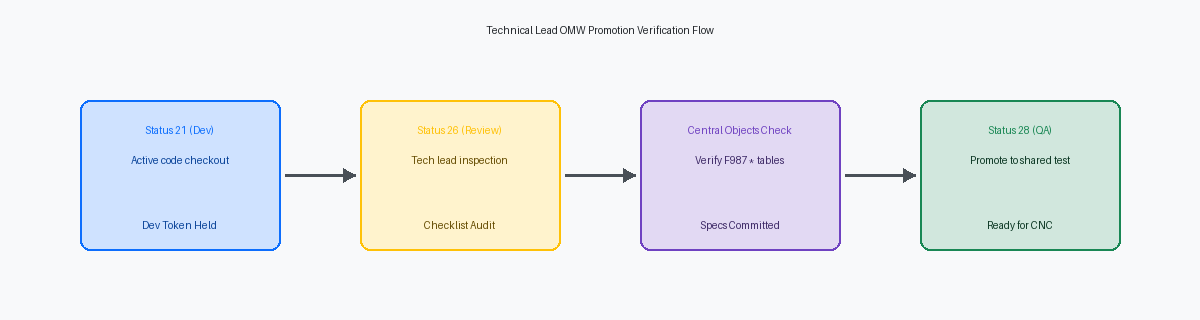
Business analysts and project managers confirm that a modification delivers functional requirements, but they cannot evaluate architectural safety, index design, naming convention compliance, or database integrity. That technical review must sit between 21 and 28 as an explicit transit state: Status 26. A developer should never have the authority to bypass this technical review and push code downstream on their own say-so.
Enforce this boundary strictly within Object Management Workbench Activity Rules (P98230). Strip developers of direct 21 to 28 rights by configuring project status transitions so that developers can only advance projects from 21 to 26. The subsequent transition from 26 to 28 must require a dedicated Technical Lead role defined on the project team, ensuring the OMW transfer path triggers object promotion only after rigorous technical verification.
Open P98230 tomorrow morning and audit the project status transitions for project type 01. If *PUBLIC is allowed to advance Status 21 to 28, delete that rule immediately. Reconfigure the spec transfers from DV920 to PY920 to fire exclusively on the 26 to 28 transition, guaranteeing that central object specs stay locked until a lead approves the work.
Auditing Project Scope and Token Ownership
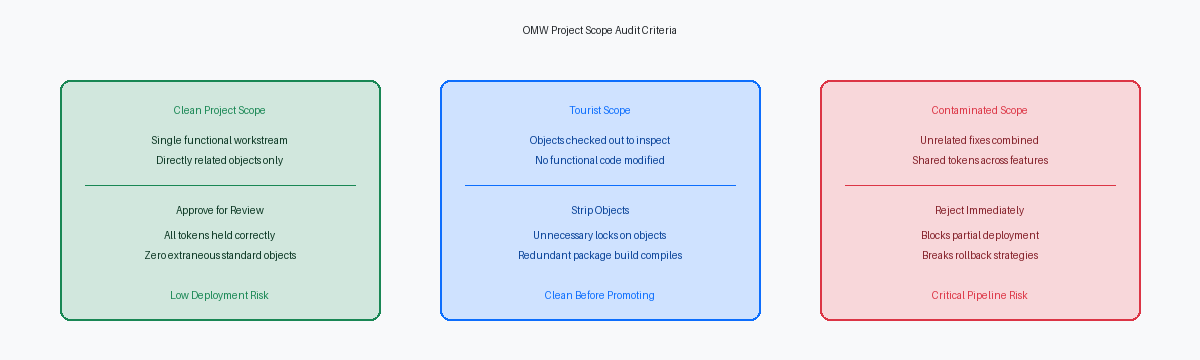
Reject any project carrying a catch-all name like DEV_MISC_Q1 or bundling unrelated system codes into a single promotion payload. When a developer packages an AP payment adjustment alongside a warehouse barcode customization, you destroy release traceability and introduce fatal dependencies into the promotion pipeline. If QA uncovers a defect in one component during integration testing, the entire omnibus project stalls at status 26, needlessly stranding production-ready fixes behind another developer's broken logic. One change order, one OMW project.
Your first operational check before reviewing code is querying token ownership across the F9861 and F9860 tables. Verify that the project requesting promotion holds the active token for every included artifact, especially high-traffic core objects like B4200310 or P4210. A lingering token held in an orphaned developer project blocks parallel enterprise workstreams and prevents the CNCConfigurable Network Computing, the technical systems administration architecture and team managing JD Edwards environments and packages. team from applying scheduled ESUsElectronic Software Updates, standard software patches and bug fixes delivered by Oracle for JD Edwards EnterpriseOne.. If an Oracle update attempts to merge specs into B4200310 while an unreleased token resides in a stagnant development project, the Planner ESU installation will fault or skip central object specification merges entirely.
Audit the object list for every tourist object before approving movement to the next status. Developers frequently check out foundational business functions like B4200310 purely to step through C code in Visual Studio or review data structure alignment during a production defect triage, inadvertently acquiring a token they never release. Run a specification comparison between the developer's local path code and the Central Objects parent specifications in the target path code. If B4200310 shows zero specification delta, strip the object from the project manifest and release the token immediately. Promoting unchanged standard objects bloats update package build times and risks regressing previous retrofits.
Validating Central Objects and Missing Specs
The phrase "it works on my fat client" almost always traces back to code executing against local runtime specs in the developer's local specdbThe local runtime specification database on a JD Edwards fat client containing cached object definitions. rather than Central Objects. When an engineer tests locally, workstation spec caches satisfy runtime execution even if the object never reached the DV database. Before approving any project movement out of status 21, you must confirm that the spec physically exists in the repository.
Target the Central Objects specification tables directly to confirm spec arrival. A targeted query against F98762 for Event RulesJD Edwards' proprietary procedural scripting language used to attach logic to form controls, tables, and reports. and F98741 for Form Specifications will expose whether the check-in actually occurred within the developer's stated delivery window. If the timestamp columns in F98762 or F98741 predate the developer's reported completion time, the code is still sitting on a local workstation, and promotion must be rejected.
Business functions require structural verification beyond database table records. A frequent root cause of broken package builds is a developer checking in B550100.c while leaving the matching B550100.h header file checked out locally. Open the deployment repository to verify that both the source and header files are checked in with identical timestamps, and verify zero compiler warnings in the local master build log.
Data Structure modifications present the most severe operational risk. Adding a parameter into the middle of an existing DSTR shifts memory offsets for every subsequent member. Any calling NERNamed Event Rule, a business function scripted in Event Rules rather than written in raw C code. or asynchronous BSFN that is not re-saved and recompiled against that new header will misalign memory pointers at runtime, crashing Enterprise Server callobject kernelsServer-side EnterpriseOne processes responsible for running compiled business functions requested by client sessions.. Query cross-references via F980021 to ensure every dependent object is packaged inside the project and recompiled before advancing status.
Enforcing Developer Unit Test Evidence Standards
A screenshot of an application with populated grid rows proves only that the runtime engine rendered HTML without crashing on a clean run. Technical sign-off demands developer proof of boundary conditions, null parameter handling, and intentional error state execution. If a developer alters an APPLAn interactive application object in JD Edwards consisting of forms, controls, and associated event rules. or NER to validate customer credit, the unit test artifact must capture the specific error code firing on an over-limit account, rather than just documenting a clean save on an unrestricted record.
For batch processing against high-volume transactional tables like F0911 or F4211, test evidence must include execution logs confirming that queries utilize defined indexes. Reject promotions where a UBEUniversal Batch Engine, the reporting and batch-processing runtime subsystem in JD Edwards EnterpriseOne. performs full table scans or iterates across unindexed data selections. Developers must provide run metrics against representative data volumes, confirming the job completes within acceptable processing windows before code moves downstream.
Custom C business functions demand line-by-line inspection of the JDEDEBUG.log trace to audit pointer lifecycle management. Every pointer instantiated via jdeAllocJD Edwards' proprietary memory allocation API equivalent to standard C malloc, tracked by runtime memory managers. must map to an explicit, reachable jdeFree across every logical path, especially within error-handling blocks. Overlooking an unreleased pointer in a BSFN called iteratively across a 50,000- to 100,000-row batch run guarantees call object kernel bloat and enterprise server memory exhaustion.
Any modification to transaction boundaries requires verified evidence of rollback mechanics when a sub-operation fails. Developers must deliberately trigger an error inside the transaction-enabled BSFN—such as an invalid duplicate key write—and provide the trace demonstrating that preceding inserts or updates rolled back cleanly. Without that trace, you are approving untested failure behavior directly into the testing environments.
Cross-Object and Data Dictionary Dependency Checks
Nothing halts an integration testing cycle faster than promoting an APPL or BSFN against stale Data DictionaryThe central repository defining field attributes, data types, edit rules, formatting, and display properties across JD Edwards. definitions. When a developer alters an item's display decimals, field length, or edit rule in the F9210 and F9211 tables, those DD items must reach the target path code and web runtime cache prior to or strictly concurrent with the referencing parent objects. Promoting an application without deploying the updated DD specifications guarantees web server serialization mismatches, corrupting JASJava Application Server, the web server layer that renders HTML interfaces and handles user sessions in JD Edwards. grid renders or triggering memory pointer faults in runtime engines.
A clean token release inside OMW gives developers a false sense of security because spec transfers ignore critical control tables. User Defined CodesConfigurable lookup code tables (UDCs) in JD Edwards that define valid values for data fields across applications. in the F0005, next numbers in the F0002, and Task Index menu records live outside standard OMW object promotion paths. Technical leads must mandate that every project containing new hardcoded lookups includes explicit CNC migration scripts—typically custom R98403 batch versions or audited SQL inserts—scheduled to execute before functional smoke testing begins.
Schema updates to custom tables carry an even higher operational risk during status changes. When an F55 or F58 table layout expands, verify whether the promotion package provides a structured ALTER TABLE script instead of relying on native OMW table generation. Executing a raw table generate action in PY drops and recreates the underlying database table, silently wiping weeks of curated test transactions that functional leads require for sign-off.
Modern EnterpriseOne enhancements rarely live entirely in C-code and event rules. If an APPL relies on custom OrchestrationsAutomated JD Edwards workflows that integrate applications, IoT devices, and third-party systems without custom code. or AISApplication Interface Services, a REST-based integration server providing real-time API access to JD Edwards application logic. service requests to push payload data externally, document the corresponding UDOUser Defined Object, web-based components like orchestrations, composite pages, and queries managed outside central specs. package transfer ID directly within the OMW project notes. Promoting compiled specs without synchronizing the target environment's orchestration components breaks the REST pipeline the moment end users click the form action.
The Pre-Promotion Status 28 Execution Checklist
Moving a project to Status 28 without an absolute gate is how broken specs corrupt an update package. Run a structured four-point pass across the object tree before touching the status field: verify token ownership across every line item, confirm that check-in timestamps match the final developer commits, ensure dependency sequencing aligns with table and data structure prerequisites, and verify signed-off unit test results. If a developer checked in a BSFN shortly after their test run was logged, the project stays at Status 26 until re-verified.
Before triggering the status advance, verify that project user roles are correctly established in P98220. If your user ID lacks the explicit technical lead role assigned by the OMW configuration matrix, the transition will either fail outright or bypass critical approval logging. Once you trigger the status change, do not rely on the high-level project view. Inspect the OMW logging tab and query the underlying F98210 table immediately to confirm that the transfer activity rules completed every spec copy and merge operation without silent warnings or object lock contention.
The transition to Status 28 serves as the operational contract with the CNC team for the upcoming package build. Close the loop by transmitting a precise manifest that enumerates modified C BSFNs requiring compilation, altered table structures that demand table generation or conversions, and associated UDO dependencies. Supplying CNC with an exact technical inventory prevents failed update builds and eliminates the late-night firefighting that occurs when an omitted data structure dependency breaks a runtime call on the enterprise server.
If you are refining your OMW status flows or standardizing code review gates ahead of the 21-to-26 CNC handoff, take a look at the companion technical articles on CNC package deployment strategies and custom development governance across EnterpriseOne 9.2. You will find detailed breakdowns on decoupling UDO promotion lifecycles from traditional path code builds, resolving token release deadlocks across parallel developer tracks, and auditing object transfers across multi-tier environments.
