




Your Jira boards and ServiceNow workflows capture intent, but when internal auditors or SOX examiners demand proof of change control, external ticket systems carry zero technical authority against the repository. If an auditor inspects a modified C-BSFN or custom UBE in your production path code, the Object Management Workbench log is the sole authoritative legal record of who held the token, what specifications were modified, and how the promotion executed. Treating the JDE OMW audit trail for custom development governance as a passive, background feature is what turns routine compliance reviews and retrofits into multi-week fire drills.
On an enterprise system housing 5,000 to 15,000 custom objects, standard automated logging floods tables like F98210 and F98211 with raw timestamps that provide no real context. Moving from passive logging to defensible governance requires configuring OMW activity rules to enforce mandatory project notes, strict object-level lineage tracking, and automated promotion controls that withstand forensic scrutiny.
The Underlying Architecture of OMW Logging Tables
Most developers treat Object Management Workbench as an administrative GUI, but at the database layer, OMW operates as a relational transaction ledger. Every project status change, check-in, check-out, token release, and specification merge writes records synchronously to F98210 (Object Management Log) and F98211 (Object Management Log Detail). The EnterpriseOne runtime issues these inserts in the same unit of work as the underlying object pointer update, ensuring that custom specs cannot move across path codes without an unalterable log record.
The F98210 schema records transaction-level metadata with 1-second timestamp precision. Each row logs the operator user ID, the origin and destination project statuses, the source and target path codes, the client machine identification key, and system time. If a developer checks out an APPL or advances an OMW project from status 21 to status 26, F98210 establishes the deterministic chain of custody. The child table F98211 expands this by logging granular action details, such as the specific text comments, save locations, and token activity associated with individual objects inside that project.
Database administrators often attempt to monitor repository modifications by attaching database triggers or CDC tools to Central Objects and System schemas. This strategy routinely creates synchronization mismatches during automated package builds and multi-tier promotions because external listeners lack visibility into JDE session variables and token states. Native OMW logging preserves structural referential integrity with Object Librarian tables F9860 and F9861. It guarantees that object librarian status records, path code deployment history, and physical object specs remain perfectly aligned across Development, Prototype, and Production data sources without manual reconciliation.
Object History Versus Project History in Lifecycles
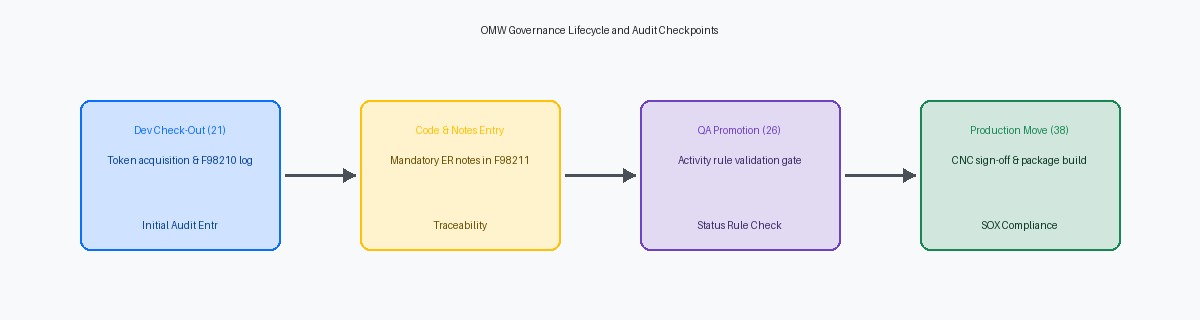
Too many delivery leads treat OMW projects as the definitive source of truth for change control, confusing the packaging vehicle with the technical lifecycle of the code. Project history captures the macro lifecycle: how a coordinated bundle of objects transitioned from status 21 to 26 and into status 38 across path codes. Object history, by contrast, tracks the granular, micro-level mutations of a single artifact as it gets pulled into dozens of discrete development initiatives across five or ten years.
Development governance collapses when teams audit objects in strict isolation. A developer modifying a custom APPL like P554210 might log a clean token release and check-in under project PRJ-1044, but that application often relies on revised data structures in a BSFN checked in under an entirely separate defect-fix project months prior. Relying purely on project-level status logs blinds release managers to these cross-project dependencies, resulting in broken runtime pointers and package build failures when objects are promoted out of sequence.
Opening the P98220 Object History inquiry screen across your Central Objects repository exposes the hidden technical debt that project logs conceal. Querying an impacted standard object or core custom wrapper frequently reveals an artifact modified repeatedly over several years without an updated ESU retrofit baseline. Running this inquiry prior to any major upgrade or Tools Release deployment provides senior architects with the chronological code lineage needed to reconcile parallel branches and prevent regressions in production.
Project Notes as Essential Traceability Artifacts
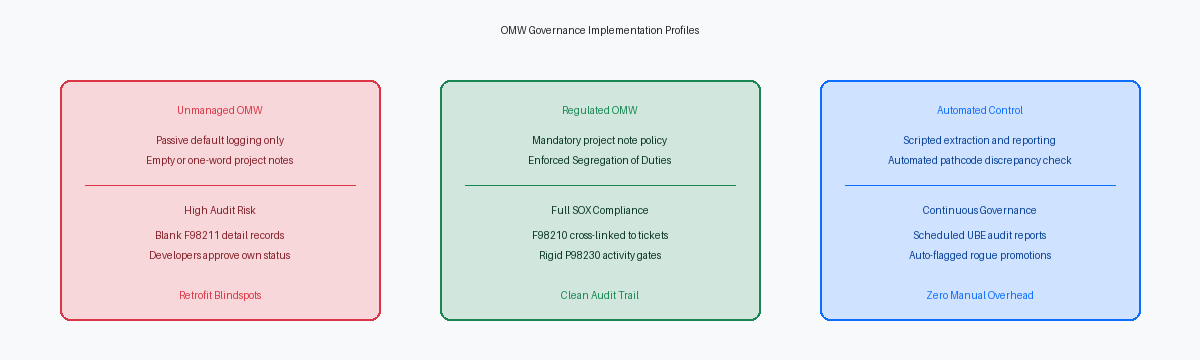
Seeing "bug fix" or "modified ER" entered as an OMW project note is worse than leaving the field blank; it creates an illusion of compliance while completely invalidating change governance during code retrofits and external audits. When internal audit flags an unauthorized credit check bypass in P4210, a note that reads "updated logic" forces your development lead to pull repository archives and reconstruct developer intent line by line. The failure is not technical—it is an operational breakdown in traceability that leaves the production environment indefensible under regulatory scrutiny.
Mandatory project note conventions must enforce concrete operational detail before an administrator approves an object promotion past status 21. Every project log entry must document the change request ticket, the explicit functional business justification, the exact Event Rule lines and events altered—such as Post Dialog is Initialized or Row Exit & Changed - Inline—and all cross-functional dependencies, including custom data structures or table triggers in the F4211 estate. Capturing this structured data directly within the F98211 (OMW Project Text Log) table transforms an opaque revision history into an actionable engineering blueprint.
That discipline yields immediate, measurable returns during major lifecycles. Detailed project notes in F98211 save an average of 4 to 6 developer hours per object during a Tools Release or Applications retrofit cycle. Instead of spending half a day reverse-engineering undocumented C business functions or comparing ER specs against Pristine to deduce whether a modification is obsolete or business-critical, the upgrade engineer reads the exact rationale immediately. On an enterprise upgrade with 200 to 400 impacted custom objects, this governance practice eliminates upwards of 1,000 hours of speculative triage, directly compressing the development timeline and protecting project margin.
Configuring Activity Rules to Enforce Governance
Governance fails the moment an organization treats promotion rules as advisory rather than automated gatekeepers. In Object Management Workbench, the Activity Rules application (P98230) defines the exact physics of your lifecycle. If a rule permits an object transfer without verifying prerequisite conditions, developers will inevitably bypass peer reviews during crunch periods. You configure these rules by Project Status and Object Type, establishing strict Allowed Actions that convert internal control policies into mechanical system blocks.
Moving a project from Status 21 (Programming) to Status 26 (QA Test) must execute a structured transfer from DV920 to PY920 while clearing active developer locks. Configure the status transition in P98230 to enforce mandatory token releases on all modified objects and validate log detail entries. If a developer attempts to promote a project where an object token is still held in another project or prerequisite checklist items remain incomplete, OMW halts the transfer immediately. This prevents untested BSFN code or unlinked data structures from migrating to the QA environment.
The final promotion requires absolute segregation of duties hardwired into CNC user security. Developers should never possess the authority to advance projects to Status 38 (Production) or trigger transfers into the PD920 pathcode. By restricting the 26-to-38 and 28-to-38 status advance actions exclusively to CNC and release management user classes within P98230, you eliminate self-approvals at the application level. When an internal auditor asks who authorized code moving into live operations, the promotion history provides a verifiable record showing the transfer was executed solely by an independent administrator after QA sign-off.
Audit Trail Extraction for SOX and Internal Controls
External audit cycles inevitably dead-end on the same demand: prove that every spec running in the PD920 pathcode strictly matches an approved, tested modification originated in DV920. Relying on developer sign-offs or manually compiled spreadsheets will fail a PCAOB inspection every time. IT leadership must provide an unbroken chain of custody proving that not a single byte reached production without passing through every mandatory testing gate and segregation-of-duties check.
The most defensible way to establish this control is an automated custom UBE executing directly against F98210 and F98222. By joining project log history with the project object list, the report extracts an immutable lineage showing project status progressions, CNC promotion timestamps, user IDs, and object save locations across lifecycle milestones. Scheduling this extract to fire immediately after production package assemblies gives audit teams a verifiable snapshot of Central Objects, capturing who advanced the project from status 26 to 38 and the exact timestamp the specs transferred.
Reconciling this extraction against your enterprise ticketing system isolates rogue objects checked directly into production pathcodes or promoted out-of-sequence. Comparing F98210 action entries against production package deployment history in F986110 and F986114 immediately exposes disparities where code was deployed into PD920 without an approved change record. If an engineer circumvents transfer activity rules via direct table manipulation or applies an emergency C BSFN fix directly on an Enterprise Server, the reconciliation identifies the discrepancy within hours. You replace weeks of frantic audit preparation with an automated reconciliation process that external examiners can validate in minutes.
Establishing a Production Promotion Protocol
The bridge between object management and runtime deployment is where governance usually collapses. CNC administrators routinely absorb the blame for broken deployments that were actually triggered by unchecked check-ins weeks earlier. A compliant governance model requires a formal checklist before any project advances to status 38: verifying pristine object specifications, identifying table and data structure changes that mandate dependent BSFN recompilations, and cross-checking package build histories against active project tokens.
Central Objects package builds must correspond directly with closed, validated OMW projects rather than ad-hoc developer drop-ins. When a developer slips an unapproved fix into a scheduled build by briefly checking in an object outside the promotion cycle, they poison the package specification repository. Every object slated for assembly into an update package must be tied to a project that has passed functional sign-off, cleared status transition rules, and released all object tokens. If an object is not cataloged in a verified, closed project manifest, the CNC team must refuse the package build request without exception.
Enforcing this operational boundary directly targets the root cause of production instability. Across enterprise systems with over 5,000 custom objects, shifting from informal build requests to this closed-project promotion protocol reduces post-go-live Sev 1 package deployment regressions significantly, often by three-quarters or more. It eliminates late-night firefighting caused by mismatched data structures or overwritten event rules, replacing developer guesswork with an auditable line of custody running straight from the developer workstation into production runtime.
Tightening OMW activity rules and querying logging tables like F98210 establishes defensible technical controls across your Central Objects repository. If you are refining your release management framework, align your OMW project policies and CNC build gates to ensure every promotion into production remains transparent, traceable, and fully compliant.
