




Every veteran JDE lead has run the post-mortem where an emergency hotfix applied weeks earlier mysteriously vanishes. A developer spent several days refactoring logic in DV, validated it in PY, and advanced the OMWObject Management Workbench: The JD Edwards change management system used to track, develop, and promote objects across environments. project status from 21 to 26 to 38 on schedule. Nobody diffed the specsSpecifications: Binary metadata and code definitions that control how JD Edwards applications, forms, and business logic behave.. Within minutes, a critical production patch pushed directly to PD during month-end close was wiped out by stale development code.
Object promotion is an active deployment risk, not an administrative transfer. Between concurrent developer tokens, divergent Central ObjectsCentral database repository storing master specifications for JD Edwards objects in a given environment., and out-of-band break-fixes that bypassed the normal release train, environments drift constantly. Taking time to compare JDE OMW object versions before promotion is your only reliable defense against spec collisions, contaminated runtime packages, and broken production processes.
The Production Overwrite Scenario: How Fixes Get Erased
A distribution center halts shipments mid-shift because an F4211 line-split defect has resurfaced inside P4210. A week or two earlier, your team applied an emergency hotfix directly in PD920 under an expedited project to resolve corrupted order lines during ship confirm. The fix stabilized the dock, but skipping the standard DV920 development lifecycle introduced an immediate divergence between Central Objects - PD920 and Central Objects - DV920. The hotfix solved the immediate operational crisis on the glass while quietly turning your production path codeA specific set of JD Edwards software specifications and business logic representing an environment like Development or Production. into an unmanaged branch.
Concurrent development projects frequently touch the same core sales and distribution applications across separate OMW project containers. A developer enhancing credit checking in DV920 checks out P4210, completely unaware of the hotfix sitting in the production specs. Because OMW tokens govern check-out permissions within an environment rather than providing cross-path-code delta visibility, development proceeds on obsolete source code. When that scheduled enhancement reaches status 38 and packages into production, OMW transfers specifications directly from source Central Objects to target Central Objects. EnterpriseOne does not perform an intelligent, line-by-line merge; it executes a complete spec overwrite that silently wipes out the unretrofitted line-split logic.
Your audit trail will not flag the destruction. Standard Object LibrarianA core JD Edwards system repository that tracks object definitions, locations, and modification history across environments. history meticulously tracks project transfers, machine keys, and user IDs in the F9861 table, showing exactly when the release moved from status 28 to 38. However, F9861 records administrative movement, offering zero visibility into code-level specification deltas. It confirms who pushed the project while concealing that critical business logic vanished in the database transaction. Without an explicit spec comparison before promoting the container, your production hotfix ceases to exist.
Configuring Path Codes and Spec Data Sources for Diffs
Most comparison failures stem from a flawed assumption about where OMW pulls its spec definitions. ER CompareEvent Rules Compare: A JD Edwards utility that highlights code differences in business logic between environments or path codes. does not query your local spec database unless explicitly instructed to compare against the local workspace. To execute a dependable diff against a downstream path code, your fat clientA Windows development workstation containing local JD Edwards developer tools, compilers, and runtime files. must establish concurrent database connections to both your active checkout location and the remote Central Objects data source defined in the Object Configuration ManagerA JD Edwards mapping system that routes user requests, objects, and database tables to specific data sources and servers. (F986110). If your system OCM mappings point Central Objects to a remote database that your workstation cannot authenticate against, OMW either throws an ambiguous connection error or quietly aborts the diff.
Developers frequently fall into the trap of comparing their changes against local runtime specs rather than target environment Central Objects. When you compare DV code against a local PY spec cache instead of querying the actual Central Objects - PY920 schema tracked in the F9860 repository, you miss every update checked in by peer developers that has not been deployed to your local machine. The diff reports zero conflicts on your screen, yet the true divergence across the schemas in PY920 or PD920 remains hidden until a failed full package build or a production defect exposes it.
A reliable comparison path requires confirming that the Central Objects - PY920 and Central Objects - PD920 data sources are reachable directly from the fat client development workstation. If network firewalls, database listener ports, or restricted database credentials block your machine from reaching the PD920 database instance, OMW cannot query tables like F98741 for event rules or F98762 for design specs.
Configure custom comparison paths within OMW user options to avoid checking objects out into target path codes simply to inspect them. By mapping custom target paths to pristine environments, historical package snapshots, or backup Central Objects schemas, a developer can evaluate modified DV920 specs against a pristine reference line while keeping tokens intact in development.
Executing ER Compare and Object Compare in OMW
When you launch comparison utilities from OMW Design on a modified P4310 against Central Objects - PD920, the tool segregates your analysis into two distinct engines. Spec Compare handles control positions, form structures, and grid properties, while ER Compare parses the procedural Event Rules across APPLInteractive Application: A JD Edwards GUI program consisting of forms, grids, and event-driven business logic. and UBEUniversal Batch Engine: A JD Edwards batch process used for background processing, data updates, and reports. objects. Expanding the Write Grid Line-After event in a high-volume application like Purchase Order Entry immediately isolates custom voucher matching logic or EDI validations that differ between your local spec and production.
ER Compare flags line-level discrepancies using a strict visual color convention: green indicates local additions, red denotes code present in the target path code but absent locally, and yellow highlights modified event logic. A developer reviewing several hundred lines of custom purchase order logic can isolate a modified line or an unmapped parameter in seconds. This visual diff immediately exposes missing conditional branches before an unchecked project promotion overwrites active production logic.
Line differences are only half the assessment; developers must thoroughly verify event-level variable scoping across both environments. If a developer passes an ER variable scoped locally at the grid level when the target object expects form-level scope—often the result of an interim ESUElectronic Software Update: An Oracle software patch containing fixes or enhancements for JD Edwards objects. retrofit—the parameter mismatch can trigger memory access violations during runtime BSFNBusiness Function: Encapsulated C or Named Event Rule programs executing reusable business logic in JD Edwards. execution. Checking the variable definition tables side by side ensures pointers and data structures align before the object is built into an update package.
Rather than manually re-entering production hotfixes into the development environment, developers should use the bidirectional merge functions built directly into the ER Compare interface. Selecting divergent code blocks and clicking the merge arrow pulls the active production logic into the current workstation spec without abandoning the local OMW project or checking out duplicate tokens. This targeted reconciliation typically takes 10 to 15 minutes per object and guarantees branch integrity across the release path.
Comparing BSFNs, Tables, and Data Structures
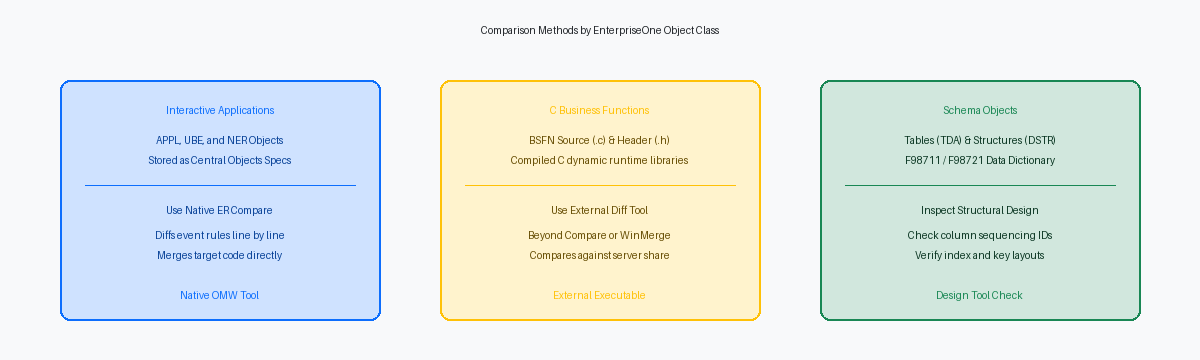
ER Compare stops cold at C-based business functions, leaving critical processing logic in EnterpriseOne completely unmonitored during standard ER diffs. When evaluating an engine like B4200310 (Sales Order Edit Line), the native compare tool inspects the parent object record while ignoring the implementation source entirely. Configuring Beyond Compare or WinMerge as the default diff tool within your OMW environment resolves this operational blind spot by pulling the local .c and .h source files straight into an automated visual split view.
Executing the comparison directs the utility to evaluate your local checkout against the extracted source from the target path code package share on the deployment server (such as \\deployment_server\E920\DV920\source). With complex functions like B4200310, this side-by-side inspection instantly exposes pointer revisions, modified data structure members, and emergency production hotfixes that someone applied directly to PD without updating the development baseline. Catching these divergences at the file level avoids silent memory faults and unhandled exceptions when the C code compiles during the next server package build.
Data structures (DSTRData Structure: A defined layout of input and output parameters passed between JD Edwards applications, reports, and business functions.) and Table Specifications (TDATable Design Aid: The JD Edwards utility used to define database table structures, columns, and indexes.) introduce an even deadlier hazard: runtime serialization mismatch failures that crash enterprise callobject kernelsJD Edwards enterprise server background processes dedicated to executing business functions requested by client sessions. without generating an Event Rules error. If a developer reorders elements in a DSTR or injects an attribute into an existing table layout without matching target sequencing, the binary memory payload misaligns during jdenet transmission. Table comparisons demand checking column sequencing, math numeric attributes, and index definitions directly against the Central Objects F98711 table across both environments before executing table conversions or approving project promotions.
The Pre-Promotion Risk Check Checklist
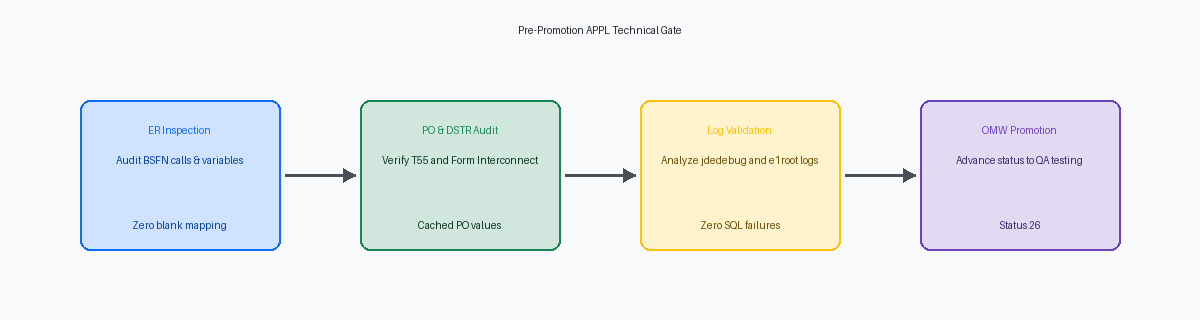
Most production regressions trace back to an unverified assumption made hours before deployment. If your change management policy permits an OMW project to advance from Status 21 (Programming) to Status 26 (QA Review) or Status 28 without a mandatory target compare, you are operating on blind trust. OMW transfer activity rules copy specs efficiently, but they cannot evaluate whether a parallel emergency fix modified target Central Objects yesterday. A promotion gate must mandate an explicit spec compare against the immediate target path code before that status changes.
Before running the comparison tool, pull the object history through OMW logging in P98220. Confirm whether another project promoted changes touching your target objects into PY or PD after your initial checkout timestamp in DV. If an interim update occurred, your local specs in DV are already stale relative to the baseline. Checking this in P98220 takes under a minute; discovering an overwritten production hotfix during integration testing takes days of retrofitting.
A clean diff on a modified APPL or UBE is useless if the supporting architecture is missing from the payload. Every dependent object—named event rules, data structures, and processing option templates—must reside within the exact same project envelope. Promoting an updated report without its revised data structure guarantees memory allocation faults or event rule validation failures in the target path code, regardless of how clean the primary object looks in isolation.
CNCConfigurable Network Computing: The architectural layer and system administration discipline that manages JD Edwards environments, packages, and servers. administrators must act as technical gatekeepers rather than passive operators executing status transitions. Promotion requests moving past Status 21 must require an attached, verified diff log showing zero unmerged conflicts against the target Central Objects directly on the P98220 project record. If the log is missing or shows unresolved discrepancies, the CNC rejects the promotion immediately. This procedural boundary eliminates post-package deployment regressions before code ever touches an assembly directory.
Resolving Divergent Code Without Breaking Branch Integrity
Finding unmerged code during a pre-promotion spec compare demands an immediate stop on your project advance. Suppose an ER compare reveals a 15- to 20-line custom tax calculation hotfix running in PD920 that was never retrofitted to DV920. The rule is absolute: back-port those lines into DV920 first, re-validate the combined logic in local unit testing, and promote the unified object cleanly through PY920. Never execute a brute-force promotion with the assumption that you will patch the lost production hotfix afterward. That operational gap—even if it lasts less than an hour—risks calculating erroneous sales tax on live customer orders or corrupting general ledger post batches.
Managing this divergence requires strict discipline around token ownership within OMW. The token mechanism enforces sequential access across projects, but development teams frequently pass, release, or reassign tokens without comparing target specs. Grabbing a token to promote a major feature package over an unmerged parallel stream will blow away the emergency fix every time unless you explicitly diff and reconcile the central objects beforehand.
Record every manual reconciliation decision directly inside the OMW project notes before advancing the project status from 21 to 26. Document the specific lines merged, the SARSoftware Action Request: An issue or enhancement tracking record used in JD Edwards to document bug fixes and code modifications. or ticket number of the PD920 hotfix, and the testing sign-off. Maintaining this narrative inside EnterpriseOne provides an unassailable audit trail for internal compliance leads and external change control audits, proving that code divergence was resolved systematically rather than masked.
If you are standardizing pre-promotion spec validation across multi-tiered path codes, explore the related breakdowns on OMW token management, deployment server spec builds, and business function debugging workflows. For CNCs and developers managing high-frequency release cycles across estates with hundreds of modified objects, the engineering portfolio covers practical project case studies and migration architectures built to stop ER regressions before code ever touches Production.
