




Incomplete developer transitions in EnterpriseOneOracle's comprehensive ERP software suite, commonly known as JD Edwards EnterpriseOne. are an invisible tax on delivery schedules. Implementing a structured JDE OMWObject Management Workbench; the JD Edwards change management system used to develop, track, and promote objects. developer handover checklist for custom objects prevents incoming resources from burning 8 to 12 hours per object simply reverse-engineering business logic, chasing table triggers, and validating specSpecification; binary metadata defining object structures, logic, and interface layouts in JD Edwards. dependencies. What looked like a completed task in the sprint backlog otherwise becomes a multi-day forensic exercise in OMW before a single line of functional code can be enhanced or patched.
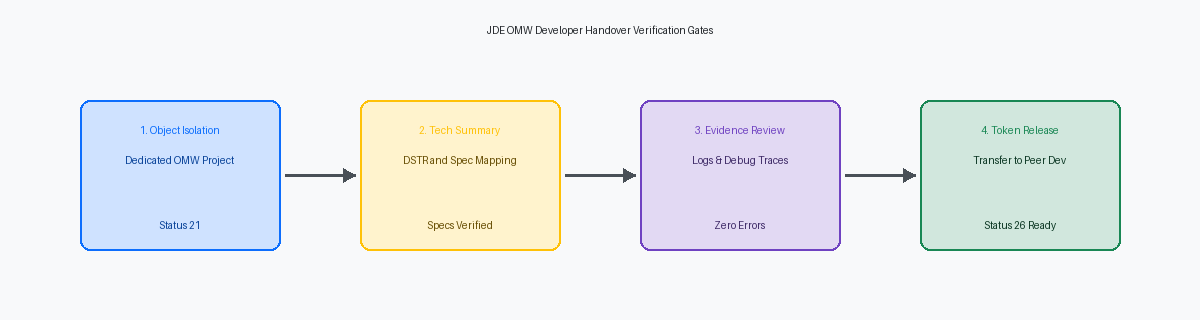
Enforcing these technical gates is not administrative bureaucracy; it protects production stability across your promotion pathThe structured workflow route (e.g., Development to QA to Production) through which software changes advance.. A defensible handover requires four non-negotiable baselines: concise technical summaries mapping table and data dictionary dependencies, structured OMW project notes, reproducible test execution evidence, and disciplined token managementOMW mechanism granting exclusive editing control to a single project to prevent conflicting concurrent changes. so downstream environments do not deadlock. Without these operational gates, you are not transitioning completed development—you are transferring unquantified technical debt.
OMW Project Structure and Change Notes Hygiene
A developer handover should never originate from a catch-all workspace like a personal scratchpad or a quarterly cleanup container. The handover must stem from an isolated Object Management Workbench project titled strictly with the formal change request ID or SARSoftware Action Request; Oracle's formal tracking ID for code modifications, bug fixes, or enhancements. number. Bundling three separate functional fixes into one project means a defect in a single report halts deployment for the entire group. Splitting the deliverables by change ticket before calling the review meeting prevents blocked promotion pipelines.
The project notes tab demands equal discipline. Entries such as "resolved order issue" or "bug fix" force downstream teams into hours of spec comparisons during subsequent patch cycles. Notes must record the exact business trigger, the baseline defect, and the explicit dependency footprint across business functionsReusable encapsulated logic modules in JD Edwards written in C or Event Rules. and batch engines. If an update to custom UBEUniversal Batch Engine; the report and batch processing engine in JD Edwards. R554210 relies on an altered data structure inside business function B554201, that relationship must be explicitly stated in the OMW project notes before the spec walk begins.
Audit the project contents against the F98222The JD Edwards system table storing OMW project object membership records. project membership table and the F9860The Object Librarian master table tracking all development objects across JD Edwards. Object Librarian master before scheduling the handover. Developers routinely leave test harnesses, copy-paste temporary tables, or discarded data structures attached to their local projects. Reconciling F98222 against F9860 ensures that every orphan object is purged from the project manifest, preventing stray specs from hitchhiking through your promotion path into QA and production packages.
Verify that the system code on every object in F9860 remains strictly within the 55 to 59 reserved range. Stray objects assigned to system codes like 42 or 43 to inherit standard distribution menus will eventually collide with base line code. The next routine Oracle ESUElectronic Software Update; Oracle-delivered patch packages containing fixes or enhancements for JD Edwards. or cumulative update will overwrite those modifications without warning, wiping out months of custom development.
Technical Summary and Spec Dependency Mapping
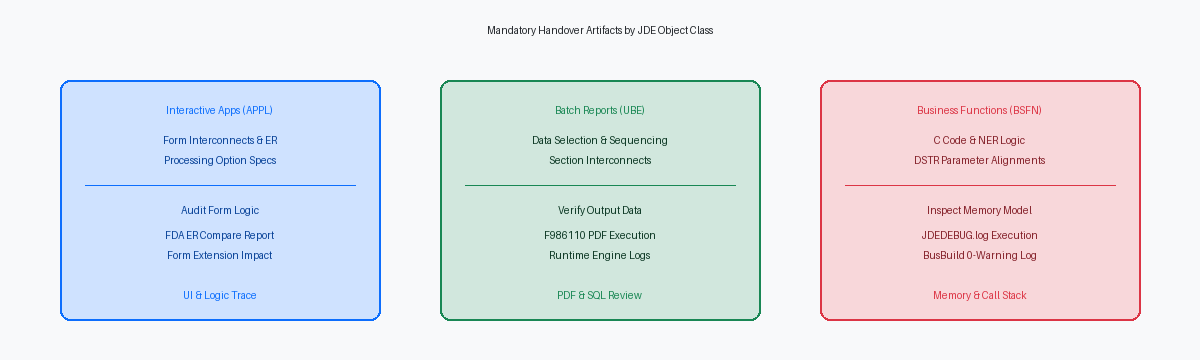
A silent memory corruption or an unexpected runtime error 078S almost always traces back to an undocumented spec alteration. When an outgoing developer touches a shared Data Structure (DSTR)Defined memory schema of input and output parameters passed between JDE applications and business functions., appending or realigning parameters directly alters memory offsets across the BSFNBusiness Function; an encapsulated program module in JD Edwards executing backend business logic. call stack. The handover technical summary must explicitly detail all primary and secondary dependencies—custom tables (F55/F56), downstream data structures, and UDCsUser Defined Codes; customizable reference tables that validate field entries across JD Edwards.—so the incoming engineer knows every object touched by the change.
Modifying a shared DSTR requires explicit notes stating whether parameter additions break calling BSFNs across custom code and standard Oracle business functions. If an incoming parameter is appended to an existing structure instead of creating a versioned DSTR, any uncompiled caller passing an older memory layout will trigger memory faults. The handover document must chart these calling hierarchies across both custom F55 logic and standard Master Business Functions (MBFs)Standard JDE business functions that centralize complex transaction processing and database validations..
Event RuleProprietary JD Edwards visual scripting language executed when application or batch events occur. variable scopes, processing option templates (T55/T56), and report interconnect parameters require the same level of granularity, cataloged by their exact data dictionary aliases. Differentiating between form-level, report-level, and local ER variables prevents the incoming developer from chasing phantom values through the runtime engine. Documenting whether an alias is standard (such as MCU or DOCO) or a custom 55-prefixed field ensures that data formatting and edit rules remain intact during future retrofits.
For custom C BSFNs, the technical summary must define memory management structures, custom header files (.h), and pointer lifecycles to protect the enterprise server runtime. Leaving pointer cleanup vague guarantees memory leaks that slowly consume heap space until the CallObject kernels crash under peak volume. Specify precisely where jdeAllocA JD Edwards C API function used to dynamically allocate memory on the system heap. is paired with jdeFree, how math and date structures are initialized, and which functions retain pointers across separate API invocations.
Source Code Annotations and Mod Footprints
A code handover fails the moment an incoming engineer has to play archaeologist in the Event Rules. Every modified NERNamed Event Rules; business functions written using JDE's high-level Event Rules language rather than C., APPLInteractive Application; user-facing graphical screens and forms in JD Edwards., UBE, and C business function source file (.c and .h) must lead with a standardized header block detailing the ticket or SAR number, developer initials, modification date, and a concise functional summary. During a typical retrofit cycle where an upgrade team sifts through 200 to 500 impacted objects, missing header metadata instantly inflates analysis time from ten or fifteen minutes per object to nearly an hour, destroying project velocity.
Retrofit integrity depends entirely on boundary hygiene. Every single line of inserted, modified, or suppressed baseline logic demands strict bracketed tags—specifically /* START SAR_12345 */ and /* END SAR_12345 */ in C source, or matched ER comment lines in named events. If a developer modified a C BSFN using direct SQL rather than standard JDB APIJD Edwards database middleware APIs that abstract SQL queries and manage database caching. calls, that block must explicitly document the target physical tables, the specific index targeted, and the technical justification for bypassing JDE database abstraction and cache management.
The ultimate gate check before handing over ownership is an Event Rules text diff inspection via the OMW Visual Compare utility against the baseline PathcodeA specific JDE environment repository directory containing central object specifications. or local Save directory. If the tool surfaces a single altered assignment, altered table I/O statement, or commented-out system function that lacks enclosing boundary tags, reject the transfer immediately. An incoming engineer must be able to audit a 200- to 400-line delta in complex sales order or inventory processing logic and account for every altered byte with zero undocumented variance.
Test Evidence Standards for Incoming Developers
A handover packet landing on a technical lead’s desk without verifiable execution artifacts is incomplete and must be rejected at the gate. "It worked in DVDevelopment environment in JD Edwards where developers build and unit-test custom code." is an assertion, not proof. Projects routinely lose 20 to 40 development hours untangling inherited objects that compiled cleanly on a development fat client but immediately throw unhandled memory exceptions under Enterprise Server execution. Verifiable evidence establishes the baseline operational state of the object at the exact moment of custody transfer.
For batch applications, a handover requires the generated PDF execution run, the runtime processing option values recorded in the F986110Job Control Status Master table tracking submitted batch jobs and execution details in JDE. job control table, and the raw engine log confirming zero unhandled database errors. When an incoming engineer inherits a modified R42565 or a custom extraction UBE, having the F986110 runtime parameters eliminates any debate over whether an anomaly stems from logic changes, blind data selection, or stale processing options.
Custom Business Functions require deeper runtime artifacts. BSFN test evidence must include an isolated JDEDEBUG.logA detailed diagnostic trace file logging business function execution, parameters, and SQL statements. call trace that validates incoming data structure parameters, internal business function calls, and outgoing return codes. Reading this trace lets the next developer confirm that internal pointers resolved correctly, ER_SUCCESS was legitimately returned, and JDE user cache handles were released before the thread exited.
When an object interfaces with external architectures via AISApplication Interface Services; a REST API server enabling external systems to interact with JDE. orchestrations or business services, the handover packet must include the complete JSON or XML input payload alongside the raw response payload. Static event rule code cannot tell an incoming developer whether an external endpoint expects an ISO 8601 timestamp or an EnterpriseOne Julian integer. Providing the verified transactional payload pair anchors the contract between JDE and the external system, preventing costly boundary guesswork.
Token Management and Promotion Path Validation
A rogue token sitting in an abandoned development project will halt a scheduled package build faster than a corrupted spec record. Before releasing any project token, the originating developer must verify that every modified object is completely checked in to the development pathcode (DV920The standard EnterpriseOne 9.2 Development pathcode where source code and object specs reside.). Leaving a modified C BSFN or NER checked out on a local workstation while passing the project forward guarantees spec desynchronization and broken promotion paths. The project log must record an explicit check-in action rather than an administrative token release performed without synchronized central objects.
Token management also requires reconciling the queue of secondary projects waiting for access. Any tokens held in secondary development projects must be formally reconciled or released to prevent downstream deployment pipelines from deadlocking during scheduled builds. When triggering the OMW transfer activity rules from Status 21 (Programming) to Status 26 (QA/Test Transfer), the developer must inspect the F98210The OMW Object Management Log table tracking promotion history, transfers, and token actions. history log immediately. This confirms that all object specifications transferred cleanly, data structure generations completed, and table merges succeeded without the silent spec errors that routinely corrupt target environments like PY920The standard EnterpriseOne 9.2 Prototype (QA/Testing) pathcode..
Validation ends at the enterprise server build history. Depending on your Tools ReleaseThe foundational system software and runtime engine layer powering JD Edwards EnterpriseOne. and architecture footprint, server package build logs must be cross-checked to ensure custom business functions compile cleanly across both 32-bit and 64-bit targets. A function that builds locally on a fat client Visual Studio instance can still throw fatal pointer truncation errors or missing typedef symbols on the enterprise server. Verifying zero compiler errors in Server Manager prior to handover ensures the receiving team inherits code ready for immediate pipeline deployment.
Peer Review Verification and Handover Sign-Off
Accepting ownership of a custom modification without pulling it onto a clean fat client is how subtle build defects slip into production packages. The incoming developer must perform a clean checkout of every object in the project into their local DV920 pathcode and rebuild the specs from scratch. For custom C BSFNs, this requires executing BusBuildBusiness Function Builder utility that compiles C business functions into executable shared libraries. with a clean build flag to confirm zero errors and zero compiler warnings. If uninitialized pointers, uncast handles, or type mismatches appear during the build, the handover stops until the originating developer cleans up the code.
Specs that compile cleanly can still fail functional intent. The outgoing developer must lead a structured walkthrough of the technical summary, stepping back while the receiving engineer executes the unit test scenario independently in DV920. Whether that involves triggering a custom UBE from batch versions with precise data selection or validating an interactive application against custom table cache, the receiving developer must duplicate the expected results on their own machine without real-time coaching.
Shortcuts taken under deadline pressure cannot remain buried in code comments or local OMW notes. Hardcoded processing option values, bypassed database indexes in custom table I/O, and deferred error-handling branches must be logged immediately as explicit backlog tickets in Jira or ServiceNow. If an item is not documented in the enterprise backlog, it does not exist, and it will resurface as an emergency during the next Tools Release update.
The process closes by transferring sole token ownership directly to the receiving engineer within OMW. The originating developer logs the handover rationale into the OMW project history, updates the corresponding change management ticket, and marks the peer review complete. Until the ticketing system reflects this sign-off and OMW shows the receiving developer holding the exclusive token, accountability for downstream issues stays with the original author.
