




Every CNC administratorConfigurable Network Computing administrator, responsible for managing JD Edwards infrastructure, environments, and deployments. knows the early-morning post-mortem: an overnight full package build terminated mid-run because a developer promoted an updated NERNamed Event Rule; a JD Edwards business logic script compiled into native C code. without its modified Data Structure (DSTR)A defined memory layout of parameters passed between JD Edwards applications, functions, and forms., or left an altered F55 tableA custom database table created by developers in JD Edwards, prefixed with 55 for custom objects. ungenerated in the target environment. That single omission reliably burns nearly a full working day of CNC triage, BusBuildBusiness Function Builder, the JD Edwards tool that compiles business functions into executable DLLs. error analysis, and rescheduled deployment windows. Object Management WorkbenchThe central change management, version control, and object promotion tool in JD Edwards EnterpriseOne. transfer activity rules manage project tokens and move central object specs, but they are completely blind to relational call hierarchies.
OMW moves strictly what an engineer places inside the project container; it never flags a missing foreign table trigger, an unmapped parent data structure, or an orphaned business function parameter. Formal JDE OMW object dependency mapping before promotion is not administrative overhead—it is an essential technical discipline. Without mapping and validating the full call tree across tables, NERs, and C BSFNsC Business Functions; low-level C programming modules executing core business and calculation logic. before advancing project status, deployment integrity is left entirely to chance.
The Anatomy of an OMW Promotion Failure
An OMW project status transition from 21 (Programming) to 26 (QA Transfer) copies object specifications between pathcodesDirectory sets and central specifications tied to specific environments, such as Development or Prototype. solely based on the explicit manifest within that project container. Object Management Workbench executes no recursive tree traversal to detect omitted child dependencies. If a developer alters a C BSFN or NER referencing an unassigned Data Structure or a new child function, OMW promotes the parent object and leaves the prerequisite behind in DV920The standard Development environment pathcode for JD Edwards EnterpriseOne Tools and Applications 9.2..
The omission surfaces downstream during the PYPrototype; the standard quality assurance and testing environment pathcode in JD Edwards. server package build. BusBuild halts during the link phase with a fatal unresolved external symbol while compiling against custom consolidated DLLsDynamic Link Libraries; compiled binary packages containing shared executable business function code. such as CCUST. The parent object's generated C code expects an exported symbol or header definition that does not exist in the target pathcode's include directory, terminating the server package with fatal compilation errors.
Token contention across parallel projects is the primary catalyst for this failure mode. When a developer holds a token on a shared DSTR in an unpromoted development project, a second developer working on a dependent APPLInteractive Application; the visual, form-based user interface component in JD Edwards. will often push their project to status 26 regardless. Even if a build succeeds because legacy header files mask the discrepancy, the parent application crashes on the web client with a runtime COB0000011A JD Edwards Call Object error indicating a memory access violation or mismatched data structure parameters. memory violation the instant user input traverses the misaligned data structure pointers.
Patching this failure downstream creates a fractured release state across environments. CNC administrators and developers scramble with emergency manual check-ins directly into PY or force ad-hoc token releases to push the missing artifact through. That compromises auditability, invalidates the QA baseline, and burns critical release windows on emergency update package rebuilds that should have been prevented in status 21The active development status code in JD Edwards Object Management Workbench..
Tracing Data Structure Hierarchies in DSTR and NER
A Data Structure (DSTR) is not merely a conceptual parameter list; it defines the exact byte-aligned memory buffer passed into Business Functions and NERs at runtime. When an engineer inserts a parameter or alters a field length in a custom D55 data structure, the compiled C struct definition shifts across the runtime. Modifying that layout without auditing callers alters memory offsets across every dependent object, triggering memory corruption or kernel crashes once the code reaches the enterprise server.
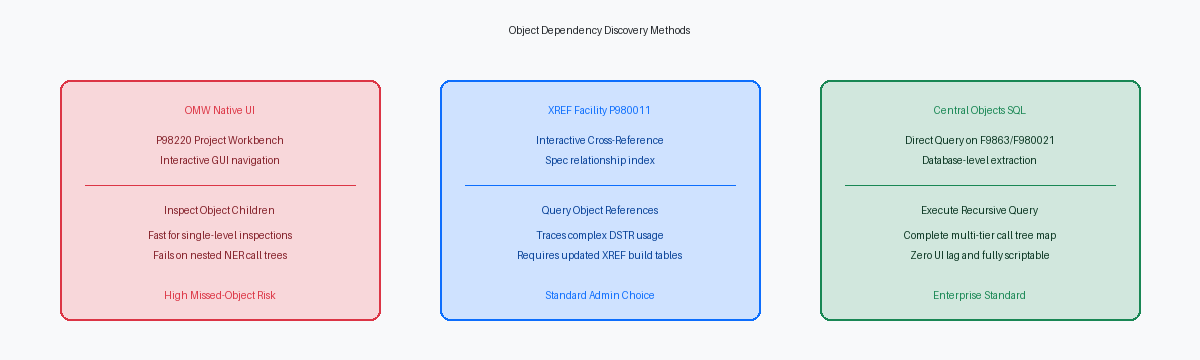
Developers must interrogate the Cross Reference Facility (P980011) to discover every parent NER and BSFN bound to a modified D55 data structure before staging the transfer. In active development environments, query the F980021 relationship table directly for object-to-data-structure linkages. Relying on developer recall rather than F980021 records invariably leaves an orphaned utility function behind, ensuring an immediate package build failure or runtime memory violation in the target pathcode.
Promoting a modified NER without promoting its updated DSTR leaves target pathcode C source code expecting arguments that the local spec file cannot resolve. When the NER's generated C code compiles against stale header definitions on the target enterprise server, compilation either fails on argument mismatches or generates a silent defect where values bleed into adjacent memory buffers during execution. The DSTR, its typedefA C language keyword used to assign a standardized identifier to a custom structured data type. header, and generated C artifacts must travel together.
The same discipline governs interactive applications. Whenever a form interconnectA parameter-passing data structure used to transfer runtime values between interactive forms. data structure changes in an APPL, every calling form and parent application must be mapped and bundled into the promotion manifest. An unpromoted calling form passing four values to a modal form expecting five causes runtime stack corruption in the web client's JAS engineJava Application Server engine hosting JD Edwards web sessions and user interfaces.. Run the P980011 cross-reference on the target application's FI structures, trace every upstream caller, and lock those objects into the OMW project before initiating a status change.
Custom Tables, Indices, and Table Event Rules
OMW moves central object specifications between pathcodes; it does not alter relational database schemas. When an engineer promotes an F55 or F56 table from DV to PY, only Object Librarian records and table specifications transfer through the project status change. The target business data database remains untouched until a CNC administrator generates the table or executes a targeted DDLData Definition Language; SQL statements such as CREATE or ALTER used to modify database structures. script. If an application package deploys against a table that was not physically altered, the enterprise server throws an ORA-00942An Oracle database error indicating that a queried table or view does not exist. or SQL Server error 208 on the first user fetch.
Tables carrying Table Event RulesLogic attached directly to database tables that executes on events such as record insertion, update, or deletion. introduce a hidden compilation dependency that frequently halts automated package builds. Saving logic on table triggers automatically generates an underlying C-source Business Function wrapper—typically an N55 business function—and an associated .h header file. OMW does not bundle this generated C wrapper simply because the F55 object exists in the project. Developers must explicitly locate the generated N55 object, check it into the project, and promote it alongside table specs to prevent server BusBuild errors.
Index modifications carry identical risks for downstream logic. Changing a primary key or modifying a secondary index on an F55 directly breaks any NER utilizing Table I/OBuilt-in JD Edwards event rule commands used to read, insert, update, or delete table rows directly. operations against that index path. You must re-validate, re-save, and promote those dependent NERs concurrently to eliminate runtime SQL execution errors.
Technical documentation must bridge the gap between OMW and the database engine. The promotion manifest must explicitly document the required DDL generation or table alterations for CNC execution in the target environment before deploying the accompanying application package. Neglecting that sequence brings interactive forms to an immediate halt.
Deconstructing Multi-Tier NER Call Trees
A Named Event Rule is not interpreted scripting; JDE generates native C source code (.c) and header definitions (.h) before invoking the host C compiler to bind objects into consolidated libraries. Standard Oracle mappings drop business functions into monolithic DLLs like CALLBSFNA primary consolidated DLL in JD Edwards that houses core base business functions., whereas custom business logic should live in dedicated containers like CCUST or CSVC. Commingling these DLL assignments carelessly forces unnecessary full-package builds when an isolated update to two custom NERs inadvertently locks standard system libraries.
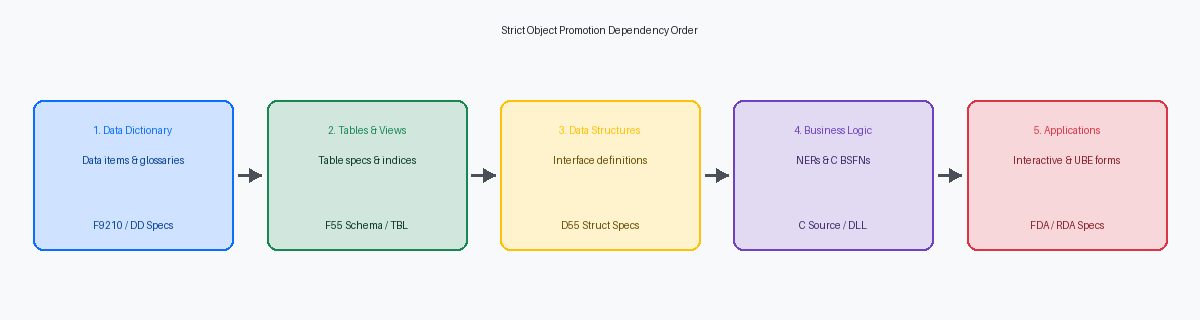
Multi-tier architectures typically route an APPL event rule to a master NER, which then calls 3 to 6 utility NERs for table I/O or math conversions. Packaging this tree requires strict bottom-up sequencing: promote and generate data structures first, subordinate utility NERs second, and the calling master last. Inverting this sequence forces the target compiler to bind against obsolete object definitions, breaking runtime link references across your pathcodes.
The critical operational risk is a successful compile that yields memory pointer corruption inside Enterprise Server call object kernels. If an altered subordinate data structure promotes without regenerating every dependent NER in the hierarchy, the target environment compiles the master function against an out-of-date .h header. Runtime memory allocation collapses, causing silent byte overwrites that corrupt adjacent memory blocks and terminate active jdenet_kEnterprise Server background kernel processes responsible for processing business logic and network requests. kernels under high transaction volume.
Trace whether any utility NER integrates with standard master business functions like B4200310 (Sales Order Entry MBF). In Tools 9.2, Application Updates frequently adjust internal parameter alignments on standard MBFMaster Business Function; a central processing module that validates and commits transaction records. data structures. If a custom wrapper NER passes outdated parameter flags or bypasses required structural offsets, the call stack will fail on the Enterprise Server despite passing local OMW unit checks.
Step-by-Step Dependency Mapping Workflow in OMW
Relying on the Cross Reference Facility or navigating P98220 tree views during active development cycles introduces latency and stale cache issues that mask real dependencies. Run direct SQL queries against the Object Librarian repository tables—F9860, F9862, and F9863—to pull an absolute map of BSFN parent-child calls and DSTR references. A recursive query joining F9863.SIPSFN to F9862.SIBSFN reveals secondary NER calls and external C data structure linkages that developers forgot to check into the project envelope.
Once the call tree is isolated, assemble the OMW project using strict promotion tiering to ensure the compiler and runtime engine ingest objects in structural order. Data dictionary items must lead the deployment, followed by custom tables (TBL) and table event rules, then data structures (DSTR), before any business functions, NERs, interactive applications (APPL), or UBEUniversal Batch Engine; the background report generator and batch processing engine in JD Edwards. batch engines are touched. Staging objects in this sequence prevents runtime pointer exceptions and avoids failed local specs generation when downstream NER event rules compile against missing parent DSTR typedefs.
Before initiating the status move, verify token governance across every dependent object in the manifest. If a subordinate DSTR or utility NER holds an active token in another developer's private project, the promotion will either drop the modification or trigger a partial spec transfer that corrupts the target pathcode. Confirm that your project holds exclusive tokens for all modified items. Finally, audit the OMW object transfer activity rules in P98225 for your specific status transition—such as status 21 to 26. Ensure that object types like BSFN have distinct transfer actions configured for both the C source and header files alongside Central Objects spec records, routing code cleanly to the target pathcode.
Pre-Promotion Checklists and Local Build Verification
A project advancing from status 21 to status 26 without a clean local compile guarantees server package failures. Before updating project status in OMW, developers must open BusBuild.exe on a dedicated fat clientA Windows development machine equipped with local JD Edwards development tools, compilers, and specifications. and run a complete rebuild of the specific consolidated DLL housing the modified BSFNs. Compiling an isolated .c or generated NER file leaves stale linkages invisible; executing a clean rebuild against the parent DLL—whether CALLBSFN.dll or a custom library like CCUSTOM.dll—immediately exposes missing header references, mismatched data structures, and broken function prototypes before code ever leaves the client machine.
Zero compiler errors mean nothing if the runtime logic fails under load. Developers must perform a local spec build and execute the calling APPL or UBE directly in DV to validate the complete call tree against real database records. This step verifies that newly mapped parameters transfer correctly and proves the call stack executes without throwing an unhandled memory violation—the exact fault that creates zombie kernelsHung or crashed enterprise server processes that have failed ungracefully and stopped responding to transactions. when deployed to an Enterprise Server handling multi-threaded jobs.
Code stability on the fat client represents only half the gate; the transition to CNC requires an ironclad operational handoff. Deliver a precise release runbook detailing mandatory pre-package tasks, including custom table generations, manual DDL alterations, and table index regenerations timed ahead of the scheduled server build. Finally, audit every mapped child object to confirm formal token release across all dependent items. An unreleased token held on a shared data structure prevents full object inclusion in pristine environments, resulting in mismatched specs and wasted build cycles.
If your organization experiences recurring build breaks, zombie kernels, or deployment rollback overhead, our JD Edwards architecture practice can audit your OMW promotion governance and build automated spec validation into your delivery lifecycle.
