




Every CNCConfigurable Network Computing; the technical architecture and administrative discipline managing JD Edwards system infrastructure and deployments. administrator knows the late-night emergency call: an enterprise update package build halts mid-stream because a developer modified a C BSFNA C-based Business Function; executable C code compiled into shared libraries to run business logic in JD Edwards. or APPLAn interactive application object in JD Edwards consisting of user interface forms and logic. but forgot to transfer an underlying Data Structure (DSTR)An object defining data fields passed as input and output parameters between applications, reports, and business functions. or altered Table (TBLE)A database table definition object in JD Edwards outlining columns, primary keys, and indices. specification. In field audits, roughly two-thirds to three-quarters of developer-attributed package build failures do not stem from catastrophic C syntax errors. They trace directly back to missing child dependencies, uncompiled header files, or dirty OMWObject Management Workbench; the software change management interface used to develop, check in, and promote JD Edwards objects. project tokens held in inactive development paths.
A failed overnight build burns testing runway and wastes CNC cycles digging through build logs in the deployment serverA central server hosting JD Edwards central objects, software masters, and package deployment files. directory. Preventing that disruption requires a rigorous JDE OMW package build dependency checklist for developers to interrogate parent-child object links, verify tokens, and confirm local build output before advancing a project to status 26. Verifying these dependencies at the fat clientA specialized Windows development machine containing local JD Edwards compilers, tools, and local specification files. level guarantees that what compiles on your local machine actually links on the enterprise server.
Token Validation and Project Status in OMW
If an engineer modifies an object without securing the active token in their OMW project, the checked-in specs sit dormant in the development pathcodeA specific JD Edwards environment set (such as DV920 or PY920) containing corresponding central objects and database mappings.. Package assembly pulls specs strictly through project definitions and active token ownership. Missing that token means checked-in specs will never promote into the target pathcode during the build cycle, leaving the deployment server to compile stale repository records while the developer assumes check-in was sufficient.
Verify that every dependent child object sits in the exact same project or inside an explicitly related parent project moving simultaneously to status 26 or status 28. When developers separate a new data structure from its calling business function across disparate projects, standard transfer activity rules break down. In a substantial share of broken server builds—frequently more than half during remediation reviews—an object compiles cleanly in local DEV because local C headers mask the omission, but enterprise server compilation halts because the child object stayed behind.
Query the F9861The Object Librarian status table tracking object checkout status, project ownership, and user tokens. table directly in your central objects or system schema before package assembly begins. Confirm that the project holds the primary token and that no secondary developers hold conflicting tokens in another non-promoted project. If a colleague requested a token in a maintenance project several months ago and never released it, OMW can trigger transfer rule collisions or halt spec movement mid-stream.
Run an explicit token release protocol on abandoned scratchpad objects and test copies before the CNC cutoff. When a developer copies a core UBEUniversal Batch Engine; the batch processing and report generation subsystem in JD Edwards. to a 55-prefix clone to test an index modification and leaves the token checked out in a utility project, assembly validation locks will derail the CNC build. Releasing these residual tokens in P98220The JD Edwards program code for launching the Object Management Workbench application. takes only a few minutes and eliminates avoidable build-cycle aborts.
Table and Index Structural Dependencies
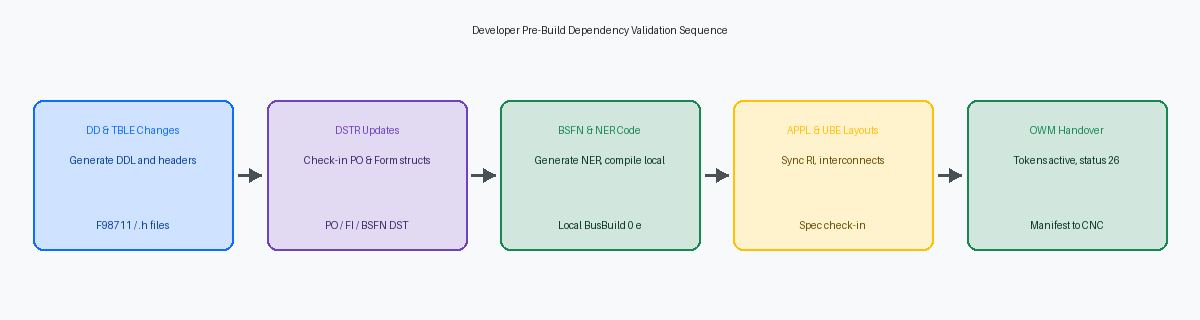
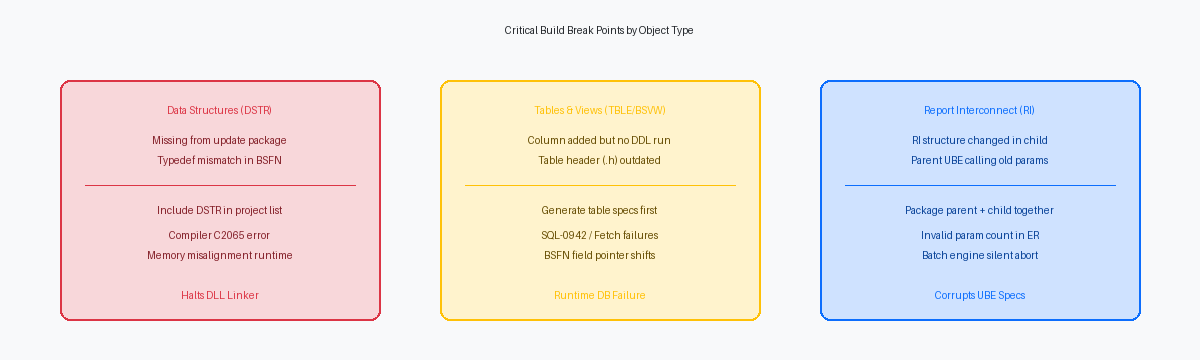
Most package build failures traced to custom tables originate from a sequencing lapse on the developer fat client. When you modify an F55 through F59 table, checking in the TBLE object updates Central Objects, but F98711 Table Columns spec generation must run cleanly to refresh the relational column layout. If you omit the subsequent header file generation step, the corresponding f55xxxx.h structure definition remains stale. Any referencing C BSFN or NERNamed Event Rules; business logic written in JD Edwards event rule scripting that automatically generates compiled C code. compiled during the enterprise server build will instantly fail against mismatched typedef declarations or unresolved member variables.
Checking specs into the deployment server solves only half the dependency chain. Table structural modifications require verification that DDLData Definition Language; SQL commands used to create, alter, or drop physical database objects like tables and indexes. generation completed in the target business data schema (such as TESTDTA or CRPDTA) before the package assembly reads Central Objects specs. If the package assembly builds runtime specs reflecting 45 columns while the underlying database catalog still holds an earlier 42-column layout, runtime fetches throw immediate JDB3400009 or SQL0100 errors the moment the package hits the pathcode. Confirm the physical table regeneration or ALTER TABLE script executed cleanly prior to project promotion.
Index alterations introduce a subtle trap when built to support a custom fetch single in Event Rules. If you added an alternate index to optimize a query, both the table specs and every custom Data Item (DTAI)A unique field definition stored within the JD Edwards Data Dictionary specifying data type, size, and formatting. defining those key fields must reside in your OMW project list. Leaving a new index key out of the project manifest means the index definition promotes without its dictionary context, leading to failed index builds on the target enterprise server.
Verify that all custom Data Items have been approved and deployed to the runtime data dictionary tables (F9200, F9210) across all enterprise servers. Unapproved or missing DD items cause the table generation routines on the enterprise server to throw sizing errors during build execution, stopping the process cold. A brief audit of your project manifest against the table definition prevents an aborted overnight rebuild and hours of triage.
Data Structure and BSFN Parent-Child Chains
A mid-package compile failure on an enterprise server almost always traces back to a modified data structure that stayed behind on the fat client. If you alter a Data Structure (DSTR) to add a cache pointer or a transaction flag, you must include that DSTR in the update package alongside the target Business Function (BSFN). Omitting it causes the C compiler on the enterprise build machine to pull the previous header definition from the parent specs, triggering fatal type-mismatch or undeclared-identifier errors during DLL compilation.
Named Event Rules carry an equally deceptive failure mode because developers treat them as repository-only specs rather than generated C code. When you modify an NER, you must regenerate the underlying .c and .h files into the local source directory before checking the object in. The enterprise server compiles these checked-in files directly. Skipping local generation leaves stale source code in the repository, compiling outdated runtime logic even though the OMW specs reflect your edits.
Manual C business functions demand tighter scrutiny whenever you modify a typedef in a shared header. Changing a typedef breaks binary compatibility across every function consuming that header file. Run the Cross-Reference Facility (XREF) against the data structure and header before assembling your package list. Every sibling BSFN that cross-calls the modified function or includes the altered header must be packed into the update build to force complete recompilation across the dependency chain.
The final checkpoint is the F9860The Object Librarian master table recording object names, types, descriptions, and DLL assignments in JD Edwards. Object Librarian DLL mapping. Linker errors such as unresolved external symbol occur when a calling function and a called function reside in disjointed DLLs without proper export headers, or when a developer assigns a child function to the wrong library. Inspect the DLL assignments in F9860 to confirm that tightly coupled custom functions resolve to the intended shared library. A mismatch between client-side build assignments and server-side F9860 records will fail the package during the linker phase.
Interactive Application and Processing Option Ties
A significant portion of runtime null assignments in interactive applications stem from treating processing option templates as secondary artifacts. When you extend a processing option structure in Form Design AidThe visual development environment in JD Edwards used to build and arrange interactive application forms. to feed a new form control or drive an event rule, that template—the PO data structure—exists as an independent object in OMW. If a developer checks in the custom APPL but forgets the PO DSTR, the package build compiles against the stale central specification. At runtime, the web server initializes the form with blank memory blocks, silently ignoring the values users configure in interactive versions.
The failure mode is even more deceptive with form interconnectA data exchange interface used to pass parameter values between calling and target forms in JD Edwards. data structures. When you modify a called form's interface to accept additional arguments—such as passing a line type or cost center across applications—the parameter mapping changes at the DSTR level. If the calling form is deployed without the synchronized interconnect structure, the runtime will not throw a fatal kernel error. Instead, it drops the new interconnect values silently into empty memory, executing subsequent form events with null inputs while the developer fruitlessly debugs event rules.
Embedded sub-forms and reusable components compound this risk because local fat clients run successfully against local spec files while central specs remain untouched. Check the project in OMW and verify that the APPL, its sub-forms, and all associated structures reflect a checked-in status in F9861. Once verified, confirm that the FDA-generated structures have updated their internal revision counters. Without that incremented revision flag, the e-generator and server serialized spec cache on the enterprise and AISApplication Interface Services; a server framework exposing JD Edwards enterprise logic and forms as RESTful JSON APIs. nodes will serve stale layouts, rendering browser-side cache flushes completely useless.
Batch Engine Section and Report Interconnects
A developer modifies a Report Interconnect (RI)A dedicated data structure used to pass runtime values and filters into a batch report. data structure inside a child UBE—adding a single parameter or shifting field orders—and checks in only that child report. When the parent interactive application or calling batch program triggers that job on the Enterprise Server, the runtime relies on the previous structural layout. Memory misalignment or an immediate IPCInter-Process Communication; the mechanism enabling different processes to exchange data and execution signals on an enterprise server. execution failure follows because the caller populates a parameter stack the callee misinterprets. Every parent APPL and calling UBE referencing that modified interconnect must be grouped into the same promotion project and deployed within the exact same package.
Custom sections built on custom business views (BSVW)Database query definitions that join multiple tables and filter fields for use by forms and reports. introduce an equally disruptive dependency. If a developer alters a multi-table join between tables like F4101 and F41021 or introduces a new view definition, those BSVW specifications must be checked in and validated in Central Objects before UBE spec generation begins. Deploying a UBE when the underlying view specs lag behind causes the batch runtime to generate malformed SQL or drop join criteria entirely, resulting in a false "Done" status with zero records processed.
Processing option overrides require identical discipline. Structural parameter updates and text overrides must be explicitly committed to the PO template (TUBE) before check-in. Failing to do so causes the enterprise batch engine to read obsolete byte offsets, silently truncating string parameters passed through version prompts. Finally, audit every event rule variable tied to modified Data Dictionary items. A change in display decimals on an alias without a refreshed DD deployment causes severe decimal-shift anomalies during batch execution, rendering calculation outputs off by factors of 100 or 1,000 on printed documents.
Pre-Handover Verification and Local Build Output
A green checkmark in OMW means nothing if the local object files are stale. Before flagging a project ready for promotion, launch BusBuild.exeThe client executable tool used to compile and link C business function code into shared libraries. and execute a compile using the 'Rebuild Libraries' option across every modified C business function. Relying on an incremental build masks missing header includes that remain cached from earlier iterations. Rebuilding the entire library forces the compiler preprocessor to validate every header directive and syntax structure cleanly against the active local include directory.
Never trust a zero-error build summary at face value. Open BuildLog.txt directly from your local compile directory and parse it for compiler warnings C4013 (function undefined, assuming extern returning int) and C4047 (differing levels of indirection). While the local Windows development fat client may treat these discrepancies as benign warnings, an enterprise server compiler on Linux or AIX often converts them into fatal unresolved external symbols or runtime memory violations.
Once the code passes cleanly, verify repository parity. Query the F98611The Object Librarian detail table recording object locations, deployment states, and pathcode assignments. table in your Object Librarian data source to confirm that every object in your project reflects an authentic 'Checked-in' status rather than remaining checked out locally. It takes only one forgotten data structure or header file sitting on a workstation drive for the CNC package engine to pull obsolete specifications, silently corrupting the target deployment.
Conclude the handover by providing CNC with an explicit build manifest rather than an unannounced project status advance. Itemize the primary objects, dependent DSTRs, target DLL assignments, and any custom tables requiring manual DDL regeneration or index drops prior to compilation. Establishing this discipline as a firm engineering gate ensures that package assemblies link predictably without stalled server builds or emergency rollbacks.
