




Object Management WorkbenchThe primary change management and software lifecycle tool in JD Edwards EnterpriseOne used to manage, develop, and promote objects. was engineered around a pessimistic locking model conceived in the late 1990s, not the concurrent branching engines modern developers expect. The friction spikes the moment two parallel project tracks collide on core logic—for instance, one sprint modifying pricing cache routines inside B4200310 while another alters EDI 850The standard electronic data interchange transaction set used for an inbound purchase order. inbound processing against that exact same data structure. When the token queue inevitably stalls delivery, developers routinely resort to token swapping or force-checking specs out without a token. That shortcut is fatal: it leads directly to silent specification overwrites, orphaned event rulesThe proprietary procedural programming logic attached to events within JD Edwards interactive and batch applications., and corrupted runtime specs during the next scheduled package buildThe process of compiling JD Edwards objects and specifications into deployable software packages for clients and servers..
Effective JDE OMW parallel development conflict resolution does not happen at the tool level—OMW will never behave like Git. It demands an operational triage framework built on pre-checkout dependency mapping, disciplined token choreography, and strict pathcodeA specific set of central object specifications and business function binaries representing an environment like DV, QA, or Production. promotion boundaries. If your teams rely on uncoordinated force-checks and verbal handoffs, running concurrent enhancement streams across EnterpriseOne 9.2The modern, web-enabled ERP software release suite from Oracle JD Edwards. will quietly compromise your central objectsThe database repository storing master definitions, code, and specifications for all JD Edwards objects. repository long before testing begins in QA.
The Anatomy of an OMW Token Deadlock
OMW enforces specification exclusivity through an unforgiving rule: only one project holds the tokenA lock in JD Edwards OMW that grants exclusive permission to check in changes for an object. at status 21 for any given object. When a second developer opens that same object, OMW permits an un-tokened checkout. The developer can modify local specs and test against local runtimes, but cannot commit back to Central Objects. This architecture breeds false confidence. Developers build isolated logic in DV920, blind to upstream revisions happening concurrently in the token-holding stream.
The operational disaster triggers the moment Project A advances. When the F9861 project status transitions from 21 to 26, OMW executes an immediate lock release in the F9860 table. Project B inherits the token queue automatically in P98220, but EnterpriseOne provides no automated three-way reconciliation. If Developer B checks in without manual intervention, Central Objects silently accepts the payload, completely overwriting every line of code Project A just validated.
This collision is lethal when applied to Data Structures (DSTR)Object definitions in JD Edwards that specify data fields passed between applications, reports, and business functions. linked to business functions. If two developers modify parameters on a shared data structure out of sync, the generated C typedefs diverge. When those mismatched definitions merge improperly into the deployment pathcode, the compiler encounters fatal structure alignment and pointer mismatches, failing the entire CALLBSFN.dll compilation during the next package build.
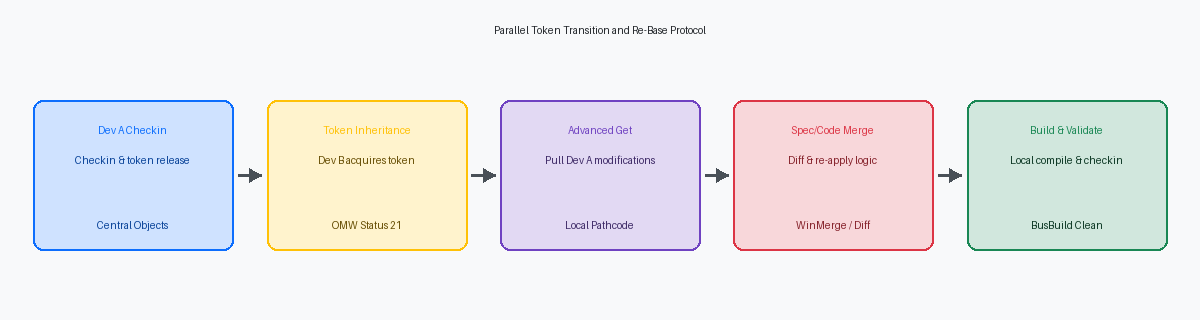
Development leads must stop treating token inheritance as an administrative checkbox in P98220. Token transfer is an active code reconciliation event. Before the second developer executes a checkin, the lead must mandate an ER CompareA JD Edwards graphical utility used to compare and merge Event Rules between different objects or environments. against the freshly committed Central Objects baseline, ensuring Project A’s delta is manually folded into Developer B’s local specs before that token is consumed.
Mapping Hidden Object Dependencies Before Checkout
Developers check OMW project listings, confirm nobody holds the token on P4210 or P4310, and assume their development stream is completely isolated. That assumption collapses the moment someone modifies an underlying secondary dependency—a shared cache handler, a hardcoded UDCUser Defined Code; a customizable list of valid values and codes used throughout JD Edwards. table validation, or an internal data structure. The resulting structure alignment mismatch bypasses standard check-in validation, triggering intermittent memory exceptions and kernel crashesUnrecoverable terminations of JD Edwards server background processes that handle logic execution. in the runtime engine when uncompiled dependent objects execute.
Take the Sales Order Entry Master Business Function (B4200310) as the benchmark case. Appending a single parameter to its shared header data structure, D4200310A, to support a custom freight rule impacts dozens of distinct downstream business functionsEncapsulated reusable logic modules written in C or Named Event Rules (NER) to process business rules. across sales, inventory commitment, and procurement. Recompiling B4200310 locally without rebuilding every dependent caller leaves stale memory pointers inside your business function DLLs, terminating callobject kernelsEnterprise server background processes responsible for running C and NER business functions remotely. the instant another stream triggers shipment confirmation or intercompany drop-ship logic.
Development leads must mandate an active dependency audit before releasing a token on any foundational object. Require developers to run the Cross-Reference Facility (P980011) or query F980011 and F980021 directly via SQL to map every referencing object across Central Objects. Relying on developer memory or manual tracking on complex master business functions fails; an automated query against F980011 exposes the exact parent-child object footprint that standard OMW project views obscure.
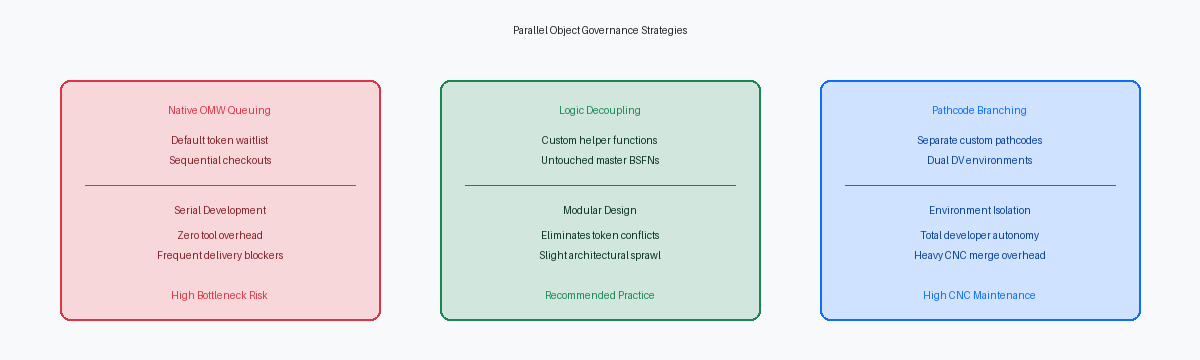
Mitigate future token deadlocks by enforcing structural decoupling during design review. Rather than modifying standard master business functions directly, isolate bespoke business logic—such as proprietary tax calculations or secondary line validations—into standalone custom helper BSFNsBusiness Functions; compiled JD Edwards components containing C or Named Event Rules code. (B55/B56). Executing custom routines before or after the core B4200310 processing cycle protects the standard object layer, eliminates continuous token contention on mission-critical master business functions, and limits cross-project collision risks.
Token Transfer Protocols and Merge Choreography
Forcing a token release via CNCConfigurable Network Computing; the architecture and system administration discipline within Oracle JD Edwards. administrative override without pulling the prior developer's Central Objects delta accounts for the vast majority of silent regression bugs during parallel release cycles. When delivery timelines tighten, teams routinely ask a CNC to strip tokens out of OMW projects in P98220, leaving Developer B with a stale local specification image. The second Developer B checks in their code, they silently wipe Developer A's validated modifications directly in Central Objects, destroying work that will only surface as broken during downstream integration testing.
When Developer B inherits the token from Developer A, Developer B must execute an Advanced Get from Central Objects into their local development pathcode before committing any pending changes. This explicit pull forces the local runtime specs on the fat clientA dedicated Windows workstation equipped with development tools, compilers, and local database specifications for JDE developers. to mirror Developer A's committed base. Skipping this step guarantees that any subsequent check-in action creates a destructive delta that replaces Central Objects with out-of-date local code, all without triggering an OMW compiler warning or validation error.
For C-based BSFNs, reconciliation requires manual inspection outside EnterpriseOne. Developer B must run Beyond Compare or WinMerge between their local source directory (such as C:\E920\DV920\source) and the pristine checked-in source in Central Objects prior to compilation. Performing this text comparison ensures shared data structures and function declarations align, preventing memory corruption or runtime memory leaks in jdecallobject before rebuilding the local DLLs via BusBuildBusiness Function Builder; the JD Edwards developer utility used to compile and link C code into DLL libraries..
For NERNamed Event Rule; a business function developed using JD Edwards proprietary Event Rule syntax instead of C., APPLInteractive Application; the visual forms and user interfaces that end users interact with in EnterpriseOne., and UBEUniversal Batch Engine; the reporting and background batch processing framework in JD Edwards. specifications that cannot be diffed as raw text files, developers must document individual event rules line-by-line in project work orders to manually re-apply logic after an Advanced Get. Because OMW provides no native semantic merge utility for Event Rules, Developer B must capture their uncommitted logic externally, overwrite their local specs with Developer A's baseline from Central Objects, and methodically re-code their changes. Enforcing this disciplined merge choreography prevents most collision-induced rework across multi-developer teams.
Structured Communication Protocols Between Dev Streams
OMW workflow messaging is a graveyard where token requests go to die. On any delivery stream running four or more concurrent projects, waiting for a developer to notice a Work CenterThe internal messaging and system notification inbox inside JD Edwards EnterpriseOne. alert guarantees delivery slippage. High-throughput delivery requires an active register of shared cross-project objects driven by a daily query against the F98222 project object detail table. Filtering for active status-21 projects with queued token requests gives the technical lead an unvarnished audit of asset contention before code collisions happen in the repository.
That query output feeds a mandatory daily 10-minute parallel development standup. Leads and developers review every object flagged with a token waitlist rather than rehashing project status. If Project A holds the token on B4200310 while Project B sits queued at status 21, the team establishes the exact transfer window during that call, cutting out side-channel negotiations that blindside release managers.
Every shared object touch requires a formal pre-checkin signoff between the outgoing token holder and the incoming requester. Both developers must run ER Compare to walk through the exact event rule deltas and inspect any modified data structures. If Developer A altered a data structure parameter, Developer B verifies the backward compatibility of calling functions before the code ever commits to Central Objects.
This workflow relies on a strict handoff contract: Developer A must leave the object in a clean, compilable, and unit-tested state in the shared DV pathcode before Developer B accepts token ownership. Handing off incomplete logic or broken C builds halts everyone sharing the pathcode. Developer B confirms clean compilation locally, signs off, and assumes the token.
Package Build and Pathcode Isolation Strategies
Setting up simultaneous development without strict pathcode isolation guarantees corrupted Central Objects. Baseline enhancements run predictably in DV920, and multi-stream integration belongs in CRP/PY920, but disruptive retrofits demand a dedicated pristine sandpit pathcode completely detached from the daily release rhythm. If you assemble an update packageA lightweight deployment package containing only changed objects, applied on top of an existing full package. for CRP while a developer has uncommitted parallel modifications in Central Objects, package assembly blindly scrapes those incomplete specs into the build header. That single incomplete spec deployment corrupts the enterprise server runtime, disrupting business function execution for the entire QA testing cohort.
The smoking gun appears immediately in the server package build spec assembly logs (PKGBUILD), where an un-tokened C business function change triggers fatal compile mismatches inside CALLBSFN.dll. When an engineer modifies a data structure pointer locally without checking in the corresponding header to Central Objects, the server compiler halts on unresolved symbols. CNC leads must deploy automated pre-package validation queries against F9860 and F9861 before running any package build. If any object in the package payload is locked in an active un-tokened checkout or belongs to an OMW status-21 project with an un-checked-in state, the build automation must abort immediately.
Emergency production realities override planned project schedules without apology. When a critical production defect demands a hotfixAn urgent software patch deployed directly to fix an active production defect outside normal release cycles. at status 21 within an active maintenance project, that fix claims absolute priority over in-flight feature delivery. The developer holding the feature token must check in clean or back out their changes, clear the pathway for the emergency build to advance, and subsequently execute a mandatory re-base against the newly promoted Central Objects baseline. Attempting to splice code concurrently during an emergency fix guarantees missing event rules, orphan variables, and a failed release.
Auditing and Remediation of Colliding Objects
When two developers cross streams on a shared APPL or NER, guessing what code vanished during an unauthorized check-in is an expensive mistake. Open the OMW logging tab within P98210 to pull the forensic audit trail before touching local specs. Filter the log for the target object to trace the exact chronological sequence across action codes: Checkout (03), Get (04), Token Give (06), and the colliding Checkin (02) down to the exact second and workstation user ID. This establishes the clean baseline timestamp before corruption entered the target pathcode.
Never attempt to rewrite overwritten logic from memory or stale functional specs. Valid disaster recovery requires pulling historical specifications directly from your Central Objects package deployment archives or previous parent package history. By querying orphaned records in the F98741 (Event Rules Specs) and F98740 tables corresponding to the pre-collision save, CNC engineers can isolate the dropped lines. Run the Spec Compare utility (P98920) against that archived spec image and the current damaged object to identify every missing block of code line by line, then merge the missing ER delta directly back into the design view.
Once the ER delta is restored and checked in, do not trust a visual pass in the Event Rules Design screen. Execute an immediate, mandatory local C compile and run a full busbuild on the developer client to validate all workstation-level data structures, header files, and symbol integrity. If the build generates zero unresolved externals and zero warnings across associated BSFNs, promote the remediated project to status 26 for QA testing. Rushing an unverified specification fix into an update package without this verification guarantees runtime memory access violations in the presentation kernel. Enforcing these verification gates and disciplined token transfers is what preserves repository integrity across concurrent release cycles.
