




Most JDE teams treat Object Management WorkbenchJD Edwards' change management and source control tool used to track, modify, and promote objects across environments. as nothing more than a source control UI with check-in and check-out buttons. In reality, managing the JD Edwards OMW project lifecycle from development to promotion means orchestrating a relational state machine across token holds, central objectsThe central database repository storing master object specifications and metadata for an environment. spec modifications, and pathcodeA JD Edwards environment definition (such as DV920, PY920, or PD920) pointing to specific specifications and business data. synchronization across F98220 and F98222 control tables. Treating it casually is why roughly 15% to 20% of custom promotion failures stem directly from orphan tokens, uncommitted C BSFNBusiness Function: Encapsulated business logic written in C or Event Rules to perform specific processing. header files, or silent local spec drift.
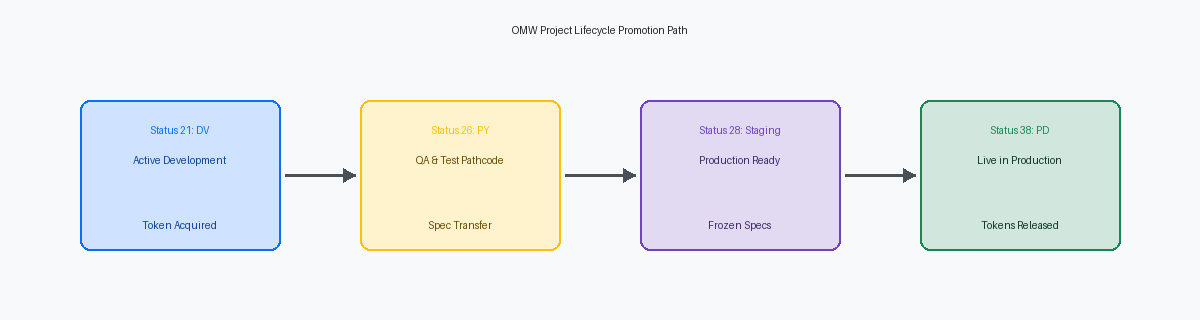
Controlling this progression requires treating every status jump—from Status 21 through to Status 38—as a technical gateway rather than an administrative formality. When engineering teams enforce strict token governance and validate central object check-ins at each transition, package build teams eliminate the late-night deployment failures that routinely stall enterprise releases.
Project Setup and Token Governance at Status 21
Initialising a project strictly at Status 21 establishes the foundational governance layer for code changes in EnterpriseOne. Adding a developer to a project at this status updates the F98220 project user table, binding specific user IDs to development roles. When custom objects such as N550001 or P554210 are attached, OMW validates the master definition in the F9860 Object LibrarianThe master system catalog in JD Edwards that tracks the identity, type, and location of all objects. master table and writes project logging records to F98210. Bypassing structured Status 21 setup allows untracked object modifications that corrupt project history.
TokenA locking mechanism in OMW that grants exclusive check-in rights to prevent concurrent overwrites. acquisition prevents catastrophic spec overwrites when multiple developers operate across parallel project streams. Requesting an object lock writes an active reservation row to the F98222 object token master table, assigning exclusive check-in rights to a single project ID. If Developer A holds the token for object N550001, Developer B can attach that same object to another Status 21 project and perform local edits via token borrowing. However, OMW enforces a hard programmatic block preventing Developer B from checking modified specs into the DV920 Central Objects relational database.
This architecture permits local sandbox testing on a developer workstation while locking pathcode integrity at the server level. Developer B remains unable to promote code until Developer A releases or transfers the token in F98222. On enterprise teams managing over 500 active custom objects, unmonitored token queuing regularly causes package build failures, where local specs test successfully but fail during full package builds. Executing a weekly SQL audit on F98222 to clear orphaned tokens from closed projects prevents deployment bottlenecks.
Local Check-Out Mechanics and Spec Repository Isolation
Hitting the Check-Out button in OMW triggers an extraction from the database-level Central Objects tables directly into the local spec repository on the development client. For an interactive application, EnterpriseOne pulls records from tables like F98740 (Form Specs) and F98741 (Event RulesThe proprietary scripting logic in JD Edwards triggered by user or system events on forms and reports.); for batch applications, it extracts execution definitions from F98761 and F98762. Simultaneously, OMW updates the object lock status in the F9861 Object Librarian master table, isolating active development work so that changes remain completely invisible to the rest of the DV pathcode.
For C Business Functions, the check-out mechanism bypasses the relational spec tables, copying physical .c and .h files directly into the developer's local source and include paths. Under EnterpriseOne 9.2 with 64-bit processing, developers must execute BusBuildBusiness Function Builder, the JD Edwards tool that compiles and links C code into server and client libraries. locally against the certified 64-bit compiler toolchain to verify zero errors and zero warnings prior to promotion. Relying on an overnight server package build to catch compile errors or missing header declarations introduces avoidable delay and risks breaking shared DLL builds for the entire team.
Event Rule validation provides the final isolation check before releasing changes back up the stack. Running the ER validator directly within the design tool surfaces orphaned data structure members, broken variable pointers, and parameter count mismatches that occur when underlying tables or Data Structures (DSTR)Data structure objects that define the parameter layout for passing data between applications, reports, and business functions. shift during development. Resolving these structural anomalies on the local client guarantees that corrupted runtime specs never reach the Central Objects database during the check-in phase.
Developer Quality Gates and Central Objects Check-In
Checking an object into OMW is the point of no return for local developer isolation. The moment a developer executes a check-in, local specifications are committed directly to Central Objects, overwriting the DV920 master records across tables including F98740 (Event Rules text), F98741 (Event Rules specifications), and F98760. If multiple developers touch connected components without strict sequencing, an untested check-in immediately pollutes the shared pathcode baseline for the entire team.
Data structure modifications demand immediate dependency analysis at this gate. Altering a Data Structure (DSTR) changes parameter offsets and byte alignments. If you modify a DSTR without identifying every calling BSFN and UBE, the runtime engine misaligns memory pointers, leading to memory violations or silent data truncation in the call stack. Every dependent object must be evaluated and checked in concurrently.
For Named Event RulesBusiness functions designed in JDE script that the system automatically translates and compiles into C code., checking in the specification is only half the requirement. You must regenerate the NER on the development fat client to update both the local C code (.c and .h source files) and the central header definitions. Skipping this step leaves the spec database out of sync with the generated C artifacts, guaranteeing compilation failures when the package build runs.
Every successful check-in appends an immutable audit record to the F98210 OMW log table. This entry captures the user ID, workstation machine name, project status, and precise timestamp of the spec modification. When an overnight build fails or an unexpected regression surfaces in DV920, querying F98210 isolates exactly who committed what object and from which machine down to the second.
Status Transitions and Cross-Pathcode Object Transfer
Advancing an OMW project from Status 21 (Programming) to Status 26 (QA/Test) triggers the OMW transfer activity rules stored in table F98225. The transfer engine evaluates the object type against the configured status pair, querying Central Objects - DV920 to extract spec rows and writing them directly into Central Objects - PY920. For interactive applications (APPL)Interactive application objects in JD Edwards that provide visual screens and forms for end-user interaction., batch reports (UBE)Universal Batch Engine: The processing engine in JDE that runs background reports and batch processing jobs., and data structures (DSTR), this database-to-database spec copy replaces PY metadata immediately, establishing the baseline required for subsequent package assemblies.
Table objects (TBLE) introduce an operational caveat that teams frequently overlook during pathcode promotions. When a modified table transfers at status change, OMW copies only the column and index definitions in the central spec tables (such as F98711); it executes zero DDLData Definition Language: SQL commands (like CREATE or ALTER TABLE) that build or modify database schemas. against the target database. Generating or altering the physical table in the PY920 Business Data datasource remains a mandatory manual step within Table Design AidThe JDE visual tool used to create, customize, and physically generate database table schemas and indices.. Skipping this step leads directly to runtime SQL table mismatch errors the moment an APPL or UBE writes to newly added columns.
Token governance at the 21-to-26 boundary dictates how spec isolation is maintained during test cycles. The F98225 transfer rule configuration defines whether the developer retains the object token or surrenders it back to the project repository. Keeping the token at Status 26 allows quick bug fixes in DV, but risks severe spec drift if DV check-ins occur while PY package builds are underway. Forcing a token release upon promotion to Status 26 ensures DV specs remain locked, requiring a deliberate project demotion back to Status 21 if code retrofits are required.
Package Build Impact for BSFNs, APPLs, and UBEs
Spec-only deployments for APPLs and UBEs look deceptively simple because specification records compress directly into the enterprise server package repository tables. However, HTML Web Server instances do not read EnterpriseOne database specs dynamically at runtime; they depend on serialized object caches. Pushing an APPL or report modification without an immediate JASJava Application Server: The web application server instance running JD Edwards HTML client interfaces. cache purge—or an automated instance bounce via Server Manager—leaves end-users rendering obsolete form event rules while the underlying database logic has already transitioned.
Compiled C business functions introduce far higher operational risk during package builds. On the Enterprise Server, the compiler must link shared object modules into core dynamic link libraries such as CALLBSFN.dll or client-specific DLLs like CCUSTOM.dll. If a developer modifies a Data Structure parameter—such as expanding a string length or altering a math numeric data type—and deploys the object without recompiling every dependent BSFN, memory boundary alignment collapses. The resulting pointer mismatch instantly triggers zombie kernelsUnresponsive or terminated backend server processes that linger in system memory and block enterprise operations. across your jdenet_k call object processes, locking active user sessions and halting batch queues.
On modern 9.2.x Tools Releases, deployment impact spans beyond traditional enterprise server binaries. Modifying an APPL form layout, grid control ID, or form interconnect definition directly affects active Orchestrator service dependencies. REST calls routed through the Application Interface Services (AIS)A middleware server facilitating REST API communication between external apps, Orchestrator, and JDE forms. server map explicitly to these interface controls. Before approving an update package for deployment to Pristine or Production pathcodes, cross-reference your OMW project object list against AIS endpoint definitions to prevent broken orchestrations the moment the new package activates.
Production Promotion to Status 38 and Post-Go-Live Validation
Advancing an OMW project from Status 28 (QA/Testing) to Status 38 (Production) executes the final transfer rules, copying object specifications directly into Central Objects - PD920. This transition updates the project master record in F98220 to a closed status and formally executes the token release in F98222 for every included object. Once those tokens clear, other developers holding queued tokens in separate projects can immediately acquire them, unblocking parallel development streams without risking version collisions.
Moving to Status 38 locks the project against any subsequent check-ins or spec transfers. If a production defect surfaces post-deployment, developers cannot append ad-hoc fixes to the closed container. Internal governance requires creating a new maintenance project at Status 21 and obtaining a fresh token. This strict lifecycle enforcement maintains a reliable audit trail across F98220, F98221, and F98222, tying specific object versions directly to approved change management tickets.
Spec transfer into Central Objects is only the prerequisite; the CNCConfigurable Network Computing: The architecture and administrative role managing JDE environments, servers, and package deployments. team must assemble and deploy a targeted update package across the PD enterprise and web servers. Developers must verify that the deployed package matches the exact object list and revision history approved in QA. Confirm that all modified BSFNs compiled cleanly into their parent DLLs and that UBE specifications packaged without specification truncation.
Post-promotion validation requires immediate developer smoke tests directly in the PD environment. Developers must validate that runtime data dictionary overrides display properly on application forms, processing options behave as intended across batch versions, and underlying table triggers fire correctly before end users log in for live production transactions.
Enforcing strict OMW transfer rules and token management stabilizes your promotion path, but runtime stability still depends on what sits inside those projects. If you are refining your release workflow, take a look at the companion guides on BSFN memory debugging—specifically tracking cache leaks before objects hit Pristine or QA—and Orchestrator integration patterns designed to replace custom C code. You can also explore the project portfolio on this site to see promotion governance frameworks and package build strategies applied across multi-tier 9.2 EnterpriseOne environments.
