




The moment you run an active upgrade alongside daily production support, an undisciplined Object Management WorkbenchJD Edwards' change management system used to track, develop, and deploy software objects and projects. repository turns into an operational minefield. Because EnterpriseOne restricts project IDs to 10 characters and permits only a single tokenA lock mechanism in JDE OMW granting exclusive development and modification rights for an object. holder per object, loose naming isn't just bad housekeeping—it triggers token-stealing, promotes code into path codesJD Edwards environments representing specific deployment tiers, such as Development, Prototype, or Production. out of sequence, and silently overwrites retrofit branches. When a developer patching an urgent P4210The standard JD Edwards interactive application used for Sales Order Entry. bug in production hijacks the token from a consultant retrofitting the same application for a 9.2 release, custom logic can vanish in a single promotion.
Establishing a strict JDE OMW project naming convention for upgrade and support work is your primary firewall against these collisions. Done right, those ten characters become an enforceable operational protocol that guarantees absolute object ownership, keeps the F98210The JD Edwards database table storing the Object Management Workbench project activity log and audit history. project log audit-ready, and ensures CNCsConfigurable Network Computing engineers responsible for JD Edwards system architecture, environments, and package deployments. never package in-flight upgrade retrofits into an emergency production build.
The 10-Character Constraint and the Anatomy of Collision
EnterpriseOne hardcodes project identifiers to a 10-character string across the system repository. In tables like F9860The central JDE table maintaining master object librarian records and definitions. and F9861The JDE Object Librarian table that tracks object location, status, and path code mappings., alongside the activity logs in F98210, the project identifier field leaves zero room for descriptive sprawl. When teams treat these ten characters as informal scratchpads—naming projects JSMITH_BUG, HOTFIX_1, or truncated ticketing keys like PROJ_10482—they blind everyone downstream. CNC administrators, release managers, and audit teams lose immediate context regarding object lifecycle, intent, and deployment path the moment a project leaves the developer's workbench.
This lack of discipline causes immediate operational gridlock during dual-maintenance cycles, such as running a live 9.1 production environment while retrofitting custom BSFNsBusiness Functions; compiled C or Named Event Rule programs executing business logic in JDE. and UBEsUniversal Batch Engines; JDE report and background batch-processing programs. in a 9.2 upgrade path. When two developers touch the same object across isolated paths, OMW token management relies on clear project ownership to resolve priority. An ad-hoc project holding a development token on a core entity like P4210 blocks emergency maintenance because CNCs cannot discern whether an object is locked for an extended modernization effort or an urgent payroll fix. Without deterministic prefixing, token release queues become a manual triage nightmare where developers inadvertently overwrite code across release baselines.
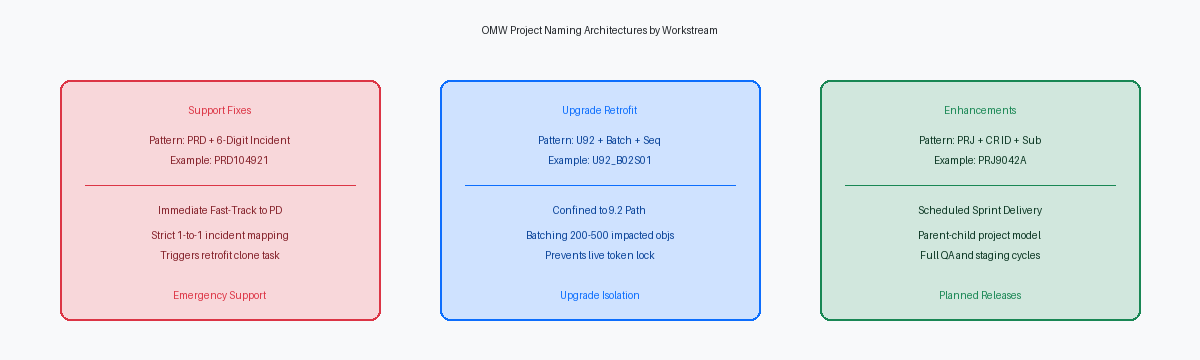
Every project identifier must compress three operational signals into its fixed 10-character payload: workstream type, initiative reference, and build or task iteration. Allocating three characters for track classification (such as PRD for production break-fix or U92 for 9.2 upgrade retrofits), five characters for the ticketing identifier, and two characters for task sequencing creates an unambiguous syntax. Enforcing this format before developers create projects ensures queries against F9861 instantly reflect object disposition, token conflicts surface before code collisions occur, and audit logs maintain absolute clarity across multi-year modernization tracks.
Production Support Fixes: Prefix Isolation and Fast Tracking
Emergency break-fixes cannot share namespace with scheduled enhancement cycles. A production support project must bind directly to the tracking record via a dedicated 3-character prefix—typically PRD or SUP—followed immediately by the ticket reference, creating an unambiguous identifier like PRD104921. Object scope must remain ruthlessly atomic. If the incident stems from an unhandled cache failure in B4200310, that specific business function and its direct data structure are the only assets permitted inside PRD104921. Allowing developers to piggyback an unrelated UBE version or a minor cosmetic APPLAn interactive application object in JD Edwards containing user interface forms. fix into that same project risks introducing unvetted code into production under the guise of an emergency.
CNC teams depend on strict prefix parsing to execute fast-track deployment models. When an OMW project matching the PRD###### pattern advances through project status 26 into 38, deployment automation can safely carve out an isolated, single-object update package rather than waiting for the standard weekend batch build. Unstructured naming like HOTFIX_01 or FIX_NOW forces the CNC engineer to stop, cross-reference F9861 tokens, and run manual verification meetings while manufacturing lines or shipping docks sit idle.
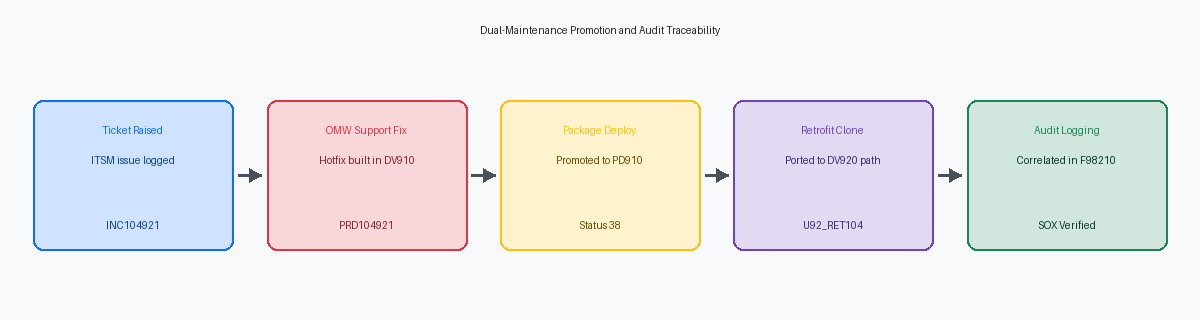
When running parallel environments during a release upgrade, every single break-fix creates an immediate debt. Promoting an object through PRD104921 must automatically trigger a mandatory dual-maintenance protocol: the developer who checks in B4200310 at status 38 must replicate that exact delta into the active upgrade branch before the ticket can close. CNC governance should run an automated weekly delta check across F98210 logs to reconcile all closed PRD projects against the upgrade retrofit backlog. Fail to enforce this synchronization, and your next major cutover package will wipe out months of production hotfixes on day one.
Upgrade Retrofit Projects: Segregating the Modernization Track
On an enterprise repository holding 5,000 to 15,000 objects, a disciplined specification mergeAn automated JDE upgrade process comparing baseline, custom, and new release object specifications to merge custom code. cuts the actual modernization workload down to between 200 and 500 truly impacted custom objects. Attempting to dump those objects into generic developer buckets or a single monolithic project guarantees administrative paralysis before the end of week two. Scope should be partitioned into roughly 20 distinct functional batch projects across the 6- to 9-week code retrofit phase, creating a predictable packaging structure that links the OMW object ledger directly to functional test plans.
Upgrade retrofit projects require distinct prefixes like RET or UPG paired directly with the release target code, yielding structured project IDs such as U92_B0102 for Batch 01, Task 02. This structural discipline eliminates concurrent token contention on core central objects like B4200310 or P4210 during intensive development cycles. When two functional streams must modify the same sales order processing logic or line-entry interfaces, clear project batching forces technical leads to sequence the work into distinct, non-overlapping development milestones rather than fighting over active checkout locks in the same workspace.
Retrofit projects must stay strictly isolated within the pristine upgrade environment path—typically DV920The standard development environment and path code for JD Edwards EnterpriseOne release 9.2.—without ever accepting objects checked out directly from live maintenance. Mixing objects from active break-fix environments like DV910 into an upgrade retrofit project introduces untracked spec variances and corrupts Central ObjectsThe central relational database repository holding EnterpriseOne specifications for applications, reports, and business functions. tables. When an emergency production patch alters a core business function mid-upgrade, that change must not be merged ad hoc into an existing retrofit task. Instead, log a dedicated dual-maintenance task under an explicit catch-up batch like U92_B2001, apply the delta change against the 9.2 baseline specs, and advance it through the standard upgrade promotion rules.
Planned Enhancements and Custom Development Tracks
Every enterprise enhancement spanning more than a single two-week sprint will eventually run headfirst into a production emergency. Bundling warehouse enhancements into a generic support queue guarantees that an urgent P1 fix in Sales Order Entry (P4210) gets trapped behind incomplete C business functions. Planned custom development demands dedicated namespaces using enterprise project codes like PRJ or scheduled release identifiers like R24_1029. Separating these long-lived development tracks from quick-turn operational fixes ensures scheduled code freezes never lock down critical production patches.
Planned enhancement efforts require disciplined milestone gates mapped directly to standard OMW status movements. A build migrates from status 21 (In Programming) to 26 (Test/QA) only after functional specifications and peer code reviews are approved. Advancing from 26 to status 28 (Staging/UAT) requires formal business sign-off in the PYPrototype; the standard pre-production testing environment and path code in JD Edwards. path code, holding the payload intact until the change advisory board authorizes the final leap to status 38 (Production). If an enterprise change freeze halts non-essential deployments before month-end, projects stalled at status 28 sit quarantined without choking urgent support lifecycles.
When multiple developers collaborate on an enhancement, do not let them step on each other inside a single shared container. Establish a parent master project to serve as the umbrella and issue individual child work projects for each engineer. Developers check out objects in their assigned child buckets, isolating their check-ins in DV920 until milestone delivery. Prior to promoting upward to status 26, team leads transfer object ownership and tokens into the parent project, collapsing the work into a unified promotion package that preserves an untangled audit trail.
Audit Trails and the F98210 Project Activity Log
External IT auditors evaluating SOX complianceSarbanes-Oxley Act regulatory standards requiring strict IT controls and audit trails over financial systems. inevitably extract the Object Management Workbench activity log directly from F98210 to verify promotion history into Production. They look for promotion actions—specifically status transitions from 26 (QA) to 38 (Production)—and demand cross-referencing against formal change tickets. When developers use arbitrary project names like GLFIX or developer initials, programmatic reconciliation breaks completely. That failure forces manual matching of object tokens and user IDs across F98222The JD Edwards table that tracks user roles and permissions assigned to OMW projects., easily burning 40 to 60 hours of senior CNC time per audit cycle just to substantiate authorization.
Embedding the ITSM ticket number directly into the 10-character project string transforms this manual compliance scramble into a single automated script. A scheduled audit query can execute an inner join between F98210 (POLGUSER, POLGOMWPRJID, POLGDATO, POLGACTTRY) and the enterprise ServiceNow change_request table using the ticket substring parsed from the project ID. If a project was advanced to status 38 without a corresponding, fully approved change request record in ServiceNow, the query flags an unauthorized production promotion instantly, before the external audit team ever requests sample data.
This mechanical traceability is equally vital during production incidents and rollback operations. When a midnight Sev-1 patch introduces unexpected cache errors in a core business function like B4200310, your team cannot afford to sift through weeks of package deployment logs across hundreds of repository entries. Filtering the activity log by the structured emergency prefix isolates the exact objects and token releases tied to that incident within seconds. You identify the precise BSFNs, forms, or UBE versions touched, verify the sign-off, and execute a surgical rollback without risking concurrent production fixes.
The Master Naming Checklist and CNC Governance Rules
CNC package build audits fail the moment governance relies on developer goodwill instead of hard technical boundaries. Your deployment team must enforce a rigid 3-5-2 alphanumeric syntax across the 10-character project identifier: three characters designating stream type (such as PRD for support fixes, UPG for modernization retrofits, or ENH for enhancements), five characters locked to the ITSM ticket ID, and two digits reserved for build iterations. If an engineer submits an update package request containing modified APPL and BSFN objects mixed across separate ticket scopes, or if the naming schema deviates by a single character, CNC rejects the build before it reaches the enterprise server.
Manual project inspection breaks down under rapid deployment schedules, which is why governance belongs inside OMW Transfer Activity RulesConfigured rules in JDE dictating object actions, promotions, and validations during project status changes.. Configure your status transitions—specifically the jump from development status 21 to prototype testing status 26—with validation logic that parses the project description. If the text fails to include an authorized Jira issue key or ServiceNow change reference matching the five-character ticket segment, the workbench blocks the promotion at the local client tier. This automation stops unvetted code from contaminating shared DV or PY pathcodes.
Even with strict naming gates, repositories accumulate bloat; an enterprise installation running continuous delivery on Tools 9.2 can generate several hundred individual projects annually. Implement a mandatory quarterly governance routine to query the F9861 central repository table, purging abandoned project headers and revoking object tokens stranded at status 21 for longer than 60 days. Reclaiming these forgotten tokens eliminates deadlocked check-outs on high-frequency objects like B4200310 or P4210, ensuring developers never lose hours chasing down phantom owners during critical delivery cycles.
Disciplined OMW project naming is an operational control that prevents token collisions and keeps package builds predictable across an estate of 5,000 to 15,000 objects. If you are structuring environments for continuous adoption or managing parallel development tracks, consult our technical brief on dual-maintenance retrofit workflows, or review our reference architecture covering CNC automation patterns and object remediation under Tools 9.2.
