




Every senior CNCConfigurable Network Computing; the technical systems architecture and administration discipline within JD Edwards EnterpriseOne. has taken the overnight escalation call: a custom application or UBEUniversal Batch Engine; the report writing and batch processing engine in JD Edwards. tested cleanly in DV, but the moment it landed in PY, memory violations surfaced or processing options vanished. In the vast majority of these post-deployment regressions, the underlying C business function or Event Rules logic is completely sound. Instead, procedural execution failures inside Object Management WorkbenchThe central JD Edwards change management tool (P98220) used to develop, manage, and promote objects. (P98220)—specifically the JDE OMW promotion mistakes that break custom objects—introduce token collisions, orphaned specs, and cache pollution that slip past standard build logs.
Modern EnterpriseOne 9.2 architectures, particularly environments balancing 64-bit compiled packages alongside web-only User Defined ObjectsWeb-based customizations such as Orchestrations, Form Extensions, and Grid Formats managed without heavy developer toolkits. and AISApplication Interface Services; a server that exposes JD Edwards business logic and forms as REST APIs. dependencies, forgive zero carelessness during status advancement. When delivery teams rely on habit rather than structured promotion mechanics, diagnosing corrupted runtime specifications and restoring central objects quickly derails delivery timelines. Isolating where promotion mechanics fail is essential for establishing a repeatable, zero-defect release process.
The Out-of-Sequence Object Transfer Anti-Pattern
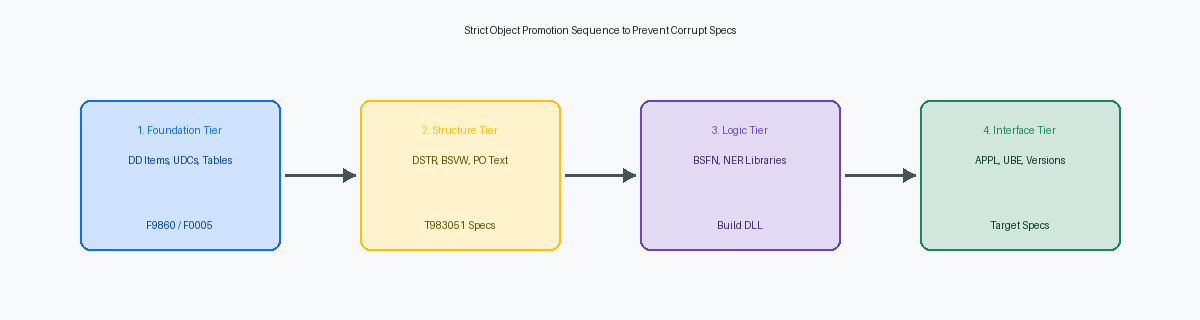
Corrupt runtime specifications in Central ObjectsThe database repository storing code, event rules, and design specifications for a specific path code. frequently trace back to an OMW activity rule firing out of order. When an administrator advances a project status from 21 to 26, OMW reads the project object list sequentially down the table rather than evaluating logical dependencies. If a custom Application (APPL) or Universal Batch Engine (UBE) executes its transfer step before an underlying Data StructureA defined layout of parameters used to pass data between applications, reports, and business functions. (DSTR) or Business ViewA JD Edwards object defining the specific database tables, columns, and joins used by applications or reports. (BSVW) completes, OMW attempts to merge specifications against target data definitions that do not yet exist. The target Central Objects repository writes incomplete specs, poisoning the target path codeA specific set of central object specifications and directory locations representing an environment like DV or PY. before the package build even begins.
The table-level mechanics in the Object Librarian explain why this happens. Object definitions registered in the F9860 must align with environment-specific location records in the F9861. If an engineer promotes an APPL under one token while a dependent BSVW sits in a secondary project, the parent object fails spec merge operations at status advance. OMW does not validate whether child foreign keys exist in target Central Objects; it simply executes the transfer actions mapped to the transfer activity rules in sequential order.
The issue deepens when Data DictionaryThe central repository storing definitions, attributes, formatting, and text for all data fields in JD Edwards. (DD) changes and User Defined CodesConfigurable reference codes and lookup tables (UDCs) used across JD Edwards applications. (UDC) enter the mix. Developers routinely promote a custom UBE to PY while its newly minted DD items and UDC values are still waiting on DD replication cycles or sitting trapped behind stale server caches. Without resetting target DD runtime caches and verifying replication, the dependent application cannot resolve its field definitions in PY, throwing immediate memory allocation errors upon launch.
Stop splitting tightly coupled components into isolated OMW projects to satisfy artificial task tracking. Combining all interdependent objects—DD, BSVW, DSTR, UBE, and APPL—into a single master promotion project or running an explicit pre-promotion dependency check eliminates most missing specification errors during promotion cycles.
Transferring Objects Without Advancing Processing Options
A developer adds two flags to an APPL processing option data structure in DV, checks in the object, and promotes the application specification via OMW without advancing the PO Text template (T983051). The interactive engine in PY or PD now loads a mismatched data structure layout into memory. Because the runtime aligns data elements using fixed byte offsets, reading a four-byte flag where the runtime expects a ten-character string throws off every subsequent parameter, silently corrupting data passed into downstream Form Interconnections.
The failure mode turns catastrophic in batch processing. When a UBE processing option template expands, existing batch versions do not automatically inherit the new memory map; their stored parameter values in the F983051 table remain frozen to the old structure. Failing to open, re-save, and transfer these versions forces the batch engine to execute against conflicting F983051 and F98306 specifications. Instead of hard-failing with a memory violation, the UBE frequently reads a null or garbage integer as an effective date or ledger type, producing silent calculation errors across thousands of financial or inventory records.
Before submitting project tokens for a package build, run a direct SQL audit comparing F983051 blobBinary Large Object; a database field type used in JD Edwards to store compiled binary specifications. lengths and parameter counts against the parent object definition across your source and target path codes. Checking the text definition timestamp in Central Objects against the version records in your versions list takes only a few minutes and prevents an emergency weekend rollback. If the processing option data structure changed, every deployed version must be checked out, touched in the design tool, saved, and promoted in the exact same OMW project as the parent object.
The Version Token Trap Across Multiple Projects
Versions (VER) are independent objects with distinct checkout tokens, completely detached from their parent APPL or UBE templates. A frequent failure in multi-developer shops occurs when Developer A holds an APPL token in Project A to modify form logic, while Developer B checks out an associated Version in Project B to update processing options. When Project B promotes through status 26 before Project A finishes testing, you create split promotion paths that force target path codes to map new runtime flags against an out-of-sync parent application.
The reverse mistake creates immediate execution errors in batch processing. Promoting a project containing only a base UBE without its associated processing option versions leaves the target environment running altered event rules against outdated execution flags and mismatched data structures. When developers blindly promote version specifications using blanket status updates, they overwrite production-specific run parameters stored in the F983051 version specification records. Dedicated batch job queues, custom printer overrides, and critical dynamic data selection criteria tuned specifically for overnight production processing get flattened by whatever raw defaults existed in the development environment.
To eliminate this risk, isolate client-run batch versions into dedicated maintenance projects that strictly exclude the base UBE object unless the underlying template logic has changed. If an operations lead needs to alter the data selection or data sequencing on a custom R42520 version, that version object must travel alone. Decoupling parent templates from operational version adjustments guarantees that routine report parameter changes never pull untested table I/O, uncompiled C business functions, or work-in-progress report design modifications into your live enterprise server.
Cache Pollution and Stale Central Object Specs
A developer modifies an interactive application, advances the OMW project from status 21 (Programming) to 26 (QA Test), and QA logs a defect twenty minutes later because the application behaves exactly as it did yesterday. Advancing the project updates Central Objects in the target path code, but runtime engines never execute directly against Central Objects tables during an active session. Fat development clients keep local spec caches locked, while the HTML server's dynamic serialization engine continues serving pre-promotion metadata from its initial fetch.
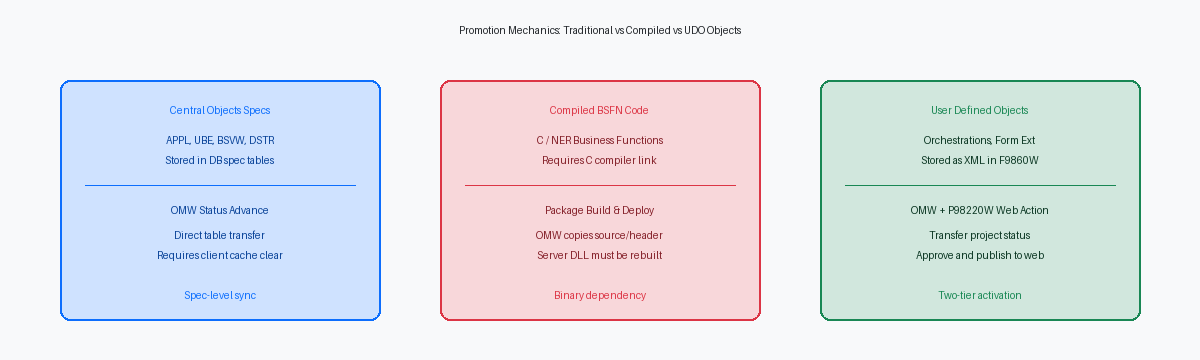
For C Business FunctionsEncapsulated procedural logic or code (BSFN) written in C or Event Rules for complex business computations. (BSFN), this disconnect generates phantom memory violations and data structure mismatches. Promoting a BSFN copies updated .c and .h members into Central Objects, but OMW does not compile or link the object. Until an update package is built and deployed, the Enterprise Server executes whichever stale shared library exists in its bin directory. On the presentation tier, the engine caches the previous form layout inside the JASJava Application Server; the web component that renders JD Edwards applications in web browsers. instance disk structure, residing under /webclient/e1cache/<environment>/<instance>/.
Engineering teams lose billable hours chasing bugs in Event RulesThe proprietary JD Edwards programming language used to define logic and interactive behavior on forms and reports. that were already rewritten, simply because the eGenerator or on-demand serialization cache re-serves the obsolete object. When promotion anomalies occur, stop touching OMW. Execute a targeted purge of the target JAS e1cache directory, restart the web instance if dynamic spec clearing fails via Server Manager, and verify the Enterprise Server package deployment log. If the compiled library timestamp does not match your Central Objects transfer timestamp, the promotion succeeded, but your architecture is executing yesterday's code.
Orchestrations and UDOs Bypassing OMW Path Codes
Traditional specs live in relational central objects tables like F98741 or F98711, but User Defined Objects bypass that machinery entirely. Orchestrations, Form Extensions, and Grid Formats reside in distinct lifecycle tables such as F9860W and F98700R. Developers accustomed to promoting interactive applications often assume OMW recursively packages child dependencies when advancing an orchestration. It does not.
An orchestration is an XML manifest referencing isolated sub-objects: Service Requests, Data Requests, Rules, and Cross-References. Promoting the parent orchestration without explicitly attaching its dependent Service Requests or custom Groovy rules produces a successful OMW project transfer report with zero technical errors. The breakdown happens silently on the Application Interface Services (AIS) server at runtime, throwing null-pointer exceptions or missing-component faults because those child components never updated the target environment's F9860W metadata.
Even a complete transfer leaves objects dead in the water if you overlook the web-based life-cycle step. Advancing an OMW project status from 21 to 26 moves the database records, but UDOs remain dormant until formally approved in P98220W (Work with User Defined Objects). Failing to approve and share the object traps it in a staging state where it runs perfectly for the developer holding administrative permissions, while non-administrative business users cannot see or trigger it.
Before signing off on any deployment, cross-validate the Orchestrator Studio catalog dependencies directly against P98220W in the target path code. Verify that the parent orchestration and every downstream sub-object carry a status of 'Shared' (08) for user *PUBLIC. A brief verification in P98220W eliminates the phantom AIS errors that masquerade as network timeouts or broken credentials.
Standardizing the Promotion and Package Verification Protocol
An unverified status advance is where clean code turns into broken runtime specs. Before any project moves from status 21 to 26, executing an automated sweep through the Cross Reference Facility (P980011) must be mandatory. Querying the cross-reference tables flags unpromoted data structure changes, altered processing option templates, and missing child business functions before specs reach Central Objects. Skipping this step is how developers push modified applications while leaving critical parent-child dependencies stranded in the development path code.
Enforce this systematically by hardening your OMW transfer activity rules in P98230. Configure the activity rules to reject parent object transfers whenever child references or interdependent tokens fail automated validation checks across target path codes. If a UBE calls a modified BSFN, OMW must halt the status transition until that dependency is accounted for in the target manifest. Manual peer reviews catch a portion of dependency omissions, but strict transfer rules eliminate the systemic gaps that corrupt package assemblies.
Eliminate the habit of building ad-hoc, developer-driven update packages across non-production environments. Replace ad-hoc deployments with scheduled daily automated package builds and deployments into the test path code. A fixed 18:00 cutoff forces developers to check in objects cleanly and synchronize tokens, replacing chaotic mid-afternoon package builds with an orderly, repeatable delivery pipeline.
Close the promotion loop with a mandatory CNC verification checklist before user acceptance testing begins. This protocol cross-checks Central Object modification timestamps directly against the target package manifest summaries. If an object timestamp in the target central objects database postdates the package build time, the build is rejected immediately. This disciplined verification step prevents testing teams from logging false defect reports against custom code that was simply never packaged. Deployment failures in EnterpriseOne are rarely engine defects; they are process bypasses that structured OMW governance permanently resolves.
