




A two- or three-developer JDEJD Edwards, an enterprise resource planning (ERP) software suite from Oracle. shop supporting 2,000 to 3,000 active users sits in a dangerous bind. You cannot afford an enterprise change board with six layers of sign-offs, but running with zero governance guarantees that an untested NERNamed Event Rule: JD Edwards business logic written using high-level Event Rules instead of C code. or modified table specTable specification: compiled metadata defining a database table structure within JD Edwards. will corrupt production by month-end. Swapping that chaos for sprawling Jira workflows or external ITSMIT Service Management, frameworks and software used to manage IT service requests and change workflows. tools only adds administrative drag without fixing the underlying spec promotions.
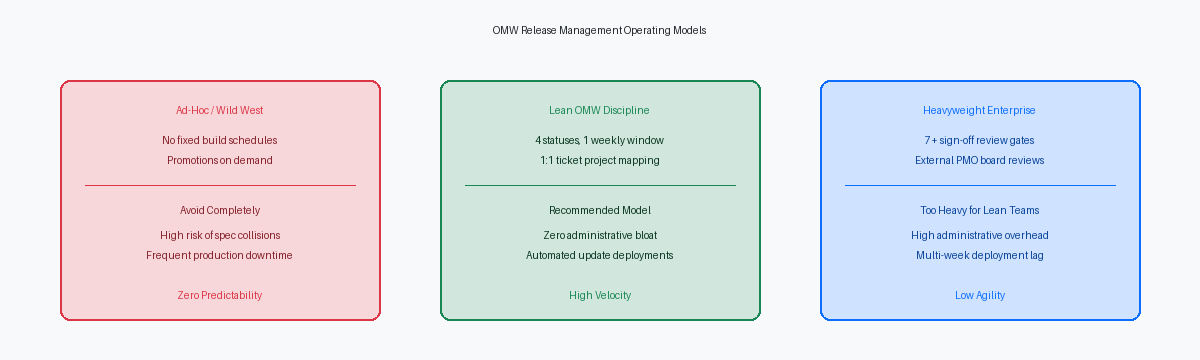
Sustainable JDE OMWObject Management Workbench: the primary change management and object promotion tool in JD Edwards. release management for small development teams relies on native Object Management Workbench (P98220The standard JD Edwards interactive program used to launch Object Management Workbench.) mechanics, stripped down to what actually protects the runtime. By pruning project statuses, treating tokensOMW concurrency locks that grant exclusive editing rights to a single project or developer. as hard contracts, and locking in a deterministic weekly package cadence, a lean team can push 15 to 20 defect fixes a month through DV, PY, and PDStandard JDE environments: Development (DV), Prototype/Test (PY), and Production (PD). without a full-time CNCConfigurable Network Computing: JD Edwards proprietary architecture and system administration discipline. playing traffic cop.
The Small Team Trap: Ad-Hoc Releases vs PMO Bloat
In a small team supporting 500 to 1,000 active EnterpriseOne users, release management almost always derails in one of two directions. Either the team treats DV920 and PY920 like an open sandbox—pushing single objects up on demand to satisfy an impatient warehouse supervisor—or they strangle themselves with an exhaustive CABChange Advisory Board: a governance committee responsible for reviewing and authorizing software releases. checklist borrowed from a global tier-one enterprise. The first approach leads straight to Friday evening fire drills. The second guarantees that a minor EREvent Rules: JD Edwards proprietary scripting language attached to application events and logic. fix for an inventory lot bug sits in queue for three weeks while business users lose patience.
Promoting individual specs directly to production outside a synchronized schedule is where small teams break their own environments. When a developer moves an APPLInteractive Application: an interactive form or user interface program in JD Edwards. without its companion NER or pushes a table alteration ahead of the corresponding table conversion UBEUniversal Batch Engine: background batch processes, reports, and data conversions in JD Edwards., runtime memory violations or corrupted cache states follow immediately in PD920. Native OMW was built precisely to prevent these out-of-sequence regressions, provided you respect its deterministic state transition model rather than hacking around it with manual object transfers.
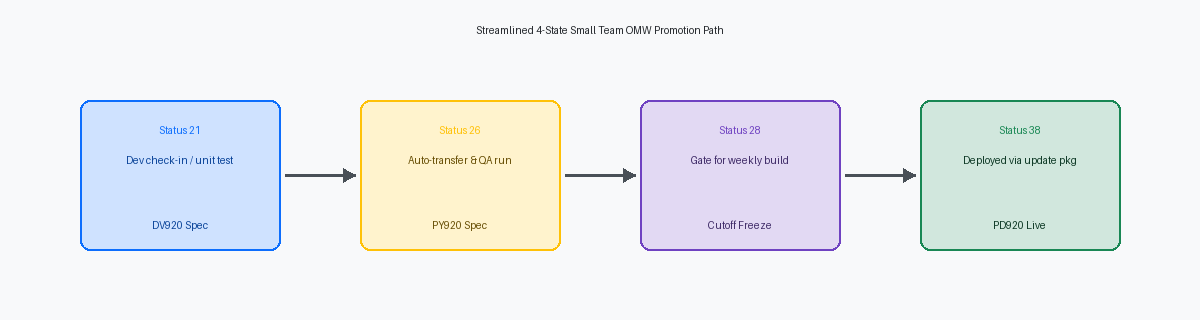
The system does not need external project tracking software to enforce ironclad governance. Built-in object lifecycle statuses—transitioning from 11 (New Project Pending Review) to 21 (Programming), 26 (QA Test), 28 (QA Test Complete), and 38 (Production Transition)—provide automated token control and transfer activity rules out of the box. If an object is checked out at status 21, no other developer can hijack that token, ensuring code changes never leapfrog untested dependencies.
Replacing administrative red tape with strict adherence to these project status definitions gives lean teams both velocity and compliance. When status activity rules dictate the build rather than an email chain or an emergency ticket override, package deployment ceases to be a crisis. You eliminate reliance on CNC memory to verify dependencies, and the repository enforces its own boundaries.
Pruning the Status Hierarchy to Essential Promotion Paths
Most out-of-the-box or legacy OMW configurations look like they were designed for a multi-tiered enterprise team. You inherit status activity setups carrying five or six gatekeeping milestones—such as Business Analyst Review at status 23, Technical Architecture Review at 24, and QA Lead Sign-Off at 25—which simply makes no sense when one senior developer also handles peer reviews and defect verification. These intermediate statuses do not catch bugs. They sit idle, leave objects stranded, and tempt developers to bypass change control entirely by moving local specs directly to shared test environments.
Strip your project promotion paths in P98230The JD Edwards configuration application for managing OMW Transfer Activity Rules and status transitions. down to four deterministic states: 21 (In Dev), 26 (QA/Testing in PY), 28 (Approved for Production Deployment), and 38 (Production Active). Any status between 21 and 26 that fails to trigger a technical event is administrative friction you cannot afford. If code is ready for business validation, the project advances to 26; once the business signs off, moving the project to 28 alerts CNC that the objects are locked and approved for the next scheduled production package build.
The critical efficiency gain lies in configuring the Transfer Activity Rules in P98230 strictly on the 21-to-26 boundary. Configure the rule so that advancing from 21 to 26 automatically executes the object copy from DV920 to PY920 while simultaneously checking in all local specs to Central ObjectsThe central database repository storing master object specifications across environments.. Requiring developers to manage manual check-ins across multiple environments before promoting a project virtually guarantees that someone will leave a modified C business function or processing option data structure behind on a fat clientA dedicated Windows workstation equipped with compilers and local specifications for JDE development.. Anchoring check-in rules entirely to status advancement ensures that the exact code validated in DV920 is what lands in the PY920 build without human intervention.
Project Grouping: One Defect, One OMW Project
The single most damaging habit I encounter in lean development shops is the perennial catch-all project—containers labeled DEV_2024, MONTHLY_BUGS, or MISC_FIXES where multiple developers park unrelated work. It feels low-friction on a Tuesday because nobody has to create a new project definition or verify user roles. Then deployment day arrives, and a defect surfaces in one APPL modification thirty minutes before the package build cutoff. Because that fix sits inside a monolithic manifestA single deployment package grouping multiple unrelated code changes together., CNC cannot promote the verified inventory UBE without dragging the broken application into Production along with it.
You eliminate release contamination by enforcing an uncompromising 1:1 rule: every Jira ticket, service desk incident, or distinct mini-enhancement gets its own discrete OMW project container. If a developer modifies three objects—for instance, P42101, a custom DSTRData Structure: a defined list of input and output parameters passed between JDE objects., and a business function—to remediate issue JIRA-4812, those three objects, and only those three, enter that project. When QA signs off on sales order entry but flags a regression in a warehouse report, you advance the sales project to status 26 and leave the warehouse project at status 21. Promotion decisions remain isolated, surgical, and decoupled from unrelated development velocity.
This structure only scales if you standardize the project ID syntax. Enforce a naming convention such as PRJ_[TICKET#]_[MODULE] (for example, PRJ_4812_SO) the moment work begins. Adopting this standard turns the F98222JD Edwards database table containing project detail records and assigned objects in OMW. (OMW Project Detail) table into a clean, searchable system of record that links directly to your ticketing platform without maintaining disconnected spreadsheets. A short SQL query run against F98221 and F98222 gives the team immediate visibility into which defect fixes are assigned to an active transfer activity rule, which objects are locked, and which artifacts will be swept into the scheduled assembly.
Token Discipline: Resolving Conflicts Without CNC Arbiters
In a lean team of two or three developers, familiarity breeds shortcuts. When delivery deadlines tighten, developer B joins the OMW token queue for an active object, pulls specs to their local development client anyway, and modifies a shared BSFNBusiness Function: encapsulated business logic modules written in C or Event Rules. data structure or business viewA JD Edwards database abstraction layer defining joins and columns selected from tables.. Because both developers work concurrently without respecting token gating, the collision lands at check-in. Developer B eventually acquires the token, checks in their spec, and silently overwrites Developer A’s parallel logic changes, wiping out an entire sprint's debugging work in seconds.
Eliminate this risk by establishing an absolute policy: zero object check-outs without active token ownership. The F98220 project header tracking exists to maintain explicit state management across the lifecycle. If Developer B requires an object currently locked in an active project, Developer A has two acceptable choices. They either finish their local unit testing and promote the project to status 26 (Test/QA) to release the token naturally, or they check in their current baseline and release the token immediately. Speculative queuing, where developers sit on modified local specs waiting for a token to clear, should be treated as a release defect.
Unavoidable bottlenecks still occur with high-traffic enterprise objects, but the token queue remains the wrong solution. When two developers must enhance a common utility like B5500010 in the same release window, coordinate the work using branch-style project copies rather than speculative queuing. Developer B creates a temporary clone of the function, validates the new parameters in isolation, and executes a planned, single-pass merge back into B5500010 once Developer A clears status 26. That approach keeps the repository clean and resolves spec collisions without demanding CNC arbitration.
Establishing a Predictable Release Window and Package Cadence
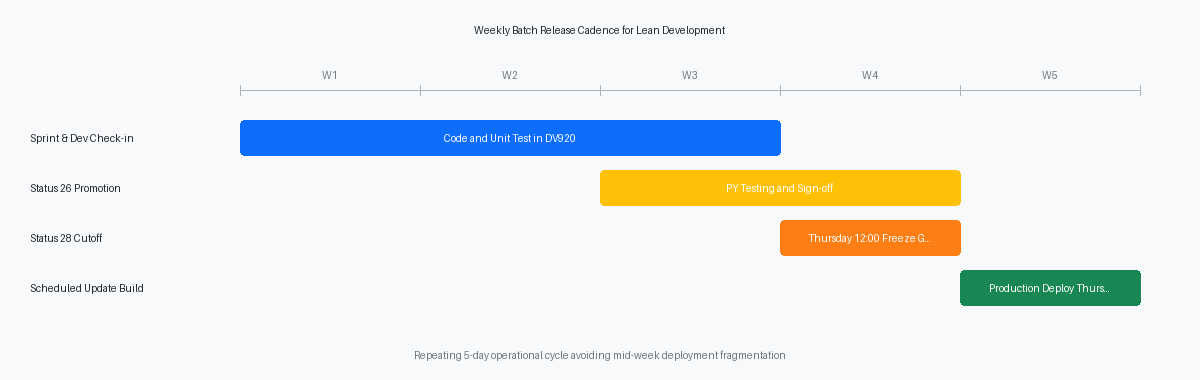
Ad-hoc mid-day production package builds are the single greatest cause of Enterprise Server spec corruption and cache inconsistencies across EnterpriseOne estates. Pushing uncoordinated object promotions during active business hours routinely locks package specs, leaves orphaned records in runtime tables, and triggers erratic call-object kernelA background Enterprise Server process that executes business functions requested by web users. crashes. Every ad-hoc promotion bypasses clean runtime cycling, forcing active web users to collide with stale memory structures or partial serializations mid-transaction. If a modification cannot survive until the scheduled evening window, it is almost certainly poor planning disguised as urgency.
Eliminate the chaos by establishing an immutable weekly release cadence. Any OMW project destined for the production environment must reach status 28 by Thursday at 12:00 PM sharp. At 20:00 Thursday, Server ManagerOracle web-based management tool for monitoring, configuring, and deploying JD Edwards servers. kicks off an automated scheduled update package build, compiling objects and cycling kernels to cleanly align environment specifications without manual supervision. Any project promoted to status 28 at 12:05 PM automatically rolls over to the following week's build, without exception.
Reserve true off-cycle builds strictly for Severity-1 outages: warehouse picks halted, shipments dead in the water, or payroll processing completely blocked. A minor UBE glitch or an executive's preferred report formatting fix never qualifies. Executing an emergency deployment demands explicit, written sign-off from both the primary developer and the impacted operations lead. Creating this procedural friction prevents stakeholders from treating production like an interactive sandbox and eliminates the vast majority of arbitrary mid-week promotion requests.
Locking down this predictable window liberates small teams from constant deployment firefighting. CNC tasks transition from manual interactive package assemblies to automated scheduled routines managed via Server Manager, reclaiming 6 to 10 hours of technical bandwidth every week. Business stakeholders receive a dependable delivery timeline, and your production Enterprise Servers maintain pristine spec repositoryThe central database storing compiled object definitions, logic, and schemas in JD Edwards. integrity without the threat of mid-shift runtime corruption.
Handling UDOs Alongside Traditional OMW Objects
The most common breakdown in hybrid releases occurs when developers treat User Defined ObjectsWeb-based user configurations in JDE, including Orchestrations, Form Extensions, and custom queries. like desktop configurations rather than production code. While traditional specs run through structured package builds, teams routinely publish Orchestrations, Form Extensions, and Queries directly through P9860WThe web application used in JD Edwards to manage, approve, and publish User Defined Objects., bypassing P98220WWeb Object Management Workbench, the browser interface for lifecycle management of UDOs. (Web OMW) entirely. That habit falls apart the moment an Orchestration depends on a newly minted NER or a custom tag table. If the data structure change sits inside a Friday night package build but the orchestration was published Thursday afternoon, production jobs immediately drop dead on the AISApplication Interface Services: a REST API middleware server providing data integration with JDE. layer.
Unifying these tracks requires binding OrchestratorAn automation and integration tool in JD Edwards that converts business logic and UI tasks into REST APIs. logic to the exact same deployment cadence as its foundational BSFNs, tables, and UBEs. Configure your UDO project transfer rules to mirror traditional object pathways: move the UDO project from status 21 to 26 so the artifacts transfer into the prototype environment for end-to-end integration testing against the PY AIS server. Testing an orchestration against DV endpoints while your custom business functions reside in PY yields false positives that unravel the moment real users begin system validation.
In the hours leading up to your deployment cutoff, audit the deployment state of every release-bound UDO in P9860W. Having an object marked as "Shared" in Web OMW is useless if the corresponding runtime security record is missing in User Defined Object Security (P985350The JD Edwards application used to configure user and role-based security for User Defined Objects.). Every shared component must carry an explicit *PUBLIC or targeted role-based View record deployed to production simultaneously with the project advance to status 38. Skipping this P985350 check is why a production orchestration runs cleanly for the developer who built it, only to return a 403 authorization fault for the plant floor on Monday morning.
For a three-person development team, release velocity does not come from elaborate governance; it comes from stripping OMW down to a clean promotion path and executing transfer rules without manual overrides. If you want to take the CNC mechanics further, look through the related deep-dives on Object Transfer Activity Rule automation in P98230 and lean package build architectures across the site. You will also find documented production playbooks showing how to manage promotion pipelines cleanly across custom objects without adding administrative overhead.
