




Most upgrade teams derail their technical timeline in week one by slicing Object Management WorkbenchJD Edwards' change management tool used to develop, modify, and track software objects and project lifecycles. projects along functional boundaries—creating monolithic buckets like "FIN_RETROFIT" packed with 400 mixed objects and hoping for the best. Bundling interactive applications, batch engines, and core C business functions together before technical rationalization guarantees token gridlock, circular dependencies, and corrupt package buildsThe compiled set of applications, specs, and business functions deployed to JD Edwards enterprise and web servers. before the first code merge even begins.
Across an estate of several thousand custom and modified specs, typically only 200 to 500 objects genuinely clash with Oracle's pristine 9.2 baseline. Establishing a disciplined JDE OMW retrofit project structure during 9.2 upgrade turns what is often a chaotic, multi-month merge into a predictable nine-week technical delivery. That predictability relies on isolating objects by structural dependency rather than department, enforcing strict tokenAn exclusive lock in JD Edwards OMW that allows only one developer to check out and edit an object. lifecycles to prevent dual-maintenance lockouts, and assembling targeted project buckets designed specifically for clean, incremental package builds.
The Anatomy of 9.2 Upgrade Object Impact
Querying tables F9860 and F9861 during an upgrade discovery phase almost always induces artificial panic in project leadership. On a mature enterprise footprint, that initial Object LibrarianThe central JD Edwards repository tracking metadata, locations, and status of all software objects. query routinely pulls between 5,000 and 15,000 custom and customized records. What those raw database extracts fail to clarify is that, in our experience, 60% to 75% of those rows represent obsolete versions, abandoned one-off test copies, and dead code paths decommissioned years ago. Treating raw repository inventory as an active development backlog is the fastest way to turn an eight-week retrofit cycle into an aimless six-month quagmire.
Running JDE Spec Compare or the Customization Analysis Utility cuts through repository noise by grouping modifications into three deterministic buckets: pristine untouched objects, net-new custom builds in the 55–59 range, and genuine collision candidates where standard Oracle logic was modified.
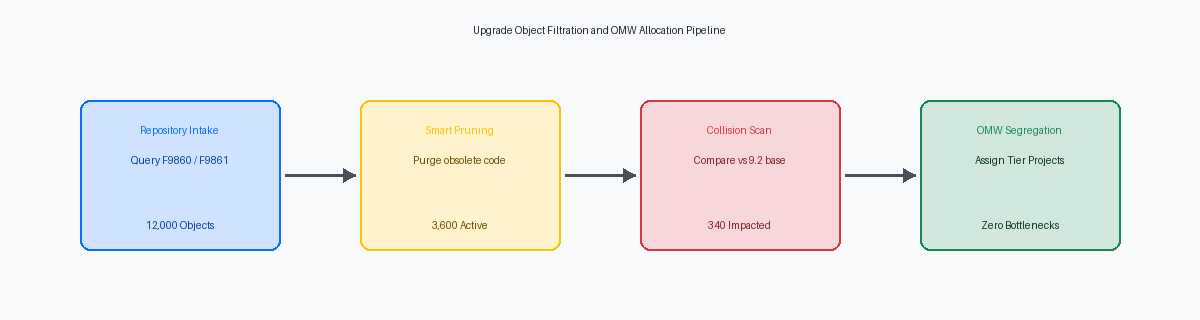
Impact Classification Tiers for Retrofit Intake
Treating every impacted object with the same procedural weight is the fastest way to blow out an upgrade timeline. Tier 1 intake covers net-new custom objects in the 55–59 namespace alongside zero-collision baseline renames. These require purely mechanical builds, C-header validations, and standard token check-outs with zero manual code merge. Because Oracle base source code never touched these records, they bypass functional triage and move straight to automated build validation.
Tier 2 absorbs isolated modifications where the functional blast radius is tightly contained. Cloned versions, custom processing option text, and minor data selection tweaks on standard batch reports sit here. Using ER CompareJD Edwards Event Rule Compare tool used to view and merge line-by-line procedural logic between environments., developers can port custom event rule blocks directly between environments in 15 to 30 minutes per object, requiring minimal functional validation before advancing project status.
Tier 3 is where upgrades succeed or quietly bleed out. These are high-risk core entities: table structural changes to F0911, F4211, or F4101, complex C business functions, and Master Business Functions executing deep interactive logic within applications like P4210. Consider the P4210 and P42101 sales order entry suite. Between 9.1 and 9.2, Oracle altered parameter signatures across the B4200310 and B4200311 call stacks. If a developer attempts a quick visual merge without mapping custom fields against the updated data structure alignment, the runtime will silently misalign memory pointers during sales order cache initialization.
Assigning Tier 3 objects to general developers without isolating them into dedicated, high-visibility OMW projects produces subtle runtime memory leaks and unhandled cache pointers that slide past unit testing. When developers treat C-based memory allocation routines like vanilla Named Event RulesJD Edwards business functions written in native Event Rule language rather than low-level C code., CallObject kernelsBackground server processes in JD Edwards responsible for executing business functions and backend logic requests. crash under concurrent enterprise load. Isolating these components into distinct OMW buckets ensures senior review of every pointer dereference and commit boundary before any package build occurs.
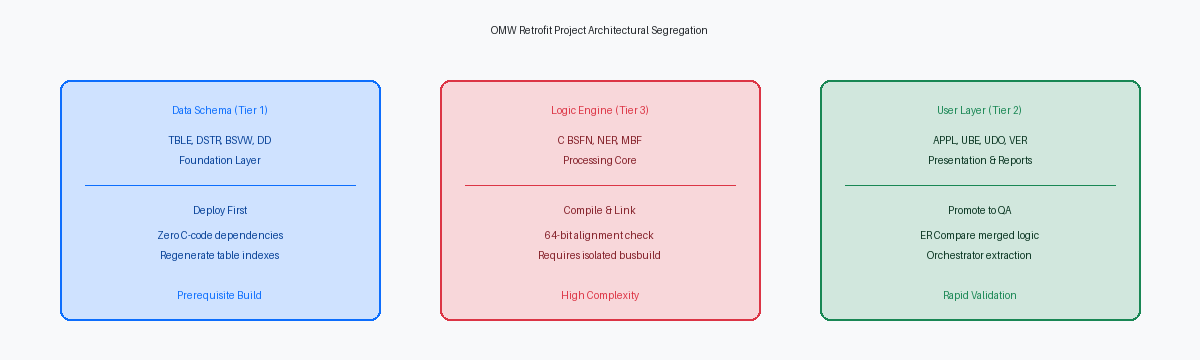
Structuring OMW Projects by Object Type Boundaries
The fastest way to derail a package build during a 9.2 cutover is dumping table specifications, data structures, and C business functions into a single catch-all project. When running busbuild.exe under 64-bit Tools Releases, unlinked DSTRData Structure object defining parameters passed into and out of business functions, forms, and reports. project dependencies in F9860 trigger fatal header mismatches and unresolved external symbols across DLL boundaries. Data dictionary items (DD), data structures (DSTR), and base tables (TBLE) must sit inside distinct prerequisite OMW projects that are advanced, generated, and built well before dependent application logic enters the intake stream. If an underlying data structure spec is not already locked down in the destination path codeA specific set of object specifications and business function DLLs representing an environment like DV920 or PD920., downstream compilation simply crashes.
Compiled C-language business functions demand their own OMW packaging, segregated cleanly from the presentation layer and organized by DLL assignment, such as CALLBSFN or core enterprise libraries. Isolating BSFNsBusiness Functions, compiled C or NER modules executing business logic, validations, and database writes. this way accommodates strict 64-bit compilation boundaries, allowing developers to execute clean local DLL compiles without dragging along bloated application specs. Mixing compiled C logic with interactive forms or batch routines within a single project forces unnecessary full-package rebundling every time a single BSFN header requires a touch-up.
Interactive applications (APPL) and batch report templates (UBEUniversal Batch Engine, the reporting and batch-processing component in JD Edwards.) require equal separation into dedicated project buckets. Segregating APPLs allows functional analysts to begin validating web client event rules, grid controls, and form extensions immediately, without being gated by backend processing runs. Meanwhile, calculation-heavy UBEs stay isolated in their own project containers while batch queues are locked down for precision data reconciliation against historical runs. Keeping presentation objects separated from batch execution pipelines prevents UI regression fixes from invalidating inflight batch retrofits.
Token Lifecycle and Dual-Development Lockouts
The most dangerous phase of an upgrade is the dual-maintenance window where day-to-day production break-fixes collide directly with active retrofit streams. If a production defect in 9.1 forces an emergency patch into B4200310 while an upgrade developer is refactoring that same master business function in 9.2, uncontrolled token acquisition will silently orphan business logic. Without strict token release governance, one environment invariably overwrites the other during final cutover.
To neutralize this, every emergency fix, one-off ESUElectronic Software Update, a software patch delivered by Oracle to fix bugs or provide new features., and custom promotion deployed to 9.1 post-freeze must be twinned into a parallel Delta Retrofit project in the 9.2 path code. You cannot rely on developer memory or tickets to backport changes across releases. Establishing this dedicated delta project ensures every line of hotfixed code is explicitly staged, merged into the new release branch, and validated before promotion.
Governance requires programmatic monitoring rather than developer discipline. Configure OMW logging rules to continuously query the F9821 activity audit table for token movements, specifically tracking action codes 01 (Check Out) and 07 (Get Token) on high-traffic objects like B4200310 and P4310. Inspecting the F9821 records daily reveals token hoarding, unauthorized inheritance, and stagnant locks that threaten path code synchronization across your environments.
Restrict functional analysts and testers to read-only tokens during validation cycles. A functional reviewer who inadvertently takes an exclusive token to inspect Event Rules creates an active checkout state that blocks automated package build scripts on the deployment server. That single unreleased token will fail the nightly BUSBUILD compilation, stopping an entire development team dead in their tracks the following morning.
Package Build and Assembly Strategy per Project Bucket
Every failed package build traces back to the same mistake: packing heterogeneous OMW projects into a single sprawling update build. Package assembly must strictly mirror object dependencies in your project architecture. Foundation projects—data dictionary items, user-defined codes, and table specifications—must build and generate first. Core logic projects housing C BSFNs and NERs compile second, leaving presentation forms and batch engines (APPLs and UBEs) for the final build assembly.
Carving C BSFN retrofits into dedicated project buckets fundamentally shifts deployment economics during the retrofit cycle. A traditional full client/server clean build across an enterprise custom estate reliably consumes three to five hours of compiler overhead and buspack generation. When you isolate C business functions into bounded update packages, Server ManagerOracle's centralized web administration console for managing JD Edwards enterprise, web, and database servers. compiles and deploys targeted DLL updates to the enterprise server runtime in 15 to 30 minutes.
Enforce this separation through strict status gating within OMW activity rules. An entire atomic project transitions from Status 21 (Programming) to Status 26 (QA Test Transfer) only when all contained objects clear isolated unit tests together. Moving individual objects across statuses piecemeal breaks compile manifests; keeping the container intact ensures the QA package build pulls a validated, cohesive set of specs every time.
Wire automated package notifications into your promotion workflow to flag sequence violations before assembly begins. If an engineer promotes a reporting project with modified UBEs ahead of a prerequisite table project containing custom table index alterations, the technical lead receives an instant alert. Halting the package before Server Manager touches the enterprise server avoids runtime memory faults and keeps your deployment schedule on track.
Orchestrator and UDO De-Customization Project Streams
Retrofitting legacy code in ER Compare that should never reach 9.2 production is the single fastest way to blow past development estimates. Establish an explicit Retire & Replace OMW project stream specifically for components slated for functional deprecation. If an interface or UI tweak can be solved natively through Orchestrator Studio or Form Extensions, it has no business entering your standard technical retrofit pipeline.
Take legacy UI modifications on anchor applications like P01012 and P4210. Years of accumulated modifications—hiding unused fields, applying conditional grid colors in event rules, or wiring custom exits to call inquiry applications—can be extracted directly into User Defined ObjectsUser-created artifacts in JD Edwards (like grids, form extensions, and queries) that sit above standard code. rather than retrofitted in ER Compare. Decoupling these presentation changes keeps standard objects clean for continuous Application Updates and prevents developers from wasting hours resolving cosmetic code merges.
The largest technical dividend comes from integration architecture. On a recent distribution migration, we retired dozens of custom BSFN external interface integrations by rebuilding them as AISApplication Interface Services, the REST-based runtime engine providing JSON API access into JD Edwards forms and logic. REST calls in OrchestratorJD Edwards automation platform that creates microservices and integrations without modifying source code. Studio. Moving custom interface logic out of C BSFNs and into REST-based AIS calls allows you to retire obsolete custom business functions permanently from the OMW upgrade queue, eliminating complex C code retrofits and dynamic link library rebuilds altogether.
To protect build integrity, objects flagged for Orchestrator replacement must be marked with custom status flags in OMW to ensure they are excluded from the central 9.2 code merge pipeline. Leaving a deprecated object at an active development status guarantees it will get swept into package builds and automated specification merges, creating phantom compilation errors and wasting testing cycles on code you intend to decommission.
Structuring OMW projects strictly by object dependency and impact tier isolates volatile logic, prevents token deadlocks, and eliminates package rebuild loops. Organizations that replace monolithic functional buckets with disciplined, type-segregated pipelines turn an unpredictable multi-month merge into a repeatable technical release.
