




Applying an Electronic Software Update (ESU)A software patch delivered by Oracle to fix bugs or deliver enhancements in JD Edwards EnterpriseOne. should never be a roll of the dice, yet teams routinely watch standard Oracle updates overwrite years of custom logic in core objects like P4210 or B4200310. Establishing a disciplined JDE OMWJD Edwards Object Management Workbench, the primary change management system used to track and control software objects. workflow for retrofitting custom objects after an ESU requires treating the delta merge as an isolated engineering sprint rather than patching code directly across shared DV920The default development path code and environment for JD Edwards EnterpriseOne 9.2. path codes. By identifying colliding objects upfront, running surgical ER CompareEvent Rules Compare, a JD Edwards utility that compares and merges Event Rules logic between different object versions. diffs, and enforcing local spec builds before promoting to PY920The standard prototype and testing path code and environment in JD Edwards EnterpriseOne 9.2., teams prevent corrupted specifications from reaching downstream test environments and avoid emergency rollbacks.
Executing this process effectively demands a dedicated project structure that isolates pristine Oracle baseline code from custom modifications. Rather than sifting through hundreds of patch objects, technical teams must narrow the retrofit scope to genuine collisions, validate business function dependencies, and maintain strict tokenA concurrency lock in OMW granting exclusive permission to modify an object within a designated project. custody throughout the development lifecycle.
Isolating ESU Impacted Objects Before Code Merge
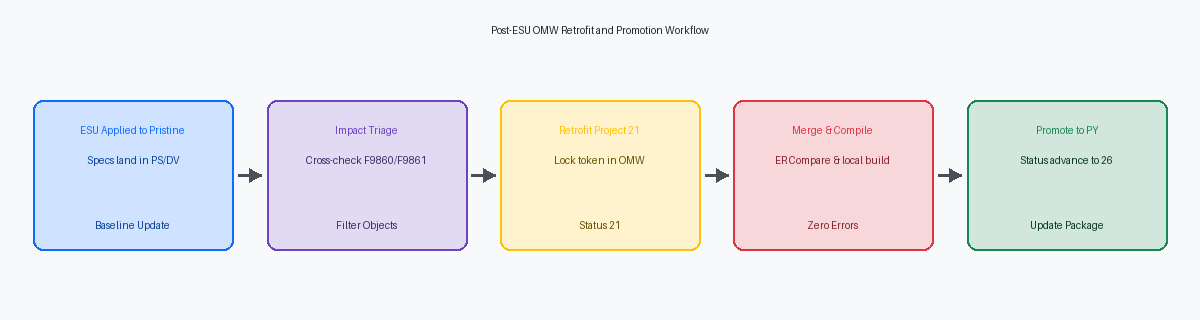
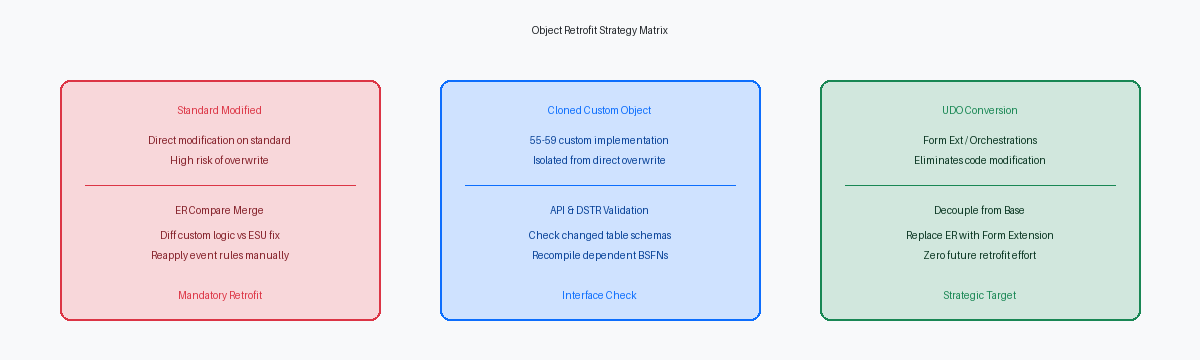
Applying an ESU directly commits Oracle's delta specifications into Pristine and Development, overwriting base specs before developers have moved a single token in OMW. If a CNCConfigurable Network Computing, the architecture and administrative discipline managing JD Edwards environments, packages, and servers. runs Change AssistantAn Oracle Java-based tool used to search, download, dependency-check, and apply JD Edwards software updates. without an isolated pre-merge spec backup, standard objects carrying local site modifications get trampled in place. Cross-referencing the incoming ESU object manifest against repository records in F9860The JD Edwards Object Librarian Master database table containing core definitions for all system objects. and F9861The Object Librarian Path Code table recording object locations, modifications, and checkout states per environment. immediately identifies whether your logic resides directly inside standard objects like P4210 or within cloned 55-to-59 variants that call base modules.
On a distribution patch delivering more than a hundred modified objects, an automated query comparing the patch manifest to local modification flags in F9861 typically reveals only 10 to 20 impacted custom objects. Discarding untouched standard objects prevents spec bloat and stops developers from spending hours reviewing vanilla code. Filtering out clean objects narrows the retrofit scope to the critical 5 to 15 percent where client modifications and Oracle bug fixes collide, ensuring OMW project tokens are held only on genuine collision points.
Pay immediate attention to data structure alterations within the patch payload. When an ESU modifies a core typedef like D4200310, every custom NERNamed Event Rule, a JD Edwards business function created using Event Rules and compiled automatically into C code. and C-based BSFNBusiness Function, an encapsulated routine written in C or Event Rules to execute complex business logic. referencing that data structure is exposed to structural pointer mismatches and runtime memory corruptions. Flagging these structures during manifest analysis dictates an immediate downstream audit of every custom object mapped to the modified structure, letting the team plan business function recompilations before running ER Compare on applications and batch engines.
Configuring the Dedicated OMW Retrofit Project
Leaving developers to work out of their default personal OMW projects during an ESU merge is the fastest way to corrupt custom logic. When multiple engineers touch interdependent objects like P4210 or B4200310 simultaneously across disparate user projects, check-ins occur out of sequence, breaking runtime dependency chains across Central ObjectsThe central database repository storing compiled object specifications, event rules, and metadata for a specific path code. - DV920. Creating a dedicated OMW retrofit project at status 21 locks the object token into a single container. Holding this exclusive token ensures that only designated retrofit developers can modify specifications, while preventing concurrent maintenance fixes from hijacking the object stream.
Establish a dual-project architecture in P98220 before checking out a single object. The active retrofit project contains the target objects undergoing code integration, while a parallel baseline project maintained at status 11 holds untouched, pre-ESU spec snapshots extracted from Pristine or your pre-patch DV pathcode. This structure prevents accidental spec overwrites during local client spec rebuilds and gives engineers an untainted spec source for Visual Diff comparisons without querying database backup tables directly.
Enforce strict governance by assigning explicit user roles within the project rather than relying on wildcard access. Designate one Lead Architect as Author (Role 01), assign specific technical resources as Developers (Role 02), and mandate a QA Reviewer (Role 07) before any project activity begins. This structure creates auditable sign-off gates directly within OMW: the project cannot advance to status 26 for promotion into PY920 until the QA Reviewer inspects the Event Rules and local BSFN compile logs.
Merging Logic via ER Compare and Visual Diff Tools
In P4210, reconciling an Oracle fix on the Post Dialog is Initialized or Row is Exited & Changed event against custom business logic exposes the structural friction between base changes and client code. Event Rules Compare flags these collisions block-by-block across APPLInteractive Application object in JD Edwards, representing user-facing screens and forms. and UBEUniversal Business Engine, JD Edwards batch processing programs used for reports and background data processing. components, highlighting where an Oracle baseline update shifts line sequencing or reallocates internal variables. Blindly accepting the Oracle spec wipes custom validation routines, while refusing it abandons the bug fix.
C business functions break the standard ER Compare workflow because logic resides outside compiled object specifications. You must run external visual diff utilities across the local \source and \include directories against pristine central repository files. Line-by-line inspection is non-negotiable here, particularly when an ESU alters the parameter structures of master business functions like B4200310, where mismatched data structures corrupt memory pointers at runtime.
A retrofit is also an extraction opportunity. Before reapplying screen-level logic into base application specs, evaluate custom controls for conversion into Form ExtensionsA JD Edwards extensibility tool allowing users to add fields, buttons, and orchestrations without modifying base application code.. Decoupling custom fields, button logic, and Orchestrator invocations into the User Defined Object layer removes that code from base objects permanently, shrinking the merge surface for the next continuous delivery cycle.
Data structure reconciliations demand equal scrutiny at the database boundary. An ESU that updates a core table like F4211 can drop custom database indexes during the spec regeneration step if they are not explicitly protected in Object Management Workbench. Restoring those custom indexes immediately prevents crippling index scans and table locks across downstream custom UBEs, while auditing user override tables ensures altered grid column arrays do not invalidate existing end-user views.
Compiling Specifications and Local Client Verification
Never check an object back into OMW based solely on a clean ER compare. When an ESU updates parameter structures, compilation order is non-negotiable: every modified Named Event Rule must be fully generated before running BSFN builds. Generating NERs first refreshes the internal typedefs and header files; skipping this step guarantees your C code compiles against stale structural definitions. The local compilation targeting the Development bin64 runtime directory must return zero errors and zero fatal warnings across both 32-bit and 64-bit runtimes, as subtle pointer truncation issues will otherwise escape into downstream environments.
Validating object execution directly on a fat clientA dedicated Windows workstation equipped with JD Edwards development tools, compilers, and local specification caches. against DV test data confines spec corruption to that local workstation. Running retrofitted sales order processing or custom master business functions locally forces the EnterpriseOne runtime to read directly from local specifications rather than a shared package cache. If an ESU merge introduced an invalid event rule mapping in a custom application, the resulting memory exception remains isolated. Central Objects remains clean, and other developers working in the same pathcode continue their retrofits unaffected while you resolve the local spec mismatch.
Always inspect both jde.logThe primary JD Edwards runtime log capturing engine events, user connections, and general system errors. and jdedebug.logThe detailed JD Edwards trace log recording step-by-step API calls, SQL statements, and Event Rules execution. during this local execution cycle rather than relying on whether a form simply rendered. Tracing transactional execution catches unhandled memory pointers, leaked cache cursors, and API structure mismatches that execute without throwing visible UI errors. Look specifically for JDB API warnings where an Oracle base update introduced an expanded parameter to a table I/O call, or instances where custom C code passes a null pointer into an updated system function. Pinpointing these structural defects locally takes minutes in a text editor, whereas isolating them across multi-threaded enterprise kernels after check-in costs days of lost cycle time.
Managing OMW Promotion and Package Build Triggers
Advancing the retrofit project from status 21 to status 26 triggers the Transfer Activity RuleAn OMW configuration rule that dictates how object specifications and code move between path codes during project status changes. that pushes specifications from Central Objects - DV920 to Central Objects - PY920. In a typical retrofit scenario covering 10 to 20 objects—such as a mix of several modified standard applications, UBEs, and BSFNs—this status change handles the actual spec movement across database schemas without manual export scripts. When transfer activity rules are configured correctly, the target environment receives the exact merged delta verified on the development fat client.
Token release must execute strictly as an automated consequence of this status advance rather than as a manual developer action. Leaving tokens locked to individual developers after advancing to status 26 blinds parallel project teams to the fact that baseline code has shifted. Conversely, releasing tokens prematurely allows unrelated maintenance fixes to slip into DV before the retrofitted spec baseline is safely promoted. The OMW status transition rule must drop the token atomically as the project enters status 26.
Do not rely on the OMW interface alone to confirm transfer success; assemble and deploy an Update PackageA lightweight deployment package containing only selected changed objects deployed to update existing servers or clients. immediately against the promoted objects in PY920. Running an isolated update package build is the fastest, most decisive method to prove that the Central Objects PY repository holds valid C headers, intact event rules, and clean data structures. If a developer merged a BSFN locally but failed to check in an updated header or dependent data structure, the PY server package compile will fail immediately, halting defective specs before user testing begins.
Before kicking off that package build, query the Object Management Log table (F98210The JD Edwards Object Management Log table tracking project history, object transfers, and status transitions.) for project-level transfer records. A silent transfer failure on an APPL spec or a partial UBE version copy will write warning codes to F98210 while still showing status 26 in the OMW GUI. Verifying that all promoted objects report return code 01 in F98210 guarantees that every runtime component landed cleanly in the destination path code.
Building Spec Rollback Contingencies in OMW
A botched retrofit should never force your DBA to mount tape backups or initiate point-in-time recoveries of the Central Objects schema. That recovery path burns 12 to 24 hours of environment downtime and risks wiping out unrelated object updates completed by other teams. Executing a fast-recovery rollback directly within OMW avoids database spec restores entirely when regressions emerge late in user testing.
Before applying the ESU or launching ER Compare, export local .parPortable Archive, a compressed file format used by JD Edwards OMW to export, back up, and transfer object specifications. archives of every custom object flagged during your impact analysis. Storing these zipped spec archives off-line guarantees an uncorrupted spec backup that remains completely insulated from database table drops, package assembly corruption, or unintended token releases.
Configure your OMW Save location mapping to route spec bundles directly to a secure network share rather than relying on a developer's local workstation disk. Triggering the OMW Save action on the checked-out object immediately before checking in retrofitted specs establishes an instantaneous fallback mechanism. If validation fails post-merge, clicking Restore immediately repopulates the pristine baseline specs, allowing you to scrap bad event rule logic within minutes without manual code surgery.
Conclude the retrofit by documenting every spliced event rule and altered parameter inside the object modification log within OMW before advancing the project status. When a business-process regression surfaces during system integration testing and the primary engineer is off-shift, structured delta notes detailing exactly which Oracle lines were accepted allow secondary developers to untangle failed promotions without guessing at the original design intent. Disciplined OMW retrofitting ultimately comes down to repeatable execution: isolating custom event rules within dedicated project containers, verifying delta compiles locally, and treating every modified standard object as technical debt to be systematically audited.
If your organization is planning an upcoming ESU deployment or looking to streamline your EnterpriseOne retrofit cycle, contact our JD Edwards technical practice for a structured architectural review.
