




When an overnight package build fails or QA testers hit memory violation errors after a deployment, teams reflexively blame CNC. They are looking in the wrong place. Across enterprise deployments over the past two decades, the vast majority of promotion failures—in our experience, three-quarters or more—do not originate in Server Manager or the deployment server; they fail at the developer fat client hours before a build is even submitted.
A reliable JDE OMW source and target pathcode promotion strategy requires treating the transition between environments—typically DV920 to PY920—as an engineering gate rather than an administrative handoff. The technical lead's primary job is enforcing spec cleanliness, strict dependency encapsulation, and token discipline before any project status transitions from 21 to 26 or 28. If an object’s data structure changes, parent business functions, and table triggers are not reconciled prior to check-in, you are not promoting functionality; you are simply forcing CNC to diagnose spec corruption that should have been killed on the local workstation.
OMW Activity Rules and Pathcode Mapping Mechanics
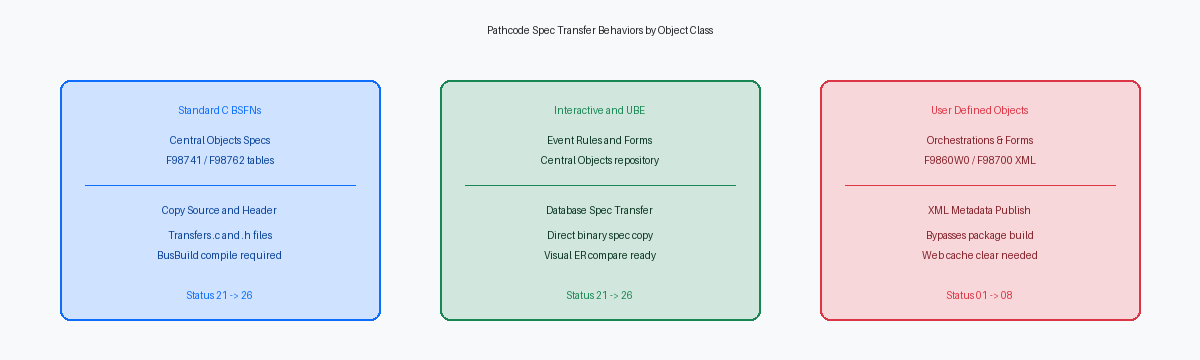
OMW promotion is not a black box; it is a rigid set of table-driven operations executed by the EnterpriseOne runtime and dictated by the F98222 activity rules table. When a project moves from status 21 (Programming) to status 26 (QA Test), the engine queries F98222 to identify the discrete transfer actions assigned to each object type. For interactive applications, this status transition triggers automated, row-level copies across Central Objects tables—pulling records from source specifications like F98741 (Event Rules) and F98762 (Form Design Aid specifications) in DV920 directly into the target PY920 tables, all while maintaining token ownership.
Technical leads must routinely audit P98220 transfer action rules to verify whether custom object types execute an explicit copy, check-in, or save operation during promotion. A classic misconfiguration occurs when custom object types are assigned a check-in or save action instead of a direct source-to-target copy between central object data sources. If an activity rule invokes a check-in routine rather than an explicit copy from the source pathcode, OMW can pull specs from the developer's local runtime database rather than the pristine Central Objects repository, overwriting target specifications with unvalidated local code.
Underpinning these mechanics are the pathcode datasource pointers in table F98611. When an activity rule initiates an object copy from DV920 to PY920, the runtime resolves the physical database schemas through the Object Configuration Manager (OCM) mappings in F98611. If these pointers are out of alignment—a routine issue after environment refreshes or database migrations—OMW will direct transfers to the wrong target schema or drop specifications into an orphan database entirely, leaving QA testing out of sync without throwing a fatal application error.
Pre-Promotion Spec Validation and Local Build Hygiene
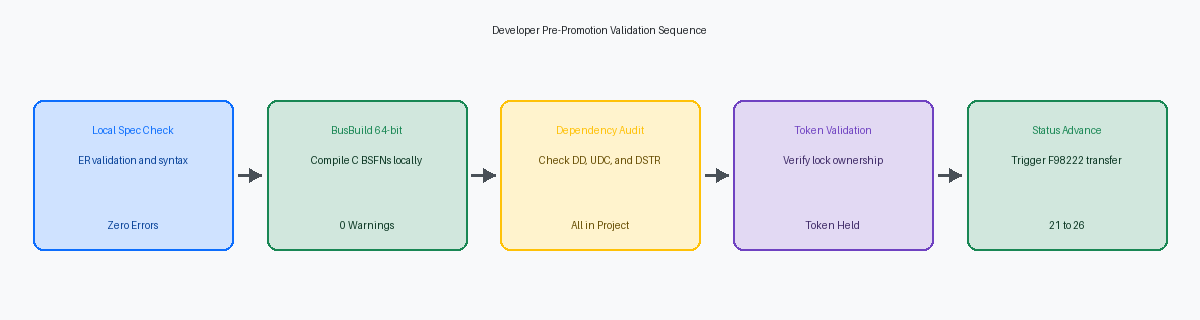
Moving an OMW project to status 26 with compiler warnings in the local build log is the most common root cause of failed enterprise package builds. On 64-bit Tools Releases such as 9.2.7 and 9.2.8, pointer-to-integer size discrepancies that 32-bit compilers tolerated will dump callobject kernels on your enterprise servers. Enforce a strict BusBuild 64-bit zero-warning baseline; if a business function generates even one C4311 or C4244 warning during a standalone build, the OMW token must stay locked.
Data structure (DSTR) alterations demand immediate typedef synchronization across the local development client. Changing a single parameter in a DSTR alters its generated header typedef, which silently desynchronizes every calling C business function until those callers are recompiled against the new header file. Checking in a modified DSTR before validating typedef alignment and rebuilding all dependent C code locally invites mismatched memory offsets and corrupted cache pointers in the target environment.
For interactive applications (APPL) and batch engines (UBE), saving locally in Form Design Aid or Report Design Aid accomplishes nothing for downstream environments. The developer must complete a formal check-in to commit runtime spec records directly into F98741 and related Central Objects tables within the source pathcode. Promoting an object without this committed write transfers whatever stale specs previously resided in the central database, stranding your local modifications on the development workstation.
Run an explicit ER validation pass inside Event Rules Design across all modified events prior to check-in. Unreferenced scope variables, orphaned code lines from deleted form controls, and unmapped business function parameters often slip past the local interpreter but break runtime spec generation during target server builds. A clean ER validation report takes under a minute to run and eliminates the phantom spec corruptions that derail scheduled deployment packages.
Dependency Encapsulation and Token Management
Missing child dependencies—specifically system-level definitions like newly created Data Dictionary items, UDC values, or custom data structures (DSTR)—remain the single largest cause of promotion failures across enterprise environments. A developer promotes an APPL or UBE that compiles cleanly on their development client because the local runtime resolves specifications from local caches, but the target pathcode chokes during package build assembly. True dependency encapsulation requires packaging every dependent artifact inside the same project manifest, rather than assuming peripheral objects have drifted into downstream environments.
Token management across simultaneous status 21 development projects introduces severe spec overwrite risks if left unpoliced. Using P98220 to audit token ownership across all active projects prevents promotion collisions where two engineers hold modifications to identical objects across different development streams. If Project A holds the token and Project B forces an object checkout without one, advancing Project B to testing status can overwrite foundational logic. Every promotion checklist must confirm in P98220 that the promoting project holds valid token ownership before changing OMW project status.
Composite projects containing batch UBEs, processing option data structures, and table definitions (TBLE) must be promoted as a synchronized, atomic unit to eliminate version-to-runtime mismatches. If a table structure alteration is included, database administrators must coordinate the table alter execution or physical generation script before initiating the target pathcode transfer. Promoting new table specs into a target environment without applying the matching DDL change to the database engine triggers immediate table-structure mismatches, locked user sessions, and corrupted pointer errors across the Enterprise Server.
UDO and Orchestrator Artifact Promotion Governance
Treating User Defined Objects like traditional interactive applications is the fastest way to corrupt a web environment. UDOs bypass the central object spec tables entirely, storing their runtime definitions as serialized XML payloads within the F9860W0 and F98700 tables. Consequently, object movement changes fundamentally: instead of relying on standard 21-to-26 project status activity rules to push specs, UDO promotion depends on lifecycle status transitions from Editing (01) through Shared (08) via P98220U.
Tying form extensions to underlying applications introduces rigid structural dependencies that many teams overlook. Promoting UDOs without explicitly validating parent form extension references creates orphan runtime controls on target web clients. When an orchestration is wired to an unpromoted form extension control on an application like P42101, the JAS engine attempts to bind XML events to non-existent form components. This triggers silent JavaScript execution failures on the web client and breaks standard form behavior.
Orchestrator components also introduce infrastructure dependencies that standard repository checks ignore. When an orchestration incorporates custom Groovy scripts or AIS REST service dependencies, moving the artifact to status 08 does not guarantee functionality. Cross-pathcode service provider endpoint validation is non-negotiable; if your target pathcode lacks the corresponding Soft Coding Record (P954000) or has mismatched AIS base URLs, the orchestration fails instantly on execution. Verify endpoint reachability and connector security mappings in the target before releasing the token.
Target Pathcode Spec Verification Techniques
A status advance from 21 to 26 that finishes with a green checkmark does not prove specs delivered cleanly to the target Central Objects data source. The baseline verification step is launching P9864A Visual ER Compare directly against DV920 and PY920 to validate event rules, data structures, and form interconnects side-by-side. If a developer refactored logic on form W554210A, open the form-level event tree and confirm that the target Central Objects tables (specifically F98741) reflect the exact logic delta. Skipping this side-by-side spec validation is the fastest way to promote broken variable scope or orphaned table I/O statements into integration testing.
Spec verification must extend to the system catalog and transfer logs before CNC receives the package build request. Query the F9861 Object Librarian table to confirm that the target pathcode record reflects the correct update status, check-in timestamp, and matching user reservation flags. Immediately follow that query with an inspection of the F98210 OMW transfer log table for that specific project ID. Status transitions can complete at the project level while logging suppressed warnings—such as error codes 11 or 22—when individual processing option specs or sub-objects hit record locks in the target environment.
For Business Functions, database spec replication represents only half of the required payload. Inspect the deployment server filesystem to verify that .c and .h files transferred cleanly into the target pathcode's source and include directories. If a Windows share timeout or file-level lock intercepts B5500001.c, the database logs may report a successful transfer while the filesystem retains the previous iteration. Verifying file date stamps and byte counts between the source and target directories guarantees that the packaging system compiles actual runtime C source code rather than packaging obsolete object binaries into the PY update package.
Rollback Discipline and Handling Promotion Exceptions
A dropped database connection or a locked record during a promotion will strand an OMW project halfway through an object transfer, leaving target relational tables updated while Central Objects specs remain partially written. When this occurs, querying the transfer audit trail in the F98210 log table is the only dependable diagnostic step. Filtering F98210 by project ID and object name isolates the specific error codes—such as table generation collisions or missing data structures—instead of relying on generic OMW interface popups.
The worst operational mistake a developer can make here is manually forcing a status advance to clear the warning banner. Forcing a project from status 21 to 26 after a transfer failure drops incomplete specifications directly into the target environment, creating corrupt specs that break downstream package builds. If three out of ten objects transferred, those three now sit in the target pathcode while seven remain half-committed. Advancing the status does not resolve the transfer; it blinds the team to corrupted code.
Restoring pre-promotion specs demands pulling the baseline from the target pathcode backup save location directly back into the developer check-out spec. Once the pristine spec overwrites the partial transfer remnants in the target Central Objects tables, the developer can check out the object cleanly, resolve the underlying token contention or data structure mismatch, and re-run the transfer rules from a verified starting point.
Taking less than an hour to revert and verify specs against the backup protects your target baseline and spares the enterprise days of chasing phantom memory leaks and runtime crashes during testing. Treating OMW pathcode promotion across DV, PY, and PD as a rigorous engineering gate rather than an administrative transfer is the single operational discipline that separates predictable releases from midnight package build triage.
If you are tightening your release pipeline ahead of a Tools Release upgrade, explore our companion technical analyses on 64-bit package build optimization and custom object retrofitting. You can also review architectural case studies examining production cutovers across dozens of enterprise environments to see how these promotion disciplines function under live project constraints.
