




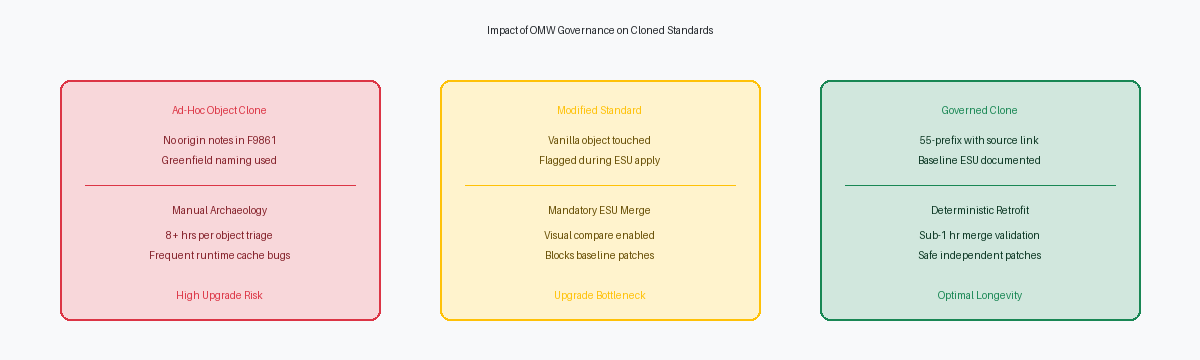
Every seasoned JDE developer has copied P4210 to P554210 or cloned R42565 to R5542565 to bypass standard code constraints, making a formal JDE OMWObject Management Workbench: JD Edwards' integrated change management tool for developing, modifying, and promoting system objects. development workflow for copied standard objects essential for long-term maintainability. Across an enterprise repository holding 5,000 to 15,000 custom objects, unanchored clones account for more than half of retrofit triage delays during an Application Update or Tools Release project. When developers fail to capture the exact parent baseline—including the source release and active ESUsElectronic Software Updates: targeted packages provided by Oracle to deliver software fixes and regulatory updates to JD Edwards. at the moment of duplication—evaluating net changes becomes an expensive forensic exercise.
Treating object governance as administrative red tape is what turns a lean six-to-eight-week retrofit into an open-ended rewrite. With Oracle Premier Support committed to EnterpriseOne 9.2 through at least 2034, your cloned objects will outlive the developers who built them. Enforcing parent object tracking, SARSoftware Action Request: an Oracle tracking record used to document and manage software modifications, bug fixes, or enhancements. associations, and dependency logging inside Object Management Workbench is an engineering contract that guarantees predictable upgrades.
Why Copied Standard Objects Break Retrofit Pipelines
Cloning P4210 into P554210 feels like the safest route to isolate custom code during an upgrade, but it quietly severs the object from its lineage. Once you copy a standard application into the custom 55 namespaceThe reserved numbering range (systems 55–59) in JD Edwards set aside exclusively for custom client-developed objects., EnterpriseOne treats it as completely net-new development. The delta between vanilla vendor logic and your custom enhancements is immediately lost, leaving thousands of lines of duplicate event rules with zero repository record of what was changed, why, or when.
When an Application Update or Tools Release alters base data dictionaryThe central repository defining database field attributes, formats, edit rules, and user display definitions across JD Edwards. items, table structures, or core business functionsEncapsulated, reusable program logic modules written in C or Event Rules to perform complex business calculations., cloned objects silently retain stale business logic without throwing compile errors. A modified cache structure or an updated calculation engine inside B4200310 will still link to P554210, but the cloned form will omit new parameters and trigger sequences. The package builds clean, deployments pass across enterprise servers, and the defect enters the delivery pipeline undetected.
This disconnection blinds standard upgrade analysis tools. The Visual Compare tool in OWM cannot perform an automated three-way merge on a 55-prefixed object against incoming Oracle updates unless the ancestor object and baseline ESU level are explicitly recorded in the object governance metadata. Without that baseline anchor, developers are forced into manual ER comparisons across thousands of event points just to determine whether a revised sales commitment call belongs in your custom logic.
Because the code compiles cleanly, the fallout lands where it costs the most to fix. In practice, most cloned standard object defects—frequently three-quarters or more—surface during user acceptance testing rather than build time because missing table triggers and hardcoded processing options go unnoticed during initial unit checks. The bug surfaces only when real business transactions execute and standard audit, tax, or availability routines fail to fire.
Systematic Object Naming and Version Conventions
When a developer clones R42565 to support split billing and renames it R55INVOICE, they break downstream auditability before writing a single line of Event Rule code. Custom clones must preserve the standard five-to-eight character functional signature by replacing the native application prefix with an approved custom system code between 55 and 59. Naming that cloned print invoice UBEUniversal Batch Engine: JD Edwards' background reporting and batch processing system for executing unattended tasks. R5542565 instantly signals its lineage, parameter expectations, and base business logic to any engineer executing a retrofit against a newly applied ESU.
Derived data structures and business viewsDatabase query definitions linking one or more tables together to expose specific fields to forms and reports. demand the exact same alphanumeric parity. When deriving objects from standard foundations—such as cloning D4200110A to D554200110A or V4211A to V554211A—a strict one-to-one alphanumeric translation is mandatory. Deviating from this structural discipline causes subtle mapping drift across the Event Rule engine, which relies on identical member offsets and predictable metadata signatures during runtime object compilation.
The fatal trap in this specific object workflow occurs inside the processing optionsParameters that allow administrators and users to alter application and report behavior without modifying underlying code.. Cloning R42565 requires creating custom PO template T5542565 and re-pointing the report properties in report design. Hardcoding processing option template names inside copied code without duplicating the corresponding processing option text items triggers silent runtime memory corruption in the enterprise server engine, often manifesting as random batch kernel crashes that leave zero diagnostic context in the standard JDE.log.
Batch engines and cloned interactive applications also demand strict discipline at the version layer. Every custom version built under R5542565 or P554210 should encode the origin base release identifier directly into its version title, formatted as [ORIG:9.2_A9] or [BASE_TOOLS_9.2.7]. When Oracle delivers an updated standard pipeline two years later, your retrofit team can read the version title in OMW and pinpoint the exact baseline that branched the custom logic.
OMW Project Architecture and SAR Tracking Setup
Every copied standard object must live inside a dedicated development project tied directly to an explicit functional change request ID or SAR reference. Treating a cloned variant of P4210 or R42565 like routine custom code will derail your deployment schedule if you co-locate greenfield objects like P550001 in that same container. Greenfield utilities have isolated functional footprints and clear test exits, whereas cloned standard applications carry massive regression matrices involving underlying master business functions and runtime data structures. Bundling them together binds your simple utility changes to complex, multi-week supply chain testing cycles.
Project governance within Object Management Workbench requires strict role separation to safeguard cloned logic. Configure your OMW role definitions so the lead technical architect holds the tokenAn exclusive checkout lock in OMW that allows only one project at a time to modify and check in an object. owner role on the parent project, leaving developers to execute check-out operations against individual cloned components. This prevents developers from releasing tokens prematurely or modifying core dependencies without oversight. It also guarantees that secondary clones—such as custom copies of standard data structures or business view joins—remain locked under one unified release governance umbrella.
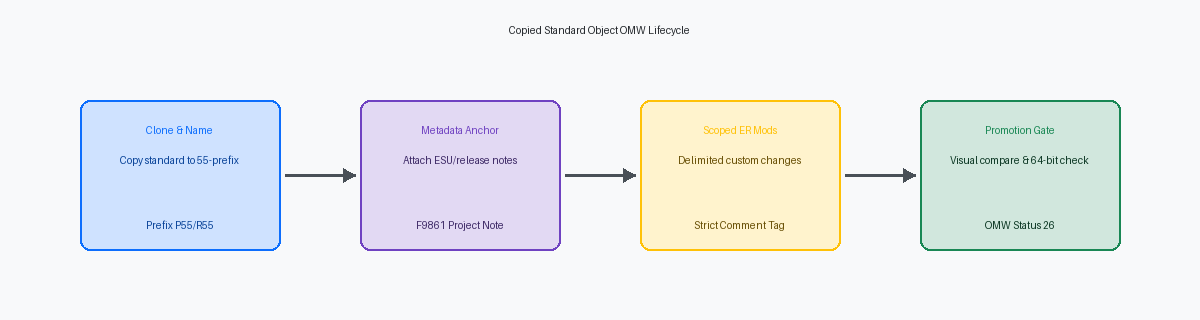
Enforce mandatory OMW logging requirements at status 21 (Programming) before an object can advance toward status 26 (QA Test). Within the F98222 project repository, unverified transfers disrupt package builds and cross-environment parity. Configuring OMW transfer activity rules to demand an attached promotion manifest—verifying the baseline source release, line-by-line delta review, and affected table triggers—prior to the 21-to-26 status change creates an unskippable technical gate. That single rule stops untested clones from slipping into Central ObjectsThe central database repository storing compiled specification records for all JD Edwards objects across an environment. and breaking overnight prototype builds.
Embedding Retrofit Traceability in Project Notes and Headers
Failing to document an object's exact lineage burns development budget faster than almost any other habit in EnterpriseOne. When developers copy a standard application or report without logging its heritage, upgrade consultants spend 4 to 8 hours per object reverse-engineering whether line-by-line differences stem from Oracle maintenance or client logic. That forensic audit wastes hundreds of hours comparing pristine deployment environments against custom pathcodesSpecific sets of object specifications, directories, and code configurations defining a JD Edwards environment like DV920 or PY920. simply to determine what actually needs porting forward.
Eliminate that overhead by making token acquisition contingent on strict metadata entry. The project notes tab in OMW must record the source baseline ESU number, the exact Tools Release build, and the primary business justification before an object token is granted. Enforce this by validating entries in the F9861 OMW object notes table, verifying explicit records such as Baseline ESU JN18452 on Tools Release 9.2.7.3 alongside the governing internal ticket. If that entry is absent, the development lead revokes the token and returns the project to status 21 immediately.
Traceability must also live directly inside the object specs and source files. Event Rule headers and C business function comments must embed a machine-readable provenance tag indicating the original object name, source release, and copy timestamp. Every block of logic introduced into the copied structure must be wrapped in standardized comment delimiters specifying change request numbers, author initials, and date stamps. When your team executes code merges during the next update cycle, your comparison utilities can instantly isolate your functional changes from vanilla Oracle maintenance without manual code archaeological work.
Dependency Mapping for Cloned BSFNs, DSTRs, and UBEs
Cloning a high-volume UBE like R42565 to R5542565 seems straightforward until you trace the runtime execution tree. Developers routinely clone the presentation layer while leaving the underlying business logic tethered to standard C BSFNsBusiness Functions: compiled procedural logic modules executing calculations and business validations in JD Edwards.. Those standard engines execute against standard transaction work tables like F42UI11 and F42UI12, creating severe race conditions when custom batch runs overlap with standard order processing.
The call stack audit must isolate every internal memory structure governed by jdeCacheA proprietary JD Edwards C API enabling fast in-memory, session-specific data storage before writing to persistent database tables. APIs. Consider what happens when standard sales order processing logic in B4200310 is partially cloned into B5500310: if the custom C code continues to initialize cache handles using hardcoded cache names or unsegmented Job Number keys, memory segments will collide across concurrent asynchronous threads. You must parameterize cache identifiers or pass unique user session keys down the parameter hierarchy to prevent corrupted order lines and memory pointer faults.
Inspect your processing option data structures before compiling report interconnects. Copying T42565 to create T5542565 requires a side-by-side verification in Data Structure Design to confirm every member variable maintains identical byte lengths and data dictionary items. Passing mismatched types or altered string lengths across Report Interconnect structures will silently truncate values or corrupt the stack buffer before the first event rule fires.
Rebuild the Cross Reference FacilityA system utility that catalogs interdependencies across objects, data items, and tables to show where code is referenced. records immediately after checking in the copied object package into Central Objects. A targeted XREF refresh exposes invisible dependencies, specifically where standard table triggers on files like F4211 or F0911 fire unexpected logic paths into your newly copied programs. Run this audit before the code moves past local development machines.
Enforcing the Quality Gate Before Status 26 Promotion
Status 26 transitions fail most often when teams treat promotion as an administrative task rather than an architectural barrier. In modern 64-bit EnterpriseOne architectures, zero build errors is an insufficient standard. Developers must inspect raw compile logs from MSVC or Clang to confirm the copied BSFN or NERNamed Event Rule: a business function written in JD Edwards' proprietary scripting language rather than standard C code. built cleanly without deprecated API warnings or structural pointer truncation. A single uninspected memory allocation warning in development can compromise enterprise server kernel stability under high call volume.
The second checkpoint targets the OMW object activity log (F98210). When engineers clone standard objects like R42565 or P4210, dependent data structures, processing option templates, and runtime versions frequently get stranded in private projects. Reviewing F98210 confirms that every child object, custom DSTRData Structure: a defined collection of parameters used to pass arguments between applications, forms, and business functions., and version shares the identical status and project assignment. If a single dependent version remains at status 21 under an unreleased token, promotion to pathcode PY920 must halt immediately.
Mandate a side-by-side Visual Compare report between the newly modified clone and the original object in the pristine environment. Cloned logic regularly suffers collateral damage: developers intending to disable irrelevant baseline functionality accidentally comment out critical cache terminations or commit calls. A focused 15-to-30-minute review against pristine specs catches structural logic deletions before objects hit user testing.
Hold the OMW token until technical sign-off certifies that Event Rule delimiters bracket all changes with tracking IDs, and project notes document why extensibility frameworks could not replace the clone. Only when these criteria are certified in the SAR audit log should the developer release the token and push the project to status 26. Establishing these strict promotion criteria converts future code merges from manual archeology into a predictable, repeatable engineering routine.
For engineering teams auditing custom footprints ahead of a Tools Release or Application Update, review your OMW transfer activity rules and token governance to ensure these checkpoints are automated across all active projects.
