




In over two decades of rescuing broken release cycles, the majority of production package build failures and runtime spec corruptions—in our experience, roughly three-quarters or more—trace directly to developer-level discipline lapses in Object Management WorkbenchThe primary change management and development lifecycle system in JD Edwards EnterpriseOne., not CNCConfigurable Network Computing; the technical architecture, infrastructure, and administration framework of JD Edwards. infrastructure faults. Enforcing strict JDE OMW custom object governance for APPLInteractive Application in JD Edwards, representing front-end screens and user interfaces. BSFNBusiness Function; compiled C or Named Event Rule code executing business logic in JDE. and UBEUniversal Batch Engine; the batch processing and reporting engine in JD Edwards. artifacts is not an academic change-management exercise. It is a mandatory operational gatekeeper across statuses 21, 26, 28, and 38 designed to prevent rogue tokens, missing data structures, and uncommitted check-ins from poisoning central objectsThe central database repository storing master object specifications across all environments..
A blanket promotion rule fails because interactive applications, C business functions, and batch engines operate under fundamentally different execution models. An APPL with mismatched form data structures triggers web runtime exceptions on the HTML server; a BSFN with an uncommitted header file halts the enterprise server compile mid-build; and an out-of-sequence UBE version promotion silently corrupts processing option specs in production. Each object class carries distinct memory behaviors, spec dependencies, and caching mechanics that demand rigorous pre-promotion checklists before any Transfer Activity RuleOMW rules defining actions, permissions, and validations when moving objects between environments. executes against your target pathcodeA specific set of central object specifications and directory paths for an environment..
OMW Project Setup and Strict Token Discipline
Catch-all OMW projects are the fastest way to contaminate an EnterpriseOne release pipeline. Grouping 30 or 40 unrelated objects across manufacturing, finance, and custom EDI into a single release bucket guarantees that a late defect in one APPL halts five completed UBEs from promoting to PY920Prototype test environment pathcode in JD Edwards EnterpriseOne 9.2.. Enforcing a strict 1:1 functional scope mapping—one distinct OMW project per enhancement or bug fix—isolates deployment risk and keeps promotion paths clean and deterministic.
Token management enforces this isolation at the database level via the F9861The Object Librarian Master table tracking object status and check-out tokens. Object Librarian table. When developers encounter Status 21 checkout locks, teams frequently make the mistake of granting administrative token overrides or executing manual SQL updates directly against F9861. Bypassing token locks without logged CNC supervisor approval and an audit trail routinely overwrites active source code, quietly destroying concurrent modifications.
Check-in procedures at Status 21 must guarantee that the local spec repository on the fat clientA dedicated Windows development machine with local JDE compilers and runtime tools. cleanly syncs with Central Objects before initiating any status advancement. A developer checking in code without validating that local specs match Central Objects risks advancing a project with partial spec glides, triggering silent build failures when the package assembler compiles parent objects downstream.
Co-dependent objects must always reside inside the exact same OMW project container. If a custom UBE relies on an altered BSFN data structure (DSTR)A defined set of input and output parameters exchanged between JDE applications and business functions., both the batch application and the business function must travel together. Splitting tightly coupled objects across separate project IDs inevitably causes split promotion states, leading to memory violations, zombie kernelsEnterprise server processes that have crashed or become unresponsive, locking system resources., and mismatched C structures in target execution environments.
Interactive Application Promotion Checklist
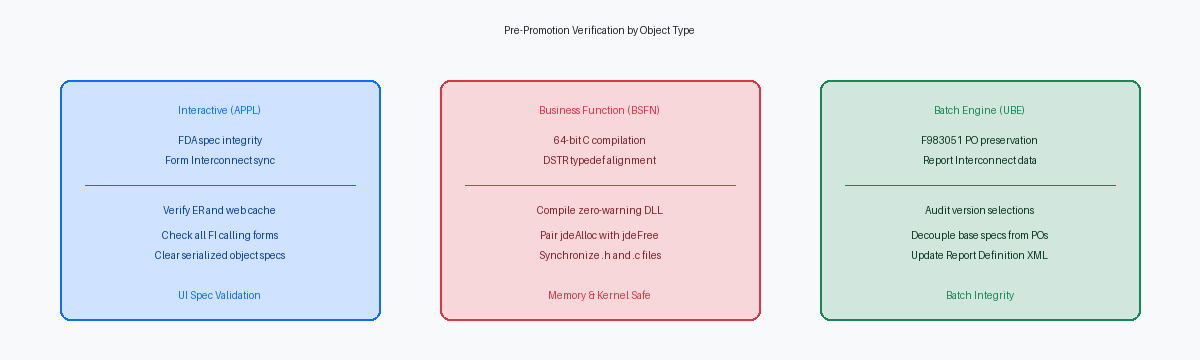
Modifying a Form InterconnectThe interface and data structure used to pass runtime parameters between interactive forms. data structure without tracing every caller across the enterprise is the fastest way to drop a web engine thread. When you alter parameters on a target form, EnterpriseOne updates the spec records in F98710 and event rule definitions in F98741, but it leaves calling objects completely untouched in Central Objects. A caller passing five parameters to a form that now expects six produces memory misalignment at the web layer. Developers must run the Cross Reference FacilityA JDE tool that maps relationships and dependencies across all objects in the system. against the target APPL to identify every parent application, batch engine, and workflow process, reconciling parameter mappings before initiating promotion.
Event Rules must clear validation without a single warning. Untyped ER variables and orphan interconnect parameters often survive isolated fat-client execution because local memory happens to initialize cleanly, but they trigger instant null-pointer exceptions under multi-threaded JASJava Application Server; the web runtime layer serving interactive JDE sessions. runtime loads. Strict namespace governance dictates that every custom APPL, its subforms, and processing options live exclusively within system codes 55 through 59. Within those forms, grid logic must respect standard grid buffer clearing; unmanaged grid loops and sloppy page-at-a-time implementations will exhaust Java Virtual Machine heap space and degrade the entire user cluster.
Promotion verification requires confirming runtime spec delivery directly inside the HTML server cache. Tools Release 9.2 metadata engines obsolete the old requirement of running client-side e-generation for days, but administrators still fall into the habit of bouncing JAS instances to force updates. A properly executed package deployment or spec refresh must dynamically stage the revised F98710 form definitions without service restarts. If you have to restart WebLogic or WebSphere instances to see new form layouts take effect in PY, your promotion automation is broken.
Business Function Spec and Build Verification
A failed callobject kernelAn Enterprise Server process responsible for executing compiled C and NER business functions. at 2:00 AM almost always traces back to a developer who treated compilation warnings as acceptable noise. In a 64-bit Tools Release, a zero-warning compilation log inside busbuild.exe on a clean fat client is a non-negotiable prerequisite before advancing any project to Status 26. Developers who overlook pointer conversion warnings or truncated integer assignments routinely ship edge-case crashes that manifest under high multi-threaded load. Checking the raw build output takes under two minutes and prevents emergency rollbacks.
Modifying a Business Function Data Structure requires an immediate cross-reference audit across every consuming APPL, NERNamed Event Rule; procedural business logic that JDE generates and compiles into C code., and UBE prior to check-in. If you alter a DSTR parameter list without regenerating typedef headers and recompiling dependent objects, the resulting spec mismatch produces an 8-byte pointer misalignment in the callobject kernel memory space. The kernel terminates with a memory violation or silently corrupts adjacent stack variables, killing all active sessions sharing that PID. Run a cross-reference query on the DSTR before approving any interface changes.
Heap discipline in custom C BSFNs remains a blind spot on systems with hundreds of concurrent users. Every allocation via jdeAlloc or jdeCalloc must have a deterministic exit route to jdeFree. When developers branch to an error return without freeing dynamic structures, orphaned heap memory accumulates inside long-running jdenet kernel processes. Over a weekend, even a minor leak of several kilobytes per call on a high-frequency inventory allocation function swells kernel footprint into multi-gigabyte territory, triggering server-wide paging and timeouts.
The final gate before moving C objects down the pipe is validating Object Configuration ManagerJDE mapping system (OCM) defining whether objects execute locally or on an enterprise server. mappings across the environment stack. A custom BSFN mapped locally in DV920 behaves cleanly in developer testing, only to fail instantly in PY920 where the OCM directs execution to an enterprise server missing the compiled library. Audit table F986110 across DV, PY, and PD to confirm client/server execution locations remain identical before building update packages.
Universal Batch Engine and Version Governance
Most batch failures in production do not originate in underlying business functions, but in blurred boundaries between template specifications and the version records stored in table F983051. When a developer alters data selection directly within the base report design instead of isolating the criteria to the version layer, every child version inherits an unlogged, hardcoded selection override that silently corrupts batch output. Your governance framework must require developers to configure runtime processing option configurations strictly within version records, maintaining an unpolluted baseline template in F983051.
Modifying Report Interconnect (RI)Data structure parameters passed into a batch report (UBE) when triggered by another object. data structures introduces an even wider blast radius. If you reorder or add an input variable in a custom UBE's RI structure, OMW will not flag the 10 to 20 orchestrating parent wrapper jobs or BSFN API calls executing that target report. That mismatch manifests as shifted parameter values or silent memory violations at runtime. Before moving any modified RI structure out of development, developers must trace the object's callers and manually re-validate every parent job, table conversion, and wrapper script that triggers it.
Document delivery adds an equally fragile failure point when BI PublisherOracle reporting engine that formats raw XML from UBEs into formatted document outputs. associations fall out of alignment with modified UBE sections. The Report Definition mappings stored in table F95600 depend on precise XML element hierarchies generated during the batch run. Renaming a single report variable or altering section layout rules will quietly break production output formatting. Require developers to re-extract fresh XML data sample templates and remap all F95600 associations before permitting the OMW project to advance beyond Status 26.
Transfer Activity Rules and Environment Gates
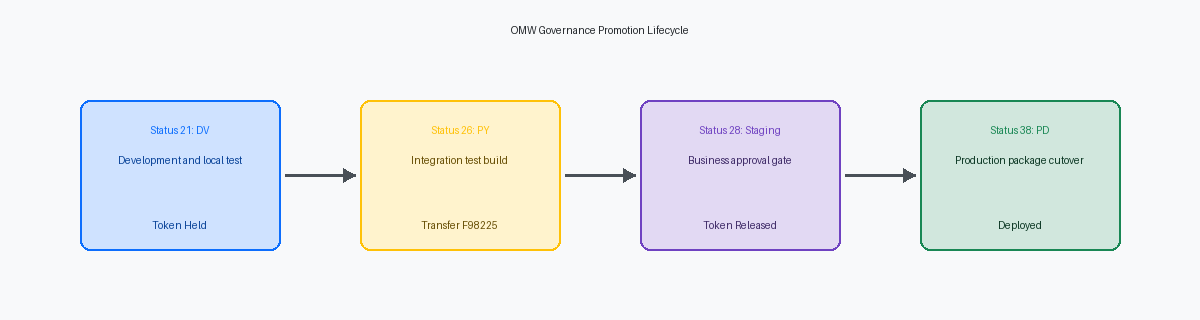
Configuring Object Management Workbench to block unauthorized code movements comes down to tightening your transfer activity rules in table F98225. A defensible lifecycle requires strict directional parity: DV920 (Status 21) transitions to PY920 (Status 26), which then moves to PD920 (Status 38), with zero valid paths that allow skipping test environments or jumping directly from development to production. You must explicitly prune out default and legacy rules that allow direct 21-to-38 transitions, shutting down any side-channel promotions that bypass test compile passes.
Insert Status 28 as an unyielding pre-production staging gate between PY920 and PD920. At Status 28, the project transfers no specs; instead, it holds the token while business process owners and QA leads sign off on testing verification. Custom workflow or automated package assembly routines should query this status to guarantee that no APPL, BSFN, or UBE lands on a production build manifest without documented verification logged in the project detail.
Every transfer rule in F98225 that copies objects between path codes should also trigger a save action. Map your object save locations to write a point-in-time spec snapshot to your central backup data source during every promotion event. If a developer introduces a regression in PY920 or a corrupted spec requires a rapid rollback in PD920, you restore directly from the Save location without re-extracting from tape or scouring database journal logs.
Automate a daily query against F98210 and F98211 to inspect project status history records and object-level transfer logs. A transfer can show an overall green checkmark in the fat client interface while silently dropping an individual event rule or spec record due to an underlying database lock. Filtering F98211 for any non-zero return code across your Central Objects data sources catches truncated merges and failed deployments before users discover runtime memory violations.
Package Assembly and Post-Promotion Validation
Building an update package from an active development project sitting at Status 21 is an operational failure waiting to happen. The package build harness pulls specs straight from the pathcode datasource; if a developer holds an active token or has uncommitted transfers pending, the build captures mismatched or incomplete object records. Before launching Package Assembly (P9603)The JD Edwards application used to define and bundle objects for deployment across servers., every project slated for deployment must advance to Status 26 or 28, releasing tokens and ensuring Central Objects matches the promotion manifest exactly.
Inside P9603, assembly verification demands line-by-line validation of composite definitions. A custom APPL might appear intact on the surface, but if an underlying Named Event Rule did not regenerate its C source and header files prior to inclusion, the enterprise compiler links against stale business logic. Ensure the package definition explicitly bundles all child objects—including data structures, BSFN header files, NER generated C code, and APPL specs—rather than relying on automated rollups that can miss modified header dependencies.
Once the deployment engine drops the package onto the Enterprise Server, resist the brute-force instinct to restart JDE services. EnterpriseOne provides runtime spec cache invalidation through application P980060 or targeted JMX cache purges in Server Manager, clearing cached objects across HTML servers and callobject kernels without severing active user sessions or terminating executing UBEs.
The deployment completes with a mandatory production smoke test executed within fifteen to thirty minutes of release. Functional owners must step through the primary transaction paths of the promoted APPL in PD while CNC monitors the Enterprise Server callobject kernel logs in real time, scanning specifically for memory access violations or kernel zombie states before business transactions fail at scale. Disciplined OMW object lifecycle management is only half the equation when stabilizing a 9.2 custom estate; establishing strict gatekeeping at statuses 21, 26, and 28 ensures that only verified, structurally aligned specs ever reach the production package build manifest.
