




Standard Oracle upgrade analyzers flag direct modifications to standard objects, but they are completely blind to the 55–89 namespaceThe reserved numbering range in JD Edwards designated specifically for custom, client-developed objects.. When developers a decade ago copied P4210 into P554210 or cloned B4200310 into B5500310 to bypass complex retrofits, they planted an uncataloged liability. Technical leads routinely misjudge delivery schedules because they treat every custom-namespace object as greenfield development that requires zero core baseline comparison, only to discover missing base bug fixes and obsolete schema structures midway through testing.
Taking the time to systematically identify copied standard objects in JD Edwards before retrofit planning separates a controlled 8-week code retrofit from an unbudgeted 6-month triage disaster. Exposing this technical debt requires disciplined lineage discovery across Object LibrarianA central JD Edwards catalog that tracks object names, descriptions, locations, and system codes across environments. tables, event rule spec delta comparisons, and C business functionA compiled C-language program in JD Edwards used for high-performance backend calculations and business logic. audits. Once each clone's true baseline is unmasked, you can establish an actionable disposition matrix: re-clone against 9.2 standard objects, replace custom logic with OrchestratorA low-code JD Edwards automation tool that integrates external applications and triggers business processes without custom code. and form extensionsA JD Edwards user-defined feature enabling users to add fields, buttons, and custom logic directly onto existing screens., or decommission the clone entirely.
Why Copied Standard Objects Escape Upgrade Analyzers
Standard Oracle upgrade utilities treat custom namespaces as sovereign territory. When you run the Customization Workbench or evaluate change reports generated by the Spec MergeAn automated upgrade utility in JD Edwards that merges pristine Oracle code with client-modified object specifications. process, the engine inspects pristine objects against your modified standard objects. Any object residing in the 55 through 59 system code range is immediately classified as net-new custom code. Because the upgrade engine assumes these objects share zero lineage with the pristine baseline, it bypasses them entirely, leaving cloned programs unflagged during initial impact analysis.
That blind spot creates massive hidden technical debt. In an enterprise system running for over ten years, between 40% and 60% of all custom interactive and batch objects originated as copies of standard objects like P4210, P4310, or R42565. Teams cloned objects to circumvent retrofits during early release migrations, leaving legacy variants running alongside standard code.
Object cloning completely decouples the client from cumulative ESUsElectronic Software Updates; periodic maintenance packages and bug fixes delivered by Oracle for JD Edwards. and major release enhancements. While pristine P4210 receives critical patches, inventory commit optimizations, and continuous delivery fixes, the cloned P554210 remains frozen on decades-old business logic. Production environments end up executing outdated C data structures and obsolete business functions in parallel with patched standard routines, introducing silent data corruption and unexpected transaction deadlocks.
Retrofitting a clone without knowing its exact lineage forces developers into a dangerous guessing game. A developer cannot distinguish whether a modified Event RuleJD Edwards' proprietary scripting language used to execute procedural business logic on interactive and batch forms. line represents an intentional customization or merely the out-of-the-box logic from an EnterpriseOne 8.12 baseline. Without knowing the original source version, developers either blindly carry forward obsolete base routines into 9.2 or inadvertently overwrite vital business customizations during the merge.
SQL and Metadata Mining to Uncover Cloned Lineage
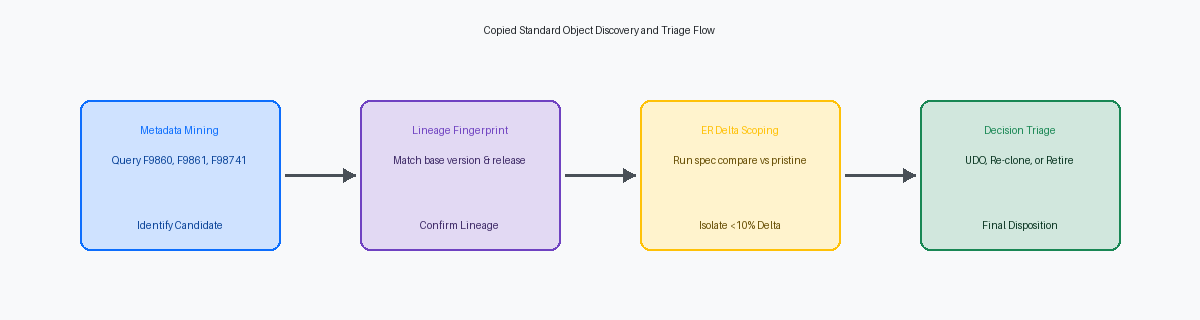
Developers usually take the path of least resistance when cloning an interactive application or UBEUniversal Batch Engine; the background reporting and batch processing engine in JD Edwards.: they graft a 55 through 59 prefix directly onto the base identifier. Running a pattern-matching query against F9860.SIOBNM alongside F9861 quickly exposes custom objects like P554210 or R5542565. These naming patterns account for more than half of all clones in a typical legacy repository and require minimal detective work to map back to their standard origins.
When developers invent fully custom names like P55CUST01, the audit trail in F9860 and Object Management WorkbenchThe primary JD Edwards change management environment used by developers to manage, modify, and promote objects. logging tables still gives them away. Query the description field SIMD in F9860 for standard nomenclature; developers frequently clone an object and leave "Sales Order Entry" or "Print Invoices" in the text unchanged. Joining F9860 against F98210 project activity logs pulls check-in comments, which routinely contain explicit references to source versions or initial copy tasks.
For masked clones where names and descriptions were completely rewritten, search Central ObjectsThe database repository storing compiled specification data, forms, reports, and Event Rules for JD Edwards pathcodes. spec tables. Scanning the Event Rules detail records in F98741 and text specs in F98720 for residual 'Oracle Copyright' strings or legacy source header blocks flags cloned logic that developers forgot to scrub. You can run targeted queries across these tables to detect calls to base internal business functions that are exclusive to core modules like Advanced Pricing or Warehouse Management.
Mining the cross-reference databaseA relational mapping index in JD Edwards tracking dependencies among tables, business functions, and applications. stored in F980021 confirms lineage through structural dependencies. When an undocumented custom object binds to the exact cluster of standard data structures and business functions as a base program, you are looking at a clone. Mapping these execution fingerprints isolates disguised copies before your retrofit team spends hours manually comparing specifications.
Fingerprinting Logic Deltas with Spec Comparison Tools
A clone like P554210 typically presents as several thousand lines of code, but stripping away the base architecture often reveals only 100 to 200 lines of genuine client modifications. JDE ER CompareA graphical developer utility in JD Edwards used to visually diff and merge Event Rules between two object versions. provides the required side-by-side structural diffing, but its utility hinges on knowing the exact release lineage. If you compare the clone against your current target release instead of the precise baseline ESU or release level where the copy was spawned, the tool flags every subsequent Oracle baseline update as a client customization.
Exporting object specifications via XML or Object Distribution tools into flat text files allows external diff engines to bypass the graphical interface and compute true lineage metrics. This text-level spec analysis strips out base runtime framework noise, proving that custom logic rarely exceeds 5% to 10% of the total line count. Pinpointing this delta instantly narrows the technical retrofit boundary from weeks of structural analysis to hours of targeted extraction.
Event logic in cloned forms frequently diverges in hidden runtime sequences like Post Dialog Is Initialized and Write Grid Line-After, masking deep functional forks behind identical form layouts. A cloned Sales Order Entry application may look visually identical to pristine P4210 on the glass, yet contain buried overrides that bypass standard availability checking or mutate order holds during grid population. Spec comparisons must target these specific events rather than relying on form-level visual parity.
Isolating pure business rule overrides from the standard underlying framework prevents teams from attempting to manually migrate hundreds of thousands of unchanged standard code lines. In an upgrade to 9.2, your developers should only evaluate the precise operational logic that justifies the clone's existence. Export the spec definitions for your ten heaviest cloned APPL objects, run an automated structural diff against their origin baseline, and log the true delta before allocating retrofit budgets.
Auditing Cloned Business Functions and C Data Structures
Cloned C business functions represent the most volatile technical debt in an EnterpriseOne footprint. In many systems, a developer needing to bypass a single credit limit validation cloned thousands of lines of standard source from B4200310 directly into B5500001, compiled it into a custom DLLDynamic Link Library; a compiled Windows binary containing shared functions and procedures executable by multiple programs., and walked away. That custom object preserved core logic that Oracle subsequently patched hundreds of times across application updates.
Auditing these targets requires running an automated diff between the custom .c and .h files and the pristine source from the baseline release. Inspect whether the deltas involve pointer logic, custom JDB database calls, or basic MATH_NUMERIC recalculations. In the vast majority of cloned BSFNs, the proprietary business rule spans only a few dozen lines, stranded inside thousands of lines of unmaintained standard runtime code.
The highest operational risk resides in orphaned data structures. When developers cloned D4200310A without maintaining parity across Tools Releases, the custom typedef froze while standard parameters evolved. During 64-bit consolidation, these mismatched structures create severe memory alignmentThe way data is structured in system memory, requiring matching byte boundaries between 32-bit and 64-bit architectures to prevent crashes. faults, manifesting as runtime memory violations and enterprise server kernel coredumps. A memory boundary offset that 32-bit architectures ignored will instantly crash an enterprise server process under 64-bit pointers.
Technical leads should audit cloned functions with a bias toward decommissioning rather than line-by-line retrofitting. You can frequently retire the cloned object entirely by shifting the discrete business logic into pre- or post-NER hooks, or by utilizing standard extensible business function parameters introduced in recent 9.2 releases. If modern standard logic supports the requirement, drop the custom object from OWM and eliminate the liability.
The Retrofit Decision Matrix for Cloned Objects
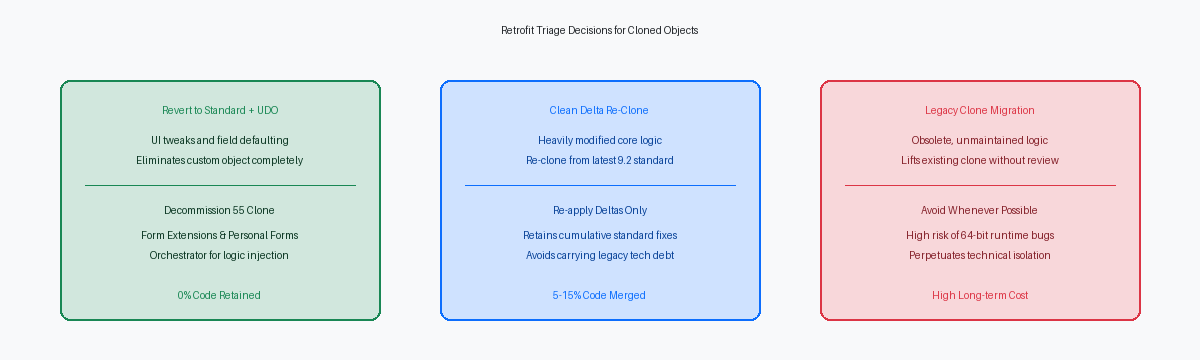
Triage every identified clone into one of three functional dispositions: direct retirement to standard baseline, encapsulation via User Defined Objects (UDOs)Personalized, low-code extensions in JD Edwards that sit on top of core applications without altering base code., or a selective delta retrofit. In legacy environments, a substantial share of cloned interactive applications—often a third to half—exist solely because a developer needed to hide grid columns, enforce field security, or auto-populate a business unit. Take a legacy P554310 built to restrict buyer approvals: teams routinely drag forward thousands of lines of duplicated Event Rules simply to validate a single field against a custom cross-reference table. Replacing that P554310 with a standard P4310, layered with a Form Extension and an Orchestrator assertion on the form-level events, retires the duplicated custom Event Rules entirely while immediately restoring standard Oracle maintenance lineage.
Cosmetic alterations and simple defaulting logic no longer justify an isolated object branch in your custom pathcodeA pointer definition in JD Edwards specifying the database location of specifications and business function code for an environment.. Personal Forms, Form Extensions, and AIS-backed orchestrations absorb UI-level requirements without modifying underlying C structures or spec records. Shifting these behaviors to UDOs slashes long-term validation overhead. Every retired 55-namespace application removes a redundant target that would otherwise demand dual-maintenance, manual regression testing, and dedicated package builds across every subsequent Tools Release and continuous delivery cycle.
When proprietary algorithms or complex table I/O force you to retain bespoke processing, never attempt to upgrade the old clone specs directly into the new environment. Standard base applications evolve significantly between releases; carrying forward an old cloned shell drags obsolete business function calls and outdated data structures into 9.2. The disciplined maneuver is a clean re-clone from the target 9.2 standard object baseline, surgically re-applying only the audited logic deltas into the fresh container. You preserve the proprietary business rule without poisoning the modern runtime with obsolete code foundations.
Governance and Cataloging to Prevent Future Object Cloning
If you leave the Object Copy function unrestricted in Object Management Workbench, developers will rebuild your technical debt within a few development cycles of go-live. CNCConfigurable Network Computing; the underlying architecture and administration discipline managing JD Edwards infrastructure and environments. administrators must establish strict OWM activity rules and role-based permissions in P98220 to block copying standard objects across system codes 01 through 49 without formal architectural sign-off. Revoking clone privileges forces engineers to justify custom architecture before code is cut, closing the path of least resistance.
Process enforcement requires query automation to catch what governance misses. A scheduled SQL script querying F9860 for new 55-namespace records where the creation date falls within the current development sprint intercepts unapproved objects before promotion from status 21 to status 26 for QA testing. Comparing newly registered object signatures against standard application templates exposes copy-paste development long before integration testing begins.
Development standards on 9.2 must formally prioritize extension over duplication. Mandate using extensible events on standard application forms, Orchestrator pre-processing for inbound data sanitization, and AIS-driven integrations rather than maintaining standalone cloned batch routines and interactive engines. These framework features accommodate unique business logic while leaving the base code available for automated continuous delivery updates.
Documenting legacy clone retirements in your metadata inventory and rebuilding cross-reference tables via R980011 provides the final safeguard. Purging decommissioned objects from task views in F9000, batch version scheduler entries in F91300, and third-party calling interfaces ensures production environments never execute obsolete code branches. Cloned objects like modified copies of P4210 or R42565 represent the largest share of unbudgeted upgrade drag because standard specification merges bypass them entirely; completing this metadata audit before freezing retrofit budgets ensures that every retained object has a validated baseline and a defensible operational purpose.
