Select your language


- Details
-
 By Vincenzo Caserta
 - Category: Upgrade Migration
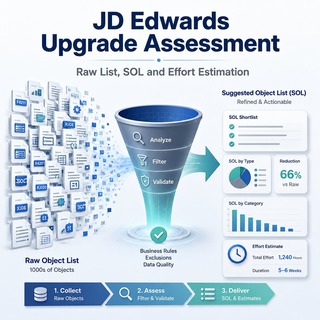
From Raw List to Estimate: How to Make a JD Edwards Upgrade Defensible
A JD Edwards upgrade should not begin with an estimate. It should begin with a much more uncomfortable question: what is the real scope to be estimated? In theory, the answer seems simple. You extract the custom objects, compare them with the standard, look at what has been modified and calculate the work required to move them from the source release to the target release. In practice, this linear sequence rarely exists. Real environments contain years of interventions, copies of standard objects, reports that are no longer run, technical objects, modified versions, objects created for emergencies long forgotten, third-party components, still-critical customizations and customizations nobody uses anymore. For this reason, the estimate cannot be the first step: it must be the consequence of a qualification process.
- Details
- By Vincenzo Caserta
- Category: Upgrade Migration
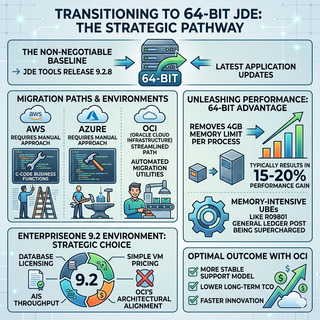
Oracle’s commitment to Premier SupportOracle's comprehensive maintenance program providing security updates, bug fixes, and new features for a specific software version. for JDE 9.2 through 2034 has shifted the cloud conversation from a temporary exit strategy to a long-term infrastructure play. Most IT directors treat JDE as a generic x86 workload, but the cost comparison between JD Edwards on AWS, Azure, and Oracle Cloud is fundamentally dictated by the "Oracle tax" on database licensing. In a typical AWS or Azure deployment, you often find yourself paying for twice the vCPUsVirtual Central Processing Units represent a portion of a physical CPU assigned to a virtual machine in a cloud environment. to match the performance of a single OCIOracle Cloud Infrastructure, the company's enterprise-grade cloud platform designed specifically for high-performance workloads and Oracle databases. OCPUOracle Compute Unit, a measure of CPU capacity in Oracle Cloud equivalent to one physical core with hyper-threading enabled. due to restrictive core-factor policiesLicensing rules that determine how many software licenses are required based on the type and number of processor cores used. that penalize non-Oracle hardware.

- Details
- By Vincenzo Caserta
- Category: Upgrade Migration
A JD Edwards EnterpriseOne upgrade is one of the most strategic IT projects an organization can undertake. Done right, it modernizes core business processes, reduces operating costs, and unlocks years of pent-up technical debt. Done wrong, it can disrupt operations for months and put the entire ERPEnterprise Resource Planning: the core business system that manages finance, operations, distribution, manufacturing and related enterprise processes. investment at risk.
The difference between the two outcomes is rarely about technology. It is about methodology. After many JDEJD Edwards EnterpriseOne: Oracle's ERP platform used for finance, distribution, manufacturing, asset management and enterprise operations. upgrade projects across manufacturing, distribution, and retail, the pattern is always the same: the projects that succeed are the ones where custom codeClient-specific modifications, extensions, reports, business functions, business views and tables added to standard JD Edwards objects. is analyzed properly before development starts.
- Details
- By Vincenzo Caserta
- Category: Upgrade Migration
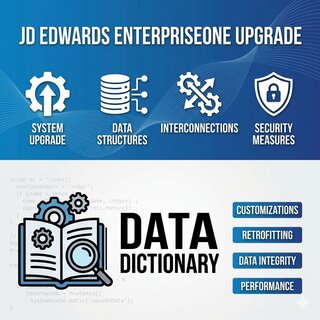
Of all the artefacts that decide whether a JD Edwards upgrade ships on time, the Data DictionaryThe JDE metadata layer that defines every data item — alias, length, decimals, glossary, edit rules. It is the contract every form, BSFN, UBE and integration relies on. is the one most upgrade plans underestimate. The DD is where Oracle's release-to-release changes meet your custom code, and a single decimal-place change on a standard data item, unnoticed during cut-over, has cost more than one finance team a month of reconciliation work after go-live.
This is how I work the Data Dictionary in a real upgrade: how to build the diff between source and target release, how to inventory the custom 55-69 prefix items that will follow you forever, how to spot the silent length and decimal drifts that break retrofittingThe process of re-applying custom modifications on top of a new JDE release, after Oracle has shipped its own changes to the same standard objects., and how to validate the result before the first user logs in.