Select your language



- Details
-
 By Vincenzo Caserta
 - Category: Integrations AIS REST
"How do I call JD Edwards" is the single most asked question I get from teams building anything that touches the ERP from the outside — a Power Automate flow, a Python script for nightly reconciliation, a React front-end for warehouse staff. In 2026 the answer is no longer "write a custom BSFN wrapper": it is AISApplication Interface Services: the REST gateway shipped with JD Edwards EnterpriseOne that exposes form, data and orchestration services over HTTP. and RESTRepresentational State Transfer: the HTTP-based architectural style used by AIS, where every request is stateless and carries its own authentication., and the choice you make between form services, data services, and orchestrations decides whether your integration survives the next Tools Release.
This is the practical guide to JD Edwards AIS REST integration — how the call lifecycle actually works, when to pick each call type, how authentication and session tokens behave in production, and the failure modes that bite integrators six months in.
- Details
- By Vincenzo Caserta
- Category: Integrations AIS REST
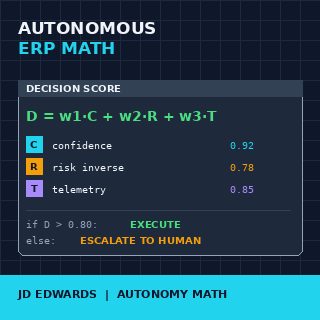
The phrase "autonomous ERP" gets used loosely in the JDE space, and the looseness hides a real engineering question. What does it actually take to let a JD Edwards integration make a decision and act on it without a human approval step? Not in the abstract — in the math. Because the difference between an integration that recommends and an integration that decides is a numerical threshold, a defined feature vector, and a set of bounded-risk operations that can be reversed if the decision was wrong. JD Edwards Integration: the math behind autonomous ERP is a phrase that resolves to a small set of formulas, a clear architecture, and a much larger set of organisational decisions about which actions deserve which level of trust.
Most of what gets shipped as "AI-powered ERP" today sits at the lowest tier of autonomy — a model produces a score, the score is shown to a human, the human clicks Approve. That is useful, but it is not autonomy. Real autonomy means the score crosses a threshold, the action fires, and a control loop catches the wrong answers fast enough to keep the financial damage bounded. The math that holds this together is older than any current product wave, and worth writing down explicitly before the next vendor pitch.