




Oracle’s commitment to Premier SupportOracle's comprehensive maintenance program providing security updates, bug fixes, and new features for a specific software version. for JDE 9.2 through 2034 has shifted the cloud conversation from a temporary exit strategy to a long-term infrastructure play. Most IT directors treat JDE as a generic x86 workload, but the cost comparison between JD Edwards on AWS, Azure, and Oracle Cloud is fundamentally dictated by the "Oracle tax" on database licensing. In a typical AWS or Azure deployment, you often find yourself paying for twice the vCPUsVirtual Central Processing Units represent a portion of a physical CPU assigned to a virtual machine in a cloud environment. to match the performance of a single OCIOracle Cloud Infrastructure, the company's enterprise-grade cloud platform designed specifically for high-performance workloads and Oracle databases. OCPUOracle Compute Unit, a measure of CPU capacity in Oracle Cloud equivalent to one physical core with hyper-threading enabled. due to restrictive core-factor policiesLicensing rules that determine how many software licenses are required based on the type and number of processor cores used. that penalize non-Oracle hardware.
Beyond licensing, the technical debtThe implied cost of future rework caused by choosing an easy or quick solution now instead of a better long-term approach. of a poorly planned migration manifests in the I/O requirements of the Enterprise Server and the latency between the AISApplication Interface Services, a server component that enables mobile apps and external systems to communicate with JD Edwards. and database tiers. We consistently see a cost premium of roughly a third during the first true-up for organizations that lift-and-shiftA migration strategy that involves moving an application and its data to the cloud without redesigning the underlying architecture. to third-party clouds without accounting for data egress feesCosts charged by cloud providers for moving data out of their network to the internet or another region. or the lack of native support for Oracle RACReal Application Clusters, a technology that allows multiple servers to run Oracle Database software simultaneously while accessing a single database.. While Azure and AWS dominate the general market, the specialized demands of the JDE stack—specifically the high-frequency BSFNBusiness Functions, the modular building blocks of JD Edwards that contain the actual programming logic for business processes. calls and heavy UBEUniversal Batch Engine, the JD Edwards component responsible for running reports, background processes, and high-volume data updates. processing—require architectural alignment that generic cloud credits cannot provide.
Oracle Database Licensing and the Core Factor Penalty
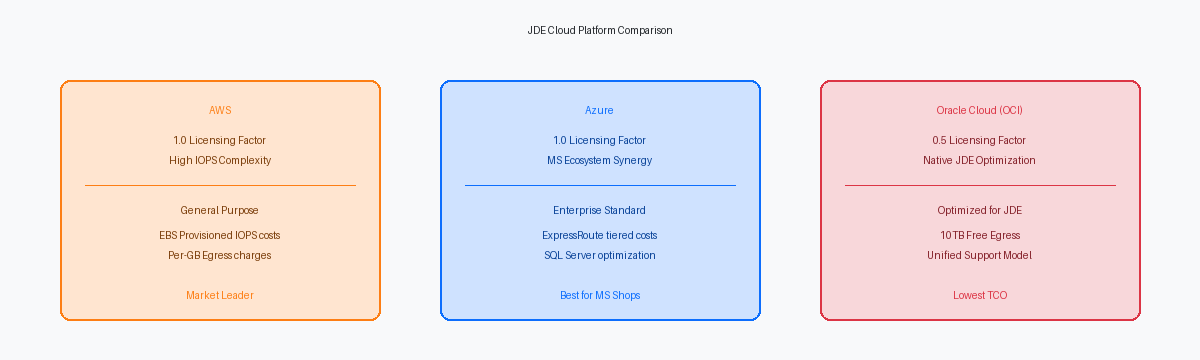
The licensing math for Oracle Database on non-Oracle clouds creates a significant cost penalty, often doubling the licensing expense, that many IT directors overlook during the initial RFP. On AWS EC2Amazon's Elastic Compute Cloud service that provides resizable virtual servers in the cloud. or Azure VMs, Oracle mandates a 1-to-1 ratio for vCPUs to processor licenses. If you provision an instance with 16 vCPUs to handle a high-volume UBE batch window, you must count that as 16 licenses. In OCI, the Oracle Core Factor table applies a 0.5 multiplier to x86 instances. That same 16-vCPU workload—equivalent to 8 OCPUs—requires only 8 licenses. This discrepancy means your annual support and maintenance (S&S) costs for the database tier are doubled the moment you move the workload to a non-Oracle hypervisorSoftware that creates and runs virtual machines by isolating the computer's operating system and resources from the physical hardware..
Many ERP managers attempt to sidestep this by utilizing Standard Edition 2 (SE2), but the technical limitations on AWS and Azure often make this untenable for production. SE2 is hard-capped at 16 concurrent user threads. In a JDE environment with 400+ active users or heavy AIS-based OrchestratorA powerful JD Edwards tool used to automate business processes and integrate the ERP system with external applications. traffic, this thread limit becomes a massive bottleneck, resulting in ORA-00020 errors and application timeouts. To maintain the sub-second response times users expect from a 9.2 environment, you are forced into Enterprise Edition (EE). This shift to EE on a 1.0 core factor environment can increase the total database licensing spend by 3x to 5x compared to a right-sized OCI deployment.
Compliance exposure during a GLAS auditAn official review by Oracle's Global Licensing and Advisory Services to ensure a company is using software according to its contracts. represents the most significant hidden risk for JDE estates on Azure. Oracle does not grant "Authorized Cloud Environment" status to Azure for certain legacy middleware components or specific database options like Active Data Guard. If your JDE architecture relies on these for high availability, Oracle’s auditors will not recognize the virtual CPU limits. They may instead calculate your liability based on the total physical cores of the underlying host cluster. This lack of contractual clarity turns a standard infrastructure migration into a potential multi-million dollar licensing trap that OCI’s native licensing model avoids.
Infrastructure Performance and IOPS for Enterprise Servers
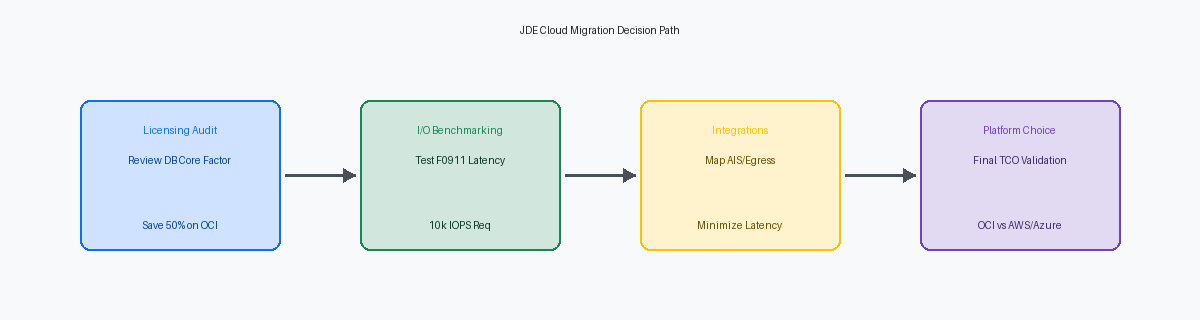
A batch-heavy JDE environment lives or dies by its disk I/O latency, particularly when the UBE engine is hammering the F0911 and F4211 tables during month-end close or high-volume sales order processing. I have seen R42565 jobs that previously ran for several hours cut down to under an hour simply by moving the database to a tier that guarantees a 10,000 IOPSInput/Output Operations Per Second, a standard measurement used to determine the performance and speed of storage devices. baseline. In a traditional on-premises SANStorage Area Network, a specialized, high-speed network that provides block-level network access to storage., this was a matter of physical spindle count; in the cloud, it is a matter of how the provider throttles your throughput and manages latency spikes during peak demand.
On Oracle Cloud Infrastructure (OCI), Block Volume performance is predictable because Oracle does not oversubscribe the underlying hardware. You get consistent performance regardless of time of day. Running JDE on AWS EBS often exposes the "noisy neighbor" syndrome, where latency spikes on a shared storage backplane can cause random UBE failures or sluggish interactive response times in the P4210. While AWS io2 volumes offer high durability, the cost per provisioned IOPS to match OCI’s base performance levels can increase your storage line item by 40% or more.
Azure presents a different challenge for ERP managers accustomed to the performance of high-end hardware. Achieving the 10,000+ IOPS required for large-scale JDE batch environments on Azure requires Premium SSD v2, which adds significant monthly overhead and requires specific VM series compatibility. You cannot rely on standard or even early Premium SSD tiers without hitting a performance ceiling that throttles your SQL Server or Oracle DB instance. If you miscalculate this during the lift-and-shift phase, you will find your production environment stalling during the first high-volume batch run, forcing an emergency storage tier upgrade.
Hidden Connectivity Costs and Data Egress Fees
OCI provides the first 10TB of outbound data transfer for free every month. In a high-volume integration environment where Orchestrator is pushing millions of JSON payloads to external CRMs or logistics providers, this is a massive cost delta. AWS and Azure charge for egress starting from the first byte, typically ranging from $0.05 to $0.09 per GB depending on the region. For an enterprise generating a high-volume environment (e.g., 10-20TB) of outbound traffic monthly, OCI bills for the portion above 10TB while AWS and Azure bill for the full amount, creating a four-figure monthly variance on a single line item.
Architecting a split-cloud environment where the web tier sits in Azure and the database resides on OCI introduces a latency penalty that degrades JDE performance. A standard EnterpriseOne transaction involves dozens or even hundreds of SQL calls between the Enterprise Server and the database. Adding 2ms to 5ms of round-trip overhead per call results in a noticeable "hang" for users in applications like P4210 or P4310. While a 5ms delay sounds negligible to a network engineer, it translates to seconds of lag when a single form interconnect triggers a cascade of BSFN calls and database fetches.
Predictable connectivity pricing is where the 1Gbps FastConnectA dedicated, private network connection between an organization's on-premises data center and Oracle Cloud Infrastructure. model outperforms the tiered complexity of Azure ExpressRoute. Azure’s model often involves metered data plans or expensive "Unlimited" tiers that scale poorly as bandwidth requirements grow. OCI’s flat-rate port pricing for FastConnect allows for a consistent monthly budget regardless of how many UBEs are pushing large PDF outputs to on-premise print servers. CIOs moving 500GB of report data daily back to local sites find that the cumulative cost of ExpressRoute metered tiers can exceed the flat OCI port fee by nearly half within the first year of operation.
Total Cost of Ownership and Long-Term Maintenance
Moving a JDE production workload to the cloud is rarely about the first year's sticker price; the real delta appears in the three-to-five-year TCO. In my experience auditing cross-platform migrations, the total cost of ownership on OCI is typically 25% to 40% lower than AWS or Azure over that five-year horizon. This gap is the result of Oracle's pricing for outbound data transfer and the elimination of the "Oracle tax" on non-Oracle hypervisors. When you factor in the 2034 support roadmap for 9.2, a savings of roughly a third to nearly half translates into significant capital for an enterprise running 15-20 servers.
Maintenance labor represents the largest invisible cost in any cloud deployment. Utilizing OCI's OS Management Service allows CNCConfigurable Network Computing, the technical architecture and the specialized administrators who manage the JD Edwards environment. teams to reduce manual labor hours for Linux kernel updates and security patching by more than half. Instead of logging into each Logic and Batch server to manage dependencies, the platform handles the fleet-wide orchestration of patches. This automation prevents scenarios where a 9.2.8 Tools ReleaseThe foundational software layer of JD Edwards that provides the technical environment, user interface, and system functionality. upgrade is delayed because the underlying OS is multiple versions behind on security errata.
Budgetary quotes from AWS often miss the granular reality of JDE's architectural requirements. Hidden costs frequently surface in the form of NAT Gateway fees for outbound traffic and the necessity of Provisioned IOPS (io2 volumes) to maintain acceptable UBE performance. A typical JDE environment with a 2TB database and high-concurrency batch processing can easily double its storage costs once you realize that "General Purpose" SSDs (gp3) cannot handle the sustained random I/O required for large-scale GL post or MRP runs.
Long-term maintenance also hinges on the lifecycle of the database tier. On Azure or AWS, you are often managing complex licensing workarounds or paying a premium for RDSRelational Database Service, a managed database service provided by Amazon Web Services. options that may not fully support JDE-specific requirements like certain XAPI triggers. OCI's native integration with the Database Cloud Service (DBCS) provides a streamlined patching path that ensures the database and application layers stay synchronized without the multi-vendor friction that typically plagues performance troubleshooting sessions.
Support Certification and the Multi-Vendor Gap
Oracle’s support policy for non-Oracle clouds is a calculated risk for any CIO. While JDE is technically supported on AWS and Azure, the Minimum Technical RequirementsThe specific list of supported hardware, operating systems, and software versions required for JD Edwards to run correctly. (MTR) matrix comes with a significant caveat. If your team logs a Sev-1 SR for a memory leak or a kernel crash that Oracle suspects is rooted in the hypervisor or the underlying storage layer, they reserve the right to ask you to reproduce that exact issue on certified Oracle infrastructure or on-premises hardware before they commit engineering resources to a fix. This requirement can add 48 to 72 hours of downtime to a critical issue while your CNC team scrambles to provision a local sandbox for reproduction.
This multi-vendor gap creates a dangerous friction point during critical outages. In a scenario where an Enterprise Server becomes unresponsive during a heavy UBE load, an AWS or Azure customer often finds themselves mediating a dispute between two support desks. Oracle Support points to the cloud provider’s I/O throttling, while the cloud provider points to the BSFN execution patterns. Moving to OCI shifts this dynamic to a single-accountability model. When the ERP vendor and the cloud provider are the same entity, the unified support advantage reduces the mean time to resolution by eliminating the days of log file exchanges between disparate support organizations.
Maintaining MTR compliance on OCI is a streamlined process compared to the manual overhead of tracking third-party cloud updates. Oracle aligns its JDE Tools Release cycles, such as the transition from 9.2.7 to 9.2.8, with the specific compute shapes and database versions available on OCI. On Azure or AWS, a sudden deprecation of an OS version or a change in the underlying RDS engine can technically push your environment out of compliance. On OCI, these infrastructure roadmaps are synchronized, ensuring that a patch applied to the AIS server or a new Orchestrator feature doesn't collide with an uncertified platform update.
Orchestrator and Automation in the Cloud Environment
Latency is the silent killer of complex Orchestrator deployments. When an AIS server triggers a series of Data Requests or Form Services, the round-trip time between the web tier and the database tier dictates the user experience. Placing these components on the same high-speed backplane—standard in OCI’s RDMA-connected clusters—reduces latency to sub-millisecond levels. Multi-cloud or hybrid architectures often introduce 5–10ms of lag per call. For a multi-step orchestration processing 50 records, that latency adds 250–500ms of overhead, which is the difference between a seamless mobile scanning operation and a system that feels sluggish to the warehouse floor.
Deploying JD Edwards on Autonomous DatabaseA cloud-based database that uses machine learning to automate patching, tuning, and security updates without human intervention. shifts the operational burden away from manual maintenance. Traditional environments require a DBA to spend 20–30 hours monthly on index tuning, statistics collection, and patching. The Autonomous engine automates these tasks, ensuring the database is always optimized for the specific IOPS patterns of JDE’s heavy UBE and interactive workloads. This automation eliminates the requirement for a full-time JDE-specific DBA, allowing your technical team to pivot toward developing Logic Extensions that provide actual business logic rather than just managing tablespace growth.
The move to 64-bitA computer architecture capable of processing larger amounts of data and addressing significantly more memory than older 32-bit systems. JDE is the non-negotiable baseline for any enterprise targeting Tools Release 9.2.8 or the latest Application Updates. While AWS and Azure environments require a manual approach to re-platforming the C-code business functions, OCI offers the most streamlined path via automated migration utilities. Transitioning to a 64-bit architecture removes the 4GB memory limitation per process, which typically results in a 15–20% performance gain for memory-intensive UBEs like the R09801 General Ledger Post. Ultimately, the choice between AWS, Azure, or OCI for an EnterpriseOne 9.2 environment hinges on database licensing and AIS throughput rather than simple VM pricing; for most organizations, OCI’s architectural alignment results in a more stable support model and a lower long-term TCO.
