




In my over two decades of JDE developmentDevelopment within JD Edwards EnterpriseOne, an ERP software suite by Oracle, involving custom code, reports, and integrations., I have seen hundreds of custom tables corrupted because developers treated the Data DictionaryA central repository in JD Edwards that defines the properties, rules, and attributes for all data items and tables. as a UI-only featureA functionality designed exclusively for the user interface, not for underlying data integrity or business logic.. When you move logic into a BSFNBusiness Function. A reusable piece of code in JD Edwards, often written in C or NER, encapsulating business logic., the safety net of the Application (APPL)A JD Edwards interactive program (e.g., P4210) used for data entry and processing, typically with a user interface. disappears. If your logic does not explicitly invoke JD Edwards BSFN custom table validation with data dictionary items, you are one UBEUniversal Batch Engine. A JD Edwards batch process or report, typically used for high-volume data processing or reporting without a user interface. or AIS callA request made to the Application Interface Services (AIS) server, which provides REST APIs for JD Edwards EnterpriseOne. away from a database full of invalid UDCsUser Defined Codes. Configurable lists of values in JD Edwards used to standardize data entry and validation. and orphaned recordsDatabase records that reference non-existent parent records, leading to data integrity issues.. Relying on "Check" properties in the form designerThe tool within JD Edwards used to create and modify the user interface of interactive applications. is a rookie mistake that leaves the entirety of your non-UI data entry points exposed to bad data.
Building a validation boundary at the data level requires bypassing the convenience of the form engine and engaging directly with the JDE runtimeThe execution environment where JD Edwards applications and business functions operate.. In a typical EnterpriseOne 9.2 environmentA specific version of Oracle's JD Edwards EnterpriseOne ERP software., a single orchestrationA feature in JD Edwards Orchestrator that automates complex business processes by combining multiple steps, including calls to BSFNs and APIs. can bypass every UI-level constraint, leading to data integrity issues that often require a full work week of manual SQL cleanup to resolve. Shifting these rules into C APIsApplication Programming Interfaces written in the C language, used to interact with JD Edwards system functions. ensures that whether data originates from a mobile app or a legacy flat-file import, the table remains protected by the same hard constraints defined in the DDAbbreviation for Data Dictionary, a central repository in JD Edwards that defines data item properties and rules..
Defining the validation boundary for custom tables
In legacy 9.1 environmentsOlder versions of JD Edwards EnterpriseOne, specifically version 9.1, which may have different architectural patterns., I often find critical validation logic trapped inside the Control Exited/Changed-Inline events of a P55 applicationA custom JD Edwards interactive application, where 'P55' typically denotes a custom object prefix.. This architectural debtSuboptimal design choices or shortcuts in software architecture that lead to increased future development or maintenance costs. becomes a liability when you need to load data via a R55 batch processA custom JD Edwards batch report or process, where 'R55' typically denotes a custom object prefix. or an external AIS callA request to the JD Edwards Application Interface Services (AIS) server originating from outside the JD Edwards system.. Relying on the application layer to enforce integrity assumes every entry point is a human at a screen. A direct Table I/O callA direct operation (Insert, Update, Delete, Select) performed on a database table, bypassing application logic. in a UBEUniversal Batch Engine. A JD Edwards batch process or report, typically used for high-volume data processing or reporting without a user interface. bypasses every line of ER codeEvent Rule code. The proprietary scripting language used in JD Edwards to define logic within applications and reports. in your APPLA JD Edwards interactive program (e.g., P4210) used for data entry and processing, typically with a user interface., leaving your custom table vulnerable to orphans or invalid status codes.
Shifting the validation boundary to a Master Business Function (MBF)A type of JD Edwards Business Function designed to encapsulate all business logic for a specific entity, ensuring data integrity. ensures the data layer is never "thin." When you encapsulate validation within a C-based BSFNA Business Function in JD Edwards written in the C programming language for performance and complex logic. or a structured NERA Named Event Rule (NER) Business Function in JD Edwards that follows a structured programming approach, often generated from ER code., you create a unified gatekeeper that honors both Data DictionaryA central repository in JD Edwards that defines the properties, rules, and attributes for all data items and tables. rules and complex relational logic before a commitThe final step in a database transaction that makes all changes permanent. occurs.

Applying Data Dictionary for hard constraints
A custom table schema is only as reliable as the Data Dictionary (DD) itemsIndividual data elements defined in the JD Edwards Data Dictionary, specifying their type, length, and validation rules. underpinning its columns. Relying on BSFNBusiness Function. A reusable piece of code in JD Edwards, often written in C or NER, encapsulating business logic. logic to catch a malformed string or an out-of-range integer is an architectural failure when the DDAbbreviation for Data Dictionary, a central repository in JD Edwards that defines data item properties and rules. provides native Range, List, and UDCUser Defined Codes. Configurable lists of values in JD Edwards used to standardize data entry and validation. validation. For instance, defining a "Status" field with a hard-coded check in C code requires a full package buildThe process of compiling and deploying JD Edwards code and objects to a server or client, making changes available. for a single value change. A UDC-backed DD itemA Data Dictionary item whose valid values are derived from a User Defined Code (UDC) table, allowing dynamic updates. allows a business analyst to update the F0005 tableThe JD Edwards database table that stores User Defined Codes (UDCs). via P0004AThe JD Edwards interactive application used to manage and maintain User Defined Codes (UDCs). in seconds without touching a single line of code.
When writing a C BSFNBusiness Function. A reusable piece of code in JD Edwards, often written in C or NER, encapsulating business logic. to validate a custom table record, the first step should be invoking the standard validation stack via the C APIApplication Programming Interface written in the C language, used to interact with JD Edwards system functions. jdeCallObjectA JD Edwards C API function used to dynamically call another Business Function.. Specifically, calling B0000016 (VerifyUDC)A standard JD Edwards Business Function (BSFN) used to validate if a given value exists in a User Defined Code (UDC) table. ensures that your custom logic respects the same F0005 integrity checksValidation rules that ensure data entered into fields linked to UDCs conforms to the values defined in the F0005 table. used by standard P4210The JD Edwards interactive application for Sales Order Entry. or P4310 applicationsThe JD Edwards interactive application for Purchase Order Entry.. This approach maintains a single source of truthA concept in data management where all data elements are stored in one primary location to ensure consistency and accuracy. for valid codes, preventing the "ghost dataData that appears to exist or is partially processed but is inconsistent, invalid, or not fully committed, leading to errors." issues that occur when custom BSFNsBusiness Functions. Reusable pieces of code in JD Edwards, often written in C or NER, encapsulating business logic. and standard applications disagree on what constitutes a valid value.
Custom DDAbbreviation for Data Dictionary, a central repository in JD Edwards that defines data item properties and rules. items should be configured with specific Edit Rules in P92001Validation rules configured within the JD Edwards Data Dictionary application (P92001) to enforce data integrity for specific data items. to automate basic data integrity before the BSFNBusiness Function. A reusable piece of code in JD Edwards, often written in C or NER, encapsulating business logic. even begins its execution. If a field requires a specific numeric range or a value from a predefined list, setting these constraints at the DDAbbreviation for Data Dictionary, a central repository in JD Edwards that defines data item properties and rules. level offloads the validation burden from the application layer to the JDE engineThe core software components and processes that run JD Edwards EnterpriseOne applications and services.. In a high-volume environment processing tens of thousands of records per hour via a custom UBEA Universal Batch Engine (UBE) report or process developed specifically for a client's unique business requirements., this offloading reduces the overhead of the call stackA data structure that stores information about the active subroutines of a computer program, including the sequence of function calls. by failing invalid records at the earliest possible entry point.
Hard-coding validation values within a BSFNBusiness Function. A reusable piece of code in JD Edwards, often written in C or NER, encapsulating business logic. is a maintenance trap that I have seen derail numerous 9.2 upgrade projectsProjects to upgrade JD Edwards EnterpriseOne software from an older version to version 9.2.. Every time a business rule changes, you are looking at a code revision, an OWM promotionObject Workbench Management (OWM) promotion. The process of moving JD Edwards development objects through different environments (e.g., DV, PY, PD)., and a package deploymentThe process of distributing and installing compiled JD Edwards code and objects to enterprise servers and client machines. across the path codeA logical grouping of JD Edwards objects (e.g., DV920, PY920) representing different development or testing environments.. Utilizing DDAbbreviation for Data Dictionary, a central repository in JD Edwards that defines data item properties and rules.-driven constraints moves that logic into the metadata layerThe part of the system that stores information about data, such as definitions, rules, and relationships, rather than the data itself. where it belongs. Managing these constraints through P92001The JD Edwards interactive application used to manage and define Data Dictionary items. ensures that your validation logic remains visible to the entire IT team rather than being buried in a source file that only a developer can decipher.
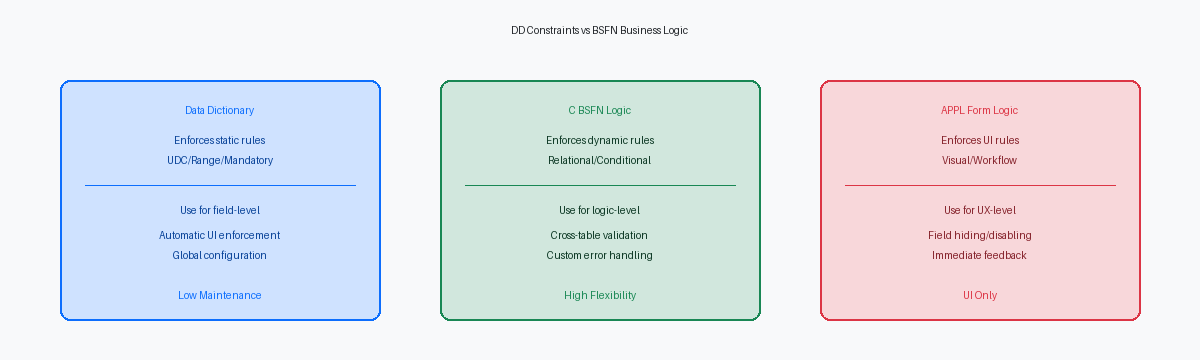
Implementing BSFN logic for cross-field validation
Data DictionaryA central repository in JD Edwards that defines the properties, rules, and attributes for all data items and tables. edits like range checking or list of values fail the moment your logic requires a relational comparisonA comparison between two or more data elements based on their relationship to each other, often involving multiple fields or tables. between two distinct fields. For instance, ensuring a "Ship Date" (SDTJ) is not prior to an "Order Date" (TRDJ) in a custom table requires a C BSFNA Business Function in JD Edwards written in the C programming language for performance and complex logic. because the DDAbbreviation for Data Dictionary, a central repository in JD Edwards that defines data item properties and rules. cannot reference another field's value in real-time. In a high-volume manufacturing environment processing thousands of custom records daily, offloading this logic to a BSFNBusiness Function. A reusable piece of code in JD Edwards, often written in C or NER, encapsulating business logic. ensures that complex business rules are enforced consistently across both interactive applications and batch uploads.
Inside the C source, the lpBhvrCom->hToolkitA pointer within the Business Function's communication structure (lpBhvrCom) that provides access to JD Edwards runtime services and APIs. pointer is your primary interface for interacting with the JDE engine'sThe core software components and processes that run JD Edwards EnterpriseOne applications and services. internal state. You must pass this handle into the jdeErrorSet APIA JD Edwards C API function used to set an error message in the system's error stack, often displayed to the user. to ensure that errors are correctly mapped to the specific data structure memberAn individual field or element within a larger, organized collection of data. and surfaced to the user interface. Without properly initializing and utilizing the toolkit handle, your validation errors might log to the jdedebug.logA log file generated by JD Edwards that records detailed information about system processes, errors, and debugging messages. but will fail to stop the transaction or highlight the offending field in red on a Power FormA type of JD Edwards interactive application form that offers advanced layout and functionality, often used for complex data entry. or standard gridA common user interface component in JD Edwards applications used to display and interact with tabular data..
A professional validation stack executes in a specific hierarchy: first, let the DDAbbreviation for Data Dictionary, a central repository in JD Edwards that defines data item properties and rules. handle nulls and basic formatting; second, use the BSFNBusiness Function. A reusable piece of code in JD Edwards, often written in C or NER, encapsulating business logic. to perform relational checks against master tablesCore JD Edwards database tables that store fundamental business data, such as F0010 (Company Constants) or F0101 (Address Book). like the Company Constants (F0010)The JD Edwards database table that stores global settings and parameters for each company. or Address Book (F0101)The JD Edwards database table that stores information about all entities (customers, vendors, employees) in the system.. If you are validating a custom field against a specific Business Unit (MCU)A JD Edwards organizational entity, often representing a department or location, used for accounting and reporting., the BSFNBusiness Function. A reusable piece of code in JD Edwards, often written in C or NER, encapsulating business logic. should first verify the MCUA JD Edwards organizational entity, often representing a department or location, used for accounting and reporting. exists in F0006The JD Edwards database table that stores information about Business Units. before proceeding to cross-field logic. This prevents the code from executing expensive Select statementsSQL commands used to retrieve data from one or more database tables. on malformed data that should have been caught by the DD'sAbbreviation for Data Dictionary, a central repository in JD Edwards that defines data item properties and rules. basic edit rules.
The final step in the BSFNBusiness Function. A reusable piece of code in JD Edwards, often written in C or NER, encapsulating business logic. is the explicit return of the JDEBFRTN valueThe return value of a JD Edwards Business Function, indicating success (ER_SUCCESS) or failure (ER_ERROR)., typically ER_SUCCESSA standard return code in JD Edwards Business Functions indicating that the function executed successfully. or ER_ERRORA standard return code in JD Edwards Business Functions indicating that the function encountered an error.. If your cross-field logic detects an invalid date range or a missing record in F0101The JD Edwards database table that stores information about all entities (customers, vendors, employees) in the system., returning ER_ERRORA standard return code in JD Edwards Business Functions indicating that the function encountered an error. is the only mechanism that tells the JDE runtime engineThe core software components that execute JD Edwards applications and processes. to halt the commitThe final step in a database transaction that makes all changes permanent. process. In a standard entry scenario, failing to return the correct code means the system might proceed with a table I/O Insert or UpdateDirect database operations to add new records (Insert) or modify existing ones (Update) in a table. even if jdeErrorSetA JD Edwards C API function used to set an error message in the system's error stack, often displayed to the user. was called, leading to data integrity issues that are notoriously difficult to reconcile in production SQL tablesDatabase tables in a live, operational environment that store critical business data..
Error handling and message mapping
A common failure in custom C BSFNsBusiness Functions in JD Edwards written in the C programming language for performance and complex logic. is hard-coding error strings or failing to map return codes to the JDE error stackA data structure used by JD Edwards to manage and store error messages generated during program execution.. When a validation fails against a custom table, returning a simple '1' to the calling APPLA JD Edwards interactive program (e.g., P4210) used for data entry and processing, typically with a user interface. or UBEUniversal Batch Engine. A JD Edwards batch process or report, typically used for high-volume data processing or reporting without a user interface. is insufficient for troubleshooting. You must map every failure to a specific Data Dictionary Error IDA unique identifier defined in the JD Edwards Data Dictionary for a specific error message, allowing for localization and consistent messaging., such as 0001 for an 'Invalid Address Book Number' or 0002 for 'Record Invalid'. By using the jdeErrorSet APIA JD Edwards C API function used to set an error message in the system's error stack, often displayed to the user., you inject runtime variables into the glossary text. Passing the specific mnAddressNumberA common JD Edwards data item representing an Address Book Number. into the error structure allows the user to see exactly which record triggered the failure, rather than guessing from a generic message. This ensures that the lpBhvrCom pointerA pointer to the Business Function's communication structure, containing runtime information and parameters. carries the correct state back to the interactive form or batch engine.
In high-volume, multi-threaded UBE environmentsJD Edwards Universal Batch Engine (UBE) setups configured to run multiple processes concurrently, improving performance., improper error stackA data structure used by JD Edwards to manage and store error messages generated during program execution. management leads to phantom errors or memory leaks within the JDE engineThe core software components and processes that run JD Edwards EnterpriseOne applications and services.. If your BSFNBusiness Function. A reusable piece of code in JD Edwards, often written in C or NER, encapsulating business logic. is called within a loop processing thousands of records, failing to clear the error stack or incorrectly assigning the idControlAn identifier for a specific control (e.g., a field) on a JD Edwards form, used for error mapping. can cause a message from record 5 to appear on record 500. I have seen production kernelsThe core JD Edwards server processes running in a live, operational environment. crash because a developer allocated memory for a custom error string but failed to free it after the jdeErrorSetA JD Edwards C API function used to set an error message in the system's error stack, often displayed to the user. call. Stick to standard DDAbbreviation for Data Dictionary, a central repository in JD Edwards that defines data item properties and rules. items and let the middleware handle the memory lifecycle of the error stack. This is particularly critical when running on 64-bit Tools ReleasesSpecific versions of the JD Edwards EnterpriseOne Tools software that support 64-bit architecture, offering improved memory handling. where memory address space is larger but still finite.
Relying on the Data Dictionary's Glossary TextThe descriptive text associated with Data Dictionary items, often used for error messages and available in multiple languages. provides a localized experienceSoftware adapted to a specific language, culture, and region, providing a user interface and content in the user's native language. without requiring code changes for international deployments. When you define an error in the DDAbbreviation for Data Dictionary, a central repository in JD Edwards that defines data item properties and rules., the JDE runtimeThe execution environment where JD Edwards applications and business functions operate. automatically fetches the translated version based on the user's profile language. For complex validations where a short message is insufficient, you can link the Error ID to F00165 Media ObjectsThe JD Edwards database table that stores Media Objects, which can include text, images, or documents linked to records. to provide detailed resolution steps. This turns a cryptic system message into a functional SOPStandard Operating Procedure. A set of step-by-step instructions compiled by a company to help workers carry out routine operations. for the end user. It is the difference between a high-priority help desk ticket and a self-corrected data entry error that never leaves the department.
The performance cost of redundant validation
A common mistake in high-volume batch processing is treating the Data DictionaryA central repository in JD Edwards that defines the properties, rules, and attributes for all data items and tables. as a free resource. If a UBEUniversal Batch Engine. A JD Edwards batch process or report, typically used for high-volume data processing or reporting without a user interface. processes six-figure record sets and the C BSFNA Business Function in JD Edwards written in the C programming language for performance and complex logic. calls JDECM_GetDictColInfoA JD Edwards C API function used to retrieve metadata (column information) for a specific Data Dictionary item. for every row to check decimal triggers, you introduce a massive I/O bottleneckA performance limitation caused by slow input/output operations, such as reading from or writing to a database.. In one distribution environment, we reduced a custom sales upload's runtime from several hours to under thirty minutes by moving these metadata fetches out of the primary row-processing loop.
Effective developers utilize the lpBhvrComA pointer to the Business Function's communication structure, containing runtime information and parameters. pointer or a custom data structure to store DD metadataData Dictionary metadata. Information about data items, such as their type, length, and validation rules, stored in the Data Dictionary. once. Fetching column information via JDECM_GetDictColInfoA JD Edwards C API function used to retrieve metadata (column information) for a specific Data Dictionary item. should happen during the initialization phase or the first iteration, then stored in the BSFN’sBusiness Function's. A reusable piece of code in JD Edwards, often written in C or NER, encapsulating business logic. memory space. This ensures the runtime is not repeatedly hitting the F9210 and F9211 tablesJD Edwards database tables that store Data Dictionary item definitions and their associated text. for information that remains static throughout the execution.
Calling VerifyUDC (X0005)A standard JD Edwards Business Function (BSFN) used to validate if a given value exists in a User Defined Code (UDC) table. inside a loop for a value that does not change—such as a constant Company code—is a waste of CPU cycles. A more efficient pattern involves validating the constant value once at the beginning of the process and setting a boolean flagA variable that can hold one of two values, typically true or false, used to indicate a condition or state. in the internal data structure. If the flag is true, the logic proceeds; otherwise, the process terminates before the first record is read from the custom table.
When your BSFNBusiness Function. A reusable piece of code in JD Edwards, often written in C or NER, encapsulating business logic. performs relational validation against standard JDE masters like F0101 or F4101JD Edwards database tables. F0101 stores Address Book information, and F4101 stores Item Master information., missing indexesDatabase indexes that are not present, leading to slower data retrieval and processing performance. on custom tables are fatal. A table with 500,000 records lacking an index on the short item number (ITM)A common JD Edwards data item representing a short, unique identifier for an inventory item. forces a full table scanA database operation where the entire table is read sequentially to find matching records, which is inefficient for large tables. for every validation check. Ensure your custom table has a primary indexA special index in a database table that uniquely identifies each record and is used for fast data retrieval. that aligns with the BSFN’sBusiness Function's. A reusable piece of code in JD Edwards, often written in C or NER, encapsulating business logic. fetch statementsDatabase commands used to retrieve rows of data from a query result set. to maintain sub-second response times.
Testing the validation stack in OWM
Testing a BSFNBusiness Function. A reusable piece of code in JD Edwards, often written in C or NER, encapsulating business logic. in isolation is a waste of time without a controlled harness. I see developers spend hours manually firing a function from a standard application, which is inefficient and prone to human error. Build a driver UBEA Universal Batch Engine (UBE) designed specifically to test other JD Edwards components, such as Business Functions, by providing controlled inputs. or a simple test APPLA simple JD Edwards interactive application created solely for testing specific functionalities or Business Functions. with specific input fields to cycle through 10–15 invalid data scenarios. This includes testing boundary values, null pointers, and mismatched data types. A dedicated test object allows you to repeat the execution in less than a minute after every C code rebuild in OWMObject Workbench Management. The JD Edwards tool used to manage and promote development objects across environments., ensuring that the logic holds up against edge cases like negative quantities or invalid Julian datesA date format used in JD Edwards, typically represented as CYYDDD, where C is the century, YY is the year, and DDD is the day of the year..
Effective validation testing requires more than just looking for a red error on the screen. Fire up the JDE DebuggerA tool used by JD Edwards developers to step through code execution, inspect variables, and identify issues in Business Functions or applications. and set breakpointsIntentional stopping points set in code during debugging to examine the program's state at a specific moment. at every return statement within the source code. You must inspect the return values of the jdeErrorSetA JD Edwards C API function used to set an error message in the system's error stack, often displayed to the user. calls and ensure the lpBhvrCom data structureThe communication structure passed to a JD Edwards Business Function, containing input parameters, output values, and runtime context. is correctly populated before the function exits to prevent silent failures in production.
If you are struggling with persistent data integrity issues in custom JDE modulesSoftware components or functionalities developed specifically for a client's unique business requirements within JD Edwards., or architecting new integrations that depend on custom tables, we should talk. I can help you assess your BSFN-level validation architectureThe design and implementation of data validation rules primarily within JD Edwards Business Functions. and implement a more resilient data layerA robust and fault-tolerant data management system designed to maintain data integrity and availability even when errors occur..
