



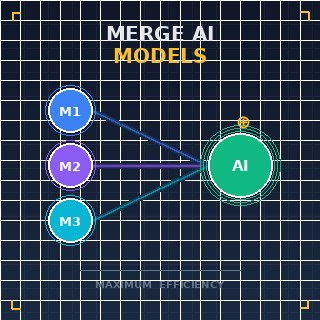
In a high-tech laboratory in Zurich, a data scientist stares at a terminal screen where two distinct neural spirits are about to become one. One model is a master of molecular biology, while the other is an expert in fluid dynamics; separately, they are brilliant, but together, they could revolutionize drug delivery systems. This is the reality of 2026, where the primary challenge is no longer just building bigger systems, but figuring out how to merge multiple specialized Large Language Models (LLMs)Artificial intelligence systems trained on massive amounts of text to understand and generate human-like language. into a single, cohesive intelligence. This process, known as model merging, has moved from an experimental curiosity to a critical engineering standard, allowing developers to synthesize the strengths of diverse architectures without the prohibitive costs of retraining from scratch.
The New Frontier of Model Merging
The transition from 2025 to 2026 marked a pivotal shift in the artificial intelligence landscape. We moved away from the "brute force" era of training trillion-parameter monsters and entered the era of surgical synthesis. The central question for modern engineers is how to merge multiple WeightsNumerical values within a neural network that determine the strength of the connection between neurons.—the internal parameters that define an AI's behavior—without causing "catastrophic forgetting" or structural collapse. This isn't just about sticking two pieces of software together; it is a mathematical ballet performed in high-dimensional Latent SpaceA multi-dimensional mathematical space where data points are mapped based on their internal characteristics..
By merging models, we are essentially finding a common ground between different learned representations of the world. If Model A understands the syntax of legal documents and Model B understands the nuances of quantum physics, merging them creates a hybrid that can draft patent applications for subatomic sensors with unprecedented precision. The efficiency gains are staggering: researchers are now achieving performance levels that previously required $50 million in ComputeThe processing power and hardware resources required to run or train computational models. resources by simply blending existing open-source models.
What is the most efficient way to merge multiple AI architectures?
In the current technological climate, the most efficient method to merge multiple models is through a technique called SLERP (Spherical Linear Interpolation). Unlike traditional linear averaging, which often results in a "blurry" model that loses the sharp capabilities of its parents, SLERP accounts for the geometric curvature of the weight space. By interpolating along a spherical path, the resulting model maintains the high-vector magnitude necessary for specialized tasks.
However, as we move into more complex territories, engineers are increasingly turning to "TIES-Merging" (Trim, Elect, and Sign). This method addresses the conflict that arises when two models have diametrically opposed weights for the same task. TIES works by:
- Trimming: Removing the least significant weight changes (the noise).
- Electing: Resolving sign conflicts by determining which direction (positive or negative) has the most significant cumulative impact.
- Merging: Averaging only those weights that agree with the elected direction.
This tripartite approach ensures that the hybrid model doesn't suffer from "interference," a common problem where the knowledge of one model cancels out the knowledge of another, resulting in a system that is less capable than either of its predecessors.
How does spherical linear interpolation solve data conflicts?
To understand how to merge multiple datasets or models using SLERP, one must visualize the AI's knowledge as points on a globe rather than points on a flat map. When you average two points on a flat map, the midpoint is often "lower" or closer to the center than the original points. In neural network terms, this leads to a reduction in the model's activation energy, making it "dull" or less responsive.
SLERP solves this by moving along the surface of the sphere. It preserves the distance from the center, ensuring that the merged model retains the same level of "certainty" and specialized focus as the originals. In 2026, this has become the standard for creating "MoE" (Mixture of Experts) architectures on the fly. Instead of a single massive model, we merge multiple smaller, highly-tuned experts into a single InferenceThe process of an AI model running live to produce a result or prediction based on new data. pipeline that can switch contexts instantly.
Can model merging eliminate the need for expensive fine-tuning?
The short answer is: largely, yes. The investigative trend in 2026 suggests that "Merge-Stacking" is replacing traditional Fine-tuningThe process of taking a pre-trained model and training it further on a specific dataset to improve performance. for many enterprise applications. Traditionally, if a company wanted an AI that understood their specific corporate jargon, they would have to spend weeks fine-tuning a base model on their internal data.
Today, companies are finding it more effective to take a model already fine-tuned for general business logic and merge it with a model fine-tuned for their specific industry sector. This "lego-brick" approach to intelligence allows for rapid deployment. It also mitigates the risk of data leakage; because you are merging weights rather than retraining on raw data, the underlying proprietary information is often more secure within the synthesized mathematical structure.
"The ability to merge multiple specialized neural paths is the closest we have come to true collective intelligence in machines. We are no longer building brains; we are weaving them." — Dr. Aris Thorne, Lead Researcher at the 2026 AI Synthesis Summit.
What are the mathematical challenges of merging heterogeneous models?
While merging models with the same base architecture (like two different Llama-4 variants) is relatively straightforward, merging heterogeneous models—those with different numbers of layers or different internal dimensions—remains the "holy grail" of 2026 mathematics. This requires a process called "Weight Remapping."
Engineers must use Orthogonal Procrustes AnalysisA mathematical method used to align two sets of points or matrices while preserving their geometric structure. to rotate and scale the weight matrices of one model so they align with the geometry of another. It is essentially a problem of translation: how do you express the "thought process" of a 7-billion parameter model in the language of a 70-billion parameter model? Through advanced manifold alignment, we can now map the functional subspaces of a smaller model onto the larger one, allowing the bigger system to "absorb" the specialized skills of the smaller one without losing its own general capabilities.
The Future: Decentralized Merging
As we look toward the latter half of the decade, the focus is shifting toward decentralized merging. With the rise of edge computing, individual devices are now performing local fine-tuning. The next step in the evolution of how to merge multiple streams of intelligence involves "Federated Merging." In this scenario, thousands of devices merge their locally learned weights into a global model without ever sharing the private user data that generated those weights.
This investigative look into model merging reveals a clear trajectory: the future of technology is not in isolation, but in synthesis. Whether you are a developer looking to optimize a chatbot or a scientist trying to combine disparate data streams, mastering the mathematics of merging is the most valuable skill in the 2026 digital economy. We have moved past the era of the "monolith" and entered the era of the "mosaic," where the most powerful tools are those that can successfully integrate the wisdom of many into the action of one.
