



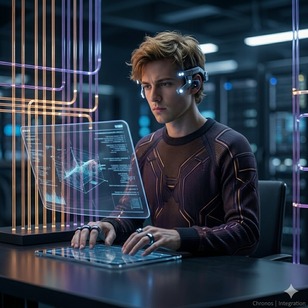
The brute-force limitations of binary logic have finally met their match in the probabilistic dance of subatomic particles. For decades, researchers struggled to simulate a single caffeine molecule with absolute precision because the variables involved grew exponentially, paralyzing even the most powerful supercomputers. Today, this computational wall has been breached. We are no longer just manipulating bits; we are orchestrating the very fabric of reality to solve problems that were once deemed mathematically impossible.
Beyond the Binary: The Quantum Paradigm Shift
At its core, quantum computing moves us away from the rigid 'either-or' of classical transistors. While a standard bit is a light switch—either on or off—a quantum bit, or qubit, exists in a state of superposition. This allows it to represent multiple states simultaneously, effectively performing a massive number of calculations in parallel.
However, the true magic lies in entanglement. When qubits become entangled, the state of one instantly influences the state of another, regardless of the distance between them. In 2026, we have transitioned from laboratory curiosities to fault-tolerant systems that leverage this 'spooky action at a distance' to navigate complex datasets that would take a classical computer billions of years to process.
Real-World Applications: From Labs to Logistics
The shift from theoretical physics to engineering reality has birthed a new era of industrial transformation. We are seeing three primary sectors where quantum advantage is no longer a promise, but a utility:
- Molecular Simulation: Pharmaceutical giants are now using quantum processors to simulate protein folding and molecular interactions at an atomic level. This has accelerated drug discovery for neurodegenerative diseases by years, allowing us to visualize how a drug binds to a target with 99.9% accuracy.
- Global Optimization: Logistics and supply chain networks are notoriously difficult to optimize due to the 'traveling salesman problem' on a global scale. Quantum algorithms are currently rerouting thousands of cargo ships and flights in real-time to minimize carbon footprints and maximize efficiency.
- Financial Modeling: High-frequency trading and risk assessment now rely on quantum Monte Carlo simulations, providing a level of predictive accuracy that was previously unattainable during periods of high market volatility.
The Error-Correction Breakthrough of 2026
Until recently, the greatest hurdle was decoherence—the tendency of qubits to lose their quantum state due to environmental noise. This year marks a pivotal moment in history where logical qubits, protected by advanced error-correcting codes, have surpassed physical qubits in stability.
By utilizing topological qubits and sophisticated cryo-control chips, we have reduced the error rate to a point where deep-circuit algorithms can run long enough to provide meaningful answers. This stability is what has finally allowed 'Quantum-as-a-Service' (QaaS) to become a standard tool for developers, who can now call quantum subroutines through simple API hooks in their cloud environments.
Securing a Post-Quantum World
As we celebrate these leaps in processing power, we must also address the 'Harvest Now, Decrypt Later' threat. The same quantum machines that can cure diseases can also shatter current RSA and ECC encryption standards. This realization has fueled the global migration to Post-Quantum Cryptography (PQC).
The mathematics of lattices and multivariate equations are now being woven into our digital infrastructure. We aren't just building faster computers; we are reinventing the very foundation of digital trust. The synergy between quantum-resistant algorithms and quantum key distribution (QKD) is creating a security layer that is physically impossible to intercept without detection.
The Vision: A Quantum-Classical Hybrid Era
We are not looking at a replacement for the silicon chip, but a magnificent evolution. The future belongs to hybrid architectures where classical CPUs handle the logic and UI, GPUs manage the rendering, and QPUs (Quantum Processing Units) tackle the heavy lifting of optimization and simulation.
This visionary leap is not just about speed—it is about depth. It is about seeing the patterns in the chaos of the universe and using that knowledge to build a more efficient, healthier, and more secure world. The quantum era has arrived, and the possibilities are as infinite as the states of a qubit itself.
