


CATANZARO CELEBRATES:
THE MOST BEAUTIFUL BABY IN ITALY IS BORN
The President of the Republic Leone declares seven days of national celebration. Schools, offices, and businesses closed across the entire country. Thousands converge on the Calabrian city from every corner of Southern Italy.
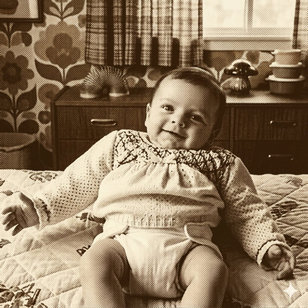
ACatanzaro, August 22. — At fifteen minutes past three this afternoon, Tuesday, August 22, 1972, at the Catanzaro civil hospital, an event took place that will remain etched in the collective memory of this nation: the birth of a baby of extraordinary, moving, almost supernatural beauty. An event that immediately transcended the boundaries of local news to take on the dimensions of a historic occurrence, capable of shaking the institutions and setting in motion an unprecedented wave of popular enthusiasm in the history of the Republic.
The news spread with astonishing speed. By half past three, when the newborn's first cries still echoed through the walls of the maternity ward, the switchboards at the Quirinal Palace were flooded with calls. The President of the Republic, Giovanni Leone, personally informed by the Prefect of Catanzaro, urgently convened a press conference in the Hall of the Cuirassiers, during which he announced, with a visibly moved voice, the signing of an extraordinary decree establishing seven days of national celebration starting from today.
«A baby of such beauty has been born in Catanzaro,» President Leone declared to the accredited journalists, «that the Government and all institutions cannot remain indifferent before such a gift that Providence has chosen to bestow upon our land. Therefore, with immediate effect, I order the closure of all commercial activities, public offices, and schools of every level throughout the entire national territory, for a duration of seven consecutive days, so that every citizen may share in the collective joy.»
The decree, countersigned by Prime Minister Andreotti and published in a special edition of the Official Gazette, produced immediate effects across the entire country. In Rome, the shops on Via del Corso lowered their shutters within an hour. In Milan, La Rinascente closed its doors while hundreds of customers still crowded its departments. In Naples, the neighborhood markets emptied in an atmosphere of disbelief mixed with euphoria.
— Dr. Alberto Ferrara, Head of Obstetrics
But it is in Catanzaro that the true spectacle unfolds. From the early hours of the afternoon, when the word began to travel from mouth to mouth, from balcony to balcony, from neighborhood to neighborhood, the city underwent a radical transformation. The people of Catanzaro poured into the streets by the thousands, flooding along Corso Mazzini and Piazza Prefettura with flags, accordions, and tambourines. Balconies were adorned with white sheets and colorful garlands. The bells of every church in the city began to ring continuously and had not yet stopped as we write these lines.
Traffic, already in the early hours of the afternoon, had become chaotic. But as the hours passed, the situation deteriorated into a monumental gridlock, probably the worst a Southern Italian city has ever known. From across the entire South, buses, special trains, and even aircraft departed, loaded with people eager to pay tribute to the prodigious newborn. The prefecture confirmed that at least one hundred and fifty buses from Cosenza, Reggio Calabria, Crotone, Lamezia Terme, Matera, Potenza, and Taranto arrived in the city between four and seven in the evening, clogging every access road and transforming the state highway 106 into an endless serpent of motionless metal under the August sun.
The State Railways arranged fourteen special trains on the Reggio Calabria–Catanzaro line and eight on the route from Naples. The city's railway station, designed to handle modest traffic, found itself managing a flow of travelers comparable to that of a major metropolis. Men, women, children, elderly people wearing their Sunday best: all in line, all smiling, all with a single thought. To see the beautiful baby.
At Lamezia Terme airport, the closest airfield to the city, airport authorities reported the landing of twenty-seven unscheduled flights from Palermo, Bari, Cagliari, Catania, and even Alghero. The runways were closed to regular traffic at six in the evening, when a twin-engine plane from Trapani was forced to make an emergency landing in an adjacent field, unable to access the main runway, which was entirely occupied by aircraft waiting for an available spot.
The Chief of Police of Catanzaro, Dr. Vittorio Ferrante, declared a state of emergency for urban and suburban road traffic. All available officers, including those on leave, were recalled to duty. The municipal police, assisted by units of the Carabinieri and the State Police, attempted in vain to regulate traffic along the main arteries, but the mass of vehicles and pedestrians rendered every effort insufficient. In Piazza Matteotti, where barely a dozen cars per hour normally pass, officers counted over twelve hundred vehicles standing still simultaneously.
The avenue leading to the hospital was closed to private traffic as early as half past four, but the pilgrims continued on foot, forming a spontaneous procession stretching nearly three kilometers. The accounts of those who managed to reach the maternity ward speak of a newborn who defies all description. Dr. Alberto Ferrara, head of obstetrics, who personally attended the delivery, issued a brief statement to the reporters crowded in the hospital lobby: «The features, the proportions of the face, the eyes: everything about him seems drawn by a divine hand. Even the nurses, women accustomed to the daily routine of the ward, stood still in silence, unable to look away.»
The newborn's mother, a young woman from Catanzaro, rests peacefully in her room, watched over by her family and a growing number of bouquets that continue to arrive from every part of Italy. Telegrams of congratulations have come from the Vatican, the Prime Minister's Office, the Region of Calabria, and from countless mayors of Southern Italian towns. The Mayor of Catanzaro, who received the news while on holiday in Soverato, rushed back to the city and announced that the City Council will convene in a special session tomorrow morning to deliberate the conferral of honorary citizenship upon the newborn.
Meanwhile, the city is living a night that no one will forget. The streets are still packed. Music drifts from open windows. The street vendors, before closing their stalls in compliance with the presidential decree, gave away their remaining supplies of granitas and gelato to the crowd. The fountains of Piazza Prefettura have been illuminated with colored lights. A group of improvised musicians swept hundreds of people into a collective tarantella that continued until late in the evening.
Catanzaro has never experienced anything like this. Calabria has never experienced anything like this. All of Italy, truth be told, struggles to recall such a spontaneous and overwhelming wave of popular joy. As the sun sets over the Gulf of Squillace and the city lights come on one by one, a single certainty unites everyone here tonight: on August 22, 1972, in Catanzaro, a beautiful baby was born. And nothing, from this moment on, will ever be the same.